
Most employee benefits are taxable in Canada under Section 6 of the Income Tax Act, unless a specific exclusion applies. The biggest exception: employer-paid premiums for a qualifying Private Health Services Plan covering medical, dental, or vision care stay tax-free federally. Quebec doesn’t follow that rule provincially, and employers are on the hook to calculate, withhold, and report every taxable benefit correctly.
TL;DR:
- Employer-paid premiums for qualifying private health plans are tax-free federally but are taxed in Quebec, requiring separate provincial reporting.
- Cash and near-cash benefits, such as gift cards or allowances, are taxable immediately, regardless of gift policies or expense reimbursements.
- Proper documentation and correct payroll coding are essential to avoid costly corrections or penalties for misclassified benefits.
- Automobiles and gift benefits have specific formulas and thresholds; calculating fair market value and tracking personal use are crucial for compliance.
- Revised CRA guidelines and provincial variations demand frequent updates and careful planning to ensure benefits are structured and reported correctly.
Table of Contents
- What Counts as a Taxable Employee Benefit in Canada
- Common Taxable Benefits Employers Need to Flag
- Which Benefits Aren’t Taxable (And Where Quebec Differs)
- Calculating the Value of a Taxable Benefit: Rules and Worked Examples
- Payroll Withholding and Reporting Codes You’ll Actually Use
- Slips, Deadlines, and What Happens If You Get It Wrong
- Building an Employer Checklist for Taxable Benefits
- Why This Guidance Holds Up
- How Taxable Benefits Push Employees Into Higher Tax Brackets
- Recent Shifts in How CRA Treats Certain Benefits
- Provincial Tax Treatment Beyond Quebec
- Smart Ways to Manage Taxable Benefits Without Cutting Corners
- Real-World Scenarios That Trip Up Payroll Teams
- Common Pitfalls and Practical Planning Tips
- How Easy-insured Helps You Get Benefits Right the First Time
- Key CRA Resources for Verifying Taxable Benefit Rules
- Sources
What Counts as a Taxable Employee Benefit in Canada
A taxable benefit is any economic advantage you give an employee that can be measured in money, whether it arrives as cash, near-cash, or a non-cash perk like a company car. The Canada Revenue Agency treats this as taxable under Section 6 of the Income Tax Act unless a specific carve-out applies, and the test employers actually use comes down to one question: is the employee the primary beneficiary?
If the answer is yes, the value gets added to income. If the benefit primarily serves your business (a required safety vest, a laptop used only for work), it typically isn’t taxable. The line between the two isn’t always obvious, which is why the CRA leans on fair market value as the standard for pricing whatever benefit you’re evaluating. FMV means what the employee would have paid for that same item or service on the open market, not what it cost you to provide it.
Payroll teams need to sort benefits into three buckets, because each one gets treated differently on a pay stub:
- Cash benefits — direct payments like a car allowance or a cash bonus tied to a specific expense.
- Near-cash benefits — items that function like cash, such as a gift card, which the CRA treats the same as cash regardless of the amount.
- Non-cash benefits — goods or services provided directly, like a gym membership paid by the employer or personal use of a company vehicle.
That distinction matters most when you get to withholding, since cash and near-cash amounts trigger income tax, CPP, and EI, while non-cash benefits usually skip EI unless the employee also received cash earnings in that pay period.
Reimbursements add another wrinkle. An accountable advance, where the employee submits receipts and any unused amount gets returned, isn’t taxable because there’s no personal gain. A non-accountable allowance, paid as a flat amount with no receipts required, is taxable income from dollar one, even if the employee genuinely spent it all on work travel. This trips up a lot of small business owners who assume a $500 monthly “car allowance” is somehow different from wages. It isn’t, unless it’s structured as a reimbursement tied to an accountable expense process.
Common Taxable Benefits Employers Need to Flag
Certain benefits show up on almost every payroll audit as taxable, and knowing them by category saves you from guessing case by case.
Group life insurance premiums. When you pay premiums for group term life insurance on behalf of employees, the premium amount is generally a taxable benefit, reported using its own specific code rather than lumped into regular pay. The employer covers the premium, but the employee absorbs the tax.
Automobile benefits. This is one of the more complicated calculations in payroll, because it has two separate components. The standby charge covers the employee’s personal use of a company-owned or leased vehicle, calculated as a percentage of the car’s cost or lease value, prorated for personal-use days. The operating cost benefit covers fuel, maintenance, and insurance the employer paid for personal driving, calculated using a per-kilometer CRA rate that changes annually. Both stack on top of each other if the employee drives the company car for anything other than work.
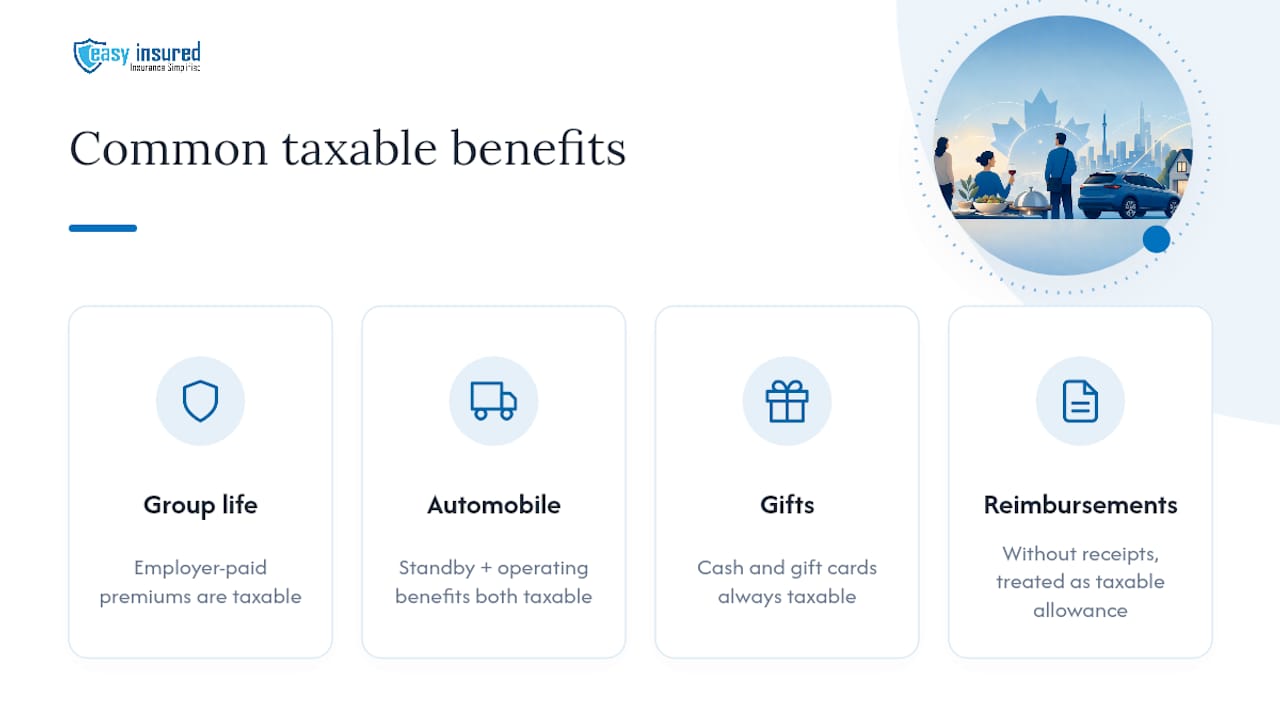
Gifts, awards, and employee discounts. Cash and near-cash gifts (including gift cards) are taxable regardless of amount. Non-cash gifts and awards may qualify for exemption under a modest annual policy, but the moment a gift crosses into cash-equivalent territory, that exemption disappears.
Employer-paid premiums for non-group individual plans. If you pay premiums on an individual policy (not a group plan) for an employee, that’s taxable. The group structure matters, not just the type of coverage.
By the numbers: The CRA’s own benefits and allowances chart lists dozens of benefit categories, each with its own rule for CPP, EI, GST/HST, and T4 code, which is exactly why payroll teams keep it bookmarked rather than trying to memorize every exception.
Reimbursements without receipts, discussed above, round out the list of the most commonly mishandled taxable items. If your payroll software flags a line item as “allowance” rather than “reimbursement,” that’s usually your first clue it needs to be taxed.
Which Benefits Aren’t Taxable (And Where Quebec Differs)
The single most valuable exclusion for Canadian employers is the qualifying Private Health Services Plan, commonly called a PHSP. When structured correctly, employer-paid premiums for medical, dental, and vision coverage are not considered taxable income federally. That’s a meaningful advantage over paying employees more cash and letting them buy coverage themselves, since cash compensation is taxed before it ever reaches their pocket.
To qualify, a plan generally needs to:
- Cover expenses that would qualify as eligible medical expenses under the Income Tax Act (prescriptions, dental work, vision care, and similar costs).
- Operate as insurance in substance, meaning there’s genuine risk pooling rather than the employer simply reimbursing costs dollar for dollar with no insurance mechanism.
- Extend to a defined class of employees, not be structured to benefit one person or a small handpicked group in a way that looks like disguised compensation.
Employers should keep the documentation that proves the plan qualifies before assuming the premiums are exempt. That means insurer statements showing the plan design, enrollment records for who’s covered, and the plan’s governing document spelling out what’s covered and how claims get paid. If you’re building this from scratch, a health spending account is one structure many small employers use to deliver PHSP-style coverage without setting up a full insured group plan.
Quebec is the exception that catches employers off guard, especially those expanding from other provinces. Quebec taxes PHSP premiums provincially even when they’re exempt federally, and employers must report that value on the RL-1 slip, Box J. If you have even one Quebec-based employee on a benefits plan, you need a payroll process that handles this differently from the rest of your workforce, or you’ll under-report provincial tax without realizing it.
Pro Tip: Before you assume a health plan is non-taxable, ask your insurer for written confirmation that the plan meets PHSP criteria. Verbal assurances from a sales rep don’t hold up if the CRA ever asks for proof during a payroll audit.
Calculating the Value of a Taxable Benefit: Rules and Worked Examples
Every taxable benefit calculation starts in the same place: fair market value, plus GST/HST where it applies. The rule of thumb is straightforward. If a benefit would carry sales tax when purchased directly by the employee, it typically carries GST/HST in the benefit calculation too, according to the CRA’s benefits chart. Cash allowances generally don’t include GST/HST since cash itself isn’t a taxable supply, but non-cash benefits like a company car or a paid membership often do.
Here’s how the math plays out in three common scenarios:
- Group life insurance premium. Say you pay $45 per month in premiums for an employee’s group term life coverage. That $45 becomes a taxable benefit added to income for that pay period, reported on the T4130 employers’ guide framework using the applicable insurance premium code. Over a year, that’s $540 added to taxable income, even though the employee never touched the cash.
- Non-cash gift. You give an employee a $200 non-cash holiday gift. If it fits within the CRA’s modest annual gift exemption alongside any other non-cash gifts given that year, it may be excluded. If your total non-cash gifts to that employee for the year exceed the policy threshold, the excess amount becomes taxable, GST/HST included, based on the item’s retail value.
- Automobile standby charge (simplified). An employee drives a $30,000 company car and uses it personally 40% of the time. The standby charge formula generally works out to 2% of the vehicle’s cost per month of availability, then prorated by personal-use percentage. Add the operating cost benefit, calculated using the CRA’s annual per-kilometer rate for personal kilometers driven, and you get the full taxable benefit for that vehicle.
| Scenario | Benefit type | Basis for value | Typically included on T4? |
|---|---|---|---|
| Group life premium ($45/month) | Cash equivalent (employer pays insurer) | Premium amount paid by employer | Yes, insurance premium code |
| Non-cash gift ($200) | Non-cash | Fair market value of item, GST/HST included | Only if it exceeds annual gift policy threshold |
| Automobile standby + operating | Non-cash | % of vehicle cost prorated by personal use, plus per-km operating rate | Yes, standby and operating charge codes |
These three examples cover the calculations most payroll administrators run into weekly. For anything unusual, cross-check against the T4130 guide before finalizing a pay run, since some plan types (like certain group term life structures) carry their own specific valuation quirks.
Payroll Withholding and Reporting Codes You’ll Actually Use
Once you know a benefit is taxable, the next question is what to withhold. The general rule: income tax applies to nearly every taxable benefit, CPP applies to both cash and non-cash benefits, and EI applies mainly to cash and near-cash benefits. Non-cash benefits are typically exempt from EI withholding unless the employee also received cash earnings in that same pay period, a nuance detailed in the T4130 guide.
This creates a real operational difference. A cash car allowance gets taxed like wages across all three deductions. A non-cash benefit like personal use of a company vehicle skips EI in most cases, which means your payroll system needs to flag benefit types correctly rather than dumping everything into one taxable-benefit bucket.
For large, irregular non-cash benefits, such as an annual bonus paid as a lump-sum non-cash prize, the CRA allows employers to spread the withholding across multiple pay periods to avoid an “undue hardship” situation where an employee’s paycheck gets wiped out by a single large deduction. It’s a practical accommodation, and one payroll teams underuse simply because they don’t know it’s an option.
Quick reference: According to the CRA’s benefits and allowances chart, every listed benefit type comes with three flags: whether CPP applies, whether EI applies, and which T4 or T4A code to use. That single chart resolves more payroll disputes than any other CRA resource.
The codes themselves are where a lot of new payroll administrators get lost. Here’s a working list:
- Code 40 — other taxable allowances and benefits, the catch-all code for many miscellaneous taxable items.
- Code 85 — employee-paid premiums for a private health services plan, used when the employee (not the employer) covers the cost, which can support a medical expense tax credit claim.
- Code 119 — used specifically for premiums paid under certain private health plans and related contributions.
- Code 028 — other income not reported elsewhere, common on T4A slips for contractors and certain non-employee payments.
- RL-1 Box J — Quebec’s provincial slip code for PHSP premiums paid on behalf of Quebec employees, which has no equivalent federal taxable status.
When setting up your payroll software, map each benefit type to its correct code before your first pay run of the year, not after. Retroactively correcting T4 codes across dozens of pay periods is a miserable exercise, and it’s one a decent payroll software platform can help you avoid if it’s configured with the right benefit categories from day one.
Slips, Deadlines, and What Happens If You Get It Wrong
T4 slips report employment income and taxable benefits for actual employees. T4A slips cover other income, commonly used for contractors, pension income, and certain benefit types that don’t flow through a standard employment relationship. Mixing these up, reporting a taxable benefit that belongs on a T4 through a T4A instead, is a common error that creates mismatched CRA records.
Year-end reporting has a fixed rhythm: T4 and T4A slips are due to both employees and the CRA by the last day of February following the calendar year in which the benefit was provided. Payroll remittances (the income tax, CPP, and EI you withheld) follow their own monthly or accelerated schedule depending on your remittance frequency, separate from the annual slip deadline.
Getting it wrong carries real cost. Under-reporting a taxable benefit or failing to withhold the right amount can expose your business to:
- Penalties for late or incorrect T4 filings, calculated per slip and scaling with the number of errors.
- Interest on unremitted payroll deductions, compounding daily from the original due date.
- Employer liability for the employee’s portion of CPP and EI you should have withheld but didn’t, meaning you may owe both shares out of pocket.
If you discover an error after slips are filed, the fix is to issue amended T4s or T4As showing the corrected amounts, then remit any shortfall with an explanation to the CRA. For anything beyond a simple correction, especially multi-year errors or Quebec RL-1 mismatches, bringing in a payroll professional or tax advisor tends to cost far less than an unresolved CRA inquiry.
Building an Employer Checklist for Taxable Benefits
A working benefits policy needs to spell out, in writing, who pays for each benefit, who’s eligible, and how fair market value gets calculated for anything non-cash. Without that document, you’re rebuilding the logic from scratch every time a new hire joins or an auditor asks a question.
Run through this sequence once a year, ideally before your first pay run of a new fiscal cycle:
- List every benefit currently offered and classify each as taxable, non-taxable, or partially taxable based on current CRA guidance.
- Confirm PHSP status in writing with your insurer or broker for any health, dental, or vision plan you’re treating as non-taxable.
- Gather documentation: insurer invoices, enrollment forms, and plan design documents that prove what you’re claiming about each benefit.
- Map benefits to payroll codes so your system automatically applies the right income tax, CPP, and EI treatment without manual overrides.
- Flag Quebec employees separately if you have any, since RL-1 reporting requirements diverge from the rest of the country.
Pro Tip: Set a recurring calendar reminder every January to re-verify PHSP status with your insurer. Plan designs change, insurers merge, and a plan that qualified last year isn’t automatically grandfathered if its structure shifted.
When you’re unsure whether a plan design still qualifies, or you’re weighing whether to expand coverage, that’s the right moment to loop in your benefits broker rather than guessing. A broker who documents plan design correctly from the outset saves you from an audit headache down the line.
Why This Guidance Holds Up
This guide draws directly from CRA’s own published materials: the T4130 Employers’ Guide, the benefits and allowances chart, and the relevant sections of the Income Tax Act. Where CRA guidance leaves room for interpretation, particularly around plan design and documentation, we’ve noted where professional advice matters more than a general rule.
Frank covers employer-facing insurance and benefits topics for Easy-insured, focusing on how plan design decisions play out in real payroll situations. Easy-insured works with Canadian business owners on group insurance, disability coverage, and PHSP-structured health and dental plans, which means the guidance here reflects patterns seen across actual employer plan setups, not just a reading of the legislation in isolation.
None of this replaces a conversation with a tax professional for complex situations, multi-province payrolls, or unusual plan structures. Treat this as the map, not the final word for your specific numbers.
How Taxable Benefits Push Employees Into Higher Tax Brackets
Adding a taxable benefit to an employee’s income doesn’t just create a flat tax bill. It stacks on top of salary, which means it can push part of an employee’s income into a higher federal or provincial bracket depending on where they already sit. An employee earning close to a bracket threshold who receives a $3,000 automobile benefit in a given year might find a meaningful chunk of that amount taxed at a higher marginal rate than their regular salary.
This matters for take-home pay planning, especially for commissioned employees or executives near bracket boundaries. It also affects other income-tested calculations: a higher reported income from taxable benefits can reduce eligibility for certain federal credits and benefits tied to net income, since taxable benefits increase line amounts on the T1 return even though the employee never received extra cash to offset the hit.
For payroll administrators, the practical takeaway is to flag employees with high non-cash benefit values (company vehicles, large group life premiums) so they aren’t blind sided at tax time by a bill they didn’t budget for. Some employers proactively communicate estimated benefit values mid-year rather than waiting for the T4 to land in February, which reduces the number of confused calls to HR every spring.
Recent Shifts in How CRA Treats Certain Benefits
CRA guidance on taxable benefits isn’t static. Automobile operating cost rates, for instance, get adjusted periodically to reflect fuel and maintenance cost changes, which means a standby charge calculation that was accurate last year might use a different per-kilometer rate this year. Payroll administrators should check the current rate before running vehicle benefit calculations rather than relying on last year’s number.
CRA has also refined its administrative position on remote work arrangements and home office equipment in recent years, an area that didn’t have much precedent before hybrid work became common. Employers providing equipment or reimbursing home office costs need to watch for updated guidance on what qualifies as a work tool versus a personal benefit, since that line has shifted as remote work became permanent for many organizations rather than a temporary accommodation.
The safest practice is treating the T4130 guide as a living document you check annually rather than a one-time reference. CRA updates it regularly to reflect new interpretations, court decisions, and policy clarifications, and a rule that applied cleanly three years ago may now carry an exception or a revised threshold.
Provincial Tax Treatment Beyond Quebec
Quebec gets most of the attention because it taxes PHSP premiums provincially when they’re federally exempt, but other provinces have their own quirks worth knowing. Most provinces piggyback on the federal definition of taxable income, meaning if a benefit is taxable federally, it flows through to provincial tax calculations automatically without a separate provincial test.
Where it gets more complex is payroll tax programs some provinces run alongside income tax. Ontario’s Employer Health Tax and British Columbia’s Employer Health Tax, for example, are calculated based on total remuneration, which can include the value of certain taxable benefits depending on how total payroll is defined for that specific levy. This isn’t the same mechanism as personal income tax, but it does mean taxable benefits can affect your business’s provincial payroll tax liability, not just your employees’ personal returns.
Employers operating in multiple provinces should confirm how each province defines “total remuneration” for its own payroll tax program, since a benefit excluded from one province’s calculation might be included in another’s. This is a detail that’s easy to miss when you’re focused on federal T4 codes and forget that provincial payroll levies run on a separate set of rules entirely.
Smart Ways to Manage Taxable Benefits Without Cutting Corners
The goal isn’t avoiding taxable benefits altogether. It’s structuring compensation so the tax burden lands where it makes the most sense for both the business and the employee. A PHSP-structured health and dental plan is the clearest example: the same coverage delivered as a cash raise would be taxed before the employee ever spent it on medical costs, while a properly designed PHSP delivers that coverage tax-free federally.
Reviewing whether allowances should be restructured as accountable reimbursements is another lever worth pulling. If your business pays a flat monthly allowance for phone or vehicle use, converting it to a reimbursement model tied to actual receipts removes it from taxable income entirely, provided the paperwork is airtight.
For higher-income employees weighing whether to have the employer or the employee pay certain premiums, there’s a genuine trade-off. Employer-paid premiums on things like disability coverage are often not taxable to the employee, but that generally means any future benefit payout becomes taxable income if a claim is made. Employee-paid premiums work the opposite way: no tax break up front, but a tax-free payout if disability benefits are ever needed. That’s a planning conversation worth having deliberately rather than defaulting to whichever option is administratively easier.
Real-World Scenarios That Trip Up Payroll Teams
A mid-sized Ontario employer once assumed its extended health plan qualified as a PHSP simply because it was labeled “health benefits” in the employee handbook. When a payroll review dug into the actual plan document, it turned out the structure reimbursed costs directly without genuine insurance risk pooling, meaning it didn’t meet PHSP criteria and the premiums should have been taxable all along. That kind of gap often sits undetected for years until an audit or a new payroll provider asks for the underlying plan documentation.
Another common scenario: an employer offers a company vehicle to a sales employee who insists they “never” use it personally. Without a mileage log or written policy restricting personal use, the CRA generally assumes personal availability counts, and the standby charge applies regardless of the employee’s verbal assurance. Payroll teams that skip this documentation step often end up defending a benefit calculation with nothing but an employee’s word.

A third pattern shows up with gift cards handed out as small “thank you” gestures throughout the year. Because gift cards are near-cash, they’re taxable from the first dollar, unlike a genuinely non-cash item such as a gift basket. Employers who track only the dollar total of gifts, rather than separating cash-equivalent items from true non-cash ones, frequently under-report taxable income without realizing the distinction even exists.
Common Pitfalls and Practical Planning Tips
Misclassifying a health plan as a PHSP without confirming the actual plan design is the mistake I see cause the most damage, because it compounds silently across every pay period until someone finally checks the paperwork. Ignoring Quebec RL-1 obligations runs a close second, especially for employers who built their payroll process around a single-province workforce and then expanded without updating that process.
Weak documentation of fair market value is the third recurring gap. If you can’t produce an insurer statement or a clear calculation method for a non-cash benefit, you’re relying on hope rather than evidence if the CRA ever asks.
On planning: there are real cases where it makes more sense for an employee to pay their own premiums, particularly for disability coverage, since a self-paid premium keeps any future payout tax-free. That trade-off deserves an actual conversation, not a default assumption that employer-paid is always the better deal.
One anonymized case that illustrates the stakes: a small business misclassified $18,000 in annual PHSP premiums across a dozen employees as non-taxable for three straight years. The correction required amended T4s for every affected employee, retroactive CPP remittances, and interest charges the business had to absorb because it hadn’t withheld anything the first time around.
— Frank
How Easy-insured Helps You Get Benefits Right the First Time
Getting PHSP documentation wrong costs more in retroactive corrections than getting it right costs in setup time. Easy-insured designs group benefit plans with the paperwork built in from day one: insurer statements, plan design documents, and enrollment records that hold up if the CRA ever asks questions about your PHSP’s taxable status.

Whether you’re setting up your first group insurance plan or auditing an existing one for PHSP compliance, Easy-insured’s brokers work directly with insurers to structure health and dental coverage that actually meets the federal exclusion criteria, not just plans labeled as if they do. For business owners weighing whether disability premiums should be employer paid or employee paid given the tax trade-offs discussed above, that’s a conversation worth having before your next renewal, not after a claim.
Book a consultation to review your current benefits setup, or explore term life options if you’re building out a broader compensation package for key employees this year.
Key CRA Resources for Verifying Taxable Benefit Rules
Payroll administrators should bookmark four CRA resources for ongoing reference: the taxable benefits overview, the T4130 Employers’ Guide, the benefits and allowances chart, and Section 6 of the Income Tax Act for the underlying statutory language.
Quebec employers should pair these with the province’s own RL-1 filing guidance, since Revenu Québec’s reporting requirements diverge from federal treatment on PHSP premiums specifically. For help structuring compliant group plans, visit Easy-insured to connect with a broker who can review your current setup.
This article is general information, not a substitute for advice from a qualified financial advisor. Consult a qualified financial professional about your own circumstances before acting on anything here.