
Business overhead expense insurance reimburses your fixed operating costs, like rent, payroll, and utilities, when you become disabled and cannot work. It does not replace your personal income. That distinction trips up more buyers than any other feature of this product.
Here’s what you need to know before you go further:
- Who it’s for: solo practitioners and small-practice owners (dentists, lawyers, consultants, physiotherapists) whose business depends on their own labor to generate revenue.
- How it pays: reimbursement of actual monthly expenses, up to a set monthly maximum, not a flat check regardless of what you spent.
- How long it lasts: a short-term bridge, typically 12 to 24 months, not a career-length safety net.
- Tax basics: premiums are generally deductible as a business expense, while benefits are reportable as income.
Because business overhead expense insurance only covers the business side of the ledger, most owners pair it with a personal disability policy to cover household bills.
Key Takeaways
Business overhead expense insurance keeps a small practice’s fixed costs paid during disability, but it never replaces the owner’s personal income, which is why pairing it with personal disability coverage is standard practice.
| Point | Details |
|---|---|
| Know what’s covered | Rent, non-owner payroll, utilities, and business debt interest qualify; owner salary and profit never do. |
| Understand the payout basis | Benefits reimburse actual monthly expenses up to a cap, not a flat guaranteed amount. |
| Expect a short benefit period | Coverage commonly runs 12 to 24 months, so treat BOE as a bridge, not permanent income. |
| Calculate before you shop | Average 12 months of overhead, round up to the nearest policy increment, and add a contingency buffer. |
| Pair it with personal coverage | Easy-insured helps small business owners combine BOE with personal disability insurance for full protection. |
Table of Contents
- What Does Business Overhead Expense Insurance Cover?
- What Does Overhead Insurance Not Cover?
- How Does Business Overhead Expense Insurance Actually Work?
- How Much BOE Coverage Should You Buy?
- How Do You Choose and Buy a BOE Policy?
- Why Pair BOE With Personal Disability Insurance?
- Get a Business Overhead Expense Quote
- Frequently Asked Questions
- Sources
What Does Business Overhead Expense Insurance Cover?
BOE policies are built around one idea: keep the doors open while you recover. That means the insurer reimburses the ordinary, recurring costs of running your office, not the cost of living your life. The most common covered categories include:
- Rent or lease payments — the physical space keeps costing money whether or not you’re in it.
- Utilities — heat, electricity, water, and telephone service.
- Non-owner employee wages and payroll taxes — your receptionist or associate still needs to get paid; your own salary does not qualify.
- Interest on business debt taken on before your disability began, not new borrowing.
- Equipment leases and maintenance contracts for machines, computers, or office furniture.
- Business insurance premiums, including coverage for employee benefit plans.
- Accounting and legal fees, plus professional membership dues tied to keeping your license or credentials active.
- Postage and office supplies, the small recurring costs that add up over months.
These qualify as ordinary and necessary business costs, and some categories carry sub-limits. Replacement staffing, for instance, is often only partially reimbursed, and coverage for insurance premium reimbursement can be capped separately from the main monthly maximum. Read the policy schedule closely before assuming every line item is covered at full value.
What Does Overhead Insurance Not Cover?
The exclusions matter as much as the coverage list, maybe more. A BOE policy will not touch:
- Your own salary or professional fee income — this is the single biggest source of confusion among buyers.
- Inventory or cost of goods sold.
- Business profits.
- Income taxes.
- Wages paid to family members in many standard contracts.
- Fees for a substitute professional brought in to cover your caseload, unless you’ve purchased a specific rider.
Picture a dentist who breaks a leg skiing. Her BOE policy covers the office lease and her hygienist’s paycheck without a hitch. But she still has a mortgage and grocery bills at home, and nothing in that BOE contract touches them. That gap is why overhead expense insurance excludes the owner’s own income by design, not by oversight. Substitute-salary riders exist for the replacement-professional scenario, but they cost more and face tighter underwriting.
How Does Business Overhead Expense Insurance Actually Work?
The mechanics come down to four moving parts, and understanding them prevents nasty surprises at claim time.
- Monthly maximum — the ceiling the insurer will pay in any given month, set when you buy the policy.
- Reimbursement of actual expenses — you submit invoices and payroll records, and the insurer pays what you actually spent, up to that ceiling.
- Elimination period — the waiting window after disability begins before benefits start, commonly 30 to 90 days.
- Benefit period — how long payments continue, typically 12, 18, or 24 months, with two years as a common ceiling.
Here’s a simplified example. Say your average monthly overhead runs $8,000 and your policy cap is $9,000. After a 60-day elimination period, you submit invoices for actual costs each month, rent, payroll, utilities, and the insurer reimburses the real total, capped at $9,000. If a slow month brings overhead down to $6,500, that’s what gets paid, not the full $9,000. Some carriers let unused monthly amounts roll forward into future months, which is worth asking about directly.
On the tax side, premiums are generally deductible as an ordinary business expense, while benefit payments count as business income when received. Canadian tax treatment can vary by structure (sole proprietorship versus incorporated practice), so confirm the specifics with your accountant before assuming either side of that equation applies cleanly to your books.
How Much BOE Coverage Should You Buy?
Setting the right monthly benefit is mostly arithmetic, not guesswork. Work through it in three steps:
- Pull 12 months of expense records — lease statements, payroll registers, utility bills, loan interest, and insurance premiums.
- Calculate your monthly average of ordinary, necessary fixed costs. Skip anything tied to inventory, personal draws, or profit.
- Set your monthly cap at that average, rounded to the nearest offered increment, with a small buffer for rising costs.
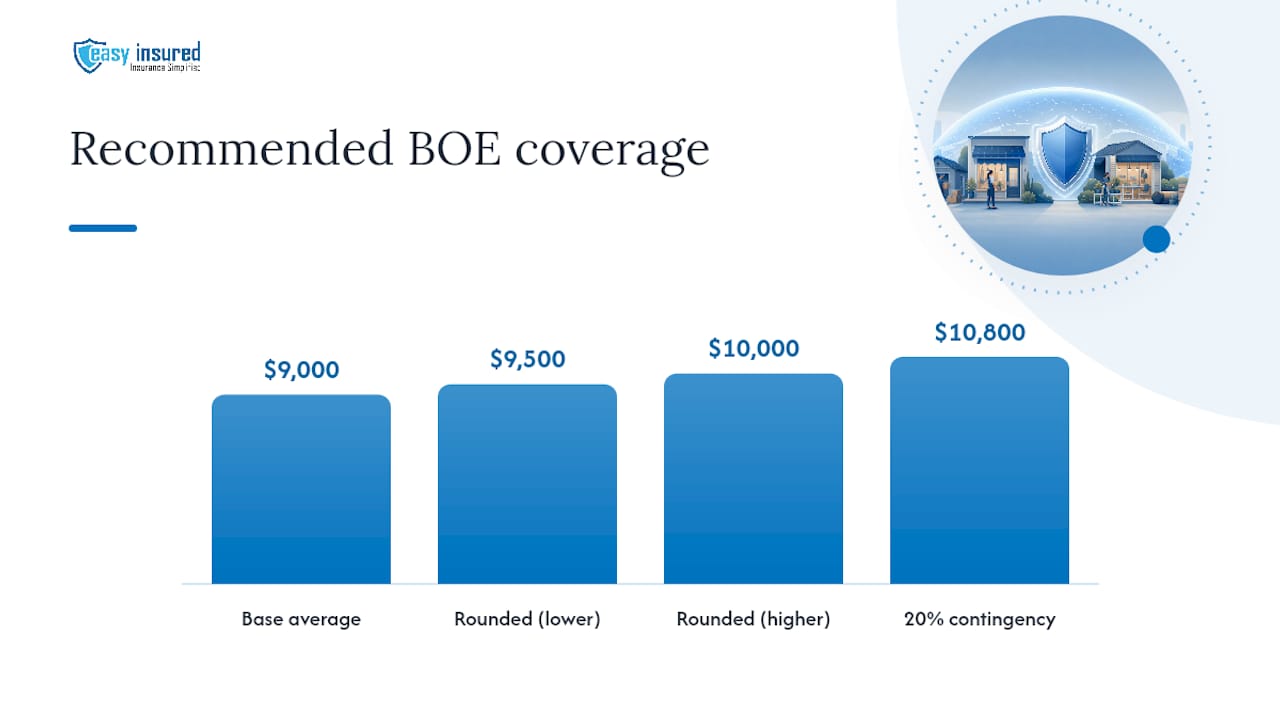
A quick example: rent at $3,200, non-owner payroll at $4,500, utilities at $600, loan interest at $400, and employee insurance premiums at $300 adds up to $9,000 a month. Round to the next available increment, often $9,500 or $10,000, and you’ve got a reasonable target benefit.
Watch for category sub-limits that could leave part of that total underinsured, and if your cash reserves are thin, build in a 10 to 20 percent contingency rather than insuring to the bare average.
How Do You Choose and Buy a BOE Policy?
Once you know your target number, comparison shopping comes down to a handful of variables. Line up quotes against these criteria:
- Monthly maximum and how it compares to your calculated need.
- Elimination period options, and whether a longer wait lowers your premium enough to matter.
- Benefit period length, since 24 months of coverage costs more than 12.
- How covered expenses are defined, including any sub-limits on staffing or premium reimbursement.
- Available riders: substitute salary, residual benefits, presumptive disability.
- Renewal terms and whether the policy is convertible later.
Before calling a broker, ask these questions directly:
- Can I see sample policy wording, not just a summary brochure?
- What proof do you require each month to process a reimbursement?
- What happens to unused benefit amounts, do they roll forward or disappear?
- Can riders extend my benefit period, or only widen what’s covered?
- How does each rider change my premium?
Have your paperwork ready before that call. Carriers typically request 12 months of expense history, recent business tax returns, payroll records, lease agreements, loan statements, and proof of ownership. Bring the worksheet from the calculation above to your broker meeting. It turns an abstract quote request into a concrete underwriting conversation and helps you avoid buying too little, or paying for more than you need.
Why Pair BOE With Personal Disability Insurance?
Think of a solo lawyer who breaks his back skiing. His BOE policy covers office rent and his paralegal’s salary for up to two years, keeping the practice technically alive. But it pays him nothing toward his own mortgage or grocery bill, because BOE excludes owner salary by definition.

That’s the exact reason most brokers recommend layering BOE with a personal disability income policy: one protects the business, the other protects the household. Relying on BOE alone leaves a real income gap the moment your own paycheck stops.
Pro Tip: Ask your accountant how BOE benefit payments interact with your specific business structure before you finalize a benefit amount, sole proprietors and incorporated practices sometimes see different tax outcomes.
A Note From Easy-insured
… Easy-insured recommends BOE for practice owners who depend on their own labor, and we help with the paperwork and pairing decisions along the way.
Get a Business Overhead Expense Quote
Reading about coverage limits and elimination periods only gets you so far. At some point you need real numbers based on your own lease, your own payroll, and your own risk tolerance, and that’s where a broker conversation earns its keep. Easy-insured works with Canadian small business owners on exactly this kind of layered protection: overhead coverage for the business, personal disability insurance for the household, and financial planning that ties both into your longer-term goals.

Bring the worksheet from earlier in this guide, your average monthly overhead, your target benefit, and your buffer, to your first conversation. We’ll review it, flag any category sub-limits that might catch you off guard, and walk through which riders actually make sense for your practice versus which ones just add cost. If you’re also weighing broader coverage, our business insurance page is a good starting point. Reach out to request a quote or schedule a broker consultation this week.
Frequently Asked Questions
Does business overhead expense insurance cover fixed expenses only, or variable costs too?
It’s built around fixed, recurring overhead, rent, utilities, non-owner payroll, and similar costs. Variable expenses tied to production volume, like inventory, generally fall outside coverage.
Can I use BOE insurance to pay myself a salary while disabled?
No. BOE reimburses business costs, not owner income. You need a separate personal disability income policy to replace your own paycheck.
How long does business overhead expense insurance pay benefits?
Most policies cap the benefit period at 12, 18, or 24 months. If you’re still unable to work after that window closes, payments stop regardless of how the business is doing.
Is business overhead expense insurance the same as business interruption insurance?
No. Business interruption insurance typically responds to property damage or a covered event that shuts down operations, while BOE responds specifically to the owner’s disability.
Are BOE insurance premiums tax deductible?
Premiums are generally deductible as an ordinary business expense, and benefit payments are typically reportable as income. Confirm the details with an accountant, since treatment can vary by business structure.
This article is general information, not a substitute for advice from a qualified financial advisor. Consult a qualified financial professional about your own circumstances before acting on anything here.
Sources
- Business overhead expense disability insurance — Wikipedia
- overhead expense insurance — IRMI
- What Is Business Overhead Expense Insurance? – Policygenius
- BOE Insurance: What it covers and how it works — LegalClarity