
Key person insurance is a company-owned life or living-benefits policy that puts cash directly into your business if a critical employee or owner dies, suffers a serious illness, or becomes disabled. The company pays the premiums, the company is the beneficiary, and the payout lands where it matters: covering payroll while you recruit a replacement, buying out a deceased partner’s shares, or repaying a bank loan the key person personally guaranteed. If you run a business where one or two people drive most of the revenue or hold relationships no one else can replicate, the first step is simple: identify the key people, then call a broker to get a quote.
Table of Contents
- What is key person insurance, and who needs it?
- What types of policies cover key person risk?
- Who actually qualifies as a “key person”?
- How does key person insurance work in Canada?
- What business problems does a payout actually solve?
- How much coverage should you buy?
- What drives the cost of key person coverage?
- How does key person insurance compare to other protections?
- How to apply for key person insurance in Canada
- How Easy-insured helps Canadian businesses get covered
- Key Takeaways
- The mistake most Canadian owners make with this coverage
- Ready to protect your business with key person coverage?
- Useful sources and further reading
What is key person insurance, and who needs it?
Key person insurance is a policy the business buys on the life or health of an owner or employee whose loss would materially harm the company. The business owns the policy, pays the premiums, and is named as beneficiary. When the insured person dies or triggers a living-benefit clause, the payout goes to the company, not to the individual’s family.
Two scenarios make the concept concrete. First, a plumbing contractor with four employees where the owner holds all the licenses, manages every client relationship, and personally guarantees the business line of credit. If that owner dies unexpectedly, the business has no revenue, a bank debt to service, and no licensed operator. Second, a mid-sized software firm where one sales director is responsible for a significant portion of new contracts through personal relationships built over a long period. Losing that person mid-year doesn’t just hurt morale; it creates a measurable revenue gap that can take 12–18 months to close.
You’ll hear several names for the same product in Canada:
- Key person insurance — (most common current term)
- Key man insurance — (older term, still used by some Canadian brokers and lenders)
All refer to the same structure: a business insurance policy owned by the company, not the individual.
What types of policies cover key person risk?
The right policy type depends on which risk you’re protecting against and for how long. The table below maps the main options to their typical business use.
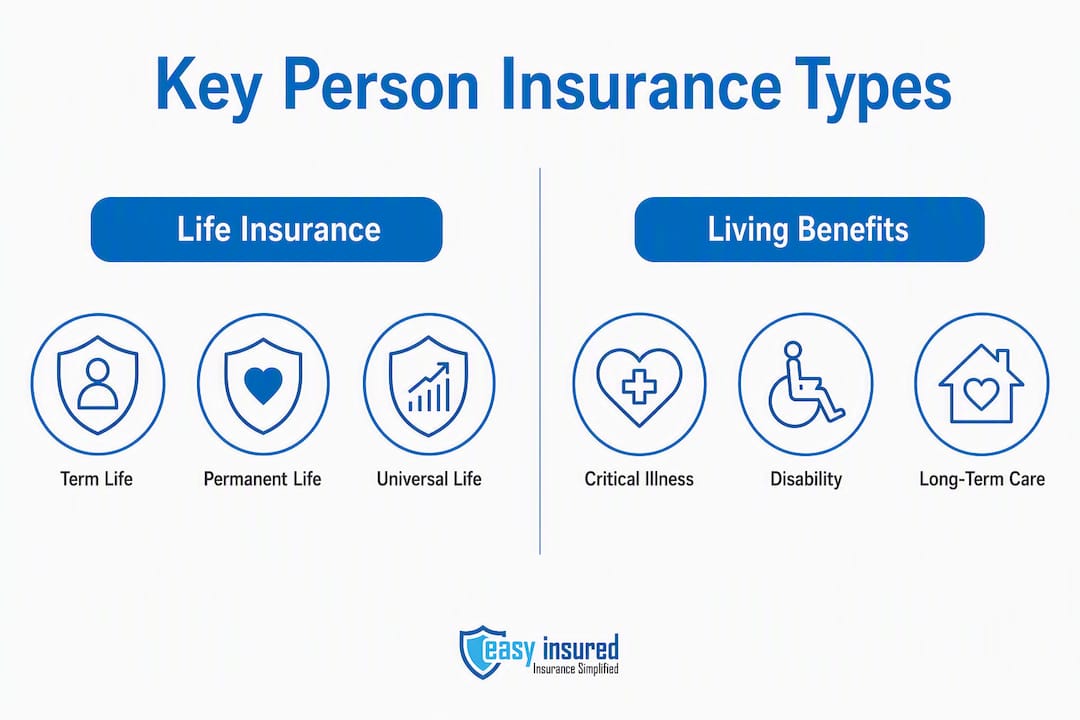
| Policy Type | Typical Business Use | Payout Trigger |
|---|---|---|
| Term life | Short-to-medium-term replacement funds, loan repayment | Death during the policy term |
| Permanent life (whole or universal) | Long-term ownership continuity, buy-sell funding, cash value | Death at any age; cash value accessible during life |
| Critical illness | Lump sum if key person survives a serious diagnosis | Diagnosis of a covered condition (cancer, heart attack, stroke, etc.) |
| Disability | Ongoing income replacement if key person cannot work | Inability to perform occupational duties past elimination period |
Term vs. permanent: the real trade-off
Term life is the most common starting point for key person coverage in Canada. Premiums are lower, coverage amounts are higher for the same dollar, and a term life policy can be structured to match a specific loan term or a business plan horizon.
- Pros: Lower cost, straightforward underwriting, easy to size to a specific liability
- Cons: No cash value, coverage ends at term expiry, conversion may require evidence of insurability
Permanent life (whole life or universal life) costs more but builds cash value the company can borrow against and provides coverage that doesn’t expire. A whole life policy is often used when the goal is long-term ownership continuity or funding a buy-sell agreement that may trigger decades from now.
- Pros: Permanent coverage, accumulates cash value, useful for estate and succession planning
- Cons: Higher premiums, more complex underwriting, slower cash value growth in early years
Living benefits: critical illness and disability
Critical illness coverage pays a lump sum if the insured survives a covered diagnosis. For a key person, that matters because disability and serious illness are statistically more likely to interrupt a career than death is. Disability insurance provides ongoing monthly benefits if the key person cannot work. Many Canadian businesses layer both onto a base life policy, particularly for founders and revenue-driving executives.
Who actually qualifies as a “key person”?
The CRA and most insurers don’t publish a rigid definition, so the practical test is this: would the business suffer a measurable financial loss if this person were gone for 12 months or permanently? If the answer is yes, they’re a candidate for coverage.
Use this checklist to evaluate candidates in your own company:
- Revenue dependency: Does this person generate, manage, or directly influence a significant share of revenue?
- Irreplaceable skills: Are their technical skills, certifications, or knowledge difficult to hire for in your market?
- Client relationships: Do clients follow this person, not the company brand?
- Lender or statutory guarantees: Has this person personally guaranteed a business loan or lease?
- Founder or operational control: Do they hold signing authority, licenses, or operational knowledge that no one else has?
- Ownership stake: Would their death trigger a share-transfer obligation under a shareholder agreement?
Examples across company sizes:
- Microbusiness (1–5 employees): The owner-operator who holds the trade license, manages all client accounts, and personally guarantees the lease. Coverage here is almost always the owner themselves.
- Growing SME (10–50 employees): A founder-CEO plus a lead salesperson whose client book represents 40%+ of revenue.
- Specialist firm: An R&D manager with proprietary process knowledge that would take two years and significant cost to rebuild.
A short note on partnerships: when two or more owners hold shares, key person life insurance proceeds are often used to fund a buy-sell agreement, giving the surviving owner the cash to purchase the deceased partner’s shares from their estate at a pre-agreed price. Without that funding, the surviving owner may find themselves in business with the deceased’s spouse or children.
How does key person insurance work in Canada?
The company owns the policy, pays the premiums, and is named as the beneficiary. That structure keeps the payout inside the business, where it can be deployed to stabilize operations rather than flowing to the insured’s estate.
According to standard Canadian broker guidance, ownership, premium payment, and beneficiary designation all affect how proceeds can be used and how they’re treated for tax purposes. Three common structures exist:
Direct business ownership: The most straightforward arrangement. The corporation applies for the policy, pays premiums from corporate funds, and receives the death or living benefit directly. This is the standard setup for most Canadian key person arrangements.

Collateral assignment to a lender: A bank or credit union may require the business to assign a key person policy as collateral for a business loan. The lender’s interest is protected up to the loan balance; any excess proceeds revert to the company.
Assignment to fund a buy-sell agreement: The policy is structured so that proceeds fund the purchase of a deceased shareholder’s shares, as outlined in a separate shareholder agreement. Corporate-owned life insurance is a common mechanism for this.
Canada tax and accounting: what you need to know
Tax treatment of key person insurance in Canada is not one-size-fits-all. As a general principle, premiums paid on a corporate-owned life insurance policy are typically not deductible as a business expense when the corporation is the beneficiary, though there are exceptions where the policy is assigned as collateral for a qualifying loan. Death benefits received by the corporation are generally received tax-free, and a portion may flow through the corporation’s Capital Dividend Account (CDA), potentially allowing tax-free distribution to shareholders.
Because the rules turn on policy structure, ownership, and how proceeds are used, always confirm the specific tax treatment with a qualified Canadian accountant or tax advisor before the policy is issued.
Mini-FAQ:
- Who owns the policy? The corporation, not the individual employee or owner.
- Can the company borrow against it? Yes, if the policy is a permanent life product with accumulated cash value. Term policies have no cash value.
What business problems does a payout actually solve?
Key person insurance proceeds are unrestricted once received by the company, which makes them flexible in a crisis. Here’s how Canadian businesses typically deploy them:
- Payroll and short-term cash flow: A $500,000 payout can cover six months of payroll for a team of ten while the business stabilizes and recruits.
- Recruitment and training costs: Executive search fees, onboarding, and the productivity gap during a replacement’s ramp-up period can easily run $75,000–$150,000 for a senior role.
- Buy out a deceased partner’s shares: Proceeds fund the purchase price under a buy-sell agreement, so the surviving owner doesn’t need to liquidate assets or take on debt.
- Repay loan guarantees: If the key person personally guaranteed a business line of credit or term loan, the payout retires that debt before the lender calls it.
- Bridge to sale or wind-down: For a business that cannot survive without the key person, proceeds give the remaining owners time and capital to negotiate a sale or manage an orderly wind-down rather than a fire sale.
RBC Wealth Management frames this as protecting human capital the same way you insure expensive equipment: low probability, high severity, and catastrophic if uninsured.
How much coverage should you buy?
Pick the sizing method that reflects your primary risk, then round up conservatively. Three methods work for most Canadian businesses:
1. Multiple of salary or profit contribution
Multiply the key person’s annual compensation or estimated profit contribution by a reasonable factor to estimate coverage.
2. Revenue-at-risk over the replacement period
Estimate the revenue likely to be lost or delayed while you find and onboard a replacement over the expected replacement timeline.
3. Replacement cost plus soft costs
Add direct replacement costs like recruiter fees and indirect costs such as training time and client attrition to capture true replacement expenses.
Worked example: a small Canadian professional services firm
A Toronto-based engineering consultancy has one principal engineer who generates 70% of project revenue, approximately $1.4M per year. Replacement timeline: 12–18 months. Recruiter and onboarding costs: $80,000. Client attrition risk during transition: 20% of the revenue base, or $280,000.
- Revenue at risk over 18 months: $2.1M
- Recruitment and transition costs: $80,000
- Client attrition buffer: $280,000
- Target coverage: approximately $2.5M
Pro Tip: Round your coverage target up by 15–20% to account for inflation, business growth, and the tendency to underestimate soft costs. Review the policy amount every two to three years or after any major change in the key person’s role or the company’s revenue.
What drives the cost of key person coverage?
Premiums vary considerably based on the insured individual and the policy structure. NerdWallet’s guidance on key person underwriting identifies the main cost drivers:
- Age: Premiums rise significantly with age; insuring a 35-year-old costs a fraction of insuring a 55-year-old for the same amount.
- Health status: Medical history, current health, BMI, and family history all affect the rate class.
- Tobacco use: Smokers typically pay two to three times the premium of non-smokers at the same age.
- Coverage amount and term: Higher face amounts and longer terms increase premiums proportionally.
- Policy type: Permanent life costs more than term; adding critical illness or disability riders increases premiums further.
- Occupation and industry: High-risk occupations (aviation, commercial diving, heavy construction) attract premium loadings or exclusions.
For most standard key person applications in Canada, underwriting takes two to six weeks from application to policy issue. Simplified issue products (no medical exam, limited health questions) are available for lower face amounts, typically up to $500,000–$1M depending on the insurer, and can be issued in days. For larger amounts, expect a paramedical exam, blood work, and possibly an attending physician statement. A broker who regularly places corporate policies can often accelerate the process by pre-screening insurers and submitting a complete application the first time.
How does key person insurance compare to other protections?
Key person insurance protects the company from the financial impact of losing a critical individual. It does not replace personal life or disability insurance, which protects the individual’s family. These are separate needs, and Canadian businesses should maintain both.
Buy-sell agreements are legal contracts that govern what happens to shares when an owner dies, becomes disabled, or exits. Key person insurance is the most common funding mechanism for a buy-sell, but the agreement itself is a legal document that must be drafted by a lawyer. The insurance and the agreement work together; neither is sufficient alone.
Personal life and disability insurance covers the individual’s mortgage, family income, and personal debts. A corporate key person policy pays the company, not the family. An owner who relies solely on corporate coverage leaves their family unprotected.
Business interruption insurance covers revenue loss from physical events: fire, flood, equipment failure. It does not cover the loss of a person. The two products address different risks and are often held simultaneously.
Creditor life insurance (sometimes required by lenders) covers a specific loan balance and pays the lender directly. It’s narrower than a full key person policy and typically not owned by the business. If a lender requires coverage, confirm whether creditor insurance satisfies the requirement or whether a collateral-assigned corporate policy is more appropriate.
How to apply for key person insurance in Canada
The process is straightforward when you know what to bring.
- Needs assessment: Identify the key person(s), estimate the coverage amount using one of the sizing methods above, and decide which policy types (life, critical illness, disability) are needed.
- Broker selection: Work with a broker who places corporate policies regularly. They’ll shop multiple insurers, advise on structure, and flag tax or ownership issues before the application is submitted.
- Application submission: The business completes the corporate application; the insured individual completes a personal health declaration and signs a consent form authorizing the insurer to access medical records.
- Underwriting: The insurer reviews the application, may order a paramedical exam or attending physician statement, and assigns a rate class.
- Policy issue: Once approved, the policy is issued to the corporation. Review the ownership, beneficiary, and assignment clauses against your shareholder agreement and any lender requirements before signing.
- Integration with corporate documents: Update your buy-sell agreement, loan covenants, and corporate minute book to reflect the new policy.
Documents commonly required:
- Two to three years of business financial statements
- Description of the key person’s duties and revenue attribution
- Employment or shareholder agreement
- Signed consent form from the insured
- Personal health information authorization
At claim time, the corporation submits a claim form, the death certificate or medical documentation, and proof of the insured’s role. Keep a copy of the policy and claim instructions in a location accessible to someone other than the key person themselves.
How Easy-insured helps Canadian businesses get covered
Easy-insured works with Canadian business owners to structure key person coverage that fits the actual risk, not a generic template. The team can package term life, whole life, critical illness, and disability components into a single coordinated arrangement, then match it to your shareholder agreement and lender requirements.
Services include:
- Needs analysis and coverage sizing
- Insurer shopping across multiple Canadian carriers
- Underwriting support and application management
- Policy placement and ownership/beneficiary structuring
- Integration with buy-sell agreements and loan covenants
- Ongoing policy reviews as your business grows
To get started, book a consultation with an Easy-insured broker to review your key person risks and get quotes from multiple carriers.
Key Takeaways
Key person insurance protects your business’s cash flow by paying the company a lump sum when a critical employee or owner dies, becomes seriously ill, or is disabled.
| Point | Details |
|---|---|
| Who to insure | Anyone whose loss would cause measurable revenue loss, trigger a loan call, or create an ownership gap. |
| How to size coverage | Use revenue-at-risk over the replacement period plus recruitment and transition costs; round up 15–20%. |
| Ownership and tax | The corporation owns the policy and is the beneficiary; premiums are generally not deductible, but death benefits are typically received tax-free. Confirm with a CPA. |
| Policy types available | Term life for cost efficiency, permanent life for long-term continuity, critical illness and disability for living-benefit gaps. |
| Easy-insured next step | Easy-insured brokers shop multiple Canadian carriers and structure term, permanent, critical illness, and disability components into one coordinated package. |
The mistake most Canadian owners make with this coverage
Most business owners who buy key person coverage get the ownership structure right but underestimate the coverage amount by a wide margin. They insure the salary, not the revenue. A key person earning $120,000 who controls $1.5M in client relationships needs coverage sized to the revenue gap, not the replacement paycheck.
The second mistake is waiting. Key person insurance is medically underwritten, which means the time to buy it is when the key person is healthy, not after a diagnosis or a health scare. I’ve seen owners try to add coverage after a key employee’s cancer diagnosis and find the policy either unavailable or priced out of reach.
The third, and most overlooked, issue is the absence of a funded buy-sell agreement. A shareholder agreement without insurance funding is a legal document with no financial teeth. If your partner dies and their estate wants fair market value for the shares, you need cash on hand. The policy is what makes the agreement executable.
If you do one thing after reading this: identify the single person in your business whose loss would hurt most, estimate what 18 months of their revenue contribution is worth, and call a broker to get a quote. The conversation takes 30 minutes. The policy can be in place in under six weeks.
Ready to protect your business with key person coverage?
Key person insurance is one of the few business decisions where the cost of waiting is genuinely asymmetric. A policy that takes six weeks to issue can protect years of business-building. Easy-insured makes the process direct: one conversation to size the coverage, one broker to shop the market, and one coordinated package that covers life, critical illness, and disability under a single corporate arrangement.
Before you call, pull together three things: your last two years of business financials, a short list of the people your business depends on most, and any existing policies the business currently holds. That’s all a broker needs to run a full needs analysis and return quotes from multiple Canadian carriers.
Get a quote or explore key person and business insurance options at Easy-insured to start the conversation today.
This article provides general information about key person insurance in Canada and is not professional legal, tax, or financial advice. Confirm current tax treatment and policy structuring with a qualified Canadian accountant, lawyer, or licensed insurance advisor.
Useful sources and further reading
- Key Person Insurance in Canada — Ratehub: Clear overview of policy types, ownership mechanics, and beneficiary structures for Canadian businesses.
- Key Person Insurance — Wikipedia: Useful background on global practices, ownership models, and why tax treatment varies by jurisdiction.
For the tax treatment of premiums and death benefits specific to your corporate structure, consult a Canadian CPA or tax advisor before the policy is issued.