
Critical illness insurance pays a fixed lump sum when you receive a covered diagnosis. Disability insurance replaces a slice of your paycheck every month for as long as you’re unable to work. Neither one is a substitute for the other because they cover different financial gaps, and for most Canadians with dependents or debt, the strongest protection comes from carrying both.
TL;DR:
- Critical illness insurance offers a one-time lump sum payout for a fixed list of approximately 20 to 30 specific conditions, with survival periods typically lasting 14 to 30 days.
- Disability insurance provides a monthly income replacement, usually covering 60% to 70% of pre-disability earnings, with longer benefit periods that can extend until retirement age.
- Critical illness triggers on diagnosed conditions listed in the policy, while disability depends on proving an inability to perform your job, often requiring ongoing medical recertification.
- Having both policies is advisable if you are the primary earner with dependents or thin savings, as each covers different financial risks and can sometimes trigger simultaneously.
- Policy selection should focus on detailed condition definitions, waiting periods, benefit formulas, and whether disability is defined as own-occupation or any-occupation, to ensure appropriate coverage.
Table of Contents
- Key Takeaways
- What Is Critical Illness Insurance, Exactly?
- What Is Disability Insurance, Exactly?
- Critical Illness vs. Disability Insurance: The Differences That Actually Matter
- Do You Need Both Disability and Critical Illness Coverage?
- How to Choose the Right Coverage: A Shopping Checklist
- An Advisor’s Take on Choosing Between the Two
- Compare and Buy Coverage Through Easy-insured
- Sources
- FAQ
Key Takeaways
Before getting into the mechanics, here’s what actually changes your decision:
- Critical illness pays once, in cash, with no restrictions on how you spend it. Disability pays monthly, tied to your ongoing inability to work.
- Disability insurance suits primary earners and salaried professionals who need income replaced for years, not weeks.
- Critical illness often makes more sense for the self-employed or anyone facing large out-of-pocket costs a paycheck alone won’t cover.
- Waiting periods differ sharply: critical illness usually has a short survival clause, while disability has a longer elimination period before payments start.
- Employer group coverage frequently includes disability but rarely includes meaningful critical illness protection, which changes what you need to buy privately.
What Is Critical Illness Insurance, Exactly?
Critical illness insurance pays a one time, lump sum benefit directly to you after a verified diagnosis of a condition named on your policy. There’s no restriction on how you spend the money, which is the entire point of buying it. Most policies cover roughly 20 to 30 specific conditions, though the exact list varies by insurer and by policy tier.
Pro Tip: Don’t assume “critical illness” means every serious diagnosis. Read the covered-conditions list before you buy, since two policies at similar price points can cover very different things.
Common covered conditions include:
- Cancer (often with specific staging requirements)
- Heart attack
- Stroke
- Major organ failure or transplant
- Coronary artery bypass surgery
Most policies attach a survival period, commonly 14 to 30 days after diagnosis, meaning you have to be alive and still meet the diagnostic criteria past that window before the insurer releases funds. This trips people up because they assume the check arrives the day of diagnosis. Some insurers also sell staged or partial-payout versions that release a smaller amount for early-stage conditions, such as pre-invasive cancer, and reserve the full benefit for advanced stages.
Statistic: Roughly 20 to 30 named conditions is the typical range for a critical illness policy, but insurers differ on which conditions make the list and how each is defined medically.
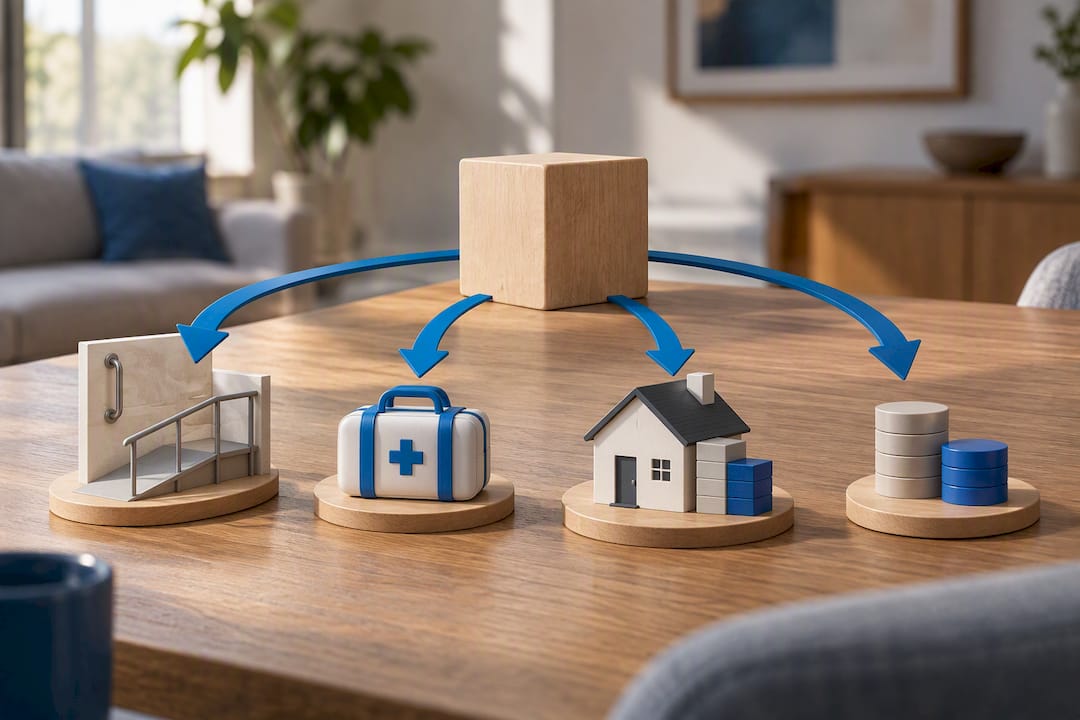
In practice, people use the lump sum to pay down a mortgage in one shot, cover a private care nurse, renovate a home for accessibility, or simply replace income while a spouse takes unpaid leave. Because the payout is unrestricted, it functions more like an emergency fund than a paycheck.
What Is Disability Insurance, Exactly?
Disability insurance replaces a portion of your earnings, paid monthly, when illness or injury stops you from doing your job. It doesn’t care what caused the disability. It only cares whether you can still work, and that distinction drives everything about how these policies are built.
The definition of disability matters more than almost any other clause in the contract. Own-occupation policies pay if you can’t perform your specific job, even if you’re capable of some other kind of work. Any-occupation policies only pay if you can’t work at any job reasonably suited to your training. Own-occupation coverage is especially valuable for specialists and licensed professionals, since a surgeon who loses fine motor control could still theoretically do administrative work, but shouldn’t lose income protection because of it.
Benefits typically replace 60% to 70% of pre-disability earnings, though the exact formula depends on the insurer and whether the policy is individual or employer-sponsored. Before any money arrives, you’ll sit through an elimination period, often several weeks to a few months, during which no benefit is paid at all. That gap is why having some emergency savings on hand matters just as much as the policy itself.
- Short-term disability typically covers weeks to a few months, often through an employer plan.
- Long-term disability can pay for years, sometimes until retirement age, depending on the policy.
- Ongoing benefits usually require periodic medical recertification. Insurers can and do request updated proof that you’re still unable to work.
Critical Illness vs. Disability Insurance: The Differences That Actually Matter
The two products differ in four practical ways, and each one changes how you’d actually use the money in a real emergency.
- Payout shape. Critical illness hands you one lump sum. Disability pays an ongoing monthly income. A lump sum is better for paying off a mortgage balance or funding a renovation; monthly income is better for covering rent, groceries, and other bills that keep arriving every 30 days regardless of your health.
- Trigger and proof. Critical illness triggers on a diagnosis matching a list. Disability triggers on your inability to work, which is a judgment call reassessed over time. A herniated disc might never appear on a critical illness list, yet it can absolutely qualify you for disability benefits if it keeps you off the job.
- Timing. Critical illness uses a survival period, typically 14 to 30 days. Disability uses an elimination period that can run 30, 60, 90, or 180 days. Longer elimination periods lower your premium but require deeper emergency savings to bridge the gap before benefits start.
- Cost. Disability insurance tends to cost more because the insurer takes on an open-ended liability, sometimes years of monthly payments. Critical illness caps the insurer’s exposure at one fixed payout, which usually makes it cheaper for comparable coverage amounts.
Pro Tip: A serious illness can sometimes trigger both policies at once. A severe diagnosis that also keeps you off work can produce a critical illness lump sum and a disability income stream in the same claim. There’s generally no coordination-of-benefits rule forcing one payout to reduce the other, but confirm this in your specific policy wording before assuming it.
Do You Need Both Disability and Critical Illness Coverage?
Run through this checklist honestly:
- Do you have dependents relying on your income?
- Do you have less than three to six months of expenses saved?
- Does your employer already provide group disability coverage?
- Are you self-employed, with no employer safety net at all?
- Does your family health history lean toward cancer, heart disease, or stroke?
If you’re the primary earner with dependents and thin savings, disability insurance protects the thing you can’t easily replace: your paycheck. If you’re self-employed, disability coverage can be harder to qualify for or more complex to structure, which is exactly why critical illness often becomes the more practical first purchase for that group.
Consider two quick scenarios. A salaried project manager with a young family and a mortgage leans toward disability first, since a multi-year absence from work is the bigger threat to the household budget. A self-employed contractor with irregular income and no group benefits might prioritize critical illness instead, using the lump sum to cover treatment costs and bridge cash flow while sorting out longer-term income protection.
Because each product covers a different risk, most financial planners frame this as complementary coverage rather than an either-or decision, once the budget allows for it.
How to Choose the Right Coverage: A Shopping Checklist
Before you sign anything, compare policies side by side using these criteria:
- Covered-conditions list. Get the exact wording, not a marketing summary. Definitions of “heart attack” or “stage of cancer” vary between insurers.
- Survival and elimination periods. Know exactly how many days you’d wait for money in either policy.
- Benefit amount and formula. Confirm the percentage of income replaced for disability, and the flat dollar figure for critical illness.
- Benefit period. How long does disability pay: two years, five years, to age 65?
- Definition of disability. Own-occupation or any-occupation. This single clause can determine whether you get paid at all.
- Exclusions and portability. Ask what’s excluded outright, and whether you can keep the policy if you change jobs.
Pro Tip: Ask your insurer or advisor to show you the exact policy definitions side by side rather than a sales brochure summary. That’s where the real differences between two similarly priced policies show up.
If your employer already provides group disability, ask how it coordinates with any personal policy you’re considering. Some employer plans offset benefits if you’re also collecting elsewhere, which changes how much private coverage you actually need to fill the gap.
An Advisor’s Take on Choosing Between the Two
Most people treat this as a either-or decision when it’s really a sequencing question. Easy-insured works with Canadian families and business owners on exactly this tradeoff every week, and the pattern is consistent: the people who regret their coverage are the ones who bought based on price instead of what the policy actually triggers on.
If you can only afford one right now, match the product to your bigger financial exposure, not the cheaper premium. Salaried employees with thin savings should start with disability. Self-employed Canadians and anyone with a family history of major illness often get more practical value starting with critical illness.
— Frank
Compare and Buy Coverage Through Easy-insured
Reading about the difference is one thing. Getting a policy that actually fits your income, your family history, and your budget is another, and that’s where Easy-insured steps in. There are services that combine instant online access with personalized guidance from financial planners, so you’re not stuck comparing dense policy wording alone.

If you’re weighing lump-sum protection against monthly income replacement, start by browsing critical illness coverage options and disability insurance plans side by side. Self-employed Canadians facing more complex underwriting can also explore Easy-insured’s broader financial planning services for a coordinated approach that covers both income protection and long-term planning. Request a personalized quote today and find out exactly what each policy would cost for your situation.
This article is general information, not a substitute for advice from a qualified financial advisor. Consult a qualified financial professional about your own circumstances before acting on anything here.
Sources
- Critical Illness Vs Disability Insurance: Which One Do You Actually Need? – Comparewise
- Critical illness & disability insurance — do you need both? – LegalClarity
FAQ
What happens after two years on disability?
It depends on your policy’s definition of disability. Many long-term policies switch from an own-occupation standard to an any-occupation standard around the two-year mark, meaning you must show you can’t work any suitable job, not just your previous one, to keep receiving benefits.
What is not covered by critical illness insurance?
Conditions not named on your specific policy’s covered list are excluded, along with pre-existing conditions disclosed before a waiting period ends and, in most policies, diagnoses that don’t meet the severity criteria defined in the contract. Early-stage or less severe versions of a condition may only qualify for a partial payout under staged policies rather than the full benefit.
What are the conditions typically covered by critical illness insurance?
Most policies center on cancer, heart attack, stroke, and major organ failure or transplant, with the full list running to roughly 20 to 30 named conditions depending on the insurer. There’s no single universal list, so always request your specific insurer’s exact wording before buying.
What are the disadvantages of critical illness insurance?
The biggest drawback is the fixed list: if your diagnosis isn’t named in the policy, you get nothing, no matter how serious the illness is. Survival periods can also delay payment by 14 to 30 days, and staged policies may only release a partial amount for earlier-stage conditions.
How much does Easy-insured’s disability or critical illness coverage cost?
Pricing depends on your age, health, occupation, and the benefit amount you choose, so current rates aren’t published as a flat figure. You can request a personalized quote directly through Easy-insured’s critical illness or disability insurance pages.