
Start by deciding what outcome you actually want from your exit, then get a real valuation and call a lawyer, a tax advisor, and an insurance broker before anything else. Business succession planning protects jobs, enterprise value, and continuity, but none of that matters if you wait too long to act. The owners who transfer smoothly are the ones who treated this as a multi-year project, not a signing-day event.
TL;DR:
- Business owners should develop a multi-year succession plan, considering the timing of ownership transfer and management succession separately.
- Choosing the appropriate transfer route depends on financial support, family circumstances, and timeline, with options including third-party sale, family transfer, management buyout, or Employee Ownership Trusts.
- Handling tax mechanics is critical, especially planning for deemed disposition at death and ensuring eligibility for tax benefits like the lifetime capital gains exemption.
- Proper insurance funding, such as life and buy-sell policies, is essential to cover taxes and prevent forced sales during the transition.
- Coordinating legal, tax, and valuation advisors early and maintaining clear, aligned documents reduce conflicts and improve success rates.
Table of Contents
- Why Business Succession Planning Matters for Canadian SMEs
- What Are Your Options for Transferring a Business in Canada?
- What Are the Tax and Legal Rules That Decide Your Payout?
- Building Your 12–36 Month Roadmap and Deal File
- How Insurance Funds Succession and Prevents a Forced Sale
- Coordinating Advisors Without Losing the Plan to Silos
- How Does Succession Planning Affect Employee Retention?
- How Do You Choose and Evaluate the Right Successor?
- What Support Does a New Owner Need After the Handover?
- Do Succession Rules Differ Across Canadian Provinces?
- Managing Family Dynamics During a Business Transfer
- Keeping the Business Running During the Transition
- A Note From Frank on Why Insurance Belongs in Every Plan
- How Easy-Insured Helps You Fund Your Succession Plan
- Sources
- FAQ
Why Business Succession Planning Matters for Canadian SMEs
Succession isn’t a someday problem. More than 17% of Canadian SME owners plan to exit their business within the next five years, according to Innovation, Science and Economic Development Canada. That’s a wave of ownership transitions hitting suppliers, employees, and local economies all at once.
Treat ownership transfer and management succession as two separate problems. You can hand over daily leadership to a general manager years before you sell or gift your shares, and that separation buys you time to test whether the successor can actually run the place. Scotiabank’s research on succession frames this correctly: succession unfolds over years, not months, and treating it as an operational resilience project strengthens governance and reduces the damage a single key person leaving can do.
Skip the planning and you’re gambling with three things at once: a forced fire sale at a discount, a tax bill that arrives faster than your cash flow can absorb, and the talent that walks out the door the moment uncertainty sets in.
What Are Your Options for Transferring a Business in Canada?
Four routes dominate business ownership transfer in Canada, and each comes with its own timeline and headaches.
- Third-party sale. Expect a due diligence process that scrutinizes contracts, financials, and customer concentration. Buyers pay more for a business that doesn’t depend entirely on the owner walking in every morning.
- Intergenerational or family transfer. This route has its own eligibility tests tied to who qualifies for preferential tax treatment, and it carries the added weight of family dynamics that a stranger buyer never brings.
- Management or employee buyout. Often financed through a vendor take-back (VTB) structure, where you as the seller finance part of the purchase price and get paid over time as the new owners generate cash flow.
- Employee Ownership Trust (EOT). BDC notes EOTs let a trust hold shares on behalf of employees, so staff don’t have to personally finance a purchase, which makes this route viable for businesses with a strong culture but no obvious single buyer.
The right route depends less on what sounds appealing and more on what your financials, your family, and your timeline can actually support.
What Are the Tax and Legal Rules That Decide Your Payout?
The route you pick matters less than whether you’ve handled the tax mechanics behind it. This is where fortunes are quietly won or lost.
Deemed disposition at death is the biggest liquidity trap in Canadian estate planning. When a business owner dies, the Canada Revenue Agency treats their shares as sold at fair market value that same day, and the resulting tax bill is typically due within six months. Without cash on hand, heirs can be forced to sell the business just to cover the tax.
More than 17% of Canadian SME owners plan to exit within five years, per ISED. The tax and liquidity planning behind that exit rarely gets the same urgency.
A few structural tools shape the outcome:
- Lifetime Capital Gains Exemption (LCGE) and QSBC status. Qualifying for the small business capital gains exemption depends on tests like the 24-month holding period and a minimum share of active-business assets. Think Accounting’s guidance on CCPC succession points out that these timing tests often decide the after-tax result, so waiting until the year you want to sell is usually too late to fix eligibility.
- Estate freezes and family trusts. BDO Canada explains that freezing the value of your shares locks in today’s tax liability while future growth passes to the next generation, often through a trust. Family trusts are subject to a 21-year deemed disposition rule, so they need periodic review, not a set-and-forget approach.
- Document alignment. Your will, shareholder agreement, buy-sell clauses, and powers of attorney all need to say the same thing. A shareholder agreement that contradicts your will is a fight waiting to happen.
Building Your 12–36 Month Roadmap and Deal File
Businesses in the $1 million to $10 million range typically need somewhere between one and three years to get transfer-ready, according to guidance from the Canadian Federation of Independent Business. Here’s the order that actually works:
- Set your exit window and after-tax cash target. Decide roughly when you want out and how much you need to net, not just gross.
- Rank your priorities. Price, speed, legacy, and continuity for employees rarely align perfectly. Know which one wins when they conflict.
- Get a usable valuation. You need both a market value figure and a transfer value figure, since a family transfer and a third-party sale get valued differently.
- Pull three to five years of clean financials. Buyers and successors both discount a business with messy books.
- Make the business run without you. Documented processes, a leadership bench, tracked KPIs, and contracts that survive an ownership change all raise your transfer value.
- Pick a likely deal structure early and line up financing, whether that’s a buyer’s loan, a VTB, or insurance-funded liquidity.
Pro Tip: Order your valuation before you talk to anyone about price. Owners who skip this step almost always overestimate what their business is worth, and that gap kills more deals than any tax issue does.
A tool like Forge can help document field operations and job workflows, which matters directly for step five. A buyer or successor pays more for a business where the processes live in a system, not in your head.
How Insurance Funds Succession and Prevents a Forced Sale
Insurance is the piece most succession plans get wrong, usually because owners treat it as an afterthought instead of the mechanism that makes the whole plan work.
- Life insurance to cover the tax bill. Because deemed disposition tax comes due within six months of death, a policy sized to that liability keeps heirs from selling assets under pressure. Explore whole life insurance as a permanent funding source for this exact scenario.
- Buy-sell insurance. If you have co-owners, a properly structured buy-sell insurance policy funds the buyout automatically when a partner dies or becomes disabled, instead of leaving the surviving owner scrambling for cash.
- Corporate-owned life insurance and estate bonds. These instruments work alongside an estate freeze to fund future tax liability while smoothing probate, and an estate bond strategy can reduce what gets tied up in probate court.
None of this works in isolation. Insurance has to be sized against your actual estate freeze and shareholder agreement numbers, not a rough guess.
Coordinating Advisors Without Losing the Plan to Silos
Your core team should be small and specific: an accountant or tax advisor, a corporate lawyer, an insurance broker, and an independent valuation professional who isn’t trying to sell you anything else. Meet as a group, not in four separate one-on-one conversations, because that’s how a will ends up contradicting a shareholder agreement.
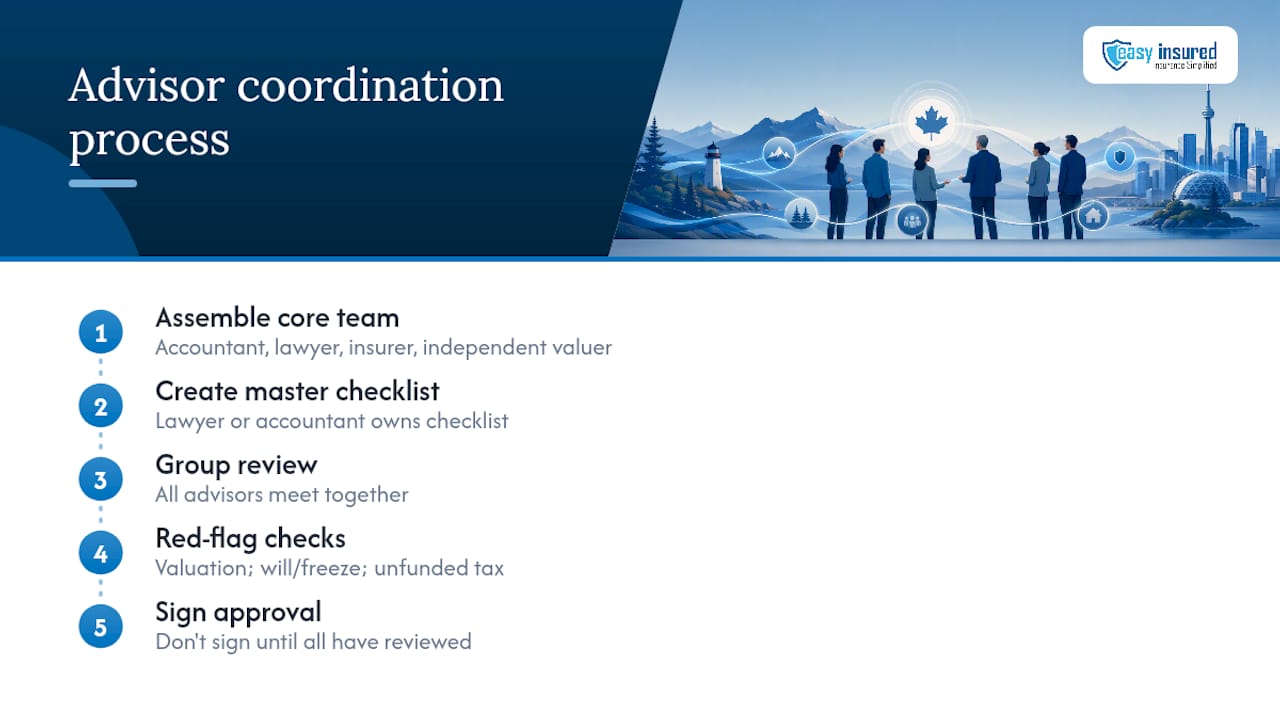
Parr Business Law’s review of multiple-wills planning points to a pattern that shows up constantly: documents drafted at different times by different advisors, each unaware of what the others wrote. Watch for three red flags specifically: a shareholder agreement using a valuation method different from your actual buy-sell insurance, a will that doesn’t reflect the freeze structure your accountant set up, and a funding gap where nobody actually priced out the tax bill against available insurance.
Pro Tip: Put one person, usually your lawyer or accountant, in charge of the master document checklist. Someone has to own the timeline or every advisor assumes someone else is tracking it.
A simple governance rule works well here: nothing gets signed until all three advisors have reviewed it against the others’ work.
How Does Succession Planning Affect Employee Retention?
Uncertainty drives good people out faster than almost anything else in a small business. When employees don’t know whether the company will exist in its current form in two years, your best performers start updating their resumes quietly, and you lose them before you’ve even decided on an exit route.
A visible succession plan does the opposite. It signals stability, and it gives ambitious employees a reason to stay: a real path toward more responsibility, equity, or a leadership seat. This is one reason management buyouts and Employee Ownership Trusts have gained traction as succession routes. They turn the uncertainty of “who’s buying this place” into an opportunity that current staff can participate in directly.
The reverse is also true. A poorly communicated transition, or one where employees hear about it as a rumor before management confirms anything, does more damage than the transition itself. Key employees, the ones a buyer or successor most needs to retain, are also the ones most likely to have other job options. If they sense chaos, they leave first.
Practical retention tools during a transition include: communicating the general timeline once it’s set (you don’t need every detail nailed down to say “we have a plan”), keeping compensation and benefits stable through the transition period, and giving key managers a defined role in the new structure before the deal closes. A group insurance or employee benefits package that doesn’t change during ownership transfer removes one more reason for anxious staff to start job hunting.
How Do You Choose and Evaluate the Right Successor?
The wrong successor is the single most common reason a technically sound succession plan fails in practice. Evaluating candidates properly means separating three distinct questions: can they run the operations, can they lead people, and do they actually want the job long-term.
Start with a skills audit against what the role genuinely requires, not what the current owner happens to be good at. Many family businesses assume the eldest child or the most available manager is the natural successor, then discover two years in that the person has no interest in sales, or freezes under financial pressure decisions the owner used to make instinctively.
A few evaluation steps work better than a gut-feel decision:
- Test the successor in a real leadership role for at least a year before finalizing anything, ideally with profit-and-loss responsibility for part of the business.
- Get outside feedback from employees, customers, or suppliers who deal with the candidate directly. Owners often have blind spots about their own family members or long-time managers.
- Check financial literacy specifically. Running day-to-day operations and managing the financial side of ownership are different skill sets, and a successor weak on the second one needs training or a strong CFO relationship before taking over.
- Confirm genuine willingness, not just willingness to avoid disappointing you. A reluctant successor who takes over out of obligation rarely thrives, and the business usually shows it within a year.
Readiness isn’t binary. Most successors need a defined runway, often 12 to 24 months of shadowing key decisions, before the transfer of authority should be considered complete.
What Support Does a New Owner Need After the Handover?
The deal closing isn’t the finish line. A surprising number of otherwise well-planned successions unravel in the first 18 months because everyone treated closing day as the end of the project instead of the start of a new one.
Structured mentoring from the outgoing owner matters more than most transition plans account for. A defined consulting period, often six months to two years depending on the complexity of the business, gives the new owner or manager access to institutional knowledge that no document can fully capture: which supplier actually delivers on time, which client needs a phone call instead of an email, which employee needs a longer leash than the org chart suggests.
Set boundaries on this arrangement in writing. An outgoing owner who lingers too long without a defined role creates confusion about who’s actually in charge, undermining the very authority the new owner needs to establish. A phased reduction of involvement, heavy advisory presence in month one, tapering to occasional check-ins by month six, tends to work better than an abrupt clean break or an indefinite part-time presence.
External support matters too. New owners benefit from staying connected to the same advisory team, the accountant, lawyer, and insurance broker, who built the original plan, since those advisors already understand the deal structure and the tax positions behind it. Bringing in entirely new advisors post-transition means re-explaining years of history to people who weren’t there for the decisions that shaped it.
Do Succession Rules Differ Across Canadian Provinces?
Yes, and the differences show up mainly in probate, corporate law, and land transfer rules rather than in federal tax mechanics like deemed disposition or the LCGE, which apply nationally under the Income Tax Act.
Probate fees vary significantly by province. Ontario charges estate administration tax on a sliding scale, while some provinces cap probate fees at a flat rate regardless of estate size, which changes how much an estate bond strategy actually saves a given business owner. Corporate law also differs depending on whether your company is incorporated federally or provincially, affecting shareholder agreement requirements and what a lawyer needs to review before a share transfer closes.
Quebec adds another layer entirely, since its civil law system handles wills, matrimonial property, and business succession differently than the common law provinces. A shareholder agreement or estate plan drafted for an Ontario business doesn’t automatically translate to Quebec without a lawyer familiar with the Civil Code reviewing it.
Given this variation, a lawyer licensed in your specific province isn’t optional. Generic templates found online routinely miss provincial quirks that can invalidate a document or trigger fees an owner didn’t plan for.
Managing Family Dynamics During a Business Transfer
Family businesses carry an extra layer of complexity that a third-party sale never has to deal with: the people negotiating the deal have a lifetime of history together, and that history doesn’t stay out of the boardroom.
Sibling rivalry over who takes control, a spouse who feels excluded from decisions, or an adult child who wants the business but not the debt that comes with it, these conflicts derail more family transfers than any tax issue does. The businesses that navigate this well tend to separate two conversations explicitly: who runs the company, and who owns the company. Those don’t have to be the same person or people, and forcing that assumption is often where the conflict starts.
A neutral third party, whether that’s a family business advisor, a mediator, or simply the independent lawyer and accountant on your advisor team, helps take emotion out of decisions that family members are too close to make objectively. Written agreements matter even more in family transfers than in arm’s-length sales, because verbal understandings between relatives tend to get remembered differently by each person once money changes hands.
Set expectations early and in writing: what happens if a child doesn’t want to run the business, how non-active family members get compensated fairly if only one sibling takes over operations, and what recourse exists if the succession doesn’t work out as planned. Silence on these questions doesn’t prevent conflict. It just delays it until the stakes are higher.
Keeping the Business Running During the Transition
A succession plan that focuses only on ownership transfer while ignoring day-to-day operations is a plan that will show cracks the moment the transition actually starts. Customers and suppliers notice instability faster than owners expect.
The strongest continuity strategy is one that makes the business less dependent on any single person well before the transition begins, not during it. That means documented processes, a management team capable of making decisions without the owner’s daily input, and client relationships that belong to the company rather than to one individual. A business continuity planning guide from ShieldIQ covers how operational resilience planning overlaps directly with succession work: both require the business to function even when a key person is temporarily or permanently unavailable.

Key-person risk deserves specific attention here. If the owner or a critical manager became suddenly unable to work, would the business survive six months? Disability insurance and critical illness coverage on key people close that gap, funding the cost of temporary replacement leadership or covering lost revenue while a successor gets up to speed faster than planned.
Communication during the transition matters as much as the operational backbone. Customers who hear about an ownership change from a rumor rather than the business itself start looking at alternatives. A short, direct message from ownership, timed to land before speculation does, keeps relationships steady through a period that otherwise breeds doubt.
A Note From Frank on Why Insurance Belongs in Every Plan
I’ve spent years watching business owners build careful legal and tax structures for succession, only to skip the funding piece that makes those structures actually work on the day they’re needed. Insurance isn’t a bolt-on. It’s often the difference between a plan that transfers a business smoothly and one that forces a fire sale to cover a tax bill nobody budgeted for.
[Client case study placeholder: buy-sell insurance funding a partner buyout]
[Client case study placeholder: corporate-owned life insurance covering deemed disposition tax]
— Frank
How Easy-Insured Helps You Fund Your Succession Plan
Your succession plan is only as strong as its weakest funding gap, and that’s exactly where we work directly with Canadian business owners on whole life insurance to fund estate taxes and build corporate liquidity, buy-sell insurance to trigger automatic partner buyouts, and estate planning advisory to make sure your insurance actually matches your shareholder agreement and your will.

Most owners who come to us have already talked to a lawyer or accountant about structure, but nobody has actually priced out the funding side against the real tax exposure. That’s the gap worth closing first. Start with a consultation and document review: bring your shareholder agreement, your latest valuation if you have one, and any existing policies, and we’ll identify where the funding falls short before it becomes a forced sale. Book a consultation to review your current coverage against your actual succession timeline.
This article is general information, not a substitute for advice from a qualified financial advisor. Consult a qualified financial professional about your own circumstances before acting on anything here.
Sources
- Business succession planning — Innovation, Science and Economic Development Canada
- Succession planning — Scotiabank
- Succession Planning for Business Owners: Canada Basics — Think Accounting
- Avoid double taxation — Claret
FAQ
What Are the 5 D’s of Succession Planning?
The 5 D’s typically refer to Death, Disability, Divorce, Departure, and Disagreement, the common triggers that force an ownership transition whether or not a plan is ready.
What Is the Best Way to Transfer a Business to a Family Member?
Start with a valuation that establishes fair transfer value, then confirm LCGE and QSBC eligibility early, since the 24-month holding period and asset-use tests can disqualify a rushed transfer from preferential tax treatment.
What Are the Downsides of Succession Planning?
The main downsides are cost and complexity: legal, tax, and valuation work takes real money and time, and rushed or poorly coordinated plans can create conflicting documents that cause more problems than no plan at all.
How Do You Plan Succession in a Family Business?
Separate ownership transfer from management transition, get an independent valuation, address family dynamics with a neutral advisor, and align your will, shareholder agreement, and insurance funding before you set a firm timeline.
How Does Life Insurance Fit Into a Succession Plan?
Life insurance funds the tax bill triggered by deemed disposition or bankrolls a buy-sell agreement so surviving owners or heirs aren’t forced to sell business assets under pressure to cover a liability due within six months of death.