
Key person disability insurance is a business-owned policy that pays a monthly benefit or lump sum to your company when a critical employee or owner becomes too sick or hurt to work. The payout covers payroll, replacement hiring, and debt payments while you regroup. If your business leans on one or two people for revenue, client relationships, or loan guarantees, this coverage belongs on your short list.
TL;DR:
- Most policies have a waiting period of 30 to 90 days before benefits begin, and the benefit duration typically ranges from two to five years or until retirement.
- Coverage should be based on estimating three to twelve months of lost revenue plus recruitment, training, and any debt guarantees, with scenarios adjusted for quick or slow replacements.
- Business owners must ensure the policy is owned by the company and benefits are directed to cover payroll, costs, and debt, not to the individual employee.
- Key person disability insurance is most relevant for employees whose absence would significantly impact revenue, client relationships, or loan guarantees, and should be reviewed annually.
- Premiums are affected by age, health, job risk, benefit size, and benefit duration, and providing detailed job descriptions can improve underwriting outcomes.
Table of Contents
- How Does Key Person Disability Insurance Work?
- Key Person Disability vs. Key Person Life vs. Business Overhead Expense
- Who Actually Counts as a Key Person?
- How Much Coverage Does Your Business Actually Need?
- Ownership, Taxes, and How Claims Actually Get Paid
- What Drives Premiums, and How to Improve Your Rate
- Why Small Businesses Keep Skipping This Coverage
- How Should Owners Actually Prioritize This Risk?
- Get Key Person Disability Coverage Through Easy-insured
- Sources
- FAQ
How Does Key Person Disability Insurance Work?
The policy is structured much like individual disability insurance, but the company owns it, pays the premiums, and collects the benefit. Some policies pay a monthly income for as long as the disability lasts, up to a set benefit period. Others pay a lump sum, which works better when a business needs one large cash injection to fund a buyout or bridge a short gap rather than ongoing income replacement.
Two terms determine how the policy actually behaves during a claim:
- Elimination period: the waiting window before benefits start, often 30, 60, or 90 days.
- Benefit period: how long payments continue, commonly two years, five years, or to a set age.
- Partial or residual riders: pay a reduced benefit if the key person can work part-time or in a limited capacity rather than not at all.
Underwriters look closely at occupation class, since a surgeon and a warehouse supervisor carry different risk profiles, and they want a documented job description showing exactly what duties the person performs. Policy structures and limits vary meaningfully by insurer, so two companies insuring similar roles can end up with very different terms and benefit periods.
Key Person Disability vs. Key Person Life vs. Business Overhead Expense
These three products get confused constantly, and mixing them up leaves gaps. Key person life pays out on death only. Business overhead expense (BOE) reimburses fixed operating costs, like rent and utilities, when an owner is disabled, but it does not replace the profit that person generated. Personal disability insurance protects an individual’s own paycheck, not the company’s revenue.
- Key person life insurance: protects against permanent loss (death), often used to fund buy-sell agreements or repay a loan outright.
- Business overhead expense: covers fixed costs for a small, owner-dependent operation, not lost revenue or replacement salary.
- Personal/individual disability: benefits the employee directly, not the business, and usually isn’t large enough to cover a company’s exposure.
- Group disability: cheaper and useful as a baseline for the whole staff, but coverage caps are usually too low to protect a business against losing its top revenue generator.
If your business guarantees a loan or has a buy-sell agreement tied to an owner’s capacity to work, key person life insurance and key person disability usually need to work together, not one instead of the other.
Who Actually Counts as a Key Person?
Not every valuable employee qualifies. A key person is someone whose absence would measurably damage revenue, client retention, or the company’s ability to operate, not just someone who’s hard to replace on paper.
- Revenue concentration: does this person generate or directly influence a significant share of the annual revenue?
- Client relationships: would major accounts leave or stall if this person disappeared for six months?
- Loan guarantees: is this person a personal guarantor on business debt or a line of credit?
- Irreplaceable expertise: does the business depend on a skill set, license, or relationship that took years to build and can’t be hired off a job board?
- Single points of failure: is there a backup person who could step in within 90 days, or is there genuinely no bench?
Run every owner and senior employee through this list once a year. Priorities shift as the business grows, and the person who mattered most three years ago isn’t always the one carrying the company today.
How Much Coverage Does Your Business Actually Need?
Sizing coverage is where most owners either guess too low or overbuy coverage they’ll never use. A workable framework has two steps: figure out short-term cash needs, then add on medium-term replacement costs and any debt tied to that person.
- Step 1, immediate cash needs: estimate 3 to 12 months of lost revenue or profit contribution tied to that person, plus payroll you’ll keep paying regardless.
- Step 2, replacement and debt: add recruitment fees, training time, and any loan balance the person personally guarantees.
Pro Tip: Run two scenarios, not one. A conservative estimate assumes a fast hire and short disruption. An aggressive estimate assumes six months of vacancy and a slow ramp for the replacement. Price coverage between the two, not at either extreme.
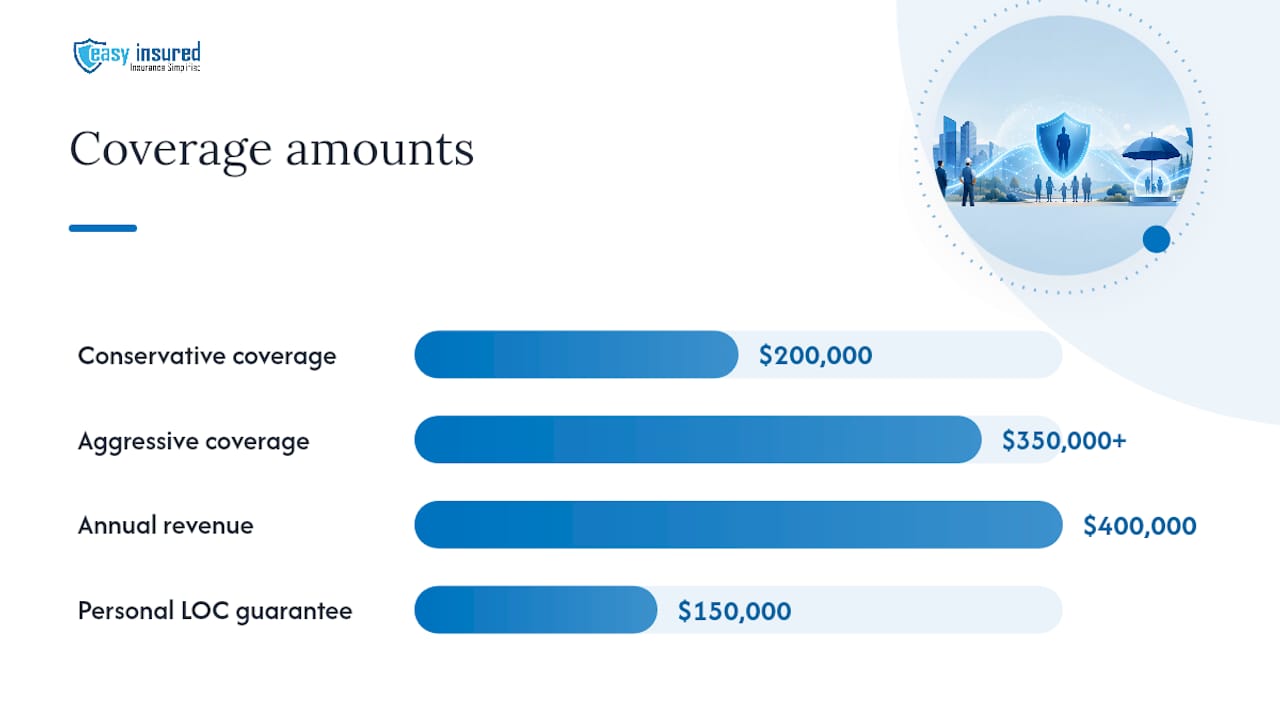
For a business owner generating $400,000 in annual revenue who also guarantees a $150,000 line of credit, a conservative estimate might land around $200,000 in total coverage, while an aggressive scenario could push past $350,000 once training costs and debt are layered in. Adjust downward if the person has been cross-training a successor for years; adjust upward if they’re the only one who holds key client relationships or specialized licensing. Because key person insurance pays a pre-agreed amount rather than exact indemnification, getting these numbers right during underwriting matters more than it does with most other business coverage.
Ownership, Taxes, and How Claims Actually Get Paid
The business itself should own the policy, pay the premiums, and be named the beneficiary. That structure is what makes this “key person” coverage rather than personal disability insurance, and it’s why proceeds can legally flow straight into business accounts rather than to the individual.
Once a claim is approved, funds typically go toward:
- Covering payroll and fixed costs while the business searches for or trains a replacement
- Funding recruitment and onboarding for a successor
- Servicing debt where the disabled person was a guarantor or co-signer
Tax and accounting treatment gets complicated fast, and it depends on how premiums are paid, how the policy is structured, and your specific corporate setup. Talk to a tax professional or accountant before finalizing ownership and beneficiary details, because getting this wrong can turn a protective payout into an unexpected tax event.
Most policies also carry standard exclusions: pre-existing conditions within a lookback window, specific waiting periods before any claim is payable, and return-to-work clauses that reduce or end benefits once the person resumes full duties. Read these provisions closely before you sign, not after a claim is denied.
What Drives Premiums, and How to Improve Your Rate
Underwriters price these policies around a handful of variables, and understanding them before you apply puts you in a stronger negotiating position.
- Age and health history: older applicants and those with chronic conditions pay more, sometimes significantly.
- Occupation risk class: physically demanding or high-liability roles cost more to insure than desk-based leadership roles.
- Benefit amount and period: larger monthly benefits and longer benefit periods raise premiums directly.
- Elimination period: a longer waiting period before payouts start lowers the premium.
Pro Tip: Come to underwriting with a written job description and documentation showing the person’s actual revenue contribution. Clear evidence of duties and financial impact reduces guesswork for the underwriter and often improves the offer. If full coverage isn’t available due to health history, ask about graded benefits or a shorter benefit period as a workaround rather than walking away entirely.
Why Small Businesses Keep Skipping This Coverage
Plenty of small companies run on the strength of one or two people, yet far fewer carry formal key person coverage than the risk would suggest. That gap usually isn’t a decision. It’s an oversight that surfaces at the worst possible moment, right when a founder or top producer goes down unexpectedly.
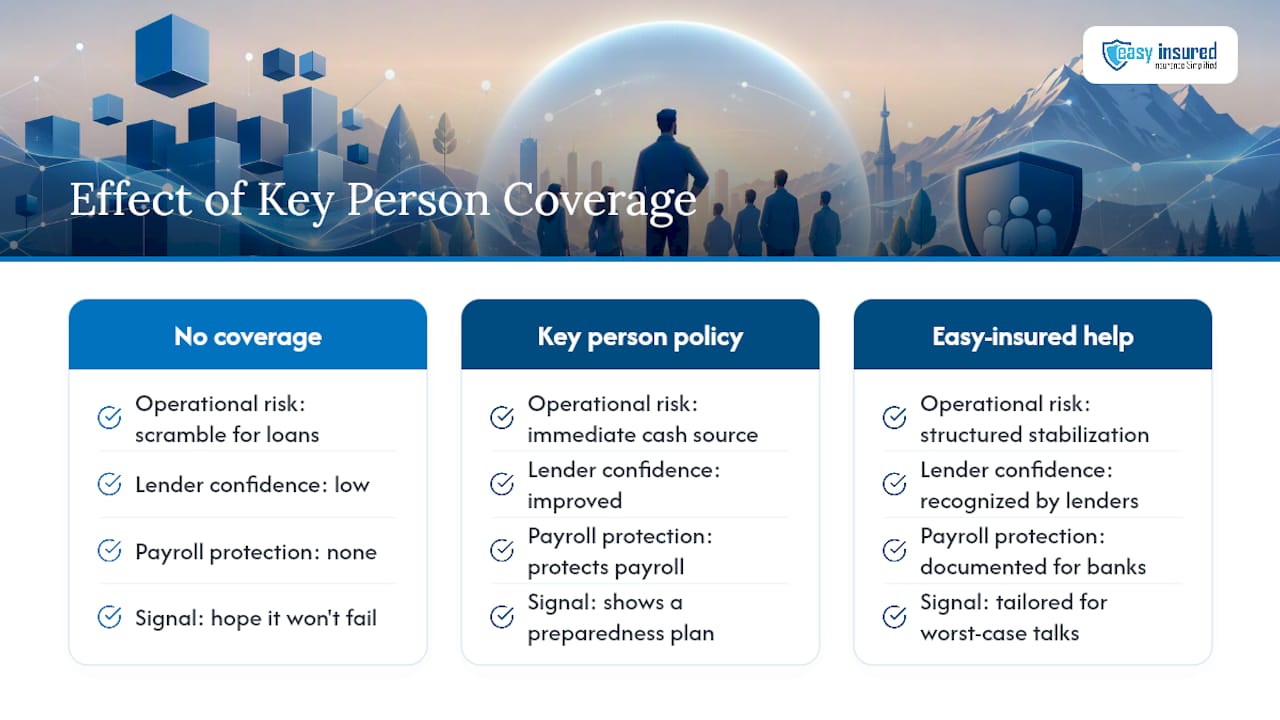
Lenders notice the gap too. A pre-arranged benefit gives a bank or investor confidence that the business has an immediate source of cash to stabilize operations after a disabling event, rather than scrambling for a bridge loan mid-crisis.
A company that insures its key person before a crisis hits isn’t just protecting payroll. It’s signaling to lenders and partners that the business has a plan for its own worst-case scenario, not just a hope that nothing goes wrong.
Easy-insured works with Canadian business owners to document these risks properly and structure coverage that lenders and accountants actually recognize as sound planning, using detailed guidance on key person insurance built specifically for that conversation.
How Should Owners Actually Prioritize This Risk?
If your business would struggle to make payroll or service debt within a few months of losing one person, that’s the signal to act now, not after renewal season.
Bring three questions to any broker conversation: What’s my realistic elimination period given how fast I could replace this person? Does the benefit period match how long recovery or replacement would actually take? And how does this coordinate with any group disability or key person life policy already in place?
— Frank
Get Key Person Disability Coverage Through Easy-insured
Some insurance brokers help Canadian business owners work through the sizing math and underwriting prep covered above, rather than handing you a generic quote and hoping it fits.
Beyond key person disability, Easy-insured brokers also arrange critical illness coverage, key person life policies, and broader business insurance so your continuity plan doesn’t have gaps between products. That coordination matters: a disability policy that doesn’t line up with your existing group benefits or a buy-sell agreement can leave you paying for overlap or missing a scenario entirely. If you guarantee business debt personally or your company depends on one or two people for most of its revenue, get a tailored quote through Easy-insured’s disability insurance page and walk through the numbers with a broker before your next renewal date.
Sources
For deeper background on how key person coverage is defined and structured, see Investopedia’s overview, Corporate Finance Institute’s breakdown, and the Wikipedia summary on key person insurance. Easy-insured’s own-occupation disability guide covers benefit definitions in more detail.
This article is general information, not a substitute for advice from a qualified financial advisor. Consult a qualified financial professional about your own circumstances before acting on anything here.
- Key Person Insurance definition — Investopedia
- Key person insurance — Corporate Finance Institute
- Key Person Disability — Tokio Marine HCC (product overview)
- Key person insurance — Wikipedia
FAQ
What Is Key Person Insurance?
Key person insurance is a business-owned policy, either life or disability, that pays the company when a critical employee or owner dies or becomes disabled, funding continuity, recruitment, or debt repayment.
Can the Key Person Be the Beneficiary?
No. The business owns the policy and is named the beneficiary, since the coverage exists to protect the company’s cash flow, not the individual’s personal finances.
Which Rider Pays a Monthly Income Due to a Disability?
A partial or residual disability rider pays a reduced monthly benefit when the key person can work in a limited capacity but not at full duties.
What Happens After Two Years on Disability?
It depends on the policy’s benefit period. Many key person disability policies cap payments at two years, though longer-term policies extend to five years or to a set retirement age, so checking that term before you buy matters.