
A policy loan borrows against your cash value while the insurer keeps that cash value invested behind the scenes; a withdrawal pulls cash value out permanently and reduces both your account and your death benefit for good. The rule of thumb that cuts through most of the confusion: if you plan to pay the money back, take a loan. If it’s leaving the policy for good, or you’re winding the policy down, a withdrawal usually makes more sense.
TL;DR:
- Taking a policy loan is generally less costly long-term since it allows continued growth of the cash value while only accruing interest, which can be managed flexibly.
- Withdrawals, up to your cost basis, are tax-free but permanently reduce your cash value and future compound growth, often making them more expensive over time.
- The decision hinges on whether you plan to repay the money; loans are better if repayment is expected, while withdrawals suit permanent exits or downsizing.
- Overfunded policies become MECs if over the IRS limit, turning loans and withdrawals into taxable income rather than debt or basis-first tax-free events.
- Regularly reviewing your policy’s current loan limit, outstanding balance, and MEC status helps prevent costly lapses and unexpected tax bills.
Table of Contents
- Policy Loan vs Withdrawal: A Side-by-Side Comparison
- How Does a Life Insurance Policy Loan Actually Work?
- What Happens When You Withdraw From a Life Insurance Policy?
- Tax Rules That Change the Math: Basis, MECs, and Lapse Risk
- When Should You Take a Loan Instead of a Withdrawal?
- The Mistakes That Turn a Smart Move Into a Costly One
- Loan vs Withdrawal in Practice: Three Quick Scenarios
- What we look at before you borrow or withdraw
- Get a Policy Review Before You Touch Your Cash Value
- An Editorial Take on Why Policyholders Get This Wrong
- Sources
Policy Loan vs Withdrawal: A Side-by-Side Comparison
The two options look similar on the surface. Both let you pull money out of a permanent life insurance policy without applying for a bank loan or passing a credit check. Underneath, they behave almost like opposites.
A policy loan is debt. The insurer advances you money from its own general account and holds your cash value as collateral, meaning your policy’s cash value keeps earning interest and dividends as if you never touched it. A withdrawal, technically a partial surrender, physically removes cash value from the contract. There’s no collateral arrangement because there’s nothing left to secure. It’s simply gone.
Here’s how the two stack up across the factors that actually move your outcome:
- How access works: A loan draws on insurer capital secured against your cash value. A withdrawal removes cash value directly from the contract.
- Tax treatment: Loans are generally tax-free while the policy stays in force. Withdrawals are tax-free only up to your cost basis, with anything above that taxed as income, and Modified Endowment Contracts flip this sequencing entirely.
- Cash value impact: A loan doesn’t reduce your cash value balance directly, though unpaid interest capitalizes over time. A withdrawal reduces cash value immediately and permanently.
- Death benefit impact: An outstanding loan only reduces the death benefit by the unpaid balance plus interest at the time of a claim. A withdrawal reduces the death benefit right away, often dollar for dollar.
- Repayment: Loans can be repaid on your own schedule, or never, with interest accruing if you don’t. Withdrawals cannot be undone.
- Real cost: A loan costs you the interest rate charged, which varies depending on the carrier and product. A withdrawal costs you the future compounding that cash value would have earned, which advisor analysis suggests can be the more expensive option over a long horizon even though no interest changes hands.
That last point trips up a lot of policyholders. A withdrawal feels “free” because there’s no interest bill attached to it. But pulling cash out of a policy that would have compounded annually for many years is not free, as it sacrifices potential future growth. It’s a quiet, invisible cost that never shows up on a statement.
How Does a Life Insurance Policy Loan Actually Work?
When you borrow against your policy, you’re not touching your cash value at all. The insurer lends you its own money and uses your cash value as collateral, which is why the loan doesn’t interrupt the growth happening inside your contract. Interest and, where applicable, dividends keep accruing on the full account balance, not on some reduced amount.
Carriers typically cap how much you can borrow, and the number that shows up most often in insurer documentation is around 85 to 90% of your net cash value. Your annual policy statement or in-force illustration will show the exact figure, along with your current loan balance if you already have one outstanding. It’s worth pulling that document before you request anything.
Interest mechanics vary by carrier, but the shared feature is flexibility, not a fixed repayment schedule the way a mortgage or car loan has one. You can pay interest annually, pay down principal whenever you like, or let both ride and let the balance grow inside the policy. That flexibility is a benefit and a trap in the same breath: skip payments long enough and compounding interest can quietly erode your cash value until the policy is at risk of lapsing.
Dividend treatment is where things get carrier-specific. Some insurers use direct recognition, meaning the dividend rate on the portion of cash value tied up as loan collateral gets adjusted separately from the rest of the policy. Others use non-direct recognition, crediting dividends the same way whether or not you have an outstanding loan. For most policyholders this distinction won’t change the loan-versus-withdrawal decision, but on a large, dividend-paying whole life policy it can shift the math meaningfully.
Requesting a loan is usually the easiest transaction in the entire cash-value toolkit. There’s no credit check, no income verification, and no underwriting, because accessing cash value is based on your policy’s own account data, not your creditworthiness. Most insurers process a loan request within days once you submit the paperwork.
Pro Tip: Call your insurer once a year and ask for your current loan balance, the interest rate charged, and how much cushion you have before the loan threatens a lapse. That single phone call catches problems years before they become a crisis.
What Happens When You Withdraw From a Life Insurance Policy?
A withdrawal, also called a partial surrender, permanently removes money from your policy’s cash value. There’s no collateral, no loan balance, and no possibility of putting the money back into that specific withdrawal later. What comes out stays out.
Tax treatment follows a basis-first rule. The premiums you’ve paid into the policy over the years form your cost basis, and withdrawals up to that basis come out tax-free. Once you withdraw more than your cumulative basis, the excess counts as taxable income in the year you take it. This is very different from a loan, which sidesteps taxation entirely as long as the policy stays active.
Withdrawals typically draw first from paid-up additions and accumulated cash value inside the contract, depending on how your specific policy structures its cash value layers. Paid-up additions matter because they’re small blocks of fully paid insurance that compound on their own. Withdraw them, and you don’t just lose today’s dollar amount. You lose every future dollar that block would have generated through decades of compounding.
Requesting a withdrawal generally means completing a form with your insurer specifying the dollar amount you want removed, and most carriers process the request within one to two weeks. Some policies impose a minimum cash value that must remain to keep the contract active, so check that floor before you submit a large request.
A withdrawal makes the most sense in a narrow set of situations:
- You’re permanently exiting a policy or winding it down for retirement income.
- You want to pull out an amount at or below your cost basis, keeping the transaction tax-free.
- You have no intention or ability to repay the money, so a loan’s flexibility offers no real advantage.
- You want to reduce future premium obligations tied to a larger death benefit you no longer need.
Tax Rules That Change the Math: Basis, MECs, and Lapse Risk
Loans and withdrawals get taxed on completely different clocks, and missing this distinction is the single most expensive mistake a policyholder can make.
For a standard, non-MEC permanent policy, a loan generally isn’t a taxable event as long as the policy remains in force. The IRS and CRA both treat it as debt, not income, because you’re technically borrowing from the insurer, not from your own accumulated gains. A withdrawal follows the basis-first rule described above: tax-free up to your premiums paid, taxable as income above that.
Modified Endowment Contracts (MECs) invert this sequencing entirely. If your policy has been overfunded relative to IRS guidelines and classified as a MEC, both loans and withdrawals get taxed on an income-first basis, meaning gains come out (and get taxed) before your basis does. Most policyholders never trigger MEC status, but if you’ve made large lump-sum premium payments or restructured your policy recently, it’s worth confirming your classification with your insurer directly rather than assuming.
The scenario that catches people off guard involves an unpaid loan and a lapsing policy. If your policy lapses or is surrendered while a loan is outstanding, the loan balance gets treated as a distribution to the extent it exceeds your cost basis, which means you can owe tax on money you never actually received in cash. This is the nightmare version of a policy loan: the coverage lapses, the death benefit disappears, and a tax bill shows up anyway.
Before transacting either way, ask your insurer for four things:
- Your current cost basis (total premiums paid to date).
- Your MEC status.
- Your outstanding loan balance and interest rate, if any.
- Your current loan limit relative to net cash value.
Roughly 85% to 90% of net cash value is the common ceiling insurers cite for loan availability, and that figure moves every year as your cash value grows, so check it fresh rather than relying on last year’s statement.
When Should You Take a Loan Instead of a Withdrawal?
The single question that resolves most of this decision: is the money coming back?
If you expect to repay what you take out, whether it’s a short-term cash flow gap, a bridge before a real estate closing, or a tax bill you’ll settle in a few months, a loan almost always costs less in net terms than a withdrawal for the same purpose. You keep your full cash value compounding, your death benefit stays intact (assuming you eventually repay), and you avoid triggering any taxable event.
If the money is leaving your financial life permanently, a withdrawal up to your cost basis is often the cleaner move, since it avoids interest charges and doesn’t create an ongoing balance you need to manage.
Run through this checklist with your annual policy statement in hand:
- Do you have a realistic timeline for paying this money back? If no, lean toward withdrawal.
- Can you comfortably absorb annual interest payments without straining your budget? If no, a loan’s compounding risk grows.
- Does your policy rely heavily on paid-up additions or dividends for long-term growth? If yes, protect that growth engine and avoid withdrawing from it.
- Do you already have an outstanding loan balance? Stacking a second loan on top increases lapse risk fast.
- What’s your current tax bracket, and is your policy a MEC? This changes whether a withdrawal is tax-free or immediately taxable.
Pro Tip: Before requesting either option, run a lapse projection with your insurer. Most carriers can model what your policy looks like in 10 or 20 years if the loan balance keeps growing unpaid. Seeing that number on paper changes a lot of decisions.
A business owner covering a short-term payroll gap is a loan candidate. A retiree supplementing income for the rest of their life, with no intention of ever paying the money back, is a withdrawal candidate.
The Mistakes That Turn a Smart Move Into a Costly One
Most of the damage in this space isn’t caused by choosing the wrong option. It’s caused by mismanaging the option you chose.
The most common failure is letting loan interest compound silently for years without paying any of it down. Compounding interest is the number one driver of unexpected policy lapses, and by the time a policyholder notices, the loan balance has often grown large enough that catching up feels impossible.
A close second: withdrawing paid-up additions to cover a short-term need without realizing those additions were quietly compounding for decades. Once withdrawn, that growth engine is gone permanently, not paused.
Other frequent errors worth flagging:
- Transacting without checking MEC status first, which can turn a tax-free move into a taxable one.
- Not comparing the current loan balance against cash value on the annual statement, which is where lapse risk hides in plain sight.
- Assuming a withdrawal is “free” simply because no interest is charged.
The fix for nearly all of these is the same: pay at least the interest on any outstanding loan every year, schedule an annual review with your insurer or advisor, and ask for a lapse projection before you assume your policy can absorb another loan or withdrawal.
Loan vs Withdrawal in Practice: Three Quick Scenarios
Numbers make this easier to see than rules alone.
Scenario one: the short-term bridge. You borrow a sum against a policy with substantial cash value to cover a short-term gap and repay it in full within a few months. Interest cost at a typical policy loan rate might be modest in such a scenario. Your cash value never stopped growing, and your death benefit was only technically reduced for those four months.
Scenario two: the multi-year loan. You borrow a sum for a business expense and only manage partial repayments over several years. Unpaid interest capitalizes each year, increasing the loan balance over time. Your death benefit, if a claim happened today, would be reduced by that full balance, not the original $35,000.
Scenario three: the withdrawal. You withdraw a sum from the policy, up to your cost basis, so the withdrawal is tax-free. Your cash value permanently drops, and it starts compounding again from that lower base going forward. There’s no interest bill, but you’ve also forfeited every dollar of future growth that $35,000 would have generated.
What we look at before you borrow or withdraw
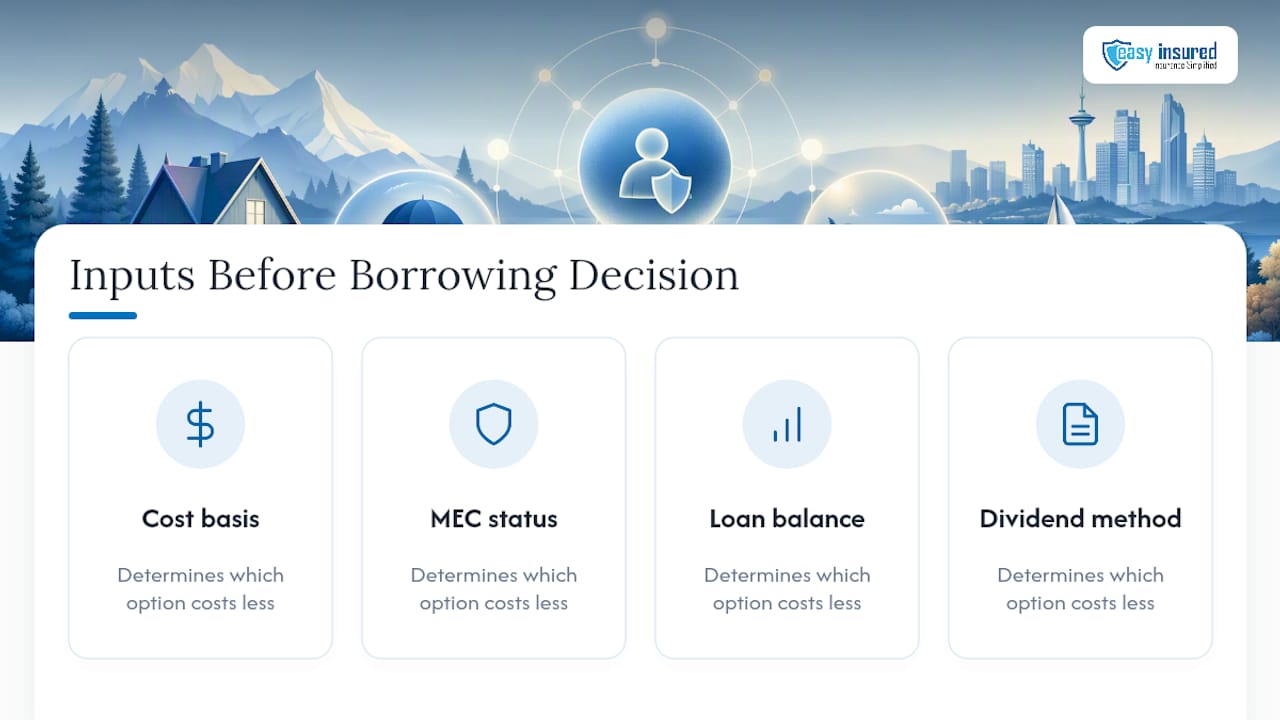
When we review a policy loan against a withdrawal, we start with the same four items every time: cost basis, MEC status, current loan balance, and dividend recognition method. Those four numbers determine almost everything about which option actually costs less.
Bring your most recent annual statement and policy ledger to that conversation. We can help run the lapse projection, confirm your loan limit, and walk through which option matches what you’re trying to accomplish, whether that’s bridging a short-term need or restructuring coverage for retirement.
Get a Policy Review Before You Touch Your Cash Value
If you already understand your policy’s mechanics but need a second set of eyes before pulling money out, that can be a valuable service. A review of your actual cost basis, MEC classification, and current loan limit against your annual statement, followed by a plain decision checklist showing which option costs less for your situation, can be helpful.

A policy review can include a full statement reconciliation, a lapse projection if you carry a loan balance, and a written recommendation you can act on immediately or bring to your accountant. If you’re carrying a whole life policy or a universal life contract and you’re unsure whether a loan or withdrawal fits your next move, request a policy review and get the numbers in front of you before you decide.
An Editorial Take on Why Policyholders Get This Wrong
Most people treat the loan versus withdrawal decision like a coin flip between two similar options, and that’s the real problem. They’re not similar. One is debt against your own collateral. The other is a permanent subtraction from an asset that was compounding quietly in the background, often for decades, without anyone checking on it.
The conventional advice out there tends to oversimplify by treating interest cost as the only variable that matters. It isn’t. The bigger, less visible cost is what a withdrawal does to paid-up additions and long-term compounding, a cost that never shows up as a line item anywhere but absolutely shows up in your policy’s value 20 years later. Advisors who only compare interest rates against zero are missing half the equation.
The other blind spot: people assume MEC status is a rare technicality that doesn’t apply to them, and most of the time they’re right. But the policies where it does apply are usually the large, overfunded ones that clients are proudest of, the ones they built up specifically to have flexible cash value later. Finding out at withdrawal time that your sequencing just flipped to income-first is not a conversation anyone wants to have after the money is already spent.
If there’s one habit worth building, it’s this: treat your annual policy statement the way you’d treat a mortgage statement, not a piece of mail you skim and file away. The loan balance, the interest rate, and the cash value trend line on that document tell you almost everything you need to know before you ever pick up the phone to request money.
— Frank
This article is general information, not a substitute for advice from a qualified financial advisor. Consult a qualified financial professional about your own circumstances before acting on anything here.
Sources
- Policy Loans Against Cash Value: Tax Rules and Risks – LegalClarity
- Borrowing Against Life Insurance: How Policy Loans Work – Investopedia
- Policy Loan vs Withdrawal: Which Should You Use? – Jason Casco