
Decreasing term life insurance is a policy where the death benefit shrinks on a set schedule, usually to track a repayment mortgage or another debt that’s paying down over time. It’s built for one job: making sure a specific balance gets cleared if you die before it’s paid off. It typically costs less than level term coverage, though not every insurer sells it, so shopping around matters.
TL;DR:
- Decreasing term life insurance typically matches the decline of a repayment mortgage, with coverage falling on a set schedule while premiums stay fixed.
- It is most suitable for those paying down amortizing debts like mortgages or car loans, but not for interest-only loans or income replacement needs.
- The policy’s benefit can decline faster than actual mortgage balances if payments are delayed or payments are only minimums, risking coverage gaps.
- Price varies mainly based on age, health, smoking status, and the loan term, with some policies including interest-rate caps that can limit benefit flexibility.
- Review your mortgage’s decline schedule carefully to ensure it aligns with the policy’s benefit reduction before purchase, especially if rates or balances change.
Table of Contents
- How Does Decreasing Term Life Insurance Work?
- Level Term vs Decreasing Term: How Do You Choose?
- What Are the Pros and Cons of Decreasing Term Cover?
- Who Should Actually Buy This Policy?
- What Drives the Price of Decreasing Term Insurance?
- How Do You Buy Decreasing Term Insurance?
- How Easy-insured Helps You Match Coverage to Your Mortgage
- The Real Problem With How This Product Gets Sold
- Get a Quote for Term Life Coverage From Easy-insured
- Sources
How Does Decreasing Term Life Insurance Work?
The payout drops on a schedule set when you buy the policy, usually a fixed percentage each year or month over the life of the term. A policy tied to a mortgage might decline steadily so the coverage roughly matches the loan’s amortization curve, potentially hitting zero around the same time the mortgage does. Glossary definitions from insurance brokers put typical terms anywhere from 5 to 30 years, giving buyers a wide range to match against their own loan length.
The premium, though, doesn’t move. You lock in one rate at the start and pay it for the entire term even as the benefit shrinks, which is part of why this product is priced the way it is: the insurer’s average risk exposure drops every year, so premiums stay fixed while the payout declines.
Here’s a simplified example of how that math plays out:
- You buy a $400,000 policy with a 25-year decreasing term to match a new mortgage.
- By year 10, your mortgage balance has fallen to roughly $260,000, and the policy’s death benefit has declined on a similar curve, sitting close to that figure.
- If you die in year 10, the payout is sized to cover what’s actually left on the loan, not the original $400,000.
- By year 24, both the mortgage balance and the coverage are small, reflecting how little debt remains.
Level Term vs Decreasing Term: How Do You Choose?
The two products solve different problems. Level term keeps the same death benefit for the whole term, which suits income replacement, since your family’s financial needs don’t shrink on a schedule the way a mortgage balance does. Decreasing term is built around a debt curve, which is why it’s the more common choice for mortgage life insurance.
A quick way to sort it out:
- Pick decreasing term if your main goal is making sure a specific, amortizing debt gets wiped out, like a repayment mortgage or a car loan.
- Pick level term if you need the payout to replace lost income, cover ongoing living costs, or fund something that doesn’t shrink over time, like a child’s education.
- Avoid decreasing term for an interest-only mortgage, since the principal isn’t actually falling and a shrinking benefit will leave a gap.
- Consider a hybrid if you have both needs: some insurers let you combine decreasing term with level term, so one piece clears the mortgage and another leaves cash for your family.
If you’re not sure which mortgage type you’re carrying or how that affects the decision, our breakdown of mortgage protection insurance versus life insurance walks through the distinction in more detail.
What Are the Pros and Cons of Decreasing Term Cover?
The appeal is straightforward: it’s cheaper than level term for equivalent starting coverage, the premium never changes, and the declining benefit matches how a repayment mortgage actually behaves. You’re not paying for protection you no longer need in year 20.
The downsides are just as real:
- The payout may fall faster than you’d like if you took extra time off the amortization schedule or made only minimum payments.
- Some policies build in an interest-rate cap or similar limit, meaning the benefit decline is fixed at issue and won’t adjust if your actual mortgage rate or balance moves differently than projected.
- It’s a poor fit if you’ll eventually need the payout for something other than debt, since there’s nothing left toward the end of the term.
Pro Tip: Review your coverage every few years, especially after a refinance or a lump-sum mortgage payment. If your loan balance and your policy’s declining benefit drift apart, a small top-up policy can close the gap cheaply.
Who Should Actually Buy This Policy?
This product fits a narrow but common situation well, and it’s worth being honest about who it isn’t for.
- Good fit: Homeowners with a standard repayment mortgage who want the cheapest way to guarantee the loan gets paid off if they die.
- Good fit: Anyone paying down a specific, amortizing debt, like a business loan with a fixed payoff date.
- Poor fit: Interest-only mortgage holders, since the principal isn’t shrinking and a declining benefit won’t track it.
- Poor fit: Anyone whose main goal is replacing income for a surviving spouse or kids, where a flat benefit serves better.
- Watch for: Policies with no conversion option, since you can’t later switch to permanent coverage if your health changes and your needs shift.
- Watch for: Fine print on interest-rate caps or exclusions that could leave the benefit lagging behind an unusually large mortgage balance.
If any of those red flags show up in a quote, it’s worth reading how convertible term life insurance works before you commit to a policy with no flexibility built in.
What Drives the Price of Decreasing Term Insurance?
Age, health history, smoking status, and the length of the term are the biggest levers on price, the same as with most term products. Riders like critical illness or waiver of premium add cost on top of the base rate.
The core reason decreasing term is usually the more affordable option comes down to math: the insurer’s average payout obligation across the whole term is lower than it would be with a flat benefit, since the coverage amount is falling every year you’re paying premiums.
When comparing quotes, ask each insurer or broker:
- What’s the exact decline schedule, and does it match my mortgage’s amortization curve?
- Is there an interest-rate cap, and how would a rate change affect my actual coverage?
- Can I convert to level term or permanent coverage later without new medical underwriting?
How Do You Buy Decreasing Term Insurance?
Not every insurer offers this product, so working with a broker who can survey multiple carriers saves time if your first quote comes back thin on options.
- Estimate the starting coverage you need, usually your current or expected mortgage balance.
- Match the policy term to your mortgage’s remaining amortization period, not an arbitrary round number.
- Get quotes from several insurers, since decline schedules and pricing vary more than you’d expect.
- Check the decline schedule and any interest-rate caps against your actual loan terms before signing.
- Confirm whether conversion to level or permanent coverage is available later.
Underwriting typically asks for standard documentation: a health questionnaire, sometimes a medical exam depending on age and coverage amount, and basic financial details tied to the mortgage or debt you’re insuring.
How Easy-insured Helps You Match Coverage to Your Mortgage
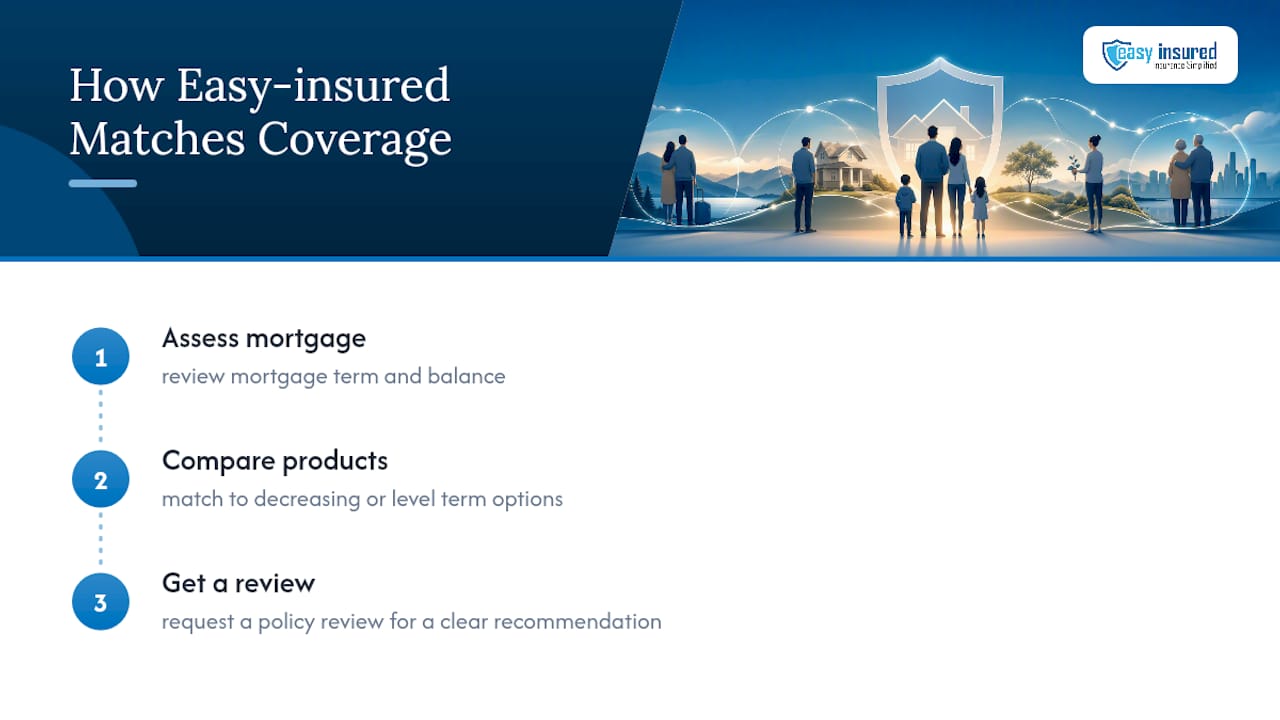
Easy-insured works with term and mortgage protection products across the Canadian market, and we’ve written detailed guides on how these policies fit different borrower situations, including our roundup of mortgage protection insurance options for homeowners. Our advisors typically start by reviewing your mortgage term and balance, then match that against decreasing or level term products from the carriers we work with. If you’re unsure which structure fits, requesting a policy review is the fastest way to get a clear answer.
The Real Problem With How This Product Gets Sold
Most explainers on decreasing term insurance treat it as a simple cost-saving swap for level term, and that undersells the actual decision. The real question isn’t “which is cheaper,” it’s whether your debt and your family’s needs are the same shape. A repayment mortgage shrinks. A grieving family’s need for income doesn’t. Conflating those two curves is where I think most buyers get steered wrong.
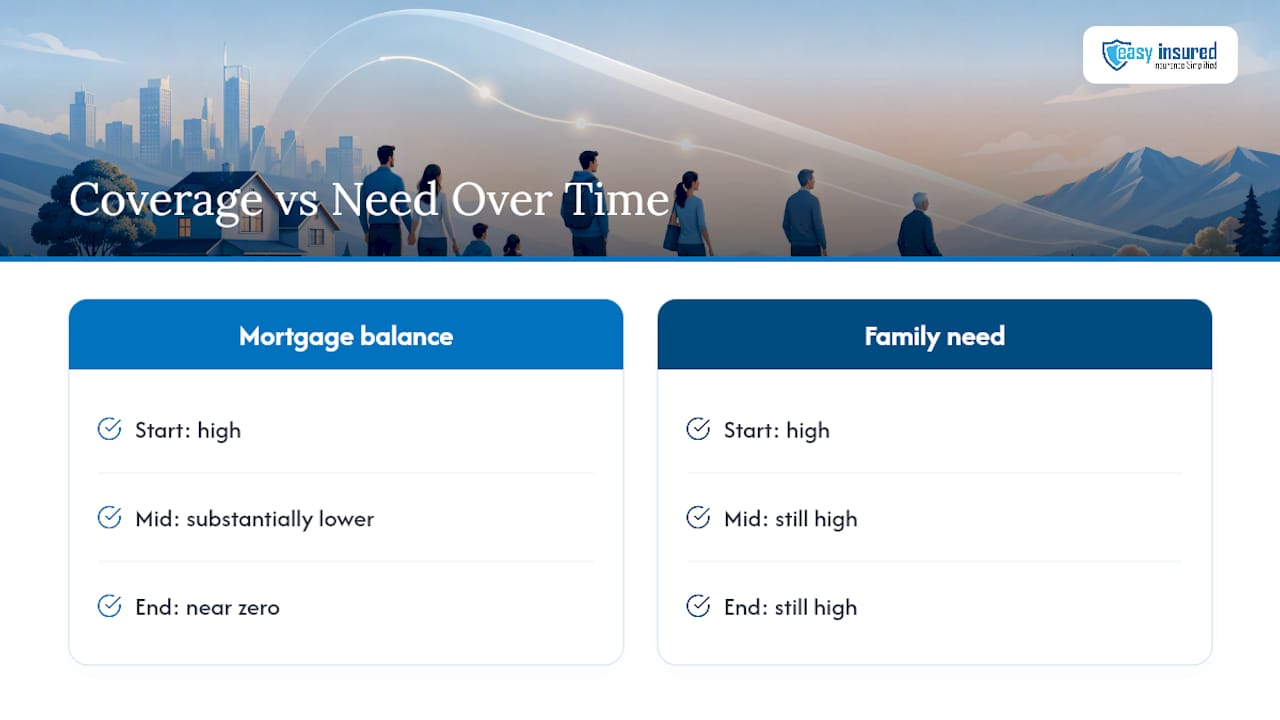
The conventional advice to “buy decreasing term because it’s cheaper” skips over the interest-rate cap problem entirely. If your mortgage rate rises and your balance doesn’t fall as fast as projected, a capped decreasing benefit can leave a real gap right when it matters most. That’s not a hypothetical edge case. It’s the exact scenario where a fixed decline schedule and a variable-rate mortgage stop matching each other.
What I’d prioritize first: read the decline schedule against your actual amortization table before comparing price. A cheaper policy that falls out of sync with your mortgage isn’t a bargain, it’s a shortfall waiting to happen.
— Frank
Get a Quote for Term Life Coverage From Easy-insured
If clearing your mortgage balance is the goal, Easy-insured’s term life products give you a direct path to coverage sized around your actual loan, without the drawn-out process of piecing together quotes from multiple sites yourself. We work with several carriers, so if decreasing term isn’t the right fit once we look at your mortgage type and rate structure, we can walk you through level term or a hybrid approach instead.

Here’s what to do next:
- Request a quote based on your current mortgage balance and remaining term.
- Ask about combining decreasing term with a smaller level term policy if you also want income protection for your family.
- Compare riders like critical illness or waiver of premium before you lock in a rate.
Start with a conversation about your mortgage details, and we’ll help you figure out which structure actually fits.
Sources
- Mortgage Life Insurance | Compare the Market
- What is Decreasing Term Life Insurance? | Progressive
- Level term vs decreasing term life insurance | Aviva
- Decreasing Term Life Insurance | Super Brokers Glossary
This article is general information, not a substitute for advice from a qualified financial advisor. Consult a qualified financial professional about your own circumstances before acting on anything here.