
Universal life insurance is permanent coverage that pairs a lifelong death benefit with a flexible, tax-deferred cash-value account. It suits people who need coverage that never expires and who are willing to actively fund and monitor the policy over decades. The trade-off is real: premiums are adjustable, but that flexibility only works in your favor if someone is watching the numbers. Underfund it, and the policy can lapse just when your family needs it most.
TL;DR:
- The guaranteed minimum interest rate in universal life policies is crucial for protecting against market downturns and should be verified before purchase.
- Regularly requesting an in-force illustration, especially under conservative assumptions, helps monitor the policy’s long-term viability and funding adequacy.
- Loan and withdrawal features can erode cash value and benefits if not carefully managed and monitored annually.
- Indexed and variable universal life policies carry additional complexity and market risks, making disciplined review even more essential.
- Universal life policies are best suited for those with long-term needs, disciplined funding habits, and a willingness to actively review policy performance.
Table of Contents
- What Is Universal Life Insurance, Exactly?
- How Universal Life Works Day to Day
- The Four Types of Universal Life, and What Each One Risks
- Why People Choose Universal Life
- Where Universal Life Falls Short
- Turning Cash Value Into Cash: Loans, Withdrawals, and Surrenders
- Riders Worth Understanding Before You Sign
- Is Universal Life the Right Fit for You?
- Steps to Buying a Policy the Right Way
- How Easy-insured Supports Your Universal Life Decision
- What Actually Matters When You’re Weighing Universal Life
- Get a Universal Life Illustration Built Around Real Numbers
- Sources
What Is Universal Life Insurance, Exactly?
Universal life insurance is permanent coverage built around three moving parts: a death benefit that lasts your whole life, a cash-value account that grows over time, and premiums you can adjust within limits set by the contract. That’s a sharp departure from term life, which pays out only if you die within a fixed window (typically 10 to 30 years) and builds no savings component at all.
Whole life insurance is also permanent, but it locks you into fixed premiums and a guaranteed, conservative growth rate. Universal life trades some of that rigidity for flexibility. You can often increase or decrease your premium payments, and in many contracts adjust the death benefit itself, as your income or financial goals shift.
Here’s how the money actually moves inside the policy:
- Every premium payment gets split between the cost of insurance (the actual mortality charge) and the cash-value account.
- The insurer deducts administrative fees and the cost of insurance before crediting the remainder to your cash value.
- Credited interest rates can fluctuate based on the policy type, but nearly every contract includes a guaranteed minimum rate that acts as a floor.
- Cash value grows tax-deferred, meaning you owe nothing on the gains as long as the money stays inside the policy.
That guaranteed minimum matters more than most buyers realize. It’s the number that protects you when markets or interest rates disappoint, and it’s the figure you should ask about before comparing anything else on a sales illustration.
How Universal Life Works Day to Day
Think of your cash value as a bucket that fills and drains at the same time. Premiums fill it. The cost of insurance and policy fees drain it, and that drain gets bigger every year as you age, because mortality risk climbs with you.
Here’s the sequence that plays out every policy year:
- You pay a premium, which can vary within the policy’s allowed range.
- The insurer subtracts the cost of insurance and administrative charges from your cash value.
- The remaining balance earns interest, credited monthly or annually depending on the contract.
- The insurer sends (or you request) an updated illustration showing projected values under current assumptions.
That fourth step is where most policyholders get blind sided. Illustrations typically show two columns: a guaranteed scenario using the contract’s minimum interest rate, and a non-guaranteed scenario using current, often optimistic, crediting assumptions. Quote recommends asking for a third, more conservative run: what happens if crediting rates sit below current projections all the way to age 90 or 100. If the policy still holds up under that stress test, you have a much better sense of what you’re actually buying.
Loans and withdrawals complicate the picture further. Borrowing against your cash value skips the credit check entirely, but any unpaid loan balance, plus accruing interest, gets subtracted from the death benefit before your beneficiaries see a dime. Withdrawals reduce cash value directly and can trigger taxable income if you pull out more than you’ve paid in premiums.

Pro Tip: Request an in-force illustration every year, not just at purchase. It’s the only way to see whether your policy is tracking toward the guaranteed column or drifting toward a funding shortfall.
The Four Types of Universal Life, and What Each One Risks
Not all universal life policies work the same way underneath the hood. The crediting method is what separates one subtype from another, and it drives both your upside and your exposure.
- Traditional universal life credits a fixed rate set by the insurer, adjusted periodically. It’s the most predictable of the flexible-premium designs, with moderate complexity.
- Guaranteed universal life sacrifices cash-value growth almost entirely in exchange for a rock-solid no-lapse promise, provided you pay the required premium on schedule. It functions as a practical compromise for buyers who want permanent coverage without betting on market or interest-rate performance.
- Indexed universal life ties credited interest to a market index, like the S&P 500, but caps and participation rates limit how much upside you actually capture. That complexity tends to work against buyers who don’t fully understand the caps before signing.
- Variable universal life invests your cash value directly in subaccounts similar to mutual funds, which means real market risk. Your cash value, and potentially your death benefit, can fall if those investments underperform.
Why People Choose Universal Life
The appeal boils down to control. You’re not locked into a single premium for 20 years like a term policy, and you’re not stuck with whole life’s rigid, one-size-fits-all structure.
- Premiums flex up or down within contract limits, letting you pay more in strong income years and less when cash is tight.
- Coverage amounts can often be adjusted as your needs change, without buying a new policy.
- Cash value grows tax-deferred, which makes universal life a tool some families use to supplement retirement income or fund estate-planning strategies alongside RRSPs and TFSAs.
- Living-benefit riders let you access a portion of the death benefit early if you’re diagnosed with a terminal or critical illness.
For a mid-sized policy, monthly premiums often fall somewhere in the $100 to $300 range for smaller face amounts, while larger policies in the $500,000 to $1 million range frequently run several hundred dollars monthly, depending on your age, health, and how aggressively you fund the cash-value side. Those figures shift dramatically based on underwriting, so treat them as a starting point for conversation, not a quote.
Where Universal Life Falls Short
Flexibility cuts both ways. The same feature that lets you skip a premium payment during a lean year is the one that can quietly erode your coverage if nobody’s paying attention.
- Universal life almost always costs more over the policy’s lifetime than term insurance for the same death benefit.
- Early surrender charges can eat into your cash value significantly if you cancel the policy in the first 10 to 15 years.
- The policy demands ongoing monitoring; a few years of underperforming credited interest can force you into much higher premiums to keep the coverage from lapsing.
- Loans and withdrawals reduce cash value immediately and, if left unpaid, can trigger a lapse or shrink the death benefit your family eventually receives.
- Indexed and variable versions carry an added layer of complexity that makes them poor fits for buyers who won’t review statements regularly.
Turning Cash Value Into Cash: Loans, Withdrawals, and Surrenders
You have three main ways to pull value out of a universal life policy while you’re alive, and each carries a different tax and structural consequence.
- Policy loans let you borrow against cash value without underwriting, but interest accrues on the balance, and any amount outstanding at death reduces the payout to your beneficiaries.
- Withdrawals reduce cash value directly. Amounts up to your cost basis (what you’ve paid in premiums) usually come out tax-free, using a first-in-first-out approach, while anything above that basis can be taxable.
- Full surrender cancels the policy and pays you the cash surrender value, minus any surrender charges still in effect, and minus any outstanding loan balance.
Surrendering is permanent; loans and partial withdrawals are not, but both chip away at the safety net the policy was built to provide. No-lapse riders and disciplined funding are the two most reliable ways to prevent a policy from collapsing under its own cost structure.
Riders Worth Understanding Before You Sign
Riders reshape what your base policy guarantees, usually at an added cost.
- No-lapse or premium guarantee riders lock in coverage even if cash value drops to zero, as long as you’ve paid the specified premium on time. They add cost but remove a major source of anxiety.
- Living-benefit riders (also called accelerated death benefit riders) let you claim a portion of the death benefit early if you’re diagnosed with a terminal or critical illness, without needing a separate critical illness policy.
- Guaranteed insurability riders let you increase coverage later at specified intervals without new medical underwriting, useful if your income or family situation is likely to grow.
Is Universal Life the Right Fit for You?
Run through this before you commit to a policy:
- Do you have a genuinely long-term need for coverage, such as estate liquidity, business succession, or lifelong dependent care?
- Are you financially disciplined enough to fund premiums consistently, even in a bad year?
- Will you (or an advisor) actually review annual in-force illustrations rather than filing them away?
- Are you trying to combine permanent protection with tax-deferred accumulation for retirement or estate purposes?
Business owners funding buy-sell agreements, higher-net-worth families managing estate tax exposure, and people who specifically need permanent coverage layered with tax-advantaged growth tend to be the best fits. If you just need coverage for a mortgage term or until kids are grown, term life is simpler and dramatically cheaper. If you want predictable, unchanging premiums with no monitoring burden, whole life is the better match.
Pro Tip: If you’re unsure whether you’ll stay disciplined about funding, choose guaranteed universal life over indexed or variable versions. It removes the performance guesswork entirely.
Steps to Buying a Policy the Right Way
Buying universal life isn’t a one-quote decision. Treat it like a multi-step evaluation.
- Request illustrations from more than one insurer, each showing both guaranteed and conservative non-guaranteed scenarios.
- Ask specifically for the cost-of-insurance schedule, current loan interest rate, surrender charge schedule, and rider pricing, since these vary widely between carriers.
- Compare the premium required to sustain the policy to age 90 or 100 under conservative assumptions, not just the headline illustrated premium.
- Get a second opinion from a fee-based advisor before signing, particularly for indexed or variable structures.
How Easy-insured Supports Your Universal Life Decision
Easy-insured builds universal life illustrations that show guaranteed and stress-tested scenarios side by side, so you’re not relying on a single optimistic projection. Alongside universal life, Easy-insured offers whole life and term life options for comparison. We recommend reviewing your in-force illustration annually, whether you bought your policy with us or elsewhere.
What Actually Matters When You’re Weighing Universal Life
Most of the advice circulating about universal life focuses on the wrong thing: the illustrated cash-value number at year 20. That figure is marketing math built on assumptions that may never hold. What actually predicts whether your family gets a payout in year 30 is the premium required under the guaranteed column, not the flashy non-guaranteed one.
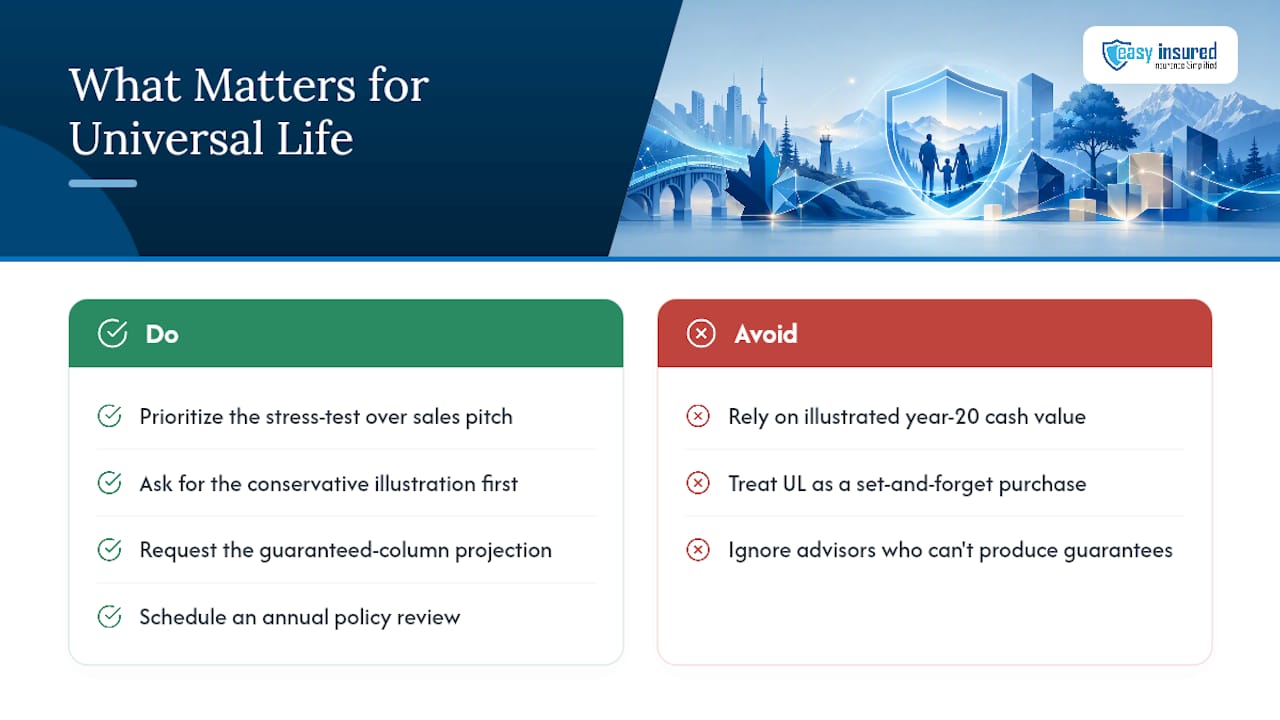
The conventional wisdom treats universal life as a “set it and forget it” purchase, similar to term or whole life. It isn’t. The flexibility that makes universal life attractive is the same flexibility that lets a policy quietly underfund itself for a decade before anyone notices. If I had to name the single biggest failure point in these policies, it’s not the product design. It’s the absence of an annual review.
Prioritize the stress test over the sales pitch. Ask for the conservative illustration before you ask about riders or index caps. And if an advisor can’t produce a guaranteed-column projection on request, that’s worth noticing.
— Frank
Get a Universal Life Illustration Built Around Real Numbers
Universal life insurance works best when the person managing it understands exactly what’s driving the cash-value column, not just the number at the bottom of a glossy projection. Easy-insured’s universal life page walks through coverage options, flexible premium structures, and how cash value is credited, with illustrations that include both guaranteed and stress-tested scenarios side by side.

If you’re comparing universal life against whole life or term coverage, or you want a conservative in-force illustration before renewing an existing policy, that’s the exact review Easy-insured builds for. For buyers weighing whether a fee-based planning session makes sense first, Vala’s financial planning guidance is a useful outside resource on what to expect from that process. Request a quote, book a policy review, and ask specifically to see both the guaranteed and non-guaranteed columns before you sign anything.
This article is general information, not a substitute for advice from a qualified financial advisor. Consult a qualified financial professional about your own circumstances before acting on anything here.
Sources
- What Is Universal Life Insurance? – Forbes Advisor
- What is universal life insurance? – NerdWallet
- What Is Universal Life (UL) Insurance? – Investopedia
- Quote
- What Is Universal Life (UL) Insurance? – Business Insider