
A decline is not the final word. Life insurance after decline is entirely possible for most applicants, and the right next move depends on why you were turned down. Before anything else, do two things in the next 24 to 72 hours:
- Request the insurer’s written underwriting explanation, in detail, not just a form letter.
- Order your medical and prescription records so you know exactly what the underwriter saw.
From there, you have three real paths: appeal the decision if something was wrong, wait and reapply once your health picture improves, or pivot to alternative coverage that doesn’t hinge on the same underwriting rules. According to Experian, reviewing the decline reason and shopping other carriers are the two effective recommended steps after a denial.
Key Takeaways
A life insurance decline is usually a solvable underwriting mismatch, not a permanent barrier, and the fastest path back to coverage starts with the insurer’s written reason.
| Point | Details |
|---|---|
| Get the reason in writing | Request the insurer’s underwriting explanation before doing anything else. |
| Check records for errors | Order medical and prescription records to compare against the cited decline reason. |
| Choose appeal vs. reapply | Appeal if the decline was based on an error; reapply later if it reflects an accurate health picture. |
| Consider alternative routes | No-medical, guaranteed acceptance, group coverage, and final expense plans all offer paths around traditional underwriting. |
| Work with a broker for placement | Easy-insured matches your decline reason to carriers and products, from term to guaranteed acceptance, and manages the paperwork. |
This article is general information, not a substitute for advice from a qualified financial advisor. Consult a qualified financial professional about your own circumstances before acting on anything here.
Table of Contents
- Why Life Insurance Applications Get Declined
- What to Do First: Verify, Appeal, or Correct the Record
- Alternative Coverage Options If You Can’t Get Approved Right Now
- How to Improve Your Odds and Know When to Reapply
- Why an Independent Broker Matters After a Decline
- What Easy-Insured Brings to the Table
- Does a Decline Follow You to Future Applications?
- When Life Insurance Isn’t the Right Tool Right Now
- Why This Approach Actually Works
- Get Help Placing Coverage After a Decline
- Sources
Why Life Insurance Applications Get Declined
Underwriters decline applications for reasons that fall into a handful of predictable buckets, and knowing which one applies to you changes everything about your next move.
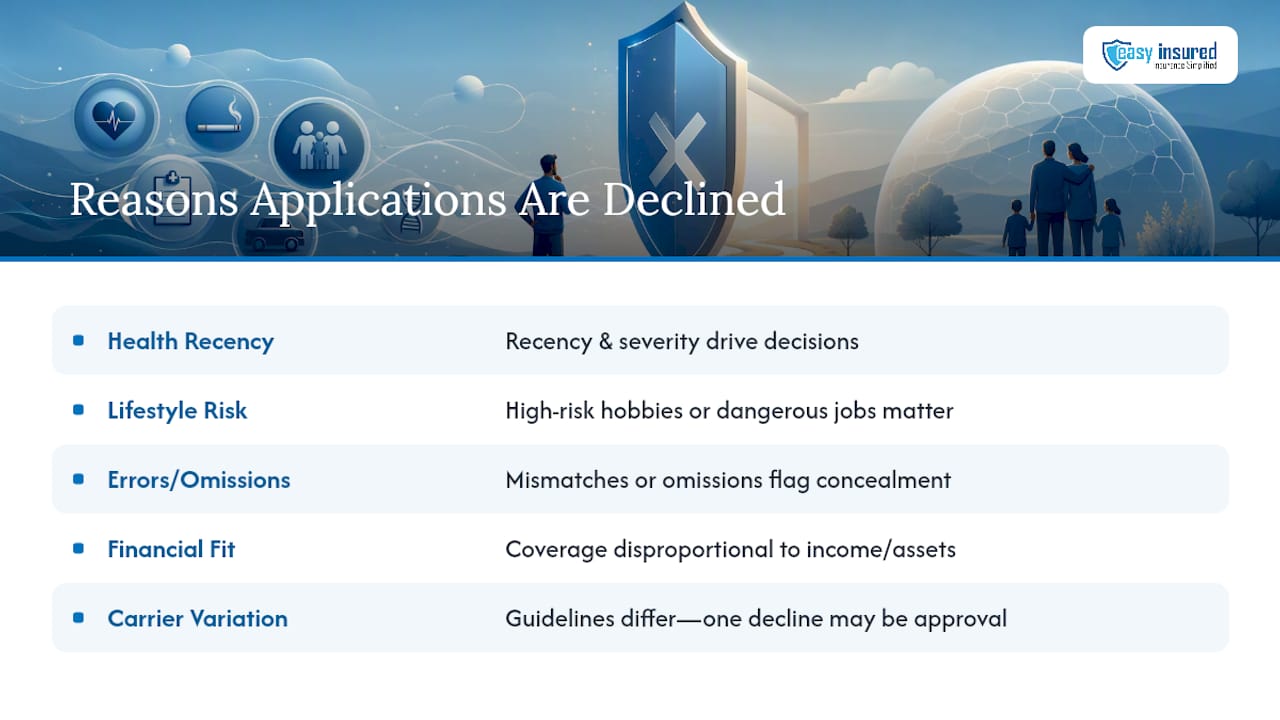
Health and recent diagnoses top the list. A cancer diagnosis three months ago reads very differently to an underwriter than one that’s five years stable. Recency and severity both matter more than the diagnosis name alone.
Lifestyle and occupational risk factors in next: high-risk hobbies like skydiving or scuba diving, jobs with elevated mortality risk (commercial fishing, logging, certain aviation roles), or a history of substance use can all trigger a decline even with otherwise clean health records.
Errors and omissions cause more declines than people realize. A mismatch between what you wrote on the application and what your pharmacy or lab records show gets flagged fast, and even innocent omissions look like concealment to an underwriter.
Financial factors matter too. If the coverage amount you requested seems disproportionate to your income or existing assets, insurers sometimes decline over what’s called an “insurable interest” concern rather than health at all.
Here’s the part most people miss: underwriting guidelines vary by carrier, so one company’s decline is often another’s approval. An insurer that’s conservative on diabetes might be far more flexible than one that’s conservative on cardiac history.
What to Do First: Verify, Appeal, or Correct the Record
Before you touch a new application, work through this sequence. Skipping steps here is how people end up declined twice for the same fixable reason.
- Request the written underwriting explanation. Insurers must tell you why you were declined if you ask. This single document tells you whether you’re dealing with a health issue, a records error, or something else entirely.
- Pull your medical and prescription records. Compare them against what the underwriter cited. Look for outdated information, a misfiled lab result, or a prescription that was discontinued but still shows as active.
- Decide: appeal or reapply. If the decline was based on an error, you can appeal and submit corrected records or a letter from your treating doctor. If it was accurate and reflects a real health picture, reapplying later with fresh evidence usually works better than fighting the original decision.
- Gather supporting evidence. Specialist notes, updated labs, and a doctor’s letter confirming stability or improvement carry real weight with underwriters reviewing an appeal.
- Set expectations on timing. Appeals typically take a few weeks to review, not months, but insurers vary. Reapplication timing depends on your specific situation and is covered in more detail below.
Pro Tip: Call the underwriting department directly instead of relying only on written correspondence. A ten-minute phone conversation often surfaces exactly what documentation would change the outcome, information that rarely appears in the decline letter itself.
Alternative Coverage Options If You Can’t Get Approved Right Now
If a full medical underwriting decline feels like a dead end, it isn’t. Several coverage routes exist specifically for people in your situation, each with real trade-offs.
No-medical and simplified issue policies skip the lab work and physical exam, relying instead on a health questionnaire. These policies typically cap face amounts lower and charge higher rates than fully underwritten term policies, but they can bridge the gap while you work on reapplying for something bigger. Easy-insured’s no-medical coverage explainer walks through how fast approval can happen and what the questionnaire actually asks.

Guaranteed acceptance life insurance is the true last resort. Approval is guaranteed regardless of health history, but premiums run higher and most policies include a two-year waiting period or graded benefit before the full death benefit applies. It’s designed for certainty, not affordability. You can review Easy-insured’s guaranteed acceptance options if this fits your timeline.
Employer or group life coverage deserves a second look if you haven’t already maxed it out. Group plans often skip individual underwriting entirely, though conversion rights and portability limits vary if you leave the job, so read the fine print before relying on it long term.
Smaller, graded-benefit policies and final expense plans can provide meaningful protection at a lower price point while you improve your eligibility for larger coverage. And for some people, self-insuring through savings, or simply accepting a temporary coverage gap, is the honest, pragmatic answer when premiums for any policy outpace the benefit.
How to Improve Your Odds and Know When to Reapply
Timing your reapplication right matters more than rushing it. Insurers generally want to see documented stability, not just time passed.
- Understand the general timeline. Depending on the condition, insurers often want anywhere from a period of documented improvement before reconsidering. A controlled blood pressure issue might only need six months of stable readings; a recent cardiac event could require the full three years.
- Document lifestyle changes concretely. Smoking cessation needs a specific quit date and, ideally, a cotinine test confirming it. Weight loss and improved A1C or blood pressure numbers need lab-backed proof, not a verbal claim.
- Collect the right medical evidence. Stabilized lab work, specialist reports, and a letter confirming treatment compliance can materially change an underwriter’s decision the second time around.
- Know how table ratings work. Many carriers use a rating table for non-standard health profiles, and those ratings can improve as your health data improves, sometimes moving you from a heavily rated policy to standard rates.
- Disclose the prior decline honestly. Every application asks if you’ve been declined before. Lying about it is grounds for the insurer to void the policy later, which defeats the entire point of buying coverage.
Pro Tip: Ask your doctor to write the improvement letter using underwriting language, not general medical language. “Well-controlled on current medication regimen, no complications in 18 months” reads very differently to an underwriter than “patient is doing better.”
Why an Independent Broker Matters After a Decline
Trying to reapply solo after a decline means guessing which carrier will look favorably on your specific situation. Working with an experienced independent broker shortens that trial and error significantly because a good broker already knows which carriers are lenient toward your particular condition.
When you’re interviewing a broker, ask directly:
- Have they placed clients with your specific health condition before, and what was the outcome?
- Which carriers do they consider most flexible for your situation?
- What documentation will they request before submitting anywhere?
- How do they handle the appeal process if the new application also gets flagged?
A broker earns their value by presenting your improvement evidence the way underwriters expect to see it, not just forwarding a stack of records. Easy-insured works this way with clients: reviewing the decline reason first, then matching you to carriers and policy types, term, whole, or guaranteed acceptance, that fit both your health profile and your budget.
What Easy-Insured Brings to the Table
A decline file doesn’t have to sit untouched for a year before someone looks at it again. Easy-insured reviews the underwriting explanation, checks it against your records, and identifies which product category, term, whole life, or guaranteed acceptance, actually matches your situation right now.
- Product mapping across term, whole, guaranteed, and no-medical policies means you’re not guessing which route fits.
- Document collection and submission support during an appeal, so the paperwork lands in front of underwriters correctly the first time.
- Follow-up on appeal status instead of leaving you to call the insurer yourself.
Most declined applicants have more paths back to coverage than the decline letter suggests. The gap is usually knowledge of which carrier fits, not a lack of insurable options.
Frank has spent years analyzing how underwriting decisions play out across different carriers and coverage types, and that pattern shows up constantly: the decline is rarely the end of the story.
Does a Decline Follow You to Future Applications?
A decline from one insurer doesn’t automatically appear on file at every other insurance company the way a credit inquiry does. There’s no shared industry blacklist that flags you the moment you apply elsewhere. What does follow you is the paper trail within your own medical records and prescription history, which any future underwriter can request and review regardless of which company declined you first.
This matters for two reasons. First, it means applying to a different carrier after a decline is a legitimate strategy, not a loophole, since underwriting standards genuinely differ between companies. Second, it means honesty on future applications is non-negotiable. Every standard application asks whether you’ve been declined before, and insurers can and do verify medical history independently of what you disclose.
There’s also a practical timing issue: applying to several carriers in rapid succession without addressing the underlying reason for the first decline can create a pattern that looks worse than one clean decline followed by a documented improvement period. Space out new applications, and only reapply once you have something new to show, whether that’s corrected records, a specialist’s letter, or measurable health improvement. A single well-prepared application beats five rushed ones.
When Life Insurance Isn’t the Right Tool Right Now
Sometimes the honest answer is that traditional life insurance, even the alternative routes, isn’t the best first move for your situation today. If your health condition makes any death benefit policy prohibitively expensive in the near term, other financial protections can fill real gaps while you work toward better underwriting terms.
Final expense insurance is worth considering if your primary concern is covering funeral and burial costs rather than replacing years of income. These policies are typically smaller face amount, easier to qualify for, and specifically designed for exactly this situation. Easy-insured’s final expense coverage is built for applicants who need certainty without the underwriting hurdles of a full life policy.

Critical illness coverage pays out a lump sum on diagnosis of a covered condition, which can help cover treatment costs and income gaps without touching a death benefit at all. If your decline stemmed from a specific diagnosed condition, a critical illness policy sometimes has more forgiving underwriting than life insurance covering the same condition.
Disability insurance matters if your bigger financial risk right now is losing income to illness or injury rather than dying prematurely. It’s a different risk entirely, and often gets overlooked while people focus exclusively on the life insurance decline.
None of these replace life insurance permanently. They’re bridges, ways to protect your family financially while you build the health record needed to qualify for the coverage you originally wanted.
Why This Approach Actually Works
The conventional advice after a life insurance decline is “wait and try again,” which wastes months if the decline was actually caused by a fixable error. The research is consistent on this: reviewing the specific reason first changes everything downstream. An applicant declined for a records mismatch needs a correction and an appeal, not a six-month wait. An applicant declined for an unstable A1C needs documented time and lab work, not an immediate reapplication that will just get declined again.
Where most guidance falls short is treating every decline the same way. It isn’t. The gap between “shop other carriers” and “here’s exactly which type of carrier fits your condition” is where a broker earns their keep, and it’s the piece most self-directed applicants skip entirely.
Prioritize this order: get the written reason, fix what’s fixable, document what’s improving, then decide between appeal, reapply, or alternative coverage. Skipping straight to a new application without that groundwork is the single most common, and most avoidable, mistake declined applicants make.
Get Help Placing Coverage After a Decline
A decline letter doesn’t come with a roadmap, and going carrier by carrier on your own wastes months you don’t need to lose. Easy-insured works directly with clients who’ve been declined, reviewing the underwriting reason, matching your health profile to carriers that are actually flexible on your condition, and handling the paperwork for an appeal or a fresh application.

Whether the right fit turns out to be a fully underwritten term policy, a whole life plan for permanent coverage, or guaranteed acceptance coverage while you rebuild your health record, Easy-insured maps the options instead of leaving you to guess. Request a consultation and bring your decline letter. That one document tells us exactly where to start.
Sources
- What to Do if Your Life Insurance Application Is Denied – Experian
- 3 Alternatives If You’ve Been Rejected for Life Insurance – SmartAsset
- Life insurance with pre-existing conditions – Progressive