
Yes, you can replace a life insurance policy, but the rule that matters more than any other is this: never cancel the old one until the new policy is officially in force. Replacing means trading your current coverage for a new policy, and it comes with real trade-offs, including fresh underwriting, possible surrender charges, a restarted contestability period, and tax exposure if cash value gets handled the wrong way. Handled carelessly, a replacement can leave you temporarily uninsured or hand you a surprise tax bill. Handled correctly, it can lower your premium, add coverage, or fix a policy that no longer fits your life.
Before you sign anything, run through this:
- Do confirm your free-look period on the new policy before making any final decision.
- Do ask for a written replacement declaration from your agent or insurer.
- Do request a 1035 exchange if you’re moving cash value, so the transfer stays insurer-to-insurer.
- Don’t let your existing policy lapse or accept a check made out to you personally.
Key Takeaways
Replacing a life insurance policy is legal and often beneficial, but it demands careful sequencing: keep old coverage active until new coverage is confirmed in force, and route cash value through a 1035 exchange rather than a personal check.
| Point | Details |
|---|---|
| Never cancel early | Keep the existing policy active and paid until the new one is officially in force. |
| Replacement triggers disclosure | Lapse, surrender, or reduced paid-up conversion tied to a new policy all count as replacement. |
| Watch contestability restart | A new policy resets the two-year contestability and suicide clause window. |
| Use a 1035 exchange | Moving cash value insurer-to-insurer avoids an unexpected taxable distribution. |
| Get expert review first | Easy-insured offers policy reviews and 1035 exchange support before you replace anything. |
Official Forms and Regulator Links Worth Checking
- FSRA Life Insurance Replacement Declaration: the standard form documenting a proposed replacement.
- Illinois DOI consumer guidance: plain-language consumer rules for comparison.
Use the FSRA and BC links for forms and legal text; use the Illinois page for consumer-facing background on how replacement rules generally work.
This article is general information, not a substitute for advice from a qualified financial advisor. Consult a qualified financial professional about your own circumstances before acting on anything here.
Table of Contents
- What Legally Counts as “Replacing” Life Insurance?
- Key Rules, Required Forms, and Insurer Obligations
- Common Costs and Pitfalls of Replacing a Policy
- How to Replace a Life Insurance Policy Step by Step
- Alternatives to Replacing a Life Insurance Policy
- Timeline and Costs You Should Expect
- Your Legal Protections During a Replacement
- A Quick Checklist Before You Sign a Replacement
- Get Help Reviewing or Replacing Your Policy
- Sources
What Legally Counts as “Replacing” Life Insurance?
Replacement isn’t limited to canceling one policy and buying another. Regulators define it broadly: any transaction that causes an existing policy to lapse, get surrendered, convert to reduced paid-up status, or get reissued with lower cash value in connection with a new policy being issued counts as a replacement. That’s why every life insurance application asks some version of “Do you intend to replace an existing policy?” The Illinois Department of Insurance spells this out clearly for consumers, listing lapse, surrender, and reduced paid-up conversion as specific replacement triggers.
Practical situations that typically qualify as replacement:
- Letting an old policy lapse within four months of buying a new one.
- Surrendering a whole life policy to fund a new universal life contract.
- Converting a policy to reduced paid-up coverage while applying elsewhere.
Key Rules, Required Forms, and Insurer Obligations
Once a replacement is triggered, both the agent and the insurer take on specific legal duties. The FSRA publishes a standardized Life Insurance Replacement Declaration (often referenced by form number, such as Form 1277 in some provincial frameworks) that documents the intent to replace and discloses material downsides to the policyholder. In British Columbia, the Insurance Contracts (Life Insurance Replacement) Regulation%20AND%20CIVIX_DOCUMENT_ANCESTORS:statreg?6174=) sets out its own procedural requirements for how replacements must be documented and disclosed.
Under model regulations that most jurisdictions follow, a replacing insurer or agent must:
- Deliver a signed notice regarding replacement before the new policy is issued.
- Provide copies of all sales materials used in the transaction.
- Send notice to your existing insurer so it can respond with its own disclosure.
Pro Tip: Ask your agent for the exact form name and number they’re using, and request a dated copy for your own file the same day you sign it. If they can’t produce it, that’s a red flag worth pausing on.
Common Costs and Pitfalls of Replacing a Policy
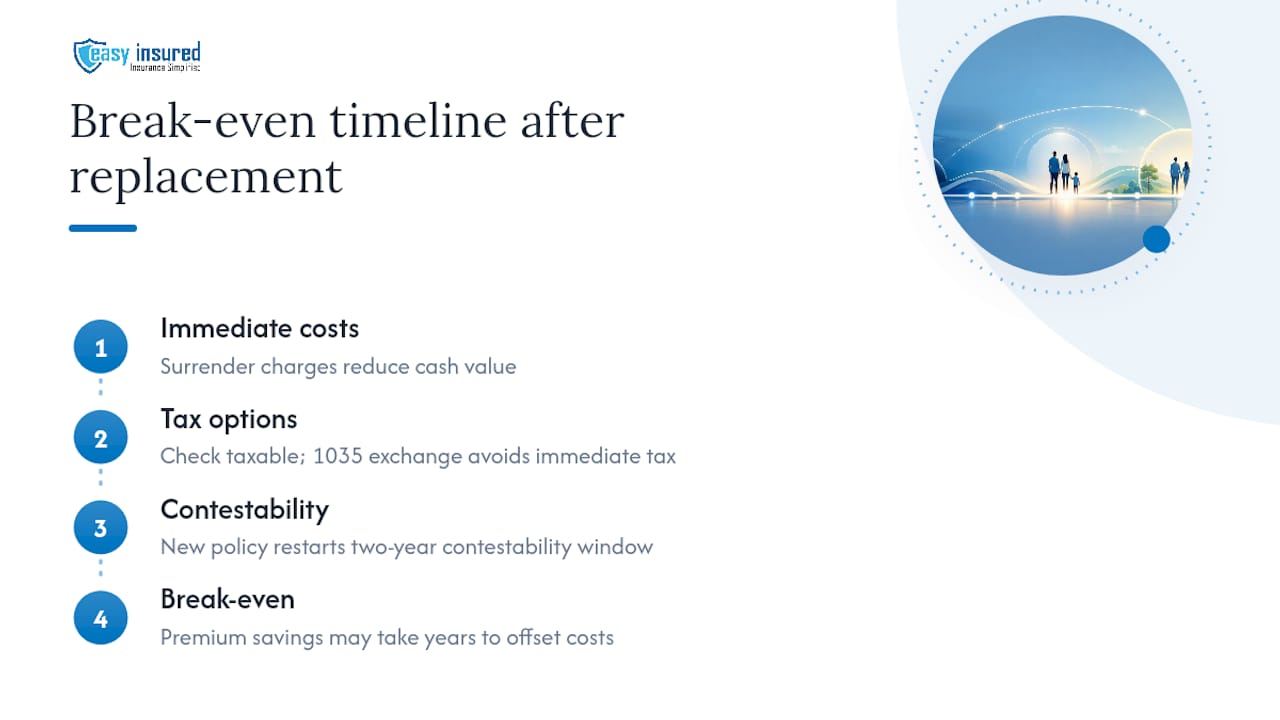
Replacement carries three risks that trip up even careful buyers. First, surrender charges on permanent policies can eat a meaningful chunk of your cash value if you exit within the first 10 to 15 years, sometimes reducing what transfers to the new policy by thousands of dollars. Second, replacing restarts your contestability period and suicide clause, meaning the new insurer gets a fresh two-year window to challenge claims based on application misstatements, a risk LegalClarity notes has fueled regulatory concern over agents “churning” policies for commission.

Third, taxes. Move cash value through a 1035 exchange and the transfer happens insurer-to-insurer with no immediate tax hit. Take a check made out to you instead, and that amount becomes taxable income the moment it lands in your account.
Quick math: if your old policy has surrender charges and the new one saves on premiums, the break-even period can span several years, requiring careful calculation before deciding to switch.
How to Replace a Life Insurance Policy Step by Step
Follow this order to avoid coverage gaps and tax surprises:
- Apply for the new policy first. Never cancel existing coverage before you’ve even applied elsewhere.
- Complete underwriting fully. Wait for written confirmation that the new policy has actually been issued and is in force.
- Request a 1035 exchange if cash value is involved. Confirm in writing that the transfer check will be payable to the new insurer, not to you.
- Sign the replacement declaration. Keep signed copies of every form, along with delivery acknowledgements from both insurers.
- Cancel the old policy only after confirming the new one is active. Not before.
Pro Tip: If your agent seems eager to skip the underwriting wait or suggests you can “cancel now and sort the paperwork later,” involve a tax advisor before you sign anything. That sequencing mistake is the single most common way people end up briefly uninsured.
Alternatives to Replacing a Life Insurance Policy
Full replacement isn’t always the right move. Several options accomplish similar goals while sidestepping a restarted contestability period or fresh underwriting:
- Convert term to permanent if your policy includes a conversion rider. No new medical exam required.
- Add a rider to your existing policy, such as a critical illness or disability rider, instead of replacing the whole contract.
- Request reduced paid-up coverage from your current carrier if premiums have become unaffordable.
- Buy supplemental coverage and keep the original policy intact, particularly if your health has changed since you first applied.
Modifications made within the same insurer generally avoid re-underwriting entirely, which is worth exploring before you assume replacement is your only path.
Timeline and Costs You Should Expect
Term policy replacements typically take two to eight weeks depending on how quickly underwriting moves. A 1035 exchange for permanent policies runs closer to 30 to 90 days once both insurers coordinate the transfer.
Budget for these costs along the way:
- Medical exam fees if the new insurer requires one.
- Surrender charges on the exiting policy, if applicable.
- The new policy’s first premium, due before or at issue.
- Potential tax liability if cash value is mishandled during transfer.
Start the process at least 60 days before you plan to drop your existing coverage. That buffer absorbs underwriting delays without leaving you exposed.
Your Legal Protections During a Replacement
You have real leverage here, and it’s worth using it. Most jurisdictions require a formal notice regarding replacement, and many provide a free-look period typically lasting 10 to 30 days, during which you can return the new policy for a full refund if something feels off.
Under model regulations, agents and replacing insurers are required to:
- Deliver a signed replacement notice and copies of sales materials to you and your existing insurer.
- Undergo training on replacement rules and have their practices monitored for compliance, a requirement Investopedia outlines as part of NAIC model regulation adoption.
- Retain records of every replacement transaction for regulatory review.
If any of this gets skipped, keep every document you do receive and contact your provincial insurance regulator directly.
A Quick Checklist Before You Sign a Replacement
Run through these before committing:
- Has your insurability changed since your original application?
- Have you calculated the break-even point on surrender charges versus premium savings?
- Is the cash value moving via a confirmed 1035 exchange, not a personal check?
- How long is the free-look window on the new policy?
- Does the new policy actually offer better terms, or just a lower price with fewer benefits?
Ask your agent directly: “Will this transfer happen through a 1035 exchange?” and “What surrender fees apply, and when do they end?” A simple rule of thumb: if your break-even point exceeds 24 months and any tax risk remains unresolved, it’s worth reconsidering.
How We Advise Clients Facing a Replacement Decision
Our approach starts with verifying insurability before anything else, because a declined application can leave a client stuck without coverage. We favor direct transfers over check-based moves and push back when an agent’s recommendation looks driven more by commission than by client benefit. One client with a new health diagnosis kept her existing whole life policy rather than risk denial elsewhere. Another, healthy and overpaying, moved to term and cut his premium by nearly half.
Get Help Reviewing or Replacing Your Policy
Deciding whether to replace a policy shouldn’t rest on guesswork about surrender charges or tax rules you’ve never had to navigate before. Easy-insured offers policy reviews, 1035 exchange coordination, and side-by-side quote comparisons, so you’re not left interpreting replacement declarations alone.

If you’re weighing whether to stay put or move to a new contract, our team can walk through your current whole life or term life policy and compare it against current options before you sign anything. We’re a brokerage, which means we earn commissions from the policies we place and also offer fee-based planning for clients who want a broader financial picture. Start with a free quote comparison to see exactly where you stand before making any changes.
Sources
- Life Insurance Replacement Declaration — FSRA
- Regulation under Ontario law (replacement notice and consumer protections)
- Replacing life insurance policies or annuities — Illinois Department of Insurance (consumer guidance)
- Can you transfer life insurance policies to another company? — MoneyGeek
- Life insurance replacement: rules, laws, and regulations — Investopedia