
A properly funded buy-sell agreement — using life and disability insurance as the core, layered with seller financing where needed — is the most reliable way to guarantee liquidity and an orderly ownership transfer when a triggering event hits. Your single next action: get a current business valuation and put a lawyer, CPA, and insurance broker in the same room. That team, working from a real number, is what turns a buy-sell agreement from a legal document into an actual plan.
The industry term for what most people call “buy sell insurance” is buy-sell agreement funding, and the distinction matters. The agreement sets the rules, and the funding makes it executable.
Key Takeaways
A properly funded buy-sell agreement requires life and disability insurance as the core funding mechanism, layered with seller financing where needed, and reviewed every 3–5 years to stay aligned with current business value.
| Point | Details |
|---|---|
| Fund for disability first | Disability is more likely than death during working years; a standalone DBO policy closes the gap life insurance cannot. |
| Match coverage to current valuation | Stale coverage amounts are the most common funding failure; review every 3–5 years or after major ownership changes. |
| Choose structure carefully | Cross-purchase preserves the surviving owner’s cost basis; redemption simplifies administration but carries estate-exposure risk post-Connelly. |
| Layer insurance with seller financing | Insurance provides immediate liquidity; a promissory note covers the balance and preserves company working capital. |
| Easy-insured for implementation | Easy-insured offers term, whole, universal, critical illness, and disability policies matched to buy-sell agreement requirements for Canadian business owners. |
Table of Contents
- What is a buy-sell agreement, and do you need one?
- How to fund buy-sell insurance: your main options
- Which policy type fits your buy-sell funding structure?
- Canadian tax and legal considerations you cannot ignore
- Step-by-step checklist to set up a funded buy-sell in Canada
- What does a funded buy-sell actually cost?
- Layering strategies that make funding more manageable
- The part most business owners get wrong
- Easy-insured supports your buy-sell funding from start to finish
- Sources
What is a buy-sell agreement, and do you need one?
A buy-sell agreement is a legally enforceable contract among business owners that governs how ownership transfers when a triggering event occurs. Without funding, it is a promise with no money behind it.
Common triggering events include:
- Death of an owner
- Disability that prevents an owner from working
- Retirement or voluntary exit
- Divorce, where a spouse could otherwise inherit an ownership stake
- Loss of license or professional certification
- Forced buyout after a shareholder dispute
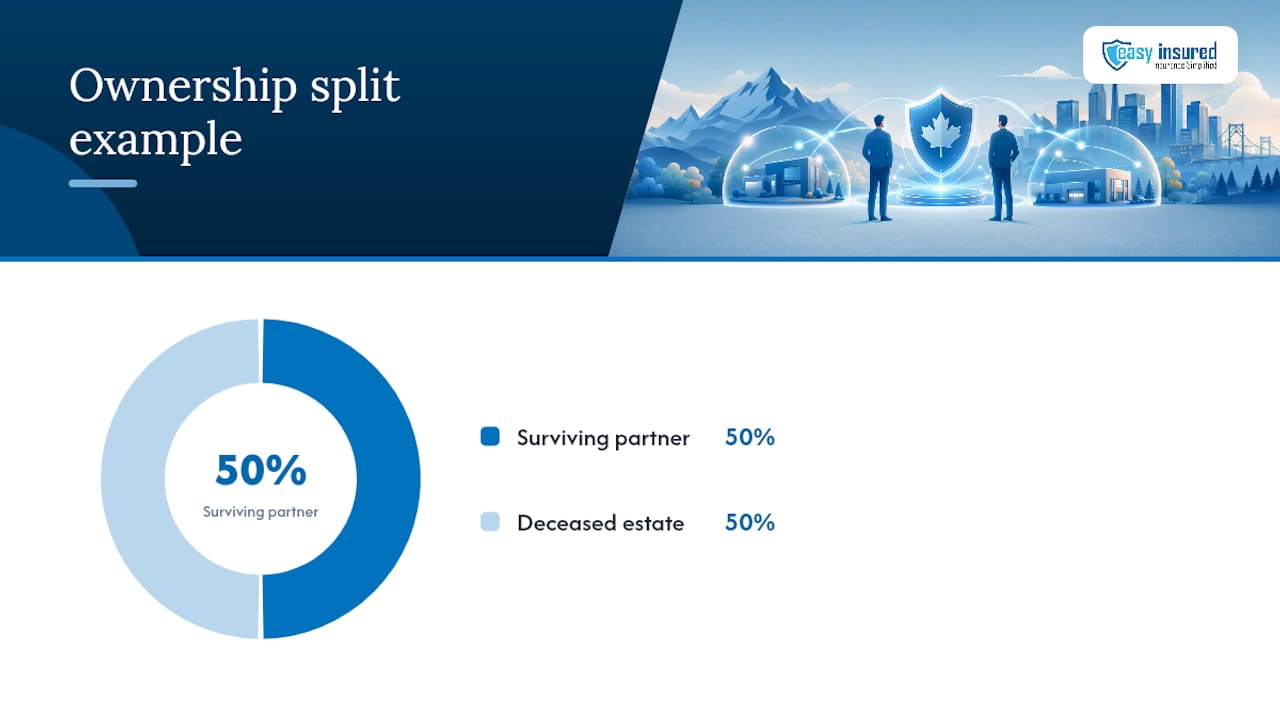
Here is a concrete scenario: two equal partners own a manufacturing business worth $2 million. One partner dies. Without a funded buy-sell, the surviving partner now shares ownership with the deceased’s estate, possibly a spouse with no industry knowledge and every incentive to sell to the highest bidder. With a funded agreement, the surviving partner receives life insurance proceeds equal to their share and uses them to buy out the estate at the pre-agreed price. The business continues without disruption.
The agreement alone does not solve the transfer risk. Funding is what makes it enforceable in practice.
How to fund buy-sell insurance: your main options
Cross-purchase and entity/redemption structures each carry different tax and administrative implications. The table below compares the main funding approaches on the dimensions that matter most for Canadian business owners.
| Funding Method | Who Holds the Policy/Instrument | When It Pays | Key Pros | Key Cons |
|---|---|---|---|---|
| Cross-purchase (life insurance) | Each owner holds a policy on the other(s) | On death or trigger | Clean tax treatment; surviving owner gets stepped-up cost basis | Policy count multiplies with more owners |
| Entity/redemption (corporate-owned life) | Company holds and is beneficiary | On death or trigger | Simpler administration; one policy per owner | Post-Connelly estate-tax exposure risk; proceeds may inflate estate value |
| Insurance partnership/trust | Trust or partnership holds policies | On death or trigger | Manages multi-owner complexity; estate-tax buffer | Requires legal setup; ongoing administration |
| Disability buy-out (DBO) insurance | Owner or company, depending on structure | After elimination period on disability | Covers the most statistically likely working-years trigger | Longer waiting periods; separate product from life coverage |
| Company reserves / sinking fund | Company retains cash | Immediately available | No insurance cost | Ties up capital; may not keep pace with valuation growth |
| Seller financing / promissory note | Selling owner holds the note | Installments over time | Preserves company cash flow | Buyer default risk; estate timing mismatch |
| Bank loan | Lender | At closing | Immediate liquidity | Debt service burden; approval not guaranteed |
Life insurance leads for death-triggered events because the payout is immediate and tax-free to the beneficiary in most Canadian structures. Disability, however, is statistically more likely to occur during working years than death, and a standard life policy does nothing for a living but incapacitated owner. That gap requires a separate disability buy-out policy. The June 2024 Connelly v. United States decision is a U.S. ruling, but Canadian advisors are watching it closely because it illustrates how corporate-owned life insurance proceeds can inflate the deceased owner’s estate value in a redemption structure, a risk that exists in analogous Canadian estate-valuation scenarios.

Which policy type fits your buy-sell funding structure?
The right policy depends on whether your ownership horizon is fixed or open-ended, and on how your agreement is structured.
Sizing your coverage starts with the valuation method your agreement uses:
- Fixed price: Set coverage equal to the agreed price, and update it every time the agreement is reviewed.
- Formula-based: Model the formula at current financials and insure to that number, with a buffer for growth.
- Independent appraisal: Match coverage to the most recent appraisal and schedule reviews every 3–5 years or after any major ownership or financial change.
Pro Tip: Add riders where they genuinely close a gap. An accelerated death benefit rider lets a terminally ill owner access proceeds early. A waiver-of-premium rider keeps the policy in force if the insured owner becomes disabled. A disability buy-out rider on a life policy is not a substitute for a standalone DBO policy, but it can bridge a short gap.
Term life is the most common starting point for buy-sell funding with a defined time horizon because it delivers the highest death benefit per premium dollar. Whole life and universal life make more sense when the ownership horizon is indefinite or when the policy needs to double as an estate-planning vehicle.
Canadian tax and legal considerations you cannot ignore
Canada does not have a U.S.-style federal estate tax, but that does not mean ownership transfers are tax-neutral. A few realities every Canadian business owner needs to understand:
- Deemed disposition on death: When an owner dies, the CRA treats the shares as sold at fair market value. The resulting capital gain flows through the estate, and the estate needs liquidity to pay the tax, often before the buy-sell proceeds arrive.
- Cross-purchase vs. redemption tax treatment: In a cross-purchase, the surviving owner’s adjusted cost base (ACB) in the shares increases, which reduces future capital gains. In a redemption structure, the company buys back shares, which can trigger a deemed dividend rather than a capital gain, a less favorable outcome in many cases.
- Insurance ownership and beneficiary designation: Who owns the policy and who receives the proceeds directly affects whether the payout flows through the estate (and attracts probate and creditor claims) or passes outside it. This coordination is one of the most common planning errors.
- Estate settlement timing: Even when payments are structured over years, the CRA’s deemed-disposition tax is due on the deceased’s final return, typically within six months of death. The estate needs cash at that point regardless of the installment schedule.
Post-Connelly, many advisors are re-evaluating entity-owned policies and considering cross-purchase arrangements or insurance held in a partnership structure to manage estate-exposure risk. Consult a Canadian tax lawyer and CPA before choosing your structure, not after.
The advisors to involve, and what to ask each one:
- Business lawyer: Is the agreement enforceable? Does it cover all triggering events? Is the valuation method legally sound?
- CPA or tax advisor: What are the tax consequences of each structure at death, disability, and voluntary exit? How does the deemed-disposition interact with the insurance payout timing?
- Insurance broker: Which policy type and ownership structure best matches the agreement’s mechanics? What riders close the living-trigger gap?
Review any pre-existing buy-sell agreement after a major tax change, ownership change, or significant shift in business value.
Step-by-step checklist to set up a funded buy-sell in Canada
- Confirm owners and ownership percentages (1–2 days): Verify the current cap table and any shareholder agreements already in place.
- Get a current business valuation and choose a valuation method (2–6 weeks): Engage a Chartered Business Valuator (CBV) for a formal appraisal, or agree on a formula with your CPA. This number sets your coverage target.
- Draft the buy-sell agreement with your lawyer (2–6 weeks, often concurrent with valuation): Define all triggering events, the chosen valuation method, and the funding mechanism.
- Choose your funding method and policy ownership structure (1–2 weeks): Cross-purchase, redemption, or trust/partnership, based on your tax and administrative analysis.
- Apply for and obtain the required insurance policies (4–12 weeks): Medical underwriting is typically the longest single step. Expect insurer review, possible medical exams, and back-and-forth on rated or declined applicants.
- Test the funding math (1–2 weeks): Confirm that the insurance proceeds, net of any tax obligations, actually cover the buyout at the agreed price and timing.
- Schedule periodic reviews (ongoing): Every 3–5 years, or immediately after any major ownership change, acquisition, or significant valuation shift.
Total typical timeline: 3–6 months from kickoff to signed agreement and issued policies, assuming no underwriting complications.
What does a funded buy-sell actually cost?
The largest single variable is insurance premiums, and those are driven by the age and health of the insured owners, the face amount required, and whether you choose term or permanent coverage. A 45-year-old in good health will pay materially less per dollar of coverage than a 58-year-old with a health history.
Beyond premiums, budget for:
- Legal fees for drafting the agreement (complexity and jurisdiction drive this)
- Valuation fees for a CBV appraisal
- CPA time for tax modeling and ongoing review
- Annual policy reviews and agreement updates
Underwriting is almost always the longest single item on the timeline. Insurers may require a full medical exam, attending physician statements, and financial justification for large face amounts. Starting the insurance application before the legal drafting is finished is a common and sensible approach, since the two processes can run in parallel.
One practical tradeoff worth modeling: a higher insurance face amount costs more in premiums but reduces the seller-carryback balance and the associated default risk. Running both scenarios side-by-side with your broker and CPA usually reveals the right balance quickly.
Layering strategies that make funding more manageable
Pure insurance funding works cleanly for smaller buyouts, but for larger businesses, layering insurance proceeds with a structured promissory note is the most common practical approach. The insurance provides an immediate down payment; the seller carryback covers the balance over an agreed term.
Common layering approaches:
- Insurance as down payment + seller note: The estate receives the death benefit immediately and the remaining balance as installments. Preserves company working capital while giving the estate near-term liquidity.
- Disability buy-out insurance + installment payments: DBO policies typically have elimination periods of 12–24 months and can be structured to match the buy-sell payment schedule, reducing the cash shock on the company.
- Sinking fund + insurance: The company accumulates reserves over time to supplement a smaller insurance face amount, useful when premiums for full coverage are prohibitive.
The risk in installment-based structures is timing: the CRA’s deemed-disposition tax on the deceased’s estate is due well before the installments complete. Critical illness and disability insurance fill the living-trigger gap that life insurance alone cannot address.
For businesses with three or more owners, the policy-count problem in cross-purchase structures (each owner needs a policy on every other owner) often makes a trust or partnership structure more practical than individual cross-purchase policies.
The part most business owners get wrong
Most buy-sell agreements fail not because the legal drafting is poor, but because the funding is either absent or stale. A business valued at $1.5 million five years ago may be worth $3 million today, and an insurance policy sized to the old number leaves a $1.5 million gap the surviving owner has to fund from somewhere.
The second most common failure is ignoring disability. Death is the trigger everyone plans for; disability is the one that actually happens more often during working years. A buy-sell that only addresses death leaves the business in limbo if an owner becomes incapacitated for two years, which is exactly when the business needs clarity most.
My recommendation: fund for disability first, because the probability is higher and the business disruption from a living but incapacitated owner is often worse than a clean death-triggered transfer. Then layer life insurance on top. Review both every three years, not five, if your business is growing fast.
Easy-insured supports your buy-sell funding from start to finish
Getting the right policies in place is where most business owners stall, not because the concept is complicated, but because matching the right product to the agreement’s mechanics takes someone who knows both sides. Easy-insured works with Canadian business owners to structure term life, whole life, universal life, critical illness, and disability coverage to the specific requirements of a buy-sell agreement, coordinating with your lawyer and CPA so the policy ownership, beneficiary designations, and coverage amounts actually match the agreement you signed.

The practical next step is straightforward: get a current valuation, then get a quote from Easy-insured to see what the insurance component will cost. All consultations are handled confidentially, and Easy-insured works alongside your existing legal and tax counsel rather than replacing them. Start there, and the rest of the implementation follows a clear sequence.
Sources
- Why your business needs a buy-sell agreement, and how to make one | J.P. Morgan Private Bank U.S.
- How businesses can fund a buy-sell agreement | Hoberman & Lesser
- Buy-Sell Agreement: Definition, Types, and Key Considerations | Investopedia
- Funding business ownership transitions with life insurance | Legacy Funding Insurance
This article provides general information for educational purposes and does not constitute legal, tax, or financial advice. Consult a qualified Canadian lawyer, CPA, and licensed insurance advisor for guidance specific to your situation and jurisdiction.