
An estate freeze lets a Canadian business owner lock in today’s company value for tax purposes while shifting all future growth to heirs or a family trust. If your business is growing and you want to control when and how that growth gets taxed, an estate freeze is worth understanding now, not at retirement.
Three things to do before your next advisor meeting:
- Commission an independent business valuation.
- Book a joint meeting with your corporate lawyer and tax accountant.
- Ask an insurance advisor how life insurance can cover the tax bill your estate will eventually face.
The core logic of a freeze: You exchange your common shares for fixed-value preferred shares equal to today’s fair market value. New common shares, worth almost nothing today, go to your children or a family trust. Every dollar the business earns above today’s value belongs to them, not your estate.
The freeze does not eliminate tax. It defers and controls it. That distinction matters for every planning decision that follows.
Key Takeaways
An estate freeze in Canada defers tax on future business growth by locking in today’s value as fixed preferred shares while shifting appreciation to heirs or a family trust.
| Point | Details |
|---|---|
| Freeze mechanics | Share exchange under s.85 or s.86 creates fixed preferred shares; new common shares capture all future growth. |
| Section 85 vs. Section 86 | Section 85 requires a T2057 election and allows LCGE crystallization; Section 86 is automatic with no election required. |
| 21-year trust rule | Family trusts face a deemed disposition every 21 years under s.104(4); plan the rollout to beneficiaries well in advance. |
| Valuation discipline | Mispricing preferred shares is the top execution risk; an independent CBV report and a price-adjustment clause are non-negotiable safeguards. |
| Easy-insured | Whole life, universal life, and term policies from Easy-insured can fund the preferred-share tax liability at death, completing the freeze plan. |
Table of Contents
- What an estate freeze in Canada actually involves
- How a corporate estate freeze actually works, step by step
- The real benefits and the trade-offs you need to understand
- When to implement and what it will cost you
- Your pre-meeting checklist before you call an advisor
- A worked example: freezing $2 million in business value
- Section 85 vs. Section 86: the tax mechanics that matter
- Common mistakes that derail estate freezes
- An advisor’s perspective on freezes vs. other exit strategies
- How Easy-insured helps you fund the tax bill a freeze creates
- Sources
What an estate freeze in Canada actually involves
An estate freeze is a corporate reorganization, not a single document or a CRA filing. The owner trades growth-oriented common shares for fixed-value preferred shares (sometimes called “freeze shares”). New common shares, issued at a nominal value, are then subscribed by the next generation or by a family trust on their behalf.
Key share types and structures:
- Freeze (preferred) shares: Fixed redemption value equal to today’s fair market value; carry voting rights so the owner keeps control; no participation in future growth.
- Growth (common) shares: Issued at nominal value; capture all appreciation above the freeze price; held by heirs or a family trust.
- Family trust: A discretionary trust that holds growth shares on behalf of multiple beneficiaries, giving flexibility to allocate income and capital gains among family members.
- Wasting freeze: A variation where the owner gradually redeems preferred shares over time, drawing cash from the company while reducing the estate’s value.
Internal vs. external freeze:
An internal freeze reorganizes shares within the existing corporation. An external freeze transfers assets to a new holding company, which then issues preferred shares back to the owner. External freezes add a layer of creditor protection and can simplify future ownership transitions, but they cost more to set up.
Who should consider a freeze:
- Owner-managers whose business has meaningful value today and strong growth prospects ahead.
- Owners approaching retirement who want to cap their personal tax exposure on death.
- Families with identified successors ready to hold growth shares.
- Owners who want to retain voting control while transferring economic upside.
Pro Tip: Time the freeze before a major growth event like a new contract, product launch, or real estate appreciation. Once value is created, it is already in your estate. The freeze only captures value that has not yet materialized.
How a corporate estate freeze actually works, step by step
The mechanics follow a predictable sequence, though the exact steps vary by province and corporate structure.
- Commission an independent business valuation. A Chartered Business Valuator (CBV) determines the fair market value of your shares. This number sets the redemption value of your preferred shares. Get it wrong, and CRA can challenge the entire structure.
- Amend the corporate articles. New share classes must be created: typically a class of fixed-value voting preferred shares and a new class of common shares. This requires filing articles of amendment with the relevant provincial or federal corporate registry.
- Pass directors’ and shareholders’ resolutions. The board approves the reorganization; shareholders approve the share exchange. These resolutions must be contemporaneous and properly documented in the corporate minute book.
- Execute the share exchange. The owner surrenders existing common shares and receives preferred shares with a redemption value equal to the business’s fair market value. Under Section 86 of the Income Tax Act, this exchange is tax-deferred automatically, with no T2057 election required.
- Issue new common shares. Children, a family trust, or both subscribe for new common shares at a nominal price (often $1 total). All future growth accrues to these shares.
- Set up the family trust (if used). A trust deed is drafted, trustees are appointed, and the trust subscribes for growth shares. The trust must have a settlor, at least one trustee who is not a beneficiary, and named beneficiaries.
- Update wills and shareholder agreements. The freeze changes the ownership structure; existing wills and any buy-sell agreements must reflect the new share classes and intended succession.
Professionals you need on the team:
- Corporate lawyer (articles of amendment, resolutions, trust deed)
- Tax accountant or tax lawyer (election strategy, attribution analysis, LCGE planning)
- Independent Chartered Business Valuator (defensible FMV report)
- Corporate secretary or trustee (ongoing minute book and trust administration)
- Insurance advisor (liquidity planning for the tax bill at death)
Documents that must be in place before closing:
- Signed valuation report from a CBV
- Articles of amendment (filed and returned by the registry)
- Directors’ and shareholders’ resolutions
- Share certificates for preferred and new common shares
- Trust deed and trustee consent (if a family trust is used)
- Updated shareholder agreement
The real benefits and the trade-offs you need to understand
A freeze offers genuine advantages, but it is not a free lunch. Here is an honest look at both sides.
| Factor | Benefit | Trade-off or Risk |
|---|---|---|
| Tax deferral | Locks in today’s taxable base; future growth taxed in heirs’ hands | No immediate tax savings; defers, not eliminates |
| LCGE multiplication | Trust beneficiaries may each claim the Lifetime Capital Gains Exemption on a future sale | LCGE rules are complex; not guaranteed for all structures |
| Control retention | Voting preferred shares let the owner keep full control | Preferred shares have no growth participation |
| Probate reduction | Preferred shares with lower value at death reduce probate fees | Depends on province and structure |
| Succession clarity | Growth shares in a trust give flexibility to allocate among children | Trust administration adds ongoing cost and complexity |
| Liquidity | Wasting freeze allows gradual redemption of preferred shares | No immediate cash; owner must plan for tax bill at death |
| Attribution risk | Properly structured, income flows to beneficiaries | s.74.4 attribution rules can redirect income back to the owner |
| 21-year trust rule | Trust can hold shares for decades | Deemed disposition every 21 years requires active management |
As Norton Rose Fulbright notes, a freeze must be tailored to personal and family circumstances to avoid unintended consequences. A structure that works perfectly for one family can create a tax trap for another.
The LCGE angle deserves a closer look. Under CRA’s capital gains deduction guidance, each individual beneficiary of a family trust may be able to claim the Lifetime Capital Gains Exemption on their share of a qualifying small business corporation sale. A family of four could potentially shelter four times the individual LCGE limit. That is the most powerful tax multiplier a freeze can deliver, and it is the reason many advisors recommend trusts even when the children are young.
One risk owners underestimate: the freeze does nothing for liquidity. When the owner dies, the preferred shares are deemed disposed of at their redemption value, triggering a tax bill. Without a plan to fund that bill, the estate may be forced to redeem shares from the company at the worst possible time. Life insurance is the standard solution, and it is worth pricing early.

When to implement and what it will cost you
Timing factors:
- Business maturity: A freeze works best when the company has established value but meaningful growth still ahead. Too early and the freeze locks in a low base with little tax benefit. Too late and most of the value is already in the estate.
- Owner’s retirement horizon: A 10–15 year window before retirement is a common planning sweet spot. It gives growth shares time to accumulate value in the trust before any sale or transition.
- Identified successors: A freeze without a clear plan for who holds the growth shares creates governance problems. Have at least a provisional answer before proceeding.
- Expected liquidity events: If a sale is imminent, a freeze may not be worth the cost and complexity. A freeze suits owners who intend to hold and grow, not those about to exit.
Typical timeline:
Most freezes take 6–12 weeks from the initial advisor meeting to completed documentation, assuming the valuation is straightforward and no major corporate restructuring is needed. Complex situations, such as multiple share classes, existing shareholders, or an external freeze involving a new holding company, can stretch to 4–6 months.
Cost drivers:
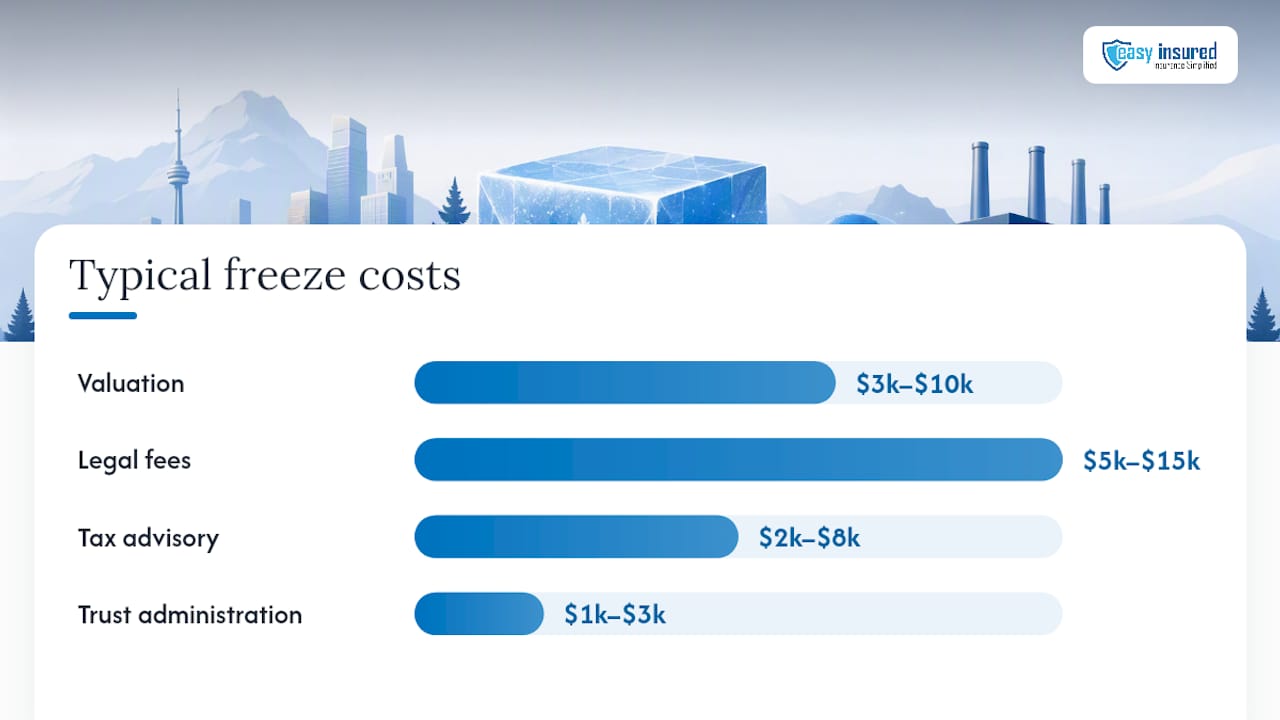
- Independent business valuation: typically $3,000–$10,000 for a small to mid-size private company, more for complex structures.
- Legal fees (articles of amendment, resolutions, trust deed): typically $5,000–$15,000.
- Tax advisory and election planning: $2,000–$8,000 depending on complexity.
- Ongoing trust administration: $1,000–$3,000 per year.
These are ballpark figures. Actual costs depend on the complexity of the corporate structure, the province, and the advisors engaged.
Practitioners commonly recommend planning freezes in quieter months, with July often cited as an ideal window. Advisor bandwidth is higher, CRA processing queues are lighter, and there is no year-end deadline pressure compressing the timeline.
Your pre-meeting checklist before you call an advisor
Getting organized before the first advisor meeting saves time and money. Here is what to gather and decide.
Documents to collect:
- Last three years of corporate financial statements (reviewed or audited preferred).
- Current capitalization table showing all share classes and holders.
- Existing shareholder agreements and any buy-sell provisions.
- Corporate minute book (including all prior resolutions and share issuances).
- Personal and corporate wills (or confirmation that none exist).
- Any prior valuation reports or purchase offers for the business.
People to contact:
- Independent Chartered Business Valuator: Start here. The valuation anchors every other number in the freeze.
- Corporate lawyer: Handles articles of amendment, resolutions, and trust deed.
- Tax accountant or tax lawyer: Advises on Section 85 vs. Section 86, T2057 election, LCGE planning, and attribution risk.
- Trustee or trust advisor: If a family trust is part of the plan, a professional trustee adds independence and reduces attribution risk.
- Insurance advisor: Prices the life insurance needed to cover the preferred-share tax liability at death.
Decisions to prepare before the meeting:
- Who will hold the growth shares: children directly, a family trust, or both?
- What level of control do you want to retain after the freeze?
- What is your target timeline for a liquidity event or business transition?
- Are you open to a wasting freeze (gradual preferred-share redemptions) to draw cash from the company over time?
Pro Tip: Bring a one-page summary of your succession goals to the first meeting. Advisors can structure a freeze in many ways; knowing whether your priority is tax deferral, income splitting, or succession clarity cuts the planning time significantly.
A worked example: freezing $2 million in business value
Assumptions:
- Company fair market value (FMV): $2 million
- Owner’s adjusted cost base (ACB) of existing common shares: $100,000
- Owner age: 55; planning horizon to retirement: 12 years
- Projected company value at retirement: a higher value than today
- Family trust established; two adult children as beneficiaries
- LCGE limit per individual is subject to indexing and may vary over time.
The freeze, step by step:
What the freeze accomplishes:
Without the freeze, the owner’s estate faces a deemed disposition on $5,000,000 of common shares at death, a capital gain of roughly $4,900,000. With the freeze, the owner’s estate is taxed on $1,900,000 (the gain on preferred shares). The remaining $3,000,000 of growth is in the trust, where it can be allocated among two beneficiaries, each potentially claiming the LCGE on a qualifying sale.
If both children qualify for the LCGE, up to $2,500,000 of that $3,000,000 gain could be sheltered. The tax saving on that sheltered amount, at a combined federal-provincial capital gains rate, is substantial.
The lesson from this example: The freeze does not eliminate the $1,900,000 gain on the owner’s preferred shares. It isolates it, makes it predictable, and separates it from the growth that heirs will eventually realize. That separation is what makes planning, and life insurance to cover the tax bill, possible.
This example is for illustration only. Actual tax outcomes depend on your specific corporate structure, province of residence, LCGE eligibility, and current tax rates. Consult a qualified tax advisor before implementing any freeze.
Section 85 vs. Section 86: the tax mechanics that matter
This is where most basic explainers stop short. Understanding the statutory difference between these two provisions determines which route your advisor recommends and what paperwork follows.
Section 86: the standard freeze route
Section 86 of the Income Tax Act provides an automatic tax-deferred share-for-share exchange within the same corporation. The owner exchanges existing shares for a new class of preferred shares. No T2057 election is required. The mechanics require amending corporate articles and passing the necessary resolutions, but the tax deferral is automatic as long as the conditions are met.
Section 86 is the workhorse of most internal freezes. It is simpler, faster, and does not require a joint election with CRA. The trade-off: less flexibility. You cannot use Section 86 to crystallize the LCGE or to do a partial freeze of only some shares.
Section 85: the rollover with more levers
Section 85 allows a taxpayer to transfer property to a corporation on a rollover basis at an elected amount, which can be set anywhere between the ACB and the FMV of the property. This flexibility is what makes Section 85 useful for LCGE crystallization: by electing at a value that triggers a capital gain equal to the available LCGE, the owner shelters that gain tax-free. Section 85 requires filing Form T2057 (a joint election signed by both the transferor and the corporation) with CRA.
A common structuring sequence: use Section 85 first to crystallize the LCGE on the existing shares, then use Section 86 to complete the broader freeze. This gives the owner LCGE certainty and efficient value capping in one coordinated transaction.
| Feature | Section 85 | Section 86 |
|---|---|---|
| T2057 election required | Yes | No |
| LCGE crystallization | Yes (by electing at appropriate amount) | No |
| Partial freeze possible | Yes | No |
| Automatic deferral | No (requires election) | Yes |
| Typical use | LCGE planning, external freezes | Standard internal freeze |
Attribution rules: Section 74.4
If preferred shares are issued to a spouse or a trust in which the owner has an interest, Section 74.4(2) of the Income Tax Act can attribute corporate income back to the owner. The rule targets income-splitting arrangements where the owner retains an indirect benefit. The standard safeguard is structuring the preferred shares to carry a prescribed-rate dividend (currently set by CRA quarterly), which satisfies the attribution exception.
The 21-year deemed disposition rule: Section 104(4)
Family trusts face a deemed disposition of all trust property every 21 years under Section 104(4). For a trust holding growth shares in a fast-growing company, this can trigger a large capital gain with no cash to pay it. The standard management strategy is to roll trust property out to beneficiaries before the 21-year anniversary, triggering the disposition in the beneficiaries’ hands where LCGE may apply. This requires active trust administration and calendar tracking from day one.
Risk mitigation checklist:
- Include a price-adjustment clause in the share exchange documents to protect against CRA valuation challenges.
- Obtain an independent, contemporaneous valuation report from a CBV.
- Attach appropriate rights to preferred shares (voting, dividend, redemption) to satisfy corporate law requirements.
- Set a prescribed-rate dividend on preferred shares if attribution risk exists.
- Calendar the 21-year trust anniversary and plan the rollout well in advance.
- Coordinate freeze structure with any future intergenerational business transfer planning to preserve IBT eligibility.
Common mistakes that derail estate freezes
Most freeze failures trace back to a handful of predictable errors. Here is what practitioners see most often, and how to avoid each one.
Mispricing the preferred shares. This is the single biggest execution risk. If the preferred shares are set at a value below FMV, CRA can challenge the freeze and assess a shareholder benefit on the difference. If they are set above FMV, the owner has over-frozen, locking in more tax exposure than necessary. An independent CBV valuation and a price-adjustment clause are the standard safeguards. The price-adjustment clause automatically corrects the redemption value if CRA successfully challenges the FMV, preventing a double-tax outcome.
Building a rigid structure with no exit. A freeze that cannot be unwound or modified is a planning trap. Owners who do not include wasting provisions (gradual preferred-share redemptions) or discretionary trust language find themselves locked into a structure that no longer fits their circumstances five years later. Build flexibility in from the start.
Ignoring attribution rules. Issuing preferred shares to a spouse or a trust without addressing Section 74.4 can redirect corporate income back to the owner, defeating the income-splitting purpose. Get a clear attribution analysis before the freeze closes.
Failing to update wills and shareholder agreements. A freeze creates new share classes. An existing will that refers to “all my shares” may not distribute them as intended. A buy-sell agreement that does not account for preferred shares can create a deadlock. Both documents must be reviewed and updated as part of the freeze process.
Ignoring the IBT interaction. As RSM Canada highlights, a freeze can affect eligibility for the intergenerational business transfer exemption. If the owner plans to transfer the business to a child under the IBT rules, the freeze structure must preserve the legal control prerequisites. A freeze designed without IBT in mind can disqualify the family from a significant tax exemption later.
Skipping the 21-year trust calendar. Trustees who do not track the 21-year anniversary of the trust deed face a deemed disposition that arrives without warning. Set a calendar reminder the day the trust is established, and review the rollout strategy at least five years before the anniversary.
Pro Tip: Ask your tax advisor to run a “what if CRA challenges the valuation” scenario before closing. If the price-adjustment clause is properly drafted, a successful CRA challenge corrects the price without triggering additional tax. If it is not, the cost of the challenge can exceed the cost of the freeze itself.
An advisor’s perspective on freezes vs. other exit strategies
The question I hear most often is not “should I freeze?” It is “should I freeze or sell?” Those are fundamentally different objectives, and conflating them leads to bad planning.
A freeze suits an owner who wants to retain control, keep the business in the family, and manage tax exposure over a long horizon. A sale suits an owner who wants liquidity now and is willing to pay the tax to get it. The freeze is not a cheaper version of a sale. It is a different tool for a different goal.
What most basic guides miss: the freeze decision should be made alongside the IBT question, not after it. If there is any chance the business will be transferred to a child under the intergenerational business transfer rules, the freeze structure must be designed with that outcome in mind from day one. A freeze that looks clean today can quietly disqualify an IBT exemption worth hundreds of thousands of dollars later.
The timing insight that rarely makes it into articles: July is genuinely the best month to start a freeze. Advisors have bandwidth, valuators are not buried in year-end work, and there is no December deadline compressing the timeline. A freeze started in July can be closed and documented by September, with plenty of time to update wills and shareholder agreements before year-end. Start in November and you are competing with every other owner-manager who waited too long.
One more thing: do not treat the life insurance question as an afterthought. The preferred shares in your estate will trigger a tax bill at death. That bill is predictable and quantifiable the day the freeze closes. Price the insurance the same week. Whole life or universal life policies can be structured to grow alongside the preferred-share value, ensuring the coverage matches the liability when it matters.
How Easy-insured helps you fund the tax bill a freeze creates
An estate freeze solves the growth-tax problem. It does not solve the liquidity problem. When the owner dies, the preferred shares trigger a capital gain, and the estate needs cash to pay it. That is where life insurance for business owners becomes the practical complement to every well-structured freeze.

Easy-insured works with Canadian business owners to match the right insurance product to the specific liability a freeze creates. Whole life insurance builds guaranteed cash value over time and provides a permanent death benefit that does not expire, making it well-suited for owners whose preferred shares will carry value for decades. Universal life adds flexibility: the death benefit and premium structure can be adjusted as the business grows and the freeze evolves. For owners with a shorter planning horizon or a tighter budget, term life covers the near-term tax exposure at a lower cost.
Beyond the death-benefit calculation, Easy-insured’s estate planning advisors can help you coordinate insurance with your broader succession plan, including buy-sell funding and key-person coverage. To get started, have your valuation report and a summary of your preferred-share redemption value ready. Book a consultation at Easy-insured.com to get a coverage analysis matched to your freeze structure.
This article is general information, not tax or legal advice. Confirm your specific planning with a qualified tax advisor and corporate lawyer.
Sources
Use primary sources for any formal planning. The articles and statutes below are the canonical references practitioners rely on.
- Estate Freeze Mechanics Using ITA Section 86 — Ontario Owner-Manager Guide 2026 – Insight Accounting CPA
- Should you be considering an estate freeze? | Norton Rose Fulbright
- How estate freezes could affect intergenerational business transfers in Canada | RSM Canada
- Canada Revenue Agency — capital gains deduction guidance (Line 25400)
- Income Tax Act (statute text) — Government of Canada
This article is general information, not a substitute for advice from a qualified financial advisor. Consult a qualified financial professional about your own circumstances before acting on anything here.