
A convertible term life policy lets you exchange your term coverage for a permanent policy, whole or universal life, without taking a new medical exam or proving insurability. That single feature is the whole point. Think of it as a built-in guarantee that your future self can still get lifelong coverage, even if your health takes a turn.
The short verdict: the conversion privilege is most valuable as a health hedge. If you’re healthy when the window closes, you can often buy new permanent coverage at competitive rates. If you’re not, conversion may be the only affordable path to lifelong protection.
A few things to know upfront:
- Conversion raises your premium. Permanent policies cost more because they cover you for life and build cash value.
- Conversion windows are time-limited. Miss the deadline and the guaranteed option disappears.
- Not every term policy is convertible. Verify the clause before you buy if future flexibility matters.
Key Takeaways
Convertible term life is primarily a health hedge: the conversion privilege guarantees lifelong coverage without a new medical exam, but converted premiums are higher and windows close earlier than most policyholders expect.
| Point | Details |
|---|---|
| No medical exam at conversion | Your original health class applies; current health is not re-evaluated when you convert. |
| Conversion windows close early | Windows commonly run 5–20 years from issue or end by ages 65–75, often before the term expires. |
| Permanent premiums are higher | Whole life can cost 5–15 times more than term for the same face amount; convert earlier to reduce the age-based jump. |
| Compare before converting | If your health is still good, fresh permanent-policy quotes may beat the converted premium. |
| Easy-insured models both scenarios | Easy-insured compares converted-policy costs against new permanent quotes so you can decide with real numbers. |
Table of Contents
- What does “convertible term life” actually mean?
- How conversion actually works, step by step
- How premiums and cash value change after conversion
- When converting is a good idea — and when it isn’t
- Limitations and pitfalls to check before you convert
- Decision checklist: should you convert?
- Questions to ask your insurer before you convert
- Tax implications of converting term life to permanent life insurance
- What does a conversion rider cost?
- How conversion affects your beneficiaries and policy features
- The conversion privilege deserves more respect than it gets
- Easy-insured can help you compare your conversion options
- Sources
What does “convertible term life” actually mean?
A convertible term life policy contains a conversion provision — sometimes built directly into the contract, sometimes added as a conversion rider. Either way, it gives you the contractual right to swap your term policy for a permanent one at a future date, with no new health questions.
Key terms you’ll see in the policy language:
- Conversion period (or conversion window): The span of time during which you can exercise the conversion right. This is often shorter than the full term.
- Conversion rider vs. built-in provision: Some policies include conversion rights automatically; others require you to add a rider at purchase, sometimes for an added cost.
- Full conversion: You convert the entire face amount of the term policy to permanent coverage.
- Partial conversion: You convert only a portion of the face amount, keeping the rest as term. Useful when you want some permanent coverage but can’t afford the full permanent premium.
- Attained age: The age you are at the time of conversion. Insurers use this, combined with your original health class, to set the new premium.
- Conversion credit: A one-time offset some insurers apply to reduce the first-year permanent premium.
Insurers typically restrict which permanent products are eligible for conversion. You may be limited to specific whole life or universal life products on the insurer’s current menu, not any policy you choose. That restriction matters when you’re comparing costs.
How conversion actually works, step by step
Converting a term policy is a defined administrative process, not a negotiation. Here’s how it typically runs:
-
Confirm the conversion privilege and exact deadline. Pull out your policy documents and look for the conversion provision or rider. The New York Department of Financial Services notes that the conversion period is usually shorter than the full policy term — so don’t assume you have until the term ends. Get the exact cutoff date in writing from your insurer.
-
Request a formal conversion application. Contact your insurer or agent and ask for the conversion form. At this stage, also ask whether partial conversion is available and what permanent products are eligible.
-
No medical exam required. The insurer applies your original health classification from when you bought the term policy. Your new premium is based on your attained age and that original health class — not your current health.
-
Receive the permanent policy. Once the application is processed, the insurer issues the new permanent policy and cancels the term coverage (or reduces it, in a partial conversion). Processing typically takes a few weeks.
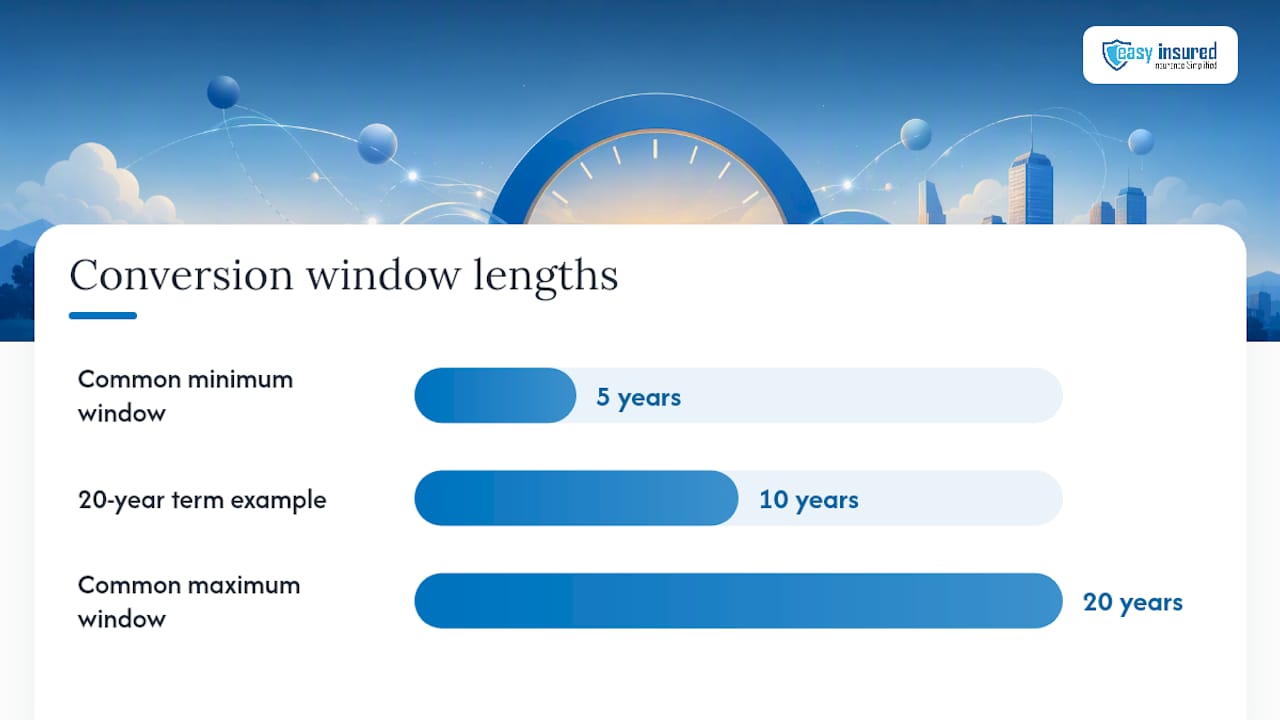
Conversion windows commonly run 5–20 years from policy issue or close by ages between 65 and 75, depending on the insurer and product. A 20-year term policy might only allow conversion during the first 10 years — meaning the window closes a full decade before the term ends.
Pro Tip: Ask your insurer specifically about conversion credits before submitting the application. Converting earlier in the allowed window also reduces the age-based premium jump, since the permanent premium is set at your attained age.
How premiums and cash value change after conversion
The cost increase after conversion surprises many policyholders. Here’s why it happens and how to frame it.
Why permanent premiums are higher:
- Term insurance covers a fixed period; permanent insurance covers your entire life.
- Permanent policies include a cash-value component that builds over time.
- Converted premiums are higher because permanent insurance provides lifelong protection and cash value — the insurer is taking on a much longer obligation.
How the premium is set after conversion:
The insurer uses two inputs: your attained age at conversion and your original health class (preferred, standard, etc.). Your current health is irrelevant. That’s the guarantee.
Conversion credits:
Some insurers reduce the first-year permanent premium through a conversion credit. According to MoneyGeek, these credits are sometimes expressed as 100%–125% of the policyholder’s most recent annual term premium. They don’t eliminate the cost jump, but they soften the first year.
Cash value and borrowing:
Once you hold a permanent policy, cash value begins to accumulate. You can eventually borrow against that cash value — something a pure term policy never allows, since term typically carries no cash value. The borrowing option adds flexibility for emergencies or retirement planning, though loans reduce the death benefit if not repaid.

Illustrative cost range:
Industry analyses show whole life costs roughly 5–15 times more than term for equivalent face amounts, depending on age and product. Converting at 45 will cost meaningfully less than converting at 62, even with the same original health class. Model the numbers at different conversion ages before deciding.
When converting is a good idea — and when it isn’t
Strong reasons to convert:
- Your health has declined. This is the core use case. Conversion is most valuable when the insured’s health has declined since buying term coverage, because it guarantees acceptance without new underwriting. A new permanent policy application would require a medical exam and could result in a higher rate class or outright denial.
- You need lifelong coverage. If you have dependents, a business, or an estate that requires coverage beyond the term period, conversion locks that in.
- You want to start building cash value. Partial conversion lets you begin accumulating cash value on a portion of your coverage while keeping affordable term protection on the rest.
Reasons to pause and compare first:
- If your health is still good, you may qualify for a new permanent policy at a competitive rate from another insurer. Shopping the market could beat the converted premium.
- The permanent products available through conversion may not be the most cost-effective options on the market.
- Higher long-term premiums are a real commitment. Make sure the budget works before converting.
The trade-off is straightforward: conversion trades cost efficiency for guaranteed acceptance. When health is the variable, that trade is often worth it.
Limitations and pitfalls to check before you convert
Several common surprises reduce the value of conversion — or eliminate it entirely.
- The conversion window is shorter than you assumed. Many policyholders discover the window closed years before the term ends. Read the policy now, not when you need to convert.
- Age cutoffs can override the time window. Even if years remain in the conversion period, an age cutoff (often 65 or 70) can end the right to convert. Both limits apply simultaneously.
- Eligible products may be limited. The insurer may restrict conversion to a narrow set of permanent products, some of which carry higher premiums or fewer features than what’s available on the open market.
- Partial conversion may not be permitted. Not all policies allow it. If yours doesn’t, you face an all-or-nothing decision.
- Conversion riders added at purchase may carry a cost. If conversion isn’t built into the base policy, the rider itself adds to your term premium.
- Administrative delays are common. Insurers can take several weeks to process a conversion. Don’t wait until the final days of the conversion window.
Watch for this clause: Some policies state that conversion is available only to “currently marketed” permanent products. That language means the insurer can limit your options to whatever they’re actively selling at the time you convert — which may not include the products with the best features or rates.
Decision checklist: should you convert?
Use this checklist before calling your insurer or advisor. Get written answers to each item.
- Confirm the conversion deadline. Ask for the exact date the conversion window closes, in writing. Don’t rely on a verbal estimate.
- Identify eligible permanent products. Get a list of which whole life and universal life products you can convert into. Ask whether that list is limited to currently marketed products.
- Request a formal conversion quote. The quote should show the converted premium, any conversion credit applied, and assumed cash-value growth projections for the permanent product.
- Ask about partial conversion. Confirm whether it’s available, how it affects the remaining term coverage, and whether the term premium changes.
- Compare with a fresh permanent-policy quote. If your health is still good, get at least one quote for a new permanent policy from another insurer. Easy-insured can run both scenarios side by side.
- Check tax implications. Review the section below on U.S. tax treatment before finalizing.
- Verify agent credentials. Use FINRA BrokerCheck to confirm your broker’s registration and any disciplinary history before acting on their advice.
| Question | What to ask |
|---|---|
| Conversion deadline | “What is the exact date my conversion right expires?” |
| Eligible products | “Which permanent products can I convert into?” |
| Conversion credit | “Do you offer a conversion credit, and how is it calculated?” |
| Partial conversion | “Can I convert a portion of my coverage and keep the rest as term?” |
| Medical exam | “Will any health questions or exam be required?” |
Questions to ask your insurer before you convert
Getting the right answers requires asking the right questions. These scripts work by phone or email.
- “What is the exact expiration date of my conversion privilege?” Don’t accept “before the policy ends” — get a calendar date.
- “Which permanent products are currently eligible for conversion under my policy?” Follow up with: “Is that list limited to currently marketed products?”
- “What would my converted premium be if I convert today versus in two years?” This reveals the cost of waiting.
- “Is a medical exam or any proof of insurability required?” The answer should be no, but confirm it.
- “Do you offer a conversion credit, and what is the amount?”
- “Can I do a partial conversion, and what happens to my remaining term coverage?”
For a written conversion quote, use this email script:
“I’d like to request a formal conversion quote for policy number [XXXX]. Please include the converted premium for [whole/universal life], any conversion credit that applies, projected cash-value growth at years 10 and 20, and the deadline by which I must submit the conversion application.”
Insurers are required to provide this information. If an agent is vague or discourages you from getting it in writing, that’s a signal to escalate.
Tax implications of converting term life to permanent life insurance
The good news: the IRS generally treats a term-to-permanent conversion as a non-taxable event. You’re exchanging one life insurance contract for another with the same insurer, so no taxable income is triggered at the time of conversion.
Key tax points to understand:
- Death benefit: Life insurance death benefits paid to beneficiaries remain income-tax-free under IRC Section 101(a), whether the policy is term or permanent.
- Cash value growth: The cash value inside a permanent policy grows on a tax-deferred basis. You don’t owe income tax on the growth as long as the money stays inside the policy.
- Policy loans: Loans against cash value are generally not taxable, as long as the policy remains in force. If the policy lapses with an outstanding loan, the loan amount may become taxable income.
- Surrendering the policy: If you later surrender the permanent policy for its cash value, any amount above your cost basis (total premiums paid) is taxable as ordinary income.
- Modified Endowment Contracts (MECs): If you overfund the converted permanent policy in the early years, it may be classified as a MEC. Withdrawals and loans from a MEC are taxed differently — gains come out first and may be subject to a 10% penalty before age 59½.
Consult a tax advisor before converting if your situation involves large face amounts, estate planning goals, or business-owned policies. The general rules above apply to most individual conversions, but the specifics depend on the permanent product and how it’s funded.
What does a conversion rider cost?
When conversion isn’t built into the base term policy, you add it through a conversion rider at the time of purchase. The cost varies by insurer, age, and face amount, but the rider typically adds a modest amount to the annual term premium.
A few things to know:
- Some insurers include conversion rights at no extra charge as a standard feature of their term products. Others treat it as an optional add-on.
- The rider cost is usually small relative to the protection it provides. Paying a slightly higher term premium to preserve the guaranteed conversion right is generally worth it for anyone who isn’t certain their health will remain stable.
- Rider language matters as much as cost. A cheaper rider that restricts conversion to a single, high-cost permanent product may be less valuable than a slightly more expensive rider with broader product access.
- Group term policies often have different — and more limited — conversion rules than individual policies. If your coverage comes through an employer, check the group insurance plan documents separately.
When comparing term life options, ask each insurer whether conversion is built in or requires a rider, what the rider costs annually, and which permanent products the rider covers.
How conversion affects your beneficiaries and policy features
Converting from term to permanent changes more than the premium. Several policy features shift in ways that directly affect your beneficiaries.
Death benefit: The face amount of the permanent policy is typically the same as the converted term coverage (or the portion converted, in a partial conversion). Beneficiaries receive the same death benefit, now guaranteed for life rather than for a fixed term.
Beneficiary designations: Your existing beneficiary designations usually carry over to the new permanent policy, but confirm this with your insurer. Some carriers treat conversion as a new policy issuance and require you to re-designate beneficiaries.
Riders on the original term policy: Riders attached to the term policy — such as a waiver of premium or accidental death benefit — may or may not transfer to the permanent policy. Ask specifically which riders survive conversion and which are dropped.
Cash value as an asset: Unlike term coverage, the permanent policy’s cash value is an asset that beneficiaries indirectly benefit from during your lifetime. If you borrow against it and don’t repay the loan, the outstanding balance reduces the death benefit dollar for dollar.
Estate planning implications: A permanent policy that builds cash value can play a role in estate planning — for example, as a tax-efficient way to transfer wealth or fund estate taxes. Term coverage, by contrast, provides no estate-planning flexibility beyond the death benefit itself.
The conversion privilege deserves more respect than it gets
Most people buy term life and never think about the conversion clause again. That’s understandable — when you’re healthy and 35, the idea of needing a health hedge feels abstract. But the conversion window is a time-limited asset, and it tends to matter most precisely when people stop paying attention to it.
The conventional advice is to convert if your health has declined. That’s correct, but incomplete. The more useful frame is this: the conversion privilege is worth something the moment you buy the policy, because it caps your downside risk on future insurability. Whether you ever use it is secondary. What matters is that you know the deadline, understand what products you can convert into, and have a plan for the decision before the window closes.
Where I see people go wrong most often is in assuming the conversion window runs the full length of the term. A 20-year term policy with a 10-year conversion window gives you exactly 10 years to decide — not 20. Missing that date by even a day removes the guaranteed option permanently.
The other mistake is converting without comparing. If your health is still good at conversion time, a fresh permanent-policy quote from a different insurer may beat the converted premium. Conversion guarantees acceptance; it doesn’t guarantee the best price. At Easy-insured, the standard approach is to model both scenarios — converted policy cost versus new permanent-policy cost — before recommending a path. That comparison takes an hour and can save years of overpaying.
Easy-insured can help you compare your conversion options
Deciding whether to convert a term policy or buy new permanent coverage is one of those decisions where the numbers matter more than the general advice. The right answer depends on your current health, your conversion deadline, the specific permanent products your insurer offers, and what fresh quotes look like.

Easy-insured works with families and business owners across the U.S. to compare converted-policy costs against new whole life and universal life quotes side by side. If your health has changed, conversion may be the clearest path to lifelong coverage. If you’re still in good health, a new policy might cost less. Easy-insured helps you figure out which scenario fits your situation — and documents your conversion deadline so nothing slips through the cracks. Get a comparison quote and see both numbers before you decide.
Sources
- What Is Convertible Term Life Insurance? – NerdWallet
- Understanding Convertible Insurance: Key Features and Examples – Investopedia
- Convert Term Life Insurance to Whole: How, When & Why – MoneyGeek
- What is “convertible” term life insurance? | Department of Financial Services
This article is general information, not a substitute for advice from a qualified financial advisor. Consult a qualified financial professional about your own circumstances before acting on anything here.