
For most buyers, term life insurance is the better starting point. It costs far less, covers the years when your financial obligations are heaviest, and leaves room to invest the premium difference. Whole life earns its place in specific situations — estate planning, lifelong dependents, or guaranteed coverage needs — but these situations are the exception, not the rule.
The three biggest tradeoffs at a glance:
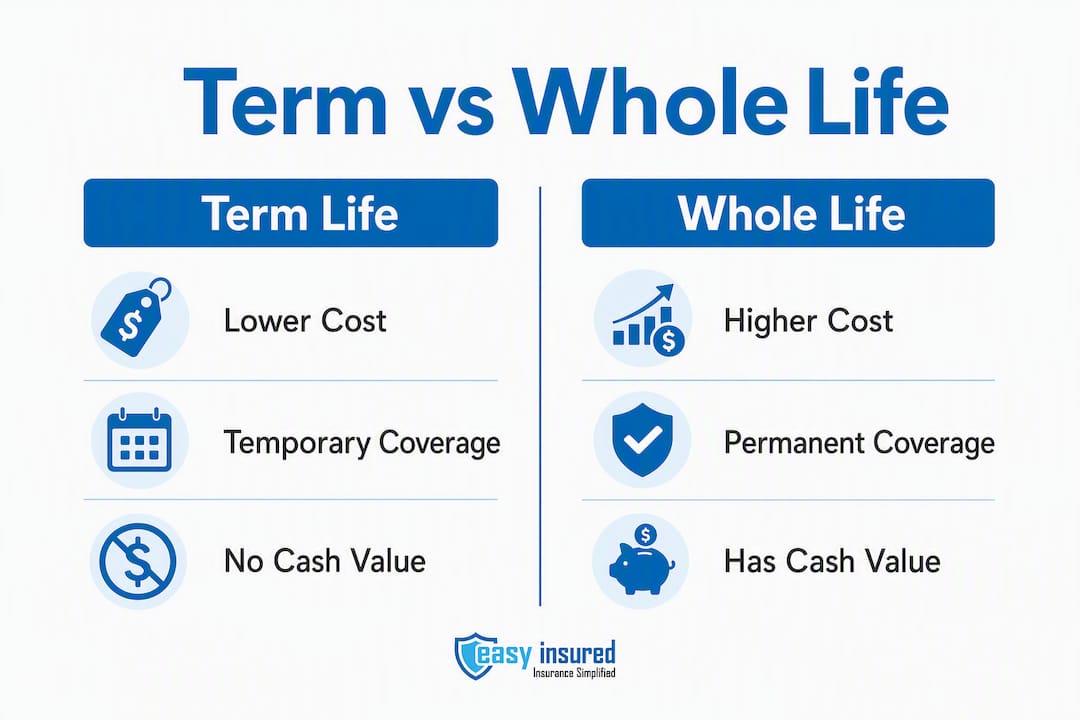
- Cost: Term premiums can be significantly lower than whole life for the same death benefit.
- Coverage length: Term expires; whole life does not.
- Cash value: Term builds none; whole life accumulates a savings component you can borrow against.
If you have dependents, a mortgage, or income to replace, this comparison is for you. If you are weighing estate planning or a lifelong financial obligation, the whole life section will matter most.
Table of Contents
- What is term life insurance and how does it work?
- What whole life insurance is and how it differs from term
- Term vs whole life: a side-by-side comparison
- How premiums and cash value actually compare in dollar terms
- How to choose between term and whole life
- Alternatives worth knowing: universal life, variable life, and term + invest
- Tax rules, loan mechanics, and what happens if a policy lapses
- Common myths, the Dave Ramsey stance, and when whole life is actually defensible
- What to do next: the short version
- Key Takeaways
- The case for getting this decision right the first time
- Easy-insured helps you compare term and whole life side by side
- Useful sources and further reading
What is term life insurance and how does it work?
Term life pays a death benefit if you die within a fixed period, typically 10, 15, 20, or 30 years. The premium stays level for that period, then the coverage ends. No payout if you outlive the term, and no cash value accumulates along the way.
The mechanics are straightforward:
- Term lengths: 10–30 years, chosen at purchase to match a specific need (a 30-year mortgage, the years until your youngest child is financially independent, or your working years to retirement).
- Renewability: Most policies allow renewal after the term ends, but renewal pricing jumps sharply because it is based on your age at that point, not your original age. A 55-year-old renewing a policy bought at 35 pays dramatically more.
- Convertibility: Many term policies include a conversion rider that lets you switch to a permanent policy without new medical underwriting. Age and dollar limits apply, so check the policy terms before you assume this option is open-ended.
- Common riders: Waiver of premium (if you become disabled), accidental death benefit, and child riders are widely available.
- Underwriting: Most policies above a modest face amount require a medical exam or at minimum a health questionnaire. Your age, health status, gender, and smoking history all affect the rate you receive.
A practical example: a 35-year-old buying a 20-year, $500,000 term policy is covered through age 55 — long enough to see a mortgage paid off and children through college. If they die during that window, the benefit pays. If they live past it, the policy simply ends.

What whole life insurance is and how it differs from term
Whole life is permanent coverage. It does not expire at 20 or 30 years — it stays in force for your entire life as long as premiums are paid. That permanence comes with a second feature: a cash-value account that grows inside the policy.

How that cash value builds matters. There is a guaranteed component — a minimum growth rate the insurer promises regardless of market conditions. Mutual insurers may also pay dividends on top of that, but dividends are not guaranteed and depend on the company’s financial performance. In the early years of a whole life policy, the cash value is minimal; meaningful accumulation typically takes a decade or more.
Key mechanics to understand:
- Policy loans: You can borrow against the cash value without a credit check. The loan accrues interest, and any unpaid balance reduces the death benefit your beneficiaries receive. If the policy lapses while a loan is outstanding, the IRS can treat the loan amount as taxable income.
- Withdrawals: You can withdraw up to your cost basis (the premiums you paid) tax-free. Amounts above that basis are taxable.
- Surrender charges: Canceling the policy early often triggers surrender charges, and the net cash you receive may be far less than the premiums you paid. This is one of the sharpest risks of whole life — early surrender can return very little.
- Best use cases: Estate planning (funding a trust, covering estate taxes), supporting a lifelong dependent such as a child with a disability, or situations where guaranteed coverage regardless of future health is the priority.
Whole life is not a bad product. It is a specific product, and it works best when the buyer genuinely needs what it offers.
Term vs whole life: a side-by-side comparison
The table below uses illustrative sample figures. Actual premiums vary by insurer, health class, state, and underwriting outcome.
| Dimension | Term Life | Whole Life |
|---|---|---|
| Cost / premium | Much lower. Sample: ~$40/month for a 35-year-old male, $500K, 20-year term | Much higher. Same profile: ~$545/month for whole life (MoneyGeek sample estimates) |
| Coverage length | Fixed period: 10–30 years | Lifetime, as long as premiums are paid |
| Cash value | None | Accumulates over time; guaranteed floor plus possible dividends |
| Premium stability | Level for the term; renewal pricing resets at attained age | Level and fixed for life |
| Flexibility / convertibility | Convertible to permanent (with rider, within limits) | Less flexible; surrendering early triggers charges |
| Tax treatment | Death benefit income-tax-free; no cash-value component | Death benefit income-tax-free; cash value grows tax-deferred; loans and withdrawals have rules |
| Best for | Income replacement, mortgage coverage, young families | Estate planning, lifelong dependents, guaranteed coverage needs |
Sample premium figures are illustrative estimates from MoneyGeek’s rate analysis and are not guaranteed offers.
Pro Tip: If you are healthy and disciplined about investing, run a “term + invest” projection before buying whole life. Take the premium difference, invest it in a low-cost index fund, and model what that account looks like in 20 years. Many buyers find the math favors term.
How premiums and cash value actually compare in dollar terms
The cost gap between term and whole life is not marginal. According to MoneyGeek’s rate analysis, a 35-year-old male buying $500,000 in coverage pays roughly $40 per month for a 20-year term policy versus approximately $545 per month for whole life. That is a difference of about $505 per month, or roughly $6,060 per year.
What drives your specific rate:
- Age: The single biggest factor. Buying at 30 versus 45 can cut your premium in half or more.
- Health class: Insurers tier applicants from preferred plus down to standard or substandard. A clean bill of health at application is worth real money.
- Gender: Women statistically live longer and typically pay lower premiums than men of the same age.
- Smoking status: Smokers pay substantially more — often two to three times the nonsmoker rate.
- Term length and face amount: A 30-year term costs more than a 10-year term; $1 million in coverage costs more than $500,000.
The cash value inside a whole life policy grows at a guaranteed rate, with the possibility of dividends from mutual insurers. That sounds attractive until you account for opportunity cost. The extra $505 per month invested in a diversified index fund over 20 years could grow substantially, and that growth would be liquid and not subject to surrender charges or loan interest. Whole life’s cash value is a policy feature, not a substitute for a retirement account.
Policy loans add another layer of complexity. The loan itself is not taxable, but interest accrues. If the policy lapses with an outstanding loan balance, the IRS treats that balance as a distribution, and you owe income tax on any amount above your cost basis.
Pro Tip: Always request a policy illustration for whole life before buying. The illustration separates guaranteed values from nonguaranteed projections. Focus on the guaranteed column — that is the floor you can count on.
How to choose between term and whole life
Start with four questions before you talk to anyone:
- How long do you need coverage? If the answer is “until my mortgage is paid” or “until my kids are grown,” term almost certainly fits. If the answer is “forever,” permanent coverage deserves a look.
- What can you afford? Whole life premiums are a long-term commitment. Missing payments can cause a policy to lapse, which is the worst outcome.
- Do you have dependents who will rely on you indefinitely? A child with a disability, for example, changes the calculus entirely.
- Is estate planning a factor? High-net-worth individuals sometimes use whole life to fund estate liquidity or trusts.
Questions to ask an agent or broker:
- What is the guaranteed cash value at years 10, 20, and 30?
- What are the surrender charges and when do they expire?
- Does this term policy include a conversion rider, and what are the age and amount limits?
- What riders are available, and what do they cost?
- Can you show me a side-by-side illustration of term + invest versus whole life over 20 years?
Fidelity’s guidance suggests starting with 10× to 12× your annual salary as a baseline for coverage amount when buying term to protect dependents and replace income.
Four reader scenarios:
Young family, age 32, two kids, $80K income. A 20- or 30-year term policy for $800,000–$960,000 covers income replacement and the mortgage. The premium is affordable, and the coverage window matches the dependency period. Term wins here.
High-net-worth individual, age 55, estate over $5 million. Whole life can fund estate taxes or a trust, ensuring heirs receive the intended inheritance without a forced asset sale. The premium cost is less of a barrier, and the guaranteed coverage is the point.
Single 45-year-old, mortgage nearly paid, no dependents. The case for life insurance weakens considerably. If coverage is still wanted, a shorter term policy (10–15 years) is the most cost-effective path. Matching mortgage timelines to term length is a common and sensible approach.
Parent of a child with a lifelong disability. Whole life or a permanent policy makes sense here. The dependency does not end at 25 or 30, and guaranteed coverage regardless of future health changes is worth the higher premium.
One more consideration: age and health change the urgency. A healthy 30-year-old has time to compare options carefully. A 50-year-old with a health condition may find that term renewal costs are prohibitive and that a conversion rider on an existing term policy is the most practical path to permanent coverage.
Alternatives worth knowing: universal life, variable life, and term + invest
Term and whole life are not the only options. Three alternatives come up frequently:
- Universal life: Permanent coverage with flexible premiums and an adjustable death benefit. You can pay more in good years and less in lean ones, within limits. The tradeoff is that the cash value earns interest tied to current rates, which can fluctuate. See universal life details for how the mechanics work. Pro: flexibility. Con: underfunding the policy can cause it to lapse.
- Indexed universal life (IUL): A variant of universal life where cash value growth is linked to a stock market index (often the S&P 500), with a floor that prevents losses. Pro: upside potential with downside protection. Con: caps limit gains, and the complexity makes illustrations harder to evaluate.
- Variable life: Permanent coverage where the cash value is invested in sub-accounts similar to mutual funds. Pro: highest growth potential. Con: investment risk is yours — a market downturn can erode cash value and threaten coverage.
- Term + invest: Buy a term policy for pure death-benefit protection and invest the premium difference in low-cost index funds or a tax-advantaged account. Many financial planners favor this approach because it separates insurance from investing, keeps each function in its most efficient vehicle, and typically produces higher liquidity and returns over time.
- Conversion riders: If you own a term policy and your health changes, a conversion rider lets you move to a permanent policy without new underwriting. This is a built-in hedge against the risk of becoming uninsurable. Check the conversion deadline — most policies require conversion before a specific age or within a set number of years.
- Guaranteed acceptance life: For buyers who cannot qualify for standard underwriting, guaranteed life insurance offers coverage without a medical exam, typically at a higher premium and lower face amount.
Tax rules, loan mechanics, and what happens if a policy lapses
Life insurance has a favorable tax profile, but the details matter.
- Death benefit: Generally received income-tax-free by beneficiaries under IRS rules. This applies to both term and whole life.
- Cash value growth: Grows tax-deferred inside a whole life policy. You do not pay annual taxes on the accumulation.
- Withdrawals: Tax-free up to your cost basis (total premiums paid). Any amount above that is ordinary income.
- Policy loans: Not taxable when taken. The loan does not count as income because it is technically a debt against the policy. However, interest accrues, and if the policy lapses or is surrendered with an outstanding loan, the IRS treats the loan balance as a taxable distribution to the extent it exceeds your cost basis.
- Surrender charges: Canceling a whole life policy in the early years often means receiving less than you paid in. Surrender charges typically decrease over time and eventually disappear, but the first 10–15 years carry real exit costs.
The lapse risk deserves emphasis. A policy that lapses with a large outstanding loan can generate a surprise tax bill at exactly the wrong moment. If you borrow heavily against a whole life policy, monitor the cash value carefully and keep the policy funded.
Using whole life as a primary investment vehicle without modeling the numbers is a common mistake. The guaranteed return is real, but after fees and the opportunity cost of higher premiums, the net return typically lags a diversified market portfolio over long periods.
This article provides general information, not tax or legal advice. Confirm current IRS rules and your specific tax situation with a qualified professional.
Common myths, the Dave Ramsey stance, and when whole life is actually defensible
Myth: “Whole life is a great investment.”
Whole life has a savings component, but its historical returns typically lag market investments after accounting for fees and the opportunity cost of higher premiums. It is a death-benefit product with a savings feature, not a substitute for a brokerage account or retirement plan.
Myth: “Term leaves you unprotected forever.”
Term leaves you unprotected after the term ends — which is exactly when most buyers no longer need coverage. By 60 or 65, the mortgage is paid, the kids are independent, and retirement savings have accumulated. The need for a large death benefit often shrinks precisely when term coverage expires.
Myth: “You can always convert or renew later.”
Conversion riders have deadlines. Renewal pricing at attained age can be unaffordable. Waiting to decide is itself a decision, and it usually costs more.
On Dave Ramsey’s stance:
“Buy term and invest the difference” is the core of Dave Ramsey’s life insurance advice. His position: whole life is an overpriced product that mixes insurance with investing inefficiently. Buy the cheapest term coverage you need, invest the premium difference in mutual funds, and build wealth outside the policy.
Many financial advisors agree with this framing for the majority of buyers. The logic holds when the buyer is disciplined about actually investing the difference and does not have estate planning needs that require permanent coverage.
When whole life is genuinely defensible:
For a high-net-worth individual who has maxed out tax-advantaged accounts and needs guaranteed estate liquidity, whole life’s tax-deferred growth and permanent coverage serve a real purpose. For a parent of a lifelong dependent, the guarantee that coverage cannot expire matters more than investment efficiency. These are real use cases — they just do not describe most buyers.
What to do next: the short version
The decision comes down to a few clear factors:
- Choose term if you need income replacement, have a mortgage, are supporting dependents through a defined period, or are working with a limited budget. Start with 10×–12× your annual salary as a coverage target.
- Choose whole life if you have estate planning needs, a lifelong dependent, or a specific guaranteed-coverage requirement that outlasts any fixed term.
- Consider alternatives like universal life or a term + invest strategy if you want flexibility or prefer to keep insurance and investing separate.
- Act sooner rather than later. Premiums rise with age, and a health change can affect your insurability or eliminate certain options entirely.
- Get multiple quotes and request a full illustration before committing to any permanent policy. The guaranteed column in a whole life illustration is the number that matters.
Key Takeaways
Term life is the right starting point for most buyers; whole life earns its place only when permanent coverage, estate planning, or a lifelong dependent makes the higher cost worthwhile.
| Point | Details |
|---|---|
| Cost gap is substantial | A 35-year-old male pays roughly $40/month for term vs. ~$545/month for whole life at the same $500K face amount. |
| Term fits most buyers | Income replacement, mortgage coverage, and dependent care during a defined window are the core use cases for term. |
| Whole life has specific uses | Estate planning, lifelong dependents, and guaranteed coverage needs justify the higher premium. |
| Opportunity cost matters | The premium difference invested in low-cost index funds often outperforms whole life cash value over time. |
| Easy-insured can help | Easy-insured provides licensed quotes and illustrations for both term and whole life across the U.S. market. |
The case for getting this decision right the first time
Most people buy life insurance once, maybe twice in their lives. They pick a product under time pressure, often without a clear comparison of what the premium difference could do if invested elsewhere. The “buy term and invest the difference” argument wins on math for most buyers, but math is not the only variable. A 58-year-old who discovers a health condition and never bought permanent coverage now faces a conversion deadline that may have passed. A parent of a child with a disability who bought only term is looking at a coverage gap that opens exactly when it cannot.
The real mistake is not choosing term or whole life. The real mistake is choosing without modeling your specific situation: your income, your dependents, your health trajectory, and your estate. A 20-minute conversation with a licensed advisor who can run both illustrations side by side is worth more than any article, including this one. The numbers will tell you which product actually fits, and the gap between the two is usually obvious once you see it on paper.
Easy-insured helps you compare term and whole life side by side
Choosing between term and whole life is easier when you can see the actual numbers for your age, health, and coverage amount. Easy-insured works with families and business owners across the U.S. to provide licensed quotes for both term life and whole life policies, along with full policy illustrations that separate guaranteed from nonguaranteed values.

Whether you are protecting a mortgage, planning an estate, or figuring out how life insurance fits into your broader financial plan, Easy-insured’s licensed advisors can walk you through a side-by-side comparison and help you size coverage correctly. Request your quotes at easy-insured.com/get-quotes and get a clear picture of what each option actually costs for your situation.
Easy-insured operates in the U.S. market and provides licensed insurance advice. This article is general information; confirm policy details and tax treatment with a licensed professional.
Useful sources and further reading
- Term Life vs. Whole Life Insurance — Forbes Advisor: Covers pros, cons, and the expert rationale for term-first recommendations.
- Term vs. Whole Life Insurance — MoneyGeek: Sample rate analysis with cost comparisons across ages and coverage amounts.
- FINRA BrokerCheck: Verify the licensing and background of any insurance or financial advisor you work with.
- FINRA — Financial Industry Regulatory Authority: Regulatory body overseeing broker-dealers; useful for understanding advisor obligations.
- Easy-insured Term Life: Product details and quote access for term life policies.
- Easy-insured Whole Life: Product details and quote access for whole life policies.