
An RRSP meltdown strategy deliberately withdraws RRSP funds during low-income years so you pay lower marginal tax now and reduce future RRIF minimums, OAS clawback risk, and the terminal tax hit your estate faces at death. If you’re retiring before CPP and OAS begin, you likely have a window of several years where your taxable income drops sharply. That window is exactly when the early meltdown strategy does its best work.
Should you consider it? Run through this quick checklist first:
- RRSP balance: Is it large enough that RRIF minimums will significantly add to your other retirement income and taxes later?
- CPP/OAS timing: Are you planning to delay both to age 70? That creates the low-income window the strategy needs.
- TFSA room: Do you have meaningful unused contribution room? The RRSP-to-TFSA pipeline is what makes the meltdown genuinely powerful.
- Other income: Do you have a large defined benefit pension already starting? If so, the window may be narrower than you think.
- RRIF minimums at 72+: Have you estimated what mandatory withdrawals will look like once the CRA requires conversion by December 31 of the year you turn 71?
If your RRSP is large, your early retirement income is low, and you have TFSA room, the strategy almost certainly deserves a serious look. If your income will stay low for life, an aggressive meltdown can actually cost you more tax than it saves.
Table of Contents
- What is the RRSP early meltdown strategy?
- Why does a large RRSP create a tax problem in retirement?
- How does the meltdown work in practice?
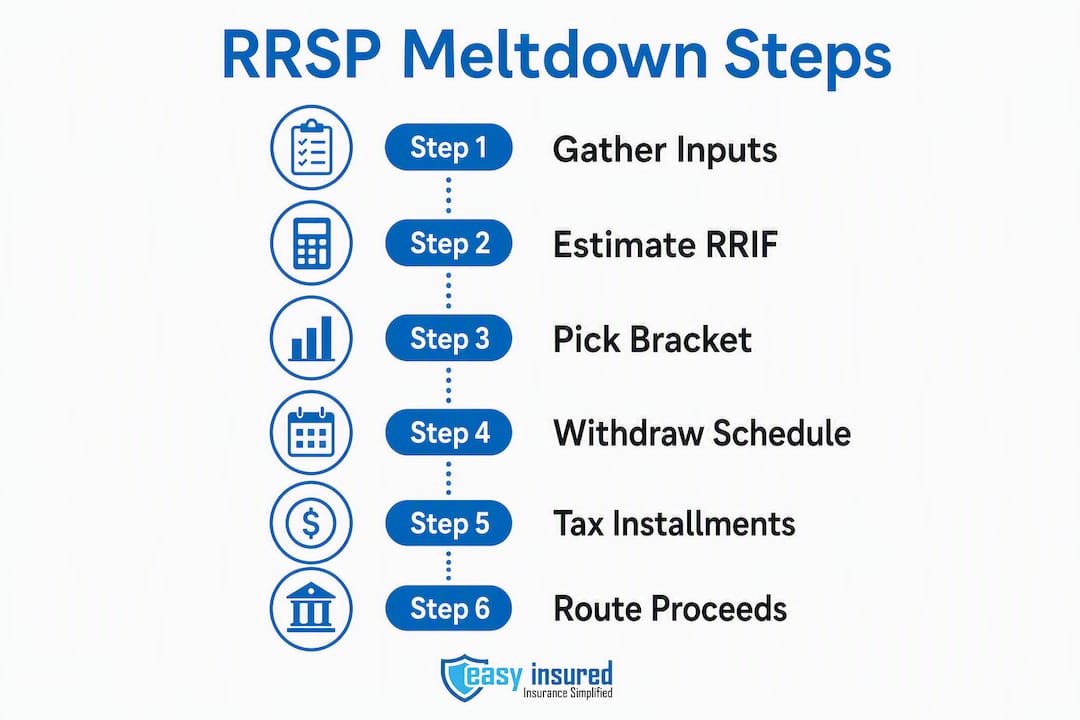
- How to model and run an RRSP meltdown step by step
- Who benefits from this strategy, and who should skip it?
- What are the real risks of an RRSP meltdown?
- When should you consult a planner, and what should you ask?
- Key Takeaways
- The part most retirees get wrong about RRSP meltdowns
- Ready to model your RRSP meltdown? Easy-insured can help
- Useful sources and further reading
What is the RRSP early meltdown strategy?
The RRSP meltdown strategy is the practice of making planned, annual RRSP withdrawals before the mandatory conversion to a Registered Retirement Income Fund (RRIF) at age 71. The goal is to pay tax on those dollars at today’s lower marginal rate rather than at the higher rates you’d face once CPP, OAS, and mandatory RRIF minimums all stack together.
The policy context matters here. Under CRA rules, you must convert your RRSP to a RRIF (or annuity) by December 31 of the year you turn 71. Once converted, the RRIF forces minimum annual withdrawals based on a percentage of the account’s value. That percentage starts around 5.28% at age 71 and climbs each year, reaching roughly 20% by age 95. You have no choice but to take those withdrawals, and every dollar is fully taxable as income in the year received.
Withholding tax applies to RRSP withdrawals right away. Outside Quebec, the withholding tax rates are 10% on amounts up to $5,000, 20% on amounts from $5,001 to $15,000, and 30% on amounts above $15,000. This is a prepayment against your final tax bill, not a separate tax, but it does affect your short-term cash flow. Plan for it.
The core mechanic is straightforward: withdraw just enough each year to fill your chosen tax bracket ceiling, pay the tax, and redeploy the net proceeds into a TFSA or non-registered account. Repeat annually until the RRSP is reduced to a manageable size or fully depleted.
Why does a large RRSP create a tax problem in retirement?
The issue isn’t the RRSP itself. It’s what happens when mandatory income from multiple sources arrives simultaneously. Once you’re 72 and collecting CPP, OAS, and RRIF minimums on a $700,000 RRIF, your taxable income can easily exceed $80,000 or $90,000 per year, pushing you into higher federal and provincial brackets and triggering the OAS clawback.
The OAS clawback (formally called the OAS recovery tax) kicks in when your net income exceeds a threshold that CRA adjusts annually. For the 2025 tax year, that threshold was $90,997. Above that level, you repay $0.15 of OAS for every dollar of net income. A retiree with $110,000 in net income could lose roughly $2,850 in OAS annually. A retiree with $130,000 could lose nearly all of it.
Three specific tax problems compound here:
- Income stacking: RRIF minimums, CPP, OAS, and any pension income all count as taxable income in the same year. There’s no spreading or averaging.
- Bracket creep: A RRIF that grows at 5–6% annually can produce larger mandatory withdrawals each year, pushing you deeper into higher brackets even if your spending stays flat.
- Terminal tax: When you die, the entire remaining RRIF balance is treated as income on your final return unless a qualifying spouse or financially dependent child is the successor holder. A $500,000 RRIF balance at death could generate a tax bill exceeding $200,000 depending on province, leaving far less for your estate.
Moving after-tax RRSP proceeds into a TFSA solves much of this. TFSA withdrawals don’t count as income, don’t affect OAS eligibility, and grow tax-free. The RRSP-to-TFSA pipeline is the single most tax-efficient routing available to most Canadian retirees.
How does the meltdown work in practice?
The mechanics follow a three-step loop repeated annually: withdraw a planned amount from your RRSP, pay the tax owing, then redirect the net proceeds into your TFSA (up to your available room) and any remainder into a non-registered account.

The meltdown window
The typical window runs from roughly age 60 to 71, though many retirees start at 65 or later. The window is widest when CPP and OAS haven’t started yet. Delaying both to age 70 creates up to a decade of relatively low income, which is often the biggest driver of lifetime tax savings when paired with a meltdown.
Pace options and their trade-offs
| Pace | Timeframe | Annual Withdrawal | Key Trade-off |
|---|---|---|---|
| Aggressive | 5 years | Large (fills upper bracket) | Higher annual tax; faster TFSA fill |
| Moderate | 8 years | Medium (fills mid bracket) | Balanced tax cost; manageable cash flow |
| Conservative | 10+ years to age 71 | Smaller (fills lower bracket) | Lower annual tax; RRIF still substantial |
An aggressive pace drains the RRSP faster and fills TFSA room quickly, but you pay more tax in those years. A conservative pace keeps annual tax low but leaves a larger RRIF balance at conversion, which means higher mandatory minimums later. Most planners land somewhere in the moderate range, calibrated to keep annual income just below the next bracket threshold.
Why CPP/OAS timing matters so much
Starting CPP at 60 or 65 while also running a meltdown narrows your low-income window and can push your annual income above your target bracket ceiling. Delaying CPP to 70 increases your eventual monthly benefit substantially compared to starting at 65, and it preserves the low-income window you need. The two strategies reinforce each other when coordinated properly.
How to model and run an RRSP meltdown step by step
Step 1: Gather your inputs
You need your current RRSP balance, an expected annual growth rate (use a conservative 4–5%), your other income by year (pension, rental, part-time work), your province of residence, your available TFSA room, your spouse’s income if applicable, and a realistic life expectancy assumption.
Step 2: Estimate future RRIF minimums
Project what your RRSP will be worth at age 71 under two scenarios: no meltdown and a planned meltdown. Calculate the mandatory RRIF minimums under each. The difference in annual forced income is the core of your tax case.
Step 3: Pick your bracket ceiling
Choose the top of the tax bracket you’re comfortable filling each year. For most retirees, this is the top of the second federal bracket (currently $111,733 for 2025) or a provincial equivalent. Never withdraw past the ceiling in a given year.
Step 4: Build a year-by-year withdrawal schedule
Map out annual withdrawals from now to age 71, accounting for RRSP growth, TFSA room replenishment each January, and any income changes (a part-time job ending, a pension starting).
Step 5: Account for withholding and instalments
Withdrawals above $15,000 trigger 30% withholding outside Quebec. That withholding reduces the net amount available to redirect into your TFSA immediately. If your total annual tax owing exceeds $3,000 in two consecutive years, CRA may require quarterly tax instalments. Budget for this.
Step 6: Route net proceeds to TFSA first, then non-registered
TFSA room is the limiting factor. Once your room is used, excess proceeds go into a non-registered account where future growth is taxable, though still better than leaving funds in the RRSP.
Worked example: before and after a meltdown
Assume a 62-year-old with a $600,000 RRSP, no other income, and $50,000 in TFSA room. CPP and OAS are both delayed to age 70.
| Scenario | Annual Taxable Income (Ages 62–70) | Estimated RRIF at 71 | Estimated Annual RRIF Minimum at 72 | Lifetime Tax (Illustrative) |
|---|---|---|---|---|
| No meltdown | ~$0 (RRSP untouched) | $600,000 | ~$43,000+ | Higher (stacked with CPP/OAS) |
| Moderate meltdown | ~$55,000/year | — | — | Lower (spread across low-income years) |
In the meltdown scenario, you pay tax on roughly $55,000 per year for eight years at a relatively low combined marginal rate. In the no-meltdown scenario, you pay little tax for eight years, then face $43,000+ in mandatory RRIF income stacked on top of CPP and OAS, potentially pushing total income above $100,000 annually and into OAS clawback territory. The lifetime tax difference can be substantial, though the exact figure depends on province, return assumptions, and longevity.
Pro Tip: Request that your planner run the withholding tax impact separately from your annual tax projection. The 30% withholding on large withdrawals can create a cash-flow gap between the withdrawal date and your tax refund or credit at filing. Keep a one-year cash buffer outside your RRSP to cover this.
Who benefits from this strategy, and who should skip it?
Strong candidates
- RRSP balance above $400,000 with no large defined benefit pension
- Retiring before CPP/OAS, creating a genuine low-income window
- Meaningful TFSA room available (ideally $50,000 or more)
- Expecting income to rise significantly once CPP, OAS, and RRIF minimums all start
- Desire to reduce estate tax exposure or simplify succession
Red flags that suggest it may not fit
- Large defined benefit pension: If your pension already fills your lower brackets, there’s no room to absorb RRSP withdrawals at low rates.
- Small RRSP (under $200,000): RRIF minimums on a smaller balance won’t push you into clawback territory, so the urgency is lower.
- GIS eligibility: If your lifetime income is low enough to qualify for the Guaranteed Income Supplement, withdrawing RRSP funds now could disqualify you from GIS later. This is a significant red flag.
- Limited TFSA room: Without a TFSA to absorb the net proceeds, the after-tax dollars sit in a non-registered account where future growth is taxable. The math still works but is less compelling.
- Short life expectancy or serious health concerns: If longevity is uncertain, leaving funds tax-deferred may be the better call. The meltdown pays off over time; it needs time to work.
Couples and spousal considerations
A spouse’s income changes the math considerably. If one partner has a large RRSP and the other has very little, a spousal RRSP contribution during working years can equalize balances and reduce the meltdown burden. At death, a surviving spouse can roll over a RRIF balance tax-free as a successor holder, which delays the terminal tax hit. That rollover option is worth modeling explicitly, especially when there’s a significant age gap between partners. For retirees navigating retirement and spousal income complications from a separation or divorce, the interaction between RRSP division and meltdown timing deserves separate legal and financial advice.
What are the real risks of an RRSP meltdown?
The strategy has genuine downsides. Knowing them upfront keeps you from over-committing.
- Paying tax earlier than necessary: If your income never rises as projected, you may have paid tax at rates that turn out to be no lower than what you’d have paid later. Aggressive meltdowns are particularly exposed to this.
- Lost tax-deferred growth: Every dollar withdrawn stops compounding inside the RRSP. If markets perform strongly after you withdraw, you’ve given up that sheltered growth.
- Longevity risk: A retiree who lives to 95 and drained their RRSP aggressively at 62 may face decades of living on TFSA and non-registered assets, with less flexibility if spending needs rise.
- Withholding tax and instalment obligations: As covered above, the cash-flow timing mismatch between withholding and final tax reconciliation can be disruptive without a buffer.
- Advanced loan-based variants: Some planners use investment loans with interest deductibility to create near-tax-neutral conversions from registered to non-registered accounts. These are higher complexity and carry real interest-rate and market risk. They’re not appropriate for most retirees without specific advice.
- Estate and succession effects: Reducing the RRSP/RRIF balance lowers the terminal tax bill at death, which is often a goal. But if you die earlier than expected with a depleted RRSP and a large non-registered account, the estate picture changes. Coordinate with your estate planning strategy before committing to an aggressive pace.
The best mitigation is phased withdrawals calibrated to your bracket ceiling, a cash buffer for tax instalments, and annual reviews that adjust the pace when income or market conditions shift.
When should you consult a planner, and what should you ask?
A spreadsheet can sketch the concept, but professional modelling is genuinely necessary when the numbers get large or the income picture is complex. The strategy is not one-size-fits-all, and the difference between a well-calibrated meltdown and a poorly timed one can be tens of thousands of dollars.
Signals you need a planner
- RRSP balance above $500,000
- Multiple income sources (pension, rental, business income, part-time work)
- Estate planning goals that interact with the meltdown
- Uncertain health or longevity
- Interest in loan-based or leveraged variants
- Spouse with significantly different income or age
Questions to bring to your first meeting
- Can you run a multi-scenario lifetime tax projection comparing no meltdown, moderate meltdown, and aggressive meltdown?
- What does the OAS clawback look like under each scenario?
- How sensitive are the results to different life expectancy assumptions (say, age 85 vs. age 95)?
- What’s the optimal TFSA routing plan given my current room and annual limits?
- How does delaying CPP to 70 change the numbers compared to starting at 65?
- What’s the projected year-by-year taxable income table, and where does each scenario cross into the next bracket?
Documents to bring
Bring your most recent RRSP and TFSA statements, your CRA Notice of Assessment, any pension statements, your TFSA contribution history from CRA My Account, and your last two tax returns. A planner who can see your actual numbers will give you far more useful projections than one working from estimates.
Key Takeaways
An RRSP meltdown strategy works best when you withdraw steadily during low-income years, route net proceeds into your TFSA, and coordinate the pace with delayed CPP and OAS to avoid income stacking and OAS clawback later.
| Point | Details |
|---|---|
| Start during low-income years | The window between retirement and CPP/OAS (ages 60–70) is when withdrawals are taxed at the lowest rates. |
| Fill your bracket, don’t exceed it | Withdraw just enough each year to reach your bracket ceiling; overshooting costs more tax than it saves. |
| TFSA routing is the key step | Moving after-tax proceeds into a TFSA eliminates future income tax and OAS clawback on that money. |
| Delay CPP and OAS to age 70 | Delaying both widens the low-income window and substantially increases lifetime CPP benefits versus starting at 65. |
| Easy-insured offers modelling help | Easy-insured’s financial planning service provides year-by-year tax projections, TFSA routing plans, and CPP/OAS coordination. |
The part most retirees get wrong about RRSP meltdowns
The conventional framing of this strategy is “drain your RRSP before the government forces you to.” That framing leads people to withdraw too aggressively, too early, and without enough attention to what happens to the money afterward.
The real objective is income smoothing across your entire retirement, not simply emptying an account. A retiree who pulls $120,000 per year from their RRSP at age 63 to “get it done faster” may be paying tax at a higher marginal rate than they would have faced from RRIF minimums at 72. The math only works when the rate you pay now is genuinely lower than the rate you’d pay later.
The second mistake is treating the TFSA as an afterthought. The RRSP-to-TFSA pipeline is what separates a good meltdown from a great one. If you withdraw RRSP funds and park them in a non-registered account without filling your TFSA first, you’ve converted tax-deferred growth into taxable growth, which is better than forced RRIF income but not as good as it could be. Plan your TFSA room years in advance.
The third mistake is running the numbers once and never revisiting them. Markets move, income changes, health shifts. A meltdown plan built at age 62 may need significant adjustment at 65 if your RRSP has grown faster than expected or if a part-time income source has ended. Annual reviews aren’t optional; they’re part of the strategy.
Ready to model your RRSP meltdown? Easy-insured can help
Running a proper RRSP meltdown projection requires more than a back-of-envelope calculation. You need a year-by-year taxable income table, a TFSA routing plan, OAS clawback scenarios, and sensitivity testing for longevity and returns. That’s exactly what Easy-insured’s financial planning service delivers.

Easy-insured works with Canadian retirees and pre-retirees to build retirement income plans that coordinate RRSP withdrawals, CPP/OAS timing, TFSA contributions, and estate planning into a single, coherent strategy. The service covers financial planning, estate planning coordination, and insurance review, including term life insurance to cover potential estate tax liabilities if a large RRIF balance remains at death.
A first meeting typically covers your current account balances, income timeline, and retirement goals. From there, Easy-insured builds a multi-scenario projection so you can see the lifetime tax difference before committing to a pace. Book a financial planning consultation to get your numbers modeled properly.
Useful sources and further reading
The thresholds and rules referenced in this article change annually. Always verify current figures directly from official sources before making decisions.
- CRA: RRSPs and related plans — Official CRA page covering RRSP rules, contribution limits, and conversion requirements. Check here for current RRIF minimum percentages and withholding tax rules.
- CRA My Account — Use your CRA My Account to confirm your current TFSA contribution room and review your RRSP deduction limit. Both figures are essential inputs for any meltdown model.
- Service Canada: CPP and OAS — Check current OAS clawback thresholds and CPP deferral enhancement rates directly at Service Canada. These figures update each year and directly affect your meltdown math.
- Provincial tax brackets — Federal brackets are only part of the picture. Your province’s marginal rates determine the combined rate you pay on each dollar withdrawn. Check your provincial revenue agency for current brackets.
| Resource | What It Covers | Why It Matters |
|---|---|---|
| CRA RRSP/RRIF page | Conversion rules, RRIF minimums, withholding rates | Confirms the legal framework for your plan |
| CRA My Account | TFSA room, RRSP deduction limit | Essential inputs for withdrawal scheduling |
| Service Canada (OAS/CPP) | Clawback thresholds, deferral rates | Determines your low-income window and benefit timing |
| Provincial revenue agency | Provincial marginal tax brackets | Combined federal/provincial rate drives the meltdown math |
A note on sources: forum discussions and blog posts vary widely in accuracy, and thresholds change every year. Rely on CRA and Service Canada for current figures, and treat any article (including this one) as a framework for understanding the strategy rather than a substitute for current official data or personalized professional advice. This article is general information, not tax or financial advice. Confirm current thresholds and your specific situation with CRA, a qualified financial planner, or a tax professional before acting.