
For most Canadian homeowners in good health, personally owned term life insurance is the better choice over lender-offered mortgage protection insurance. It pays your beneficiaries directly, keeps the death benefit level, and typically costs less for equivalent coverage. The main exception: if you can’t qualify for traditional life insurance due to health conditions or a high-risk occupation, mortgage protection insurance (MPI) may be your only realistic option to ensure the mortgage gets paid. When in doubt, get a quick term life quote and compare it side by side with whatever your lender is offering before you sign anything.
Table of Contents
- What mortgage protection (creditor) insurance actually does in Canada
- What personal life insurance is and why homeowners use it
- How the two products compare side by side
- Pros and cons of each option
- What does mortgage protection actually cost compared to term life?
- When mortgage protection insurance actually makes sense
- Practical alternatives and complementary coverages
- How to choose: a short decision checklist
- Why personally owned term life usually wins: the broker view
- Easy-insured can run the comparison for you
- Key Takeaways
- A broker’s honest take on what most clients get wrong
- Useful Canadian resources for further reading
What mortgage protection (creditor) insurance actually does in Canada
Mortgage protection insurance, also called creditor insurance, is sold primarily to protect the lender, not your family. When you die, the payout goes directly to the lender to retire the outstanding mortgage balance. Your beneficiaries receive no cash. They get a paid-off house, which sounds fine until you realize they have no money left to cover property taxes, utilities, or the income they just lost.
In Canada, this product is sold through two main channels:
- Lender-offered creditor insurance: Packaged and sold by your bank or mortgage lender at the time of closing. Convenient, but the lender is both the seller and the beneficiary.
- Third-party creditor products: Sold by independent insurers or brokers, sometimes with slightly better terms, but still structured as creditor-style coverage.
The benefit declines as your mortgage balance falls. If you start with a $500,000 mortgage and die 15 years in with $280,000 remaining, the payout is $280,000, not $500,000. Meanwhile, your premiums typically stay flat or change very little. The policy term usually mirrors your mortgage amortization, and coverage ends when the loan is paid off or you sell.
Underwriting is often guaranteed issue or minimal, meaning few or no medical questions. That accessibility is the product’s biggest selling point. The trade-off is a long list of exclusions: pre-existing conditions, certain occupations, and specific causes of death are commonly excluded, and these exclusions are often not fully disclosed at the point of sale. For a deeper look at how creditor offers are structured, the mortgage protection agency overview at Easy-insured is worth reading before you accept a lender’s pitch.
What personal life insurance is and why homeowners use it

Personal life insurance is a contract between you and an insurer. You own the policy, you name the beneficiaries, and when you die, a lump-sum death benefit goes directly to the people you chose. They can use that money for anything: paying off the mortgage, covering living expenses, funding education, or rebuilding savings.
For homeowners, the most relevant form is term life insurance. You pick a coverage amount and a term length (10, 20, or 25 years are common in Canada) that aligns with your mortgage amortization. The death benefit stays level for the entire term. If you buy $500,000 of coverage today, your family gets $500,000 whether you die in year 2 or year 22.
Permanent life insurance (whole life, universal life) is another option, but it costs significantly more and is usually not the first tool for pure mortgage protection. It makes more sense as part of a broader estate planning strategy.
Most term life policies require medical underwriting: a health questionnaire, sometimes a paramedical exam, and a review of your medical history. For healthy buyers in their 30s and 40s, this process typically results in lower premiums than MPI for the same coverage amount. No-exam and guaranteed-issue life options exist, but they usually carry higher premiums or lower coverage limits than fully underwritten policies.
Portability is a major advantage. Your term life policy travels with you through refinances, lender changes, and home sales. It has nothing to do with your mortgage.
How the two products compare side by side
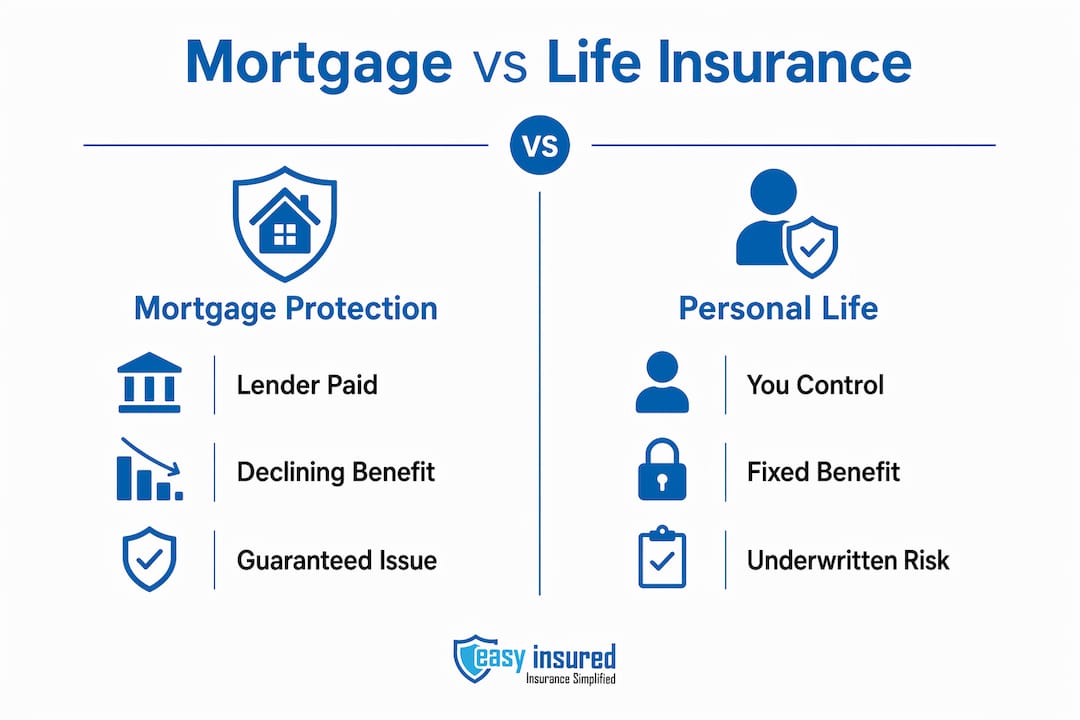
The differences between mortgage protection insurance vs life insurance come down to who controls the money and how much your family actually receives.

| Dimension | Mortgage Protection Insurance | Personal Term Life Insurance |
|---|---|---|
| Who gets paid | The lender (mortgage balance retired) | Named beneficiaries (cash, any use) |
| Coverage amount | Declines with mortgage balance | Level death benefit throughout term |
| Premium behavior | Typically flat; coverage shrinks | Level premium, level coverage |
| Underwriting | Often guaranteed issue or minimal | Medically underwritten (usually) |
| Portability | Tied to the mortgage; may lapse on refinance or sale | Owned by policyholder; fully portable |
| Flexibility of proceeds | None — lender receives payment | Full — beneficiaries decide how to use funds |
| Policy duration | Matches mortgage amortization | Chosen term (10, 20, 25 years, etc.) |
| Canadian tax treatment | Death benefit generally non-taxable | Death benefit generally non-taxable |
One clarification that trips up a lot of buyers: PMI and MIP (private mortgage insurance and mortgage insurance premium) are completely different products. They protect the lender against default on low-down-payment loans. They pay nothing to your family on death. MPI (mortgage protection insurance) is the creditor product discussed in this article. The acronyms are similar; the products are not.
The core problem with lender-offered mortgage protection: your family gets a paid-off house but no cash. If the household loses an income earner, the surviving spouse may still need money for daily expenses, childcare, or debt beyond the mortgage. A personally owned life insurance policy gives beneficiaries that choice. The lender’s product does not.
For Canadian homeowners evaluating a mortgage broker’s recommendation on refinancing or lender-offered creditor products, a resource like Denée Noel Mortgages can provide independent mortgage perspective alongside your insurance comparison.
Pros and cons of each option
Mortgage protection insurance
Pros:
- Accessible to buyers who can’t qualify for traditional life insurance
- Guaranteed or simplified issue means no medical exam in many cases
- Convenient: often offered at closing alongside the mortgage
- Ensures the mortgage is paid off automatically, with no family decision required
Cons:
- Benefit declines as the mortgage balance falls; premiums typically do not
- Payout goes to the lender, not your family
- Limited portability: coverage may not transfer if you refinance or switch lenders
- Exclusions are common and not always clearly disclosed at point of sale
- Limits beneficiary control over how proceeds are used
Personal term life insurance
Pros:
- Level death benefit throughout the term
- Beneficiaries receive cash and can allocate it as needed
- More flexible and cost-effective for healthy buyers than MPI for equivalent coverage
- Fully portable across lenders, refinances, and home sales
- Can be structured to cover more than just the mortgage (income replacement, education, debt)
Cons:
- Requires medical underwriting; some buyers won’t qualify at standard rates
- Application process takes longer than a lender’s creditor offer
- Premiums are higher for older buyers or those with health conditions
- Requires active beneficiary management (naming and updating beneficiaries)
Pro Tip: If a client is uninsurable for standard term life but still needs mortgage coverage, a small guaranteed-issue MPI can bridge the gap while they work with a broker to explore guaranteed life insurance options. The two products don’t have to be mutually exclusive.
What does mortgage protection actually cost compared to term life?
These figures are illustrative. Actual premiums depend on age, health, smoking status, insurer, and province.
Sample scenario: 35-year-old non-smoker, $500,000 mortgage, 25-year amortization.
| Coverage Type | Estimated Monthly Premium | Total Premiums Over 25 Years | Death Benefit at Year 15 |
|---|---|---|---|
| Lender-offered MPI | a higher monthly premium | total premiums over the term are high | benefit declines over time |
| 25-year term life | a lower monthly premium | total premiums over the term are significantly less | benefit remains level |
The math is stark. A healthy 35-year-old non-smoker can typically secure $500,000 of 25-year term life coverage for a fraction of what a lender-offered MPI product costs, while keeping the full death benefit level for the entire term. With MPI, you pay flat premiums while the benefit shrinks every year.
Consumer and adviser guides consistently find that for healthy applicants, term life provides better value and flexibility than MPI for equivalent coverage amounts.
On Canadian tax treatment: death benefits from both term life and mortgage protection insurance are generally received tax-free by beneficiaries in Canada. The Canada Revenue Agency does not include life insurance death benefits in a beneficiary’s taxable income in most standard cases. Any tax complexity typically arises from estate or investment components, not the basic death benefit itself. Confirm your specific situation with a tax professional or the CRA directly.
Premiums shown are illustrative estimates only. Your actual premium will vary based on your age, health, smoking status, insurer, and the specific policy terms. Always request a personalized quote.
When mortgage protection insurance actually makes sense
MPI is not always the wrong answer. There are real situations where it is the most practical or only available choice.
- You can’t qualify for traditional life insurance. Serious health conditions, a recent cancer diagnosis, or a high-risk occupation can make standard term life unavailable or prohibitively expensive. MPI’s guaranteed or simplified issue means you can still protect the mortgage.
- You need coverage immediately. MPI can often be activated at closing with no waiting period for underwriting. Term life applications take weeks.
- You have a very large mortgage and a short remaining amortization. If you’re 10 years from payoff and primarily want to ensure the balance is cleared, the declining benefit structure is less of a disadvantage.
- You prefer an automatic lender-payment mechanism. Some borrowers want the certainty that the mortgage is paid off without requiring a surviving spouse to manage a claim and then decide what to do with a lump sum.
Red flags to watch for:
- Guaranteed acceptance language that buries exclusions in fine print
- Pressure to sign at closing without time to compare alternatives
- No clear explanation of what happens to coverage if you refinance or switch lenders
- Premiums that are not clearly disclosed as flat while the benefit declines
If you’re in a situation where MPI seems like the only option, talk to a broker first. Guaranteed life insurance products exist outside the lender channel and may offer better terms than what’s presented at the mortgage desk.
Practical alternatives and complementary coverages
Term life is the primary alternative to MPI for most homeowners, but it doesn’t cover every risk a household faces.
- Critical illness insurance: Pays a lump sum if you’re diagnosed with a covered condition (cancer, heart attack, stroke). It doesn’t require death. For homeowners, this can cover mortgage payments during a treatment period when income drops. Easy-insured offers critical illness coverage as a standalone or rider.
- Disability insurance: Protects your income if you can’t work due to injury or illness. Most mortgage defaults happen not because someone died, but because they stopped earning. A disability policy addresses the scenario MPI and term life both miss.
- Joint term life policies: Cover two lives under one policy, often at a lower combined premium than two separate policies. Useful for dual-income couples where both incomes support the mortgage.
- Convertible term: A term life policy with a conversion option lets you convert to permanent coverage later without new medical underwriting. Useful if your health changes during the term.
- Riders: Return-of-premium, waiver of premium on disability, and accidental death benefit riders can add value to a base term policy without requiring a separate application.
Suggested combinations by household type:
- Single-earner family with young children: 20–25 year term life (level, high coverage) plus disability insurance. MPI is redundant if term life is in place.
- Dual-income couple: Individual term policies on each earner, sized to cover the mortgage and income replacement. Add critical illness if budget allows.
- Borrower with health issues: Guaranteed-issue MPI to cover the mortgage balance, supplemented by a final expense policy for additional family support.
How to choose: a short decision checklist
Work through these questions before accepting any offer from a lender or signing a new policy.
- What is your coverage goal? Mortgage payoff only, or full income replacement for your family? If the latter, term life is almost always the right tool.
- Who do you want to receive the money? If the answer is “my family, to use as they see fit,” MPI fails this test by design.
- Can you qualify for term life? If yes, get a quote before accepting any lender-offered product. If no, MPI or guaranteed life insurance becomes the conversation.
- What term length do you need? Match your coverage term to your mortgage amortization, not just the current mortgage term. A 5-year fixed mortgage with a 25-year amortization needs 25 years of coverage.
- Is the policy portable? Ask explicitly: what happens to this coverage if I refinance, switch lenders, or sell the home?
- What are the exclusions? Request the full policy document, not just the brochure. Pre-existing condition exclusions in MPI can be extensive.
- What does it cost over the full term? Calculate total premiums paid, not just the monthly amount.
Questions to ask your lender about their creditor/MPI offer:
- “Who receives the death benefit payment, and can my family access any portion directly?”
- “What happens to my coverage if I refinance or switch lenders?”
- “What conditions or causes of death are excluded from this policy?”
- “Can I cancel this policy at any time without penalty?”
Questions to ask a broker about term life:
- “What medical information do you need, and how long does underwriting take?”
- “Is this policy convertible to permanent coverage later?”
- “What riders are available, and which ones make sense for my situation?”
A simple script for your lender conversation: “Before I add creditor insurance, I’d like to see the full policy document including all exclusions, and I’d like to know exactly what my family receives if I die tomorrow versus in 20 years. Can you provide that in writing?”
Red flags: a seller who can’t or won’t provide the full policy document before you sign, guaranteed acceptance marketed without any mention of exclusions, and pressure to decide at closing without a comparison period.
For mortgage context and refinancing questions that affect your coverage decisions, David Mordue’s mortgage resource is a useful reference point.
Why personally owned term life usually wins: the broker view
The research is consistent on this point. Broker experience and consumer guides repeatedly find that portability, beneficiary control, and a level death benefit make term life the preferred option for most homeowners in good health.
The underwriting difference is the crux of it. MPI’s guaranteed or simplified issue is a feature for buyers who need it, but for everyone else, it means the insurer is pricing for a higher-risk pool. A healthy 35-year-old non-smoker subsidizes the guaranteed-issue pricing when they buy MPI. When that same person applies for medically underwritten term life, they get priced on their own risk profile, which is usually much lower.
The real cost of declining coverage: a homeowner who pays flat MPI premiums for 25 years while the benefit shrinks from $500,000 to zero has paid for a product that delivered less protection every single year. A term life policyholder paid similar or lower premiums and maintained $500,000 of coverage on day one and day 9,000. The math favors term life for healthy buyers by a significant margin.
Guaranteed-issue MPI can be the right call for borrowers who are uninsurable, but buyers should understand the trade-off: higher long-term cost per dollar of protection and a benefit that shrinks as the mortgage is paid down. For edge cases, a broker can sometimes arrange a small guaranteed-issue product to cover the mortgage while simultaneously applying for a larger term life policy, giving the client coverage on both fronts during the underwriting period.
The financial planning lens matters here too. Mortgage protection is a single-purpose product. Term life is a household financial tool that can cover the mortgage, replace income, fund education, and support estate planning goals simultaneously.
Easy-insured can run the comparison for you
Choosing between mortgage protection and term life doesn’t have to mean hours of research. Easy-insured is a Canadian insurance brokerage that offers term life, whole life, guaranteed life, mortgage protection, critical illness, and disability coverage, with access to multiple insurers so you get a real comparison rather than a single lender’s pitch.

Before you call, have these ready: your current mortgage balance and remaining amortization, your age and smoking status, a basic sense of your medical history (any major diagnoses, medications, or recent hospitalizations), and the names of your intended beneficiaries. That’s enough for a broker to pull quotes across multiple carriers and show you the cost difference between a lender-offered MPI and a personally owned term policy side by side.
Getting a broker quote through Easy-insured carries no obligation to purchase. You can compare, ask questions, and decide on your own timeline. Start with a no-obligation quote and see the numbers for yourself.
Key Takeaways
For most Canadian homeowners, personally owned term life insurance delivers more value, more flexibility, and more beneficiary control than lender-offered mortgage protection insurance at a lower cost for healthy buyers.
| Point | Details |
|---|---|
| Term life pays your family | MPI pays the lender; your beneficiaries get a paid-off house but no cash for other needs. |
| Coverage shape matters | MPI benefit declines with the mortgage balance; term life stays level for the full term. |
| Cost favors term life | Healthy buyers typically pay significantly less for equivalent term life coverage than for MPI. |
| MPI has a real use case | Uninsurable buyers or those needing immediate guaranteed coverage may have no better option than MPI. |
| Easy-insured compares both | Easy-insured offers quotes across term life, guaranteed life, and mortgage protection with no obligation. |
A broker’s honest take on what most clients get wrong
The most common mistake I see is homeowners accepting a lender’s creditor insurance offer at closing without ever asking what their family actually receives. The answer, in most cases, is: the lender gets paid, and your spouse gets a mortgage-free house with no cash. That’s not nothing, but it’s not the same as financial security.
The second mistake is assuming that because MPI was easy to get, it must be the right product. Ease of access is a feature for people who need it. For everyone else, it’s a signal that the pricing reflects a higher-risk pool than you belong to.
Easy-insured offers term life, whole life, guaranteed life insurance, mortgage protection, disability, and critical illness coverage across Canada… The advice is impartial: Easy-insured works with multiple insurers, so the recommendation is based on what fits your situation, not what pays the highest commission. A quick, no-obligation comparison takes less time than reading the fine print on a lender’s creditor brochure.
Useful Canadian resources for further reading
- Term life quotes and comparison at Easy-insured — start here if you want to compare term life to a lender’s MPI offer
- Guaranteed life insurance options at Easy-insured — for buyers who can’t qualify for standard underwriting
- Financial planning services at Easy-insured — for homeowners who want to integrate insurance into a broader household plan
- Estate planning at Easy-insured — for beneficiary and estate considerations tied to life insurance proceeds
- What is mortgage insurance and how does it work? at the CFPB — authoritative explanation of PMI vs MPI distinctions
- Mortgage protection vs life insurance at Bankrate — consumer-facing comparison with underwriting and cost context
- Mortgage protection insurance vs life insurance at Experian — adviser-backed analysis of term life as the preferred option for healthy buyers
- Top mortgage protection insurance agencies at Easy-insured — how creditor products are structured and what to watch for
This article is general information for Canadian homeowners and is not professional financial, legal, or tax advice. Confirm your specific situation with a licensed insurance broker, financial advisor, or the Canada Revenue Agency before making coverage decisions.