
For most Canadian homeowners, the best mortgage protection insurance decision comes down to one question: can you qualify for a personal term life or disability policy? If yes, that route usually gives you better value and more flexibility. If not, or if you want a fast, simple safety net at mortgage signing, a mortgage protection policy from an independent broker is worth a close look. Before you sign anything at the bank, get a comparison quote. Easy-insured can run that side-by-side for you and show you exactly what each option costs.
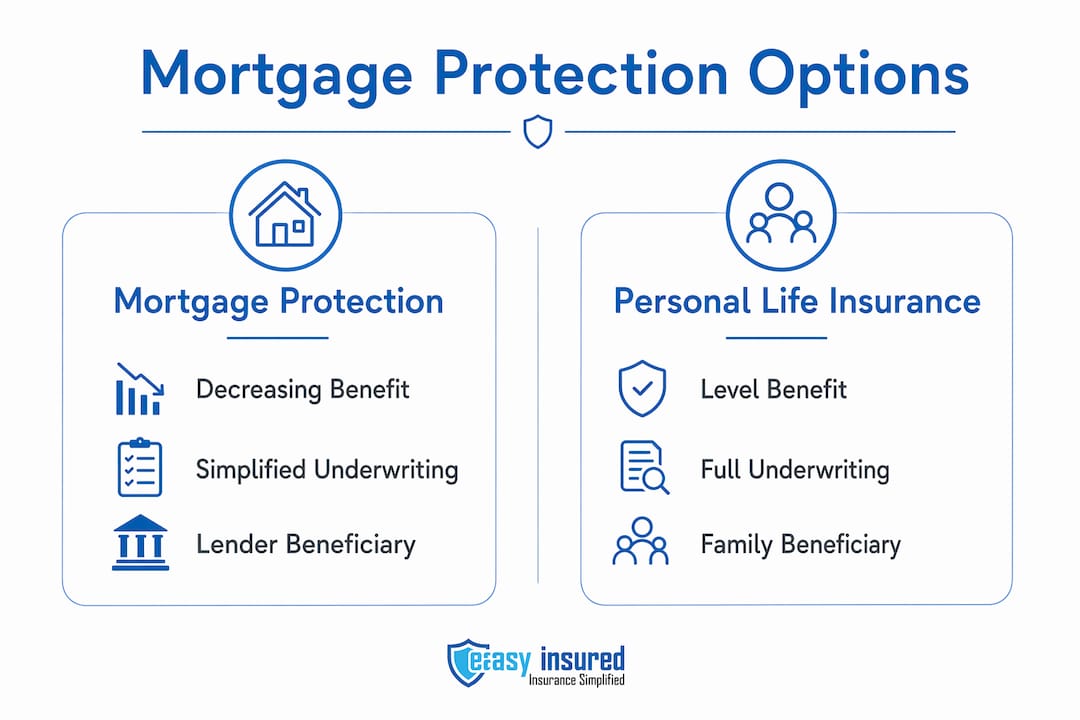
Table of Contents
- What is mortgage protection insurance in Canada?
- What policy types and features should you compare?
- How does mortgage protection compare with personal life and disability insurance?
- What does mortgage protection insurance typically cost?
- Where should you buy mortgage protection in Canada?
- How do you pick the right mortgage protection policy?
- What happens during underwriting and how long does approval take?
- How do claims work and what exclusions should you watch for?
- How Easy-insured helps Canadian homeowners compare and buy mortgage protection
- Key Takeaways
- What brokers see homeowners get wrong when buying mortgage protection
- Easy-insured makes comparing mortgage protection straightforward
- Sources and further reading
What is mortgage protection insurance in Canada?
Mortgage protection insurance (also called creditor insurance or mortgage life insurance) is a product that pays your outstanding mortgage balance to your lender if you die, become critically ill, or are disabled during the policy term. It is designed to protect the borrower, not the lender. That distinction matters because it is often confused with mortgage default insurance, which protects the lender if you stop making payments.
According to Canada.ca, mortgage protection products are optional — you are never required to buy them to close a mortgage. The CAFII explains the distinction clearly: mortgage default insurance (like CMHC coverage) protects the lender if you default, while mortgage protection insurance helps you by paying the mortgage balance or payments when a covered event occurs.
Typical covered events include:
- Death (including terminal illness in most policies)
- Critical illness (cancer, heart attack, stroke — list varies by insurer)
- Disability (inability to work, usually after a waiting period)
- Involuntary job loss (offered by some, but not all, products)
There are two main underwriting types. Simplified-issue products ask a short health questionnaire and approve quickly. Guaranteed-acceptance products skip health questions entirely but usually carry higher premiums and more exclusions. Fully underwritten policies take longer but tend to offer the best rates for healthy applicants.
What policy types and features should you compare?
Not all mortgage protection policies are built the same. The structure of the benefit is the first thing to nail down.

Decreasing vs. level benefit
A decreasing benefit policy ties the payout to your remaining mortgage balance. As you pay down the loan, the insured amount shrinks, but your premium usually stays the same. You end up paying a fixed monthly cost for a benefit that gets smaller every year.
A level benefit policy keeps the payout constant for the full term, regardless of how much you have paid off. It typically costs more upfront, but co-borrowers and homeowners with irregular repayment schedules (lump-sum prepayments, variable-rate mortgages) often find it the better fit. If you pay down $80,000 ahead of schedule, a decreasing policy shrinks accordingly, while a level policy still pays the original face amount.
Common features and riders to ask about:
- Critical illness rider: Covers a defined list of conditions; Canada.ca notes that critical illness coverage is frequently conditional on having mortgage life insurance already in place.
- Disability rider: Covers mortgage payments while you cannot work, usually after a 30-to-90-day waiting period.
- Job-loss rider: Available from some lenders; typically covers a limited number of monthly payments.
- Portability/convertibility: Whether the policy follows you if you switch lenders or refinance.
- Age and term limits: Many lender products cap eligibility at age 69 for life coverage and 55 for critical illness.
Pro Tip: If you and a co-borrower are both on the mortgage, check whether a single policy covers both of you or whether you each need separate coverage. A single “first-to-die” joint policy pays out once and then lapses, leaving the surviving borrower uninsured.
How does mortgage protection compare with personal life and disability insurance?
The direct answer: personal life and disability policies are usually more flexible and often better value for your family. Mortgage protection can make sense when you cannot qualify for personal coverage, or when you want immediate coverage at mortgage signing without a medical exam.
Here is where the two approaches diverge:
| Feature | Mortgage protection (creditor) | Personal term life / disability |
|---|---|---|
| Beneficiary | Lender receives payout | You name any beneficiary |
| Payout use | Applied to mortgage balance | Family uses funds freely |
| Underwriting | Often simplified or guaranteed | Fully underwritten (best rates) |
| Portability | Tied to lender; may lapse at renewal | Follows you regardless of lender |
| Benefit over time | Usually decreases with balance | Stays level for the full term |
| Premium behavior | Level premiums, shrinking benefit | Level premiums, level benefit |
A quick example: A 38-year-old non-smoker with a $400,000 mortgage might pay a moderate monthly cost for a simplified-issue mortgage protection policy through their lender. A fully underwritten term life policy for the same face amount could come in noticeably cheaper, and the payout goes to the family, not the bank. The family can then decide whether to pay off the mortgage, cover living expenses, or both.
Where mortgage protection wins: if a health condition makes full underwriting difficult, guaranteed-issue mortgage protection may be one of the few options available. The Bankrate analysis puts it plainly: MPI can be helpful when an applicant cannot qualify for personal life or disability insurance, but it offers less flexibility because the payout goes to the lender.
What does mortgage protection insurance typically cost?
Pricing depends on four main drivers: your age, smoker status, the coverage structure (decreasing vs. level), and the underwriting type. Guaranteed-acceptance products cost more per dollar of coverage than fully underwritten ones because the insurer takes on more unknown risk.
Worked examples (approximate monthly premiums):
| Mortgage amount | Age bracket | Underwriting type | Estimated monthly premium |
|---|---|---|---|
| $400,000 | 30s or 40s, healthy applicant | Simplified issue | $60–$80 per month |
| $400,000 | — | Simplified issue | $60–$80 per month |
| — | 30s or 40s, healthy applicant | Simplified issue | $60–$80 per month |
| — | — | Simplified issue | $60–$80 per month |
These are illustrative estimates based on published industry ranges. Your actual premium depends on your specific health profile, insurer, and policy structure. Always request a personalized quote.
One important cost note: mortgage default insurance premiums (CMHC-style coverage) range from roughly 0.6% to 4.5% of the mortgage amount based on down payment size. That is a completely separate cost from mortgage protection premiums, and the two are often confused when homeowners are reviewing their mortgage documents at closing.
Industry range: Monthly MPI premiums commonly run from about $60–$80 per month for a healthy applicant in their 30s or 40s on a simplified-issue policy covering a $250,000–$400,000 mortgage, based on Bankrate’s analysis.
For context on the tax side: mortgage protection insurance premiums are generally not tax-deductible for personal homeowners in Canada. If you are a business owner using the property commercially, speak with a tax advisor about your specific situation.
Where should you buy mortgage protection in Canada?
You have three main channels, and the one you choose has a real impact on price, product quality, and what happens at renewal.
Purchase channels:
- Lender/branch creditor insurance: Offered at mortgage signing by your bank or credit union. Convenient, but limited to that lender’s product. Coverage is typically tied to the mortgage and may lapse if you switch lenders.
- Direct from an insurer: Some insurers sell mortgage protection directly. More product choice than a single lender, but you are still comparing within one company’s lineup.
- Independent broker or agency: Access to multiple insurers and product types. A broker can show you lender offers alongside personal term life and disability options so you can make a real comparison.
Canada.ca is clear on this: federally regulated lenders must assess whether optional creditor insurance is appropriate for your circumstances and must tell you if they believe it is not. That suitability obligation exists, but it does not mean the lender’s product is the best one available to you.
The practical rule: Always compare your lender’s creditor insurance offer with an independent broker quote before you sign. The lender’s product is convenient, but convenience is not the same as value. An independent broker can show you whether a personal term life or disability policy covers more for less, and whether the coverage is portable if you refinance.
For homeowners also exploring mortgage strategies, understanding how your mortgage structure interacts with insurance decisions is worth a read. The Smith Manoeuvre is one example of a mortgage strategy where the type of coverage you hold can affect your overall financial plan.
How do you pick the right mortgage protection policy?
Start with a short checklist before you compare any quotes.
Decision checklist:
- Do you have existing life or disability coverage that already protects your mortgage?
- Can you qualify for a fully underwritten personal term life policy?
- Is beneficiary flexibility important (do you want your family to control the payout)?
- Does the policy need to be portable across lenders?
- What is the maximum monthly premium you can sustain long-term?
- Are you buying at mortgage signing under time pressure, or do you have time to shop?
Questions to ask any broker or lender:
- “Who is the beneficiary — me, my family, or the lender?”
- “Is this a decreasing or level benefit policy?”
- “What happens to my coverage if I refinance or switch lenders?”
- “What pre-existing conditions are excluded, and for how long?”
- “Does the critical illness rider require life insurance to already be in place?”
- “Is the premium guaranteed not to increase for the full term?”
Red flags that justify walking away:
- The certificate of insurance is vague about how the benefit amount is calculated.
- The benefit declines as the mortgage balance falls, but the premium does not drop with it.
- Guaranteed-acceptance language is used without a clear explanation of the exclusion period.
- You are being pressured to decide at the closing table with no time to compare alternatives.
- The salesperson cannot clearly answer who the beneficiary is.
When to choose term life or disability instead: if you are in good health, under 55, and want your family to have flexible access to the payout, a term life policy almost always makes more sense. If income replacement during a disability is the main concern, a standalone disability policy typically covers more ground than a mortgage disability rider.
What happens during underwriting and how long does approval take?
The timeline depends almost entirely on which underwriting path your policy takes.
- Guaranteed-issue: No health questions, coverage starts immediately or within days. Premiums are higher and exclusions are broader.
- Simplified issue: A short health questionnaire and a prescription history check. Decision usually within 24–72 hours. Most lender-offered creditor insurance falls into this category.
- Fully underwritten: A detailed health application, possible paramedical exam, blood and urine labs, and an insurer review. Timeline is typically 2–6 weeks, sometimes longer if the insurer requests medical records from your doctor.
Typical steps for a fully underwritten application:
- Complete the application and health questionnaire.
- Schedule a paramedical exam (blood pressure, height/weight, blood draw) if required.
- Insurer reviews labs and medical history.
- Approval, modification (reduced benefit or exclusion added), or decline.
- Policy issued and premium schedule confirmed.
The timing issue that catches homeowners off guard: if your mortgage closes in three weeks and you are applying for a fully underwritten personal policy, you may not have coverage in place by closing. In that case, a simplified-issue creditor policy from the lender can serve as temporary coverage while your personal policy is being underwritten. Just make sure you cancel the lender policy once the personal one is active, so you are not paying for both.
Pro Tip: Speed up underwriting by having your complete medication list, the names of any specialists you have seen in the past five years, and your prior insurance coverage details ready before you start the application. Missing information is the single biggest cause of delays.

How do claims work and what exclusions should you watch for?
Step-by-step claim process:
- Notify the insurer or lender as soon as the covered event occurs (death, diagnosis, or disability onset).
- Submit required documentation: death certificate, physician’s statement, or disability assessment from a licensed medical professional.
- The insurer reviews the claim against the policy terms, the original application, and any exclusions.
- If approved, the insurer pays the outstanding mortgage balance (or a portion of it) directly to the lender.
- Any amount above the outstanding balance is typically not paid to the borrower’s estate.
Common exclusions to read carefully:
- Pre-existing conditions: Most policies exclude conditions you were diagnosed with or treated for before the policy started, often for a defined period (two years is common).
- Self-inflicted injury: Standard exclusion across virtually all policies.
- Waiting periods for disability and job-loss benefits: Many disability riders require 30–90 days of continuous disability before payments begin. Job-loss riders often have a 60-to-90-day waiting period and a cap on total benefit months.
- Critical illness list limitations: Coverage applies only to the specific conditions named in the certificate. Canada.ca confirms that critical illness products contain defined lists of covered conditions, and pre-existing conditions are commonly excluded.
What happens at mortgage payoff or refinancing? When the mortgage is paid off, the policy ends. If you refinance with a new lender, creditor insurance tied to the original lender typically lapses, and you would need to reapply. This is the portability problem that catches many homeowners by surprise.
The payout goes to the lender, not your family. If your family needs flexible access to funds after your death — to cover living expenses, pay off other debts, or fund education — mortgage protection alone is not enough. A personal term life policy with a named beneficiary gives your family that control. Mortgage protection and term life can work together, but they are not interchangeable.
Always read the Certificate of Insurance before you apply. The certificate defines maximum benefit amounts, age limits, and the exact method used to calculate the payout. Insurely notes that product booklets list definitions, benefit limits, exclusions, and benefit calculation methods — and most homeowners never read them.
How Easy-insured helps Canadian homeowners compare and buy mortgage protection
Easy-insured is a Canadian insurance brokerage that works with homeowners across the country to compare mortgage protection options against personal life, disability, and critical illness policies. The goal is straightforward: make sure you are not paying more for less coverage than you could get elsewhere.
What Easy-insured offers:
- Mortgage protection insurance (creditor and independent policies)
- Term life insurance as a flexible alternative to lender mortgage life
- Whole life and guaranteed life for applicants who need permanent or guaranteed-acceptance coverage
- Disability insurance and critical illness as standalone policies or riders
- Financial planning and estate planning services for homeowners who want a broader picture
The typical Easy-insured process:
- Discovery: A brief conversation about your mortgage balance, health, dependents, and coverage goals.
- Quote comparison: Side-by-side quotes from multiple insurers, including lender creditor options and personal policy alternatives.
- Application support: Help completing the application accurately, gathering medical information, and navigating underwriting.
- Claims assistance: Guidance through the claim process if you ever need to file.
Easy-insured is recognized among the top mortgage protection agencies in Canada for its broker-first approach and its focus on matching the right product to each homeowner’s actual situation. Frank, Easy-insured’s lead advisor, brings deep knowledge of both the creditor insurance market and the personal insurance alternatives that lenders rarely mention at the closing table.
Key Takeaways
Mortgage protection insurance is worth buying when you cannot qualify for personal coverage, but most healthy Canadian homeowners get better value from a fully underwritten term life or disability policy.
| Point | Details |
|---|---|
| Personal policies usually win | Term life and disability policies offer better beneficiary flexibility and often lower premiums than lender creditor insurance. |
| Decreasing benefit is the default | Most creditor policies shrink the payout as your balance falls while premiums stay level — ask specifically about level-benefit options. |
| Portability matters at renewal | Lender-tied creditor insurance can lapse when you refinance; confirm portability before you sign. |
| Always compare before you commit | Get an independent broker quote alongside the lender’s offer — Canada.ca confirms lenders must assess suitability, but that is not the same as finding you the best price. |
| Easy-insured runs the comparison | Easy-insured compares lender creditor insurance against personal term life, disability, and critical illness options so you see the full picture before deciding. |
What brokers see homeowners get wrong when buying mortgage protection
The most common mistake I see is buying whatever the lender offers at closing without asking a single question. The closing table is a high-pressure moment, and mortgage protection is often presented as a natural part of the process, almost like it comes with the mortgage. It does not. It is a separate product, and you have every right to say “I need a few days to compare this.”
Three specific traps come up again and again. First, homeowners buy only at closing and never revisit the decision. Their mortgage balance drops, their health improves, and they could now qualify for a better personal policy, but they keep paying the original creditor premium for a shrinking benefit. Second, they do not check portability. When they refinance two years later, the creditor policy lapses and they are back to square one, often older and with a different health profile. Third, they confuse the lender’s required mortgage default insurance (CMHC) with the optional mortgage protection product being offered alongside it. One is mandatory and protects the lender. The other is optional and is supposed to protect them. Mixing them up leads to signing for something they did not fully understand.
The fix is simple: before you commit to any mortgage protection product, get an independent quote. A 20-minute conversation with a broker who can show you a term life alternative alongside the creditor offer is usually enough to make the right call.
Easy-insured makes comparing mortgage protection straightforward
Choosing between a lender’s creditor insurance and a personal policy is genuinely confusing when you are also navigating a mortgage closing. Easy-insured cuts through that by pulling quotes from multiple insurers and laying them side by side with the lender’s offer, so you can see the actual cost difference and what each policy covers.

The process takes about 20 minutes. You get a clear comparison of mortgage protection, term life, and disability options tailored to your mortgage size, age, and health profile. No pressure, no jargon.
Three reasons Canadian homeowners work with Easy-insured:
- Broader market access: Easy-insured compares products across multiple insurers, not just one lender’s lineup.
- Underwriting guidance: If your health history is complicated, Easy-insured knows which insurers are more likely to approve your application and at what terms.
- Time saved: One conversation replaces hours of research and multiple insurer calls.
Ready to see what your mortgage protection actually costs versus a personal policy? Get a tailored quote from Easy-insured and make the decision with real numbers in front of you.
This article is general information for Canadian homeowners and is not a substitute for personalized insurance or financial advice. Confirm current product terms and eligibility with your insurer or a licensed advisor before purchasing.
Sources and further reading
Government guidance:
- Canada.ca — Optional mortgage insurance products: The primary government source on optional creditor insurance, suitability rules, and the difference between mortgage protection and mortgage default insurance. Start here.
Industry explainers:
- CAFII — Mortgage insurance vs. mortgage protection insurance: Clear explanation of the borrower-vs-lender protection distinction and the protection gap among Canadian homeowners.
- Bankrate — What is mortgage protection insurance?: Useful overview of premium ranges, decreasing vs. level benefit structures, and when MPI makes sense versus term life.
- Insurely — Primary mortgage insurance: Explains mortgage loan insurance premiums (0.6%–4.5% range), the Certificate of Insurance, and product feature details.
Easy-insured product pages:
- Term Life: Compare term life as a flexible alternative to lender mortgage life insurance.
- Disability Insurance: Standalone disability coverage versus mortgage disability riders.
- Critical Illness: Stand-alone critical illness policies versus mortgage critical illness riders.
- Top mortgage protection agencies: Easy-insured’s positioning among leading Canadian mortgage protection brokers.
Always read the insurer’s Certificate of Insurance for exact coverage terms, benefit calculation methods, and exclusions before you apply.