
For self-employed Canadians, the best disability insurance is an individual long-term disability policy with an own-occupation definition — one that pays benefits when you can no longer perform the specific work you do, not just any work. Association group plans and business overhead expense (BOE) insurance round out a complete protection strategy, depending on your situation.
Here is what strong self-employed disability coverage looks like at a glance:
- Own-occupation individual policy: Replaces a portion of your net income based on documented earnings from prior tax years
- Benefit period to age 65: The most common and practical choice for self-employed buyers
- Elimination period of 90 days: The standard sweet spot between cost and coverage, assuming you have savings to bridge the gap
- Business overhead expense (BOE) insurance: Covers fixed costs like rent, utilities, and employee salaries while you recover
- Association group plans: Lower-cost entry point through professional associations, though typically with broader “any-occupation” definitions
- Key riders to add: Residual disability, cost-of-living adjustment (COLA), and future purchase option
Easy-insured offers customizable individual disability policies and BOE coverage designed specifically for self-employed Canadians, with licensed advisors who guide you through income documentation and underwriting.
Table of Contents
- How disability insurance works for self-employed Canadians
- What conditions actually trigger disability claims for self-employed workers?
- Why self-employed Canadians cannot afford to skip disability coverage
- How to choose the right disability insurance plan for self-employed individuals
- Eligibility criteria and what disability insurance actually costs
- Is disability insurance actually worth it for self-employed workers?
- Easy-insured’s disability insurance solutions for self-employed Canadians
- How pre-existing conditions affect your eligibility and premiums
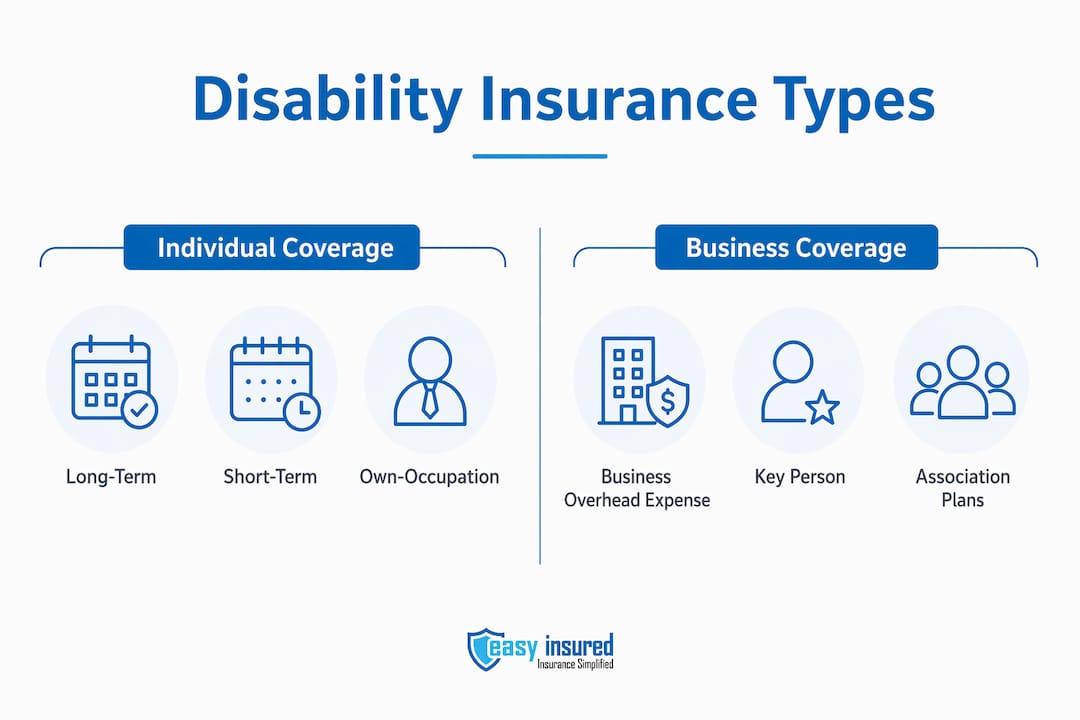
- What types of disability insurance are available to self-employed individuals?
- Key Takeaways
- Easy-insured gives self-employed Canadians a real path to income protection
How disability insurance works for self-employed Canadians
Disability insurance pays you a monthly benefit when a medical condition prevents you from performing the essential duties of your occupation. For self-employed workers, that income replacement is calculated from your net self-employed income as reported on your tax returns, typically averaged over the two most recent years.
The mechanics differ from what employees experience:
- Own-occupation definition: Benefits pay if you cannot perform your specific job, even if you could theoretically do other work. A self-employed physiotherapist who loses hand function qualifies, even if they could answer phones.
- Any-occupation definition: Far stricter. Benefits only pay if you cannot perform virtually any gainful work. Standard any-occupation policies often deny claims if other employment is possible, which is why own-occupation coverage matters so much for specialists and tradespeople.
- Waiting (elimination) period: The time between your disability onset and your first benefit payment. Options run from 30 to 365 days; 90 days is the most common for self-employed buyers.
- Benefit period: How long payments continue. Options range from two years to age 65 or 67. Most self-employed Canadians choose to age 65 for maximum protection.
- Policy renewal terms: Non-cancellable, guaranteed-renewable policies lock in your premium and benefits as long as you pay. The insurer cannot raise rates or alter coverage without your consent.
The claims process requires both medical evidence and financial documentation. You will need physician confirmation of your condition and proof of income, typically your Notice of Assessment from the Canada Revenue Agency. Without employer records to fall back on, self-employed individuals face unique income verification challenges during claims.
What conditions actually trigger disability claims for self-employed workers?
The most common reasons self-employed Canadians file disability claims are not dramatic accidents. They are the slow-building conditions that quietly make it impossible to keep working.
- Musculoskeletal injuries: Back problems, repetitive strain injuries, and joint conditions are leading claim drivers, particularly for tradespeople, contractors, and anyone doing physical work.
- Mental health conditions: Depression, anxiety disorders, and burnout have become a significant and growing category of disability claims across all occupations.
- Cardiovascular disease and cancer: These are among the most frequent causes of long-term disability claims in Canada, often requiring extended treatment and recovery periods that stretch well beyond a short-term savings cushion.
- Chronic illness: Conditions like multiple sclerosis, diabetes complications, and autoimmune disorders can gradually limit your ability to perform essential job duties without a single acute event.
- Neurological conditions: Migraines, concussions, and progressive neurological disorders can impair cognitive function, which is particularly disabling for knowledge workers and professionals.
For self-employed workers, any of these conditions creates a compounding problem. Your personal income stops, but your business overhead does not. Rent, software subscriptions, equipment leases, and any staff you employ keep drawing from your accounts. That is the gap BOE insurance is designed to fill, separate from your personal income replacement policy. Timely documentation matters: the sooner you report a claim and gather medical records, the smoother the process.
Why self-employed Canadians cannot afford to skip disability coverage
No employer. No group plan. No paid sick leave. When you work for yourself, the entire financial risk of a disability lands on you alone.
Approximately 1 in 4 Canadians will experience a disability lasting 90 or more days before retirement. That is not a fringe risk. For a self-employed person, a disability of that length without coverage means:
- Mortgage or rent payments stop being manageable within weeks if savings are thin
- Business clients move on during a prolonged absence, sometimes permanently
- Business overhead continues regardless of whether revenue is coming in
- Family financial stability erodes as emergency funds deplete
The public safety net offers limited relief. EI sickness benefits cover up to 15 weeks at approximately 55% of earnings, with maximum weekly limits, and only for self-employed Canadians who have registered and paid EI premiums. That is a short bridge for what could be a years-long disability. Canada Pension Plan disability benefits exist but require a lengthy contributions history and carry strict eligibility criteria.
Private disability insurance is the only mechanism that can realistically replace your income for years, not weeks, and protect the business you have built.

How to choose the right disability insurance plan for self-employed individuals
Choosing the right plan starts with understanding what you actually need, not just what is cheapest. Here are the decisions that matter most:
- Own-occupation vs. any-occupation: Always prioritize own-occupation or “true own-occupation” coverage. It is the difference between a policy that pays when you cannot do your job and one that pays only when you cannot do any job.
- Benefit period: To-age-65 is the standard recommendation for self-employed buyers. Shorter periods (two or five years) cost less but leave you exposed if a disability is permanent.
- Elimination period: A 90-day elimination period is the practical sweet spot for most self-employed Canadians with a modest emergency fund. Shorter periods (30 days) cost significantly more; longer ones (180 days) require larger cash reserves.
- Income replacement percentage: Policies typically replace 60–70% of average monthly earnings based on documented income.
- Policy type: Individual policies offer the strongest own-occupation definitions and portability. Association group plans are cheaper but often use any-occupation definitions after a period. BOE policies are a separate layer for business expenses.
- Key riders to consider: Residual disability rider (partial benefits when returning to work at reduced capacity), COLA rider (benefit increases with inflation after disability begins), and future purchase option (increase coverage as income grows without re-underwriting).
- Non-cancellable provisions: Policies with non-cancellable and guaranteed-renewable terms lock in your premium and coverage terms for the life of the policy.
Pro Tip: Work with a licensed insurance broker who specializes in disability coverage. Policy language varies materially between carriers, and the difference between an own-occupation and any-occupation definition can mean the difference between a paid claim and a denied one.
Eligibility criteria and what disability insurance actually costs
Who qualifies
To get approved for individual disability insurance in Canada, you need to demonstrate stable, verifiable income. Insurers typically require:
- Two years of tax returns (T1 General and Notice of Assessment) showing consistent net self-employed income
- Minimum income thresholds that vary by carrier, but generally you need to earn enough to justify the benefit amount you are applying for
- Medical underwriting: Age, current health status, pre-existing conditions, and occupation class all factor into approval and premium rates
- Occupation classification: Insurers assign occupations to risk classes. A software developer pays far less than a roofer for the same benefit amount.
What you will pay
Premiums typically range from 1% to 3% of the income replacement coverage value annually. A 35-year-old consultant earning $100,000 might pay $1,200–$1,800 per year for $5,000 monthly benefit to age 65 with a 90-day elimination period and own-occupation rider. Higher-risk occupations pay considerably more.
Self-employed workers pay more than employees with group coverage because there is no employer cost-sharing. That said, the coverage is portable and individually owned, which a group plan is not.
Tax implications
Personal disability insurance premiums paid with after-tax dollars are not tax-deductible for self-employed individuals. The trade-off is that benefits received are tax-free. For BOE policies, premiums are generally deductible as a business expense, but the benefits received are taxable. Understanding these self-employment tax deductions is worth reviewing with your accountant before you buy.
Is disability insurance actually worth it for self-employed workers?
The math is straightforward. If a 40-year-old self-employed Canadian earning $90,000 a year becomes disabled for three years, the income loss is $270,000 before accounting for inflation or business overhead costs. A policy paying $4,500 per month to age 65 might cost $2,000–$3,000 per year in premiums. The break-even point on a three-year claim is reached within the first year of benefits.
The harder question is whether you can afford the risk of going without it. Consider:
- Savings adequacy: Most financial planners recommend three to six months of expenses as an emergency fund. A disability lasting two or more years exhausts that quickly.
- Business continuity: Without income, maintaining client relationships, paying staff, and keeping the business operational becomes nearly impossible.
- Residual and partial disability benefits: Good policies include residual disability riders that pay partial benefits when you return to work at reduced capacity. This matters enormously during recovery, when you might be working half-time before you are fully back.
- The duration reality: Disabilities that trigger claims often last far longer than people expect. A back injury or mental health episode that sidelines you for six months is not unusual.
The one scenario where disability insurance is genuinely less critical: you have substantial liquid assets, no dependents, and low fixed expenses. For everyone else running a self-employed business in Canada, the risk of going uninsured outweighs the premium cost by a wide margin.
Easy-insured’s disability insurance solutions for self-employed Canadians
Easy-insured is recognized among the top health insurance agencies for small business owners in Canada, with disability coverage built specifically for freelancers, contractors, sole proprietors, and incorporated business owners.
Here is what Easy-insured brings to self-employed disability coverage:
- Customizable individual disability policies with own-occupation definitions, so your benefit reflects your actual profession, not a generic standard
- Business overhead expense insurance that covers fixed costs while you recover, keeping your business alive during a disability
- Income documentation guidance from licensed advisors who understand the unique challenges of proving self-employed income during underwriting and claims
- Rider selection support: advisors help you evaluate which riders (residual, COLA, future purchase option) make sense for your income trajectory and risk tolerance
- Claims support: Easy-insured’s team assists with documentation and the claims process, which is where self-employed policyholders most often need help
Pro Tip: When applying for disability insurance as a self-employed Canadian, have your last two years of T1 returns and Notices of Assessment ready before your first advisor meeting. It speeds up underwriting and gives your advisor an accurate picture of your insurable income.
How to get started with Easy-insured:
- Visit easy-insured.com/disability to review coverage options
- Use the quote tool to get a preliminary estimate based on your occupation and income
- Book a consultation with a licensed advisor to discuss own-occupation definitions, riders, and BOE coverage
- Submit your application with income documentation and medical history
- Review your policy terms carefully, particularly the disability definition and elimination period
How pre-existing conditions affect your eligibility and premiums
Pre-existing conditions are one of the most significant underwriting variables in disability insurance, and they affect self-employed applicants differently than employees joining a group plan.
When you apply for individual disability insurance, the insurer reviews your full medical history. A pre-existing condition does not automatically disqualify you, but it changes what you are offered. Common outcomes include:
- Exclusion riders: The insurer approves your policy but excludes claims related to the specific pre-existing condition. A history of back problems might result in a musculoskeletal exclusion rider.
- Premium loading: Higher premiums to account for elevated risk, without excluding the condition outright.
- Postponement: If a condition is acute or recently diagnosed, the insurer may postpone the application until the condition stabilizes.
- Decline: Severe or progressive conditions may result in a full decline from standard carriers. Specialized markets exist for some cases.
The contrast with group association plans is notable. Many association plans offer simplified underwriting or guaranteed issue for new members, which can be an entry point for self-employed individuals with health histories that complicate individual underwriting. The trade-off is the any-occupation definition and lower benefit limits that typically come with those plans.
Applying while you are healthy and your income is established gives you the best access to own-occupation coverage at standard rates. Waiting until a health issue emerges limits your options considerably.
What types of disability insurance are available to self-employed individuals?
Self-employed Canadians have more coverage options than most realize. The right combination depends on your occupation, income level, and business structure.
Individual long-term disability insurance
This is the foundation of any solid protection plan. You own the policy, it is portable, and it can be written with an own-occupation definition. Benefit periods typically run to age 65, and you can add riders to customize coverage. Income replacement generally covers 60–70% of your documented net income, and premiums are fixed for the life of the policy if it is non-cancellable.
Business overhead expense (BOE) insurance
BOE insurance is a separate policy that covers your fixed business expenses during a disability. Rent, utilities, equipment leases, employee salaries, and professional fees are all eligible expenses. Coverage can reimburse up to 100% of covered fixed monthly costs. This is particularly critical for self-employed professionals with staff or significant overhead, since personal disability income insurance does not touch business expenses.
Association group plans
Professional associations, trade groups, and industry organizations sometimes offer group disability coverage to members. These plans are typically cheaper than individual policies and may have simplified underwriting. The catch: most use any-occupation definitions after an initial own-occupation period, and coverage is not portable if you leave the association. They work best as a supplement or as a starting point while you build toward an individual policy.
Short-term disability insurance
Short-term disability covers the first 90–180 days of a disability. It is difficult to obtain as a standalone individual product in Canada. Most self-employed workers address this gap with emergency savings rather than a separate short-term policy. If you want formal short-term coverage, some carriers offer it as a rider on a long-term policy.
Key person disability insurance
If your business depends on a specific employee or partner, key person disability insurance compensates the business for revenue loss resulting from that person’s disability. This is distinct from your personal income replacement and is structured as a business-owned policy.
For most self-employed Canadians, the practical starting point is an individual long-term disability policy with own-occupation coverage, supplemented by BOE insurance if you carry meaningful business overhead. You can explore disability coverage options tailored to your situation through Easy-insured’s advisory team.
Key Takeaways
For self-employed Canadians, individual own-occupation disability insurance is the only coverage that reliably replaces your specific income and protects your business when a disability strikes.
| Point | Details |
|---|---|
| Own-occupation coverage is non-negotiable | Policies with any-occupation definitions frequently deny claims; own-occupation pays if you cannot do your specific job. |
| Income replacement is based on documented net income | Policies replace a portion of average monthly earnings, calculated from two years of tax returns. |
| Premiums run 1%–3% of coverage value annually | Cost varies by age, occupation class, benefit period, and elimination period chosen. |
| 1 in 4 Canadians face a 90+ day disability | The probability of a long-term disabling event during a working career makes coverage a practical necessity, not a luxury. |
| Easy-insured offers tailored self-employed solutions | Easy-insured provides customizable individual disability policies, BOE coverage, and licensed advisor support for self-employed Canadians. |
Easy-insured gives self-employed Canadians a real path to income protection
Running your own business means every dollar of income depends on your ability to work. Easy-insured was built for exactly that reality. Unlike a generic online quote tool, Easy-insured’s licensed advisors work through your actual income documentation, occupation class, and business structure to find coverage that holds up when you need it.
The difference with Easy-insured is specificity. Self-employed Canadians get own-occupation policy options, BOE coverage for business expenses, and guidance on riders that match how your income actually works, whether you are a freelancer with variable earnings or an incorporated professional with fixed overhead. Easy-insured is also recognized among top agencies for small business owners, which means the advisory experience reflects the real complexity of self-employed income protection.
You can also pair disability coverage with critical illness insurance for a more complete protection plan, since some conditions that do not fully disable you can still generate significant out-of-pocket costs.
Get a personalized disability insurance quote at easy-insured.com/get-quotes and speak with a licensed advisor who understands what self-employed income protection actually requires.