
Avoiding probate in British Columbia is straightforward when you use the right legal tools. Joint tenancy, named beneficiaries on registered accounts, inter vivos trusts, lifetime gifting, and multiple wills all transfer assets outside your estate, cutting both fees and delays. The strategies below are not theoretical. BC residents use them every day to protect their families from a process that can stretch months and cost thousands.
The fastest ways to bypass probate in BC:
- Hold real estate and bank accounts in joint tenancy with right of survivorship
- Name beneficiaries on RRSPs, TFSAs, RRIFs, life insurance, and pension plans
- Transfer assets into an inter vivos (living) trust before death
- Gift property to heirs during your lifetime
- Use multiple wills to separate probatable assets from private company shares or other non-probatable property
Each method has trade-offs. The right combination depends on your asset mix, family situation, and tax position.
What is probate in BC and why does it matter?
Probate is a court-supervised process that confirms a will’s validity and authorizes an executor to administer an estate. Financial institutions and BC’s Land Title and Survey Authority routinely require a Grant of Probate before releasing funds or transferring registered property. Without it, your executor’s hands are tied.
Key facts about BC probate:
- The BC Supreme Court issues the Grant of Probate after verifying the will
- Banks, investment firms, ICBC, and the Canada Revenue Agency each have their own thresholds for releasing assets without probate
- Probate fees are calculated on graduated scales based on total estate value
- Estates valued below a certain low threshold pay no probate fee
- The process can take months, sometimes longer for contested estates
- Probate makes the will’s contents public record
The executor named in your will must apply to the BC Supreme Court, submit Form P2 and related documents, and file an Application for Search of Wills Notice with Vital Statistics before the court will act.
Common legal methods to avoid probate in BC
Joint tenancy with right of survivorship is the most widely used strategy. When one joint owner dies, their interest passes automatically to the survivor, completely outside the estate. No probate, no property transfer tax on that transfer.

Beneficiary designations work the same way for registered accounts and insurance. RRSPs, TFSAs, RRIFs, life insurance policies, and employer pension plans with a named beneficiary bypass probate entirely. The funds go directly to the person you named, often within days of death.
Trusts remove assets from your estate while you are still alive. An inter vivos (living) trust, an alter ego trust (available to those 65 and older), or a joint partner trust each hold assets outside your estate so they avoid probate on your death. You can retain significant control during your lifetime, particularly with a revocable living trust.
Lifetime gifting is blunter but effective. Once you transfer an asset, it is no longer yours and cannot be subject to probate. Cash, vehicles, jewelry, and even real estate can all be gifted.
Multiple wills let you separate assets that require probate (solely owned real estate, bank accounts) from those that do not (private company shares, certain personal property). Your executor probates only the first will, leaving the second will’s assets to transfer without court involvement.
Risks and pitfalls of probate avoidance strategies in BC
Every strategy carries real downsides. Joint tenancy exposes assets to the creditors of any joint owner, including a co-owner’s divorce proceedings. Adding an adult child to a property title can trigger the “presumption of resulting trust,” where courts assume the child holds the interest for the estate unless you have clear written evidence of a gift. The BC Supreme Court has examined many such cases.
Risks by strategy:
- Joint tenancy: creditor exposure, unintended tax consequences, loss of control, potential family disputes
- Trusts: setup costs, ongoing administration fees, tax implications under BC and federal law
- Gifting: permanent loss of control, capital gains tax on appreciated assets, property transfer tax on real estate
- Beneficiary designations: may create unequal distributions if your will assumes those assets are part of the estate
- Multiple wills: must be carefully drafted to avoid conflicts between the two documents
Improper planning without professional guidance can trigger litigation among heirs, unintended tax burdens, and loss of control over assets during your lifetime. Sometimes paying a modest probate fee is genuinely cheaper than the legal costs of an aggressive avoidance strategy gone wrong.
Pro Tip: Before adding anyone to a title or moving assets into a trust, get written legal advice. A one-page letter from a BC estate lawyer documenting your intentions can prevent years of litigation.

What assets are exempt from probate in British Columbia?
Certain assets pass outside your estate by operation of law, regardless of what your will says.
Assets that typically bypass BC probate:
- Real estate held in joint tenancy
- Non-registered bank accounts with a surviving joint owner
- Life insurance with a named beneficiary
- RRSPs, RRIFs, TFSAs, and employer pension plans with a named beneficiary
- Assets held in an inter vivos trust
- Gifts completed during your lifetime
- Private company shares or valuable personal property covered by a secondary will
- Most household items and personal effects of modest value
Some personal property such as jewelry, expensive artwork, and valuable heirlooms may still require probate depending on their value. Clear ownership documentation and up-to-date beneficiary designations are what actually make the exemption stick. An asset with a stale or missing designation can fall back into the estate.
Probate application process, fees, and timelines in BC
The executor applies for a Grant of Probate at any BC Supreme Court registry. The application requires the original will, Form P2, an inventory of estate assets, and a Wills Notice search from Vital Statistics. Filing a Wills Notice while alive is voluntary and carries a small fee, but it simplifies the search process for your executor.
BC probate fees under the Probate Fee Act:
| Estate value | Fee |
|---|---|
| — | — |
| — | — |
| — | — |
Estates over $50,000 pay $150 plus $14 per $1,000 above that threshold, before legal fees, asset transfer costs, and other administrative expenses. Timeline from application to estate settlement typically runs several months for straightforward estates, and considerably longer when assets are complex or the will is contested.
Local BC legal support for probate avoidance and estate planning
Three Vancouver-area firms specialize in exactly this work.
| Firm | Core focus | Notable strength |
|---|---|---|
| ALG Lawyers | Estate planning, probate, family law | Offices in Vancouver, Surrey, and Abbotsford; practical fee-reduction guidance |
| Onyx Law Group | Estate litigation, trusts, probate administration | Boutique firm; complex family and estate disputes; flexible billing |
| Munro & Crawford | Wills, trusts, probate, elder care | Extensive experience; reduced-rate initial consultations |
ALG Lawyers publishes detailed guidance on balancing probate fee reduction against legal risk, a useful starting point before any consultation. Onyx Law Group handles both planning and litigation, which matters if your estate involves blended families or disputed assets. Munro & Crawford’s elder care practice makes them a strong fit when the estate owner is managing health or capacity concerns alongside planning.
How to set up a trust in BC for probate avoidance
Setting up an inter vivos trust in BC follows a clear sequence.
- Define your goals. Decide which assets you want outside probate and who the beneficiaries are.
- Choose the trust type. An inter vivos trust works for most people. An alter ego trust suits those 65 and older who want to retain income rights. A joint partner trust covers spouses.
- Draft the trust deed. A BC estate lawyer prepares the document, naming you as settlor, appointing a trustee (often yourself initially, with a successor trustee), and setting out distribution terms.
- Transfer assets into the trust. Real estate requires a new title registration at the Land Title Office. Bank accounts and investments need to be re-titled in the trust’s name. This step, called “funding the trust,” is where most people stall.
- Obtain a trust account number from the Canada Revenue Agency for tax filing purposes.
- File annual trust tax returns. Trusts are separate tax entities under federal law.
- Review and update. Major life changes (marriage, divorce, new beneficiaries) require amendments to the trust deed.
Trust strategies offer privacy and control over asset distribution, but they require thoughtful setup and ongoing management. Budget for both legal fees at setup and annual accounting costs.
Transfer on Death (TOD) designations in BC
Transfer on Death designations are well established in the United States under the Uniform Transfer-on-Death Securities Registration Act, but BC does not currently recognize TOD deeds for real estate the way many American states do. In BC, the equivalent tools are beneficiary designations on registered accounts and insurance, and joint tenancy for real property.
For financial accounts, BC residents can designate beneficiaries on RRSPs, TFSAs, RRIFs, life insurance, and pension plans. These function identically to TOD designations: the asset transfers directly to the named person on death, with no probate required. For non-registered investment accounts and real estate, joint tenancy or a trust achieves the same result. If you own property outside BC, including in a US state that does recognize TOD deeds, consult an estate lawyer about cross-border planning.
Comparing probate avoidance strategies for BC residents
| Strategy | Probate avoided? | Cost to set up | Key risk | Best for |
|---|---|---|---|---|
| Joint tenancy | Yes | Low | Creditor exposure, tax consequences | Spouses, common real estate |
| Beneficiary designations | Yes | Minimal | Stale designations, unequal distribution | RRSPs, TFSAs, life insurance |
| Inter vivos trust | Yes | Moderate to high | Ongoing admin, tax complexity | Larger or complex estates |
| Lifetime gifting | Yes | Low to moderate | Loss of control, capital gains tax | Specific assets, early inheritance |
| Multiple wills | Partial | Moderate | Drafting errors, conflicts | Private company shares |
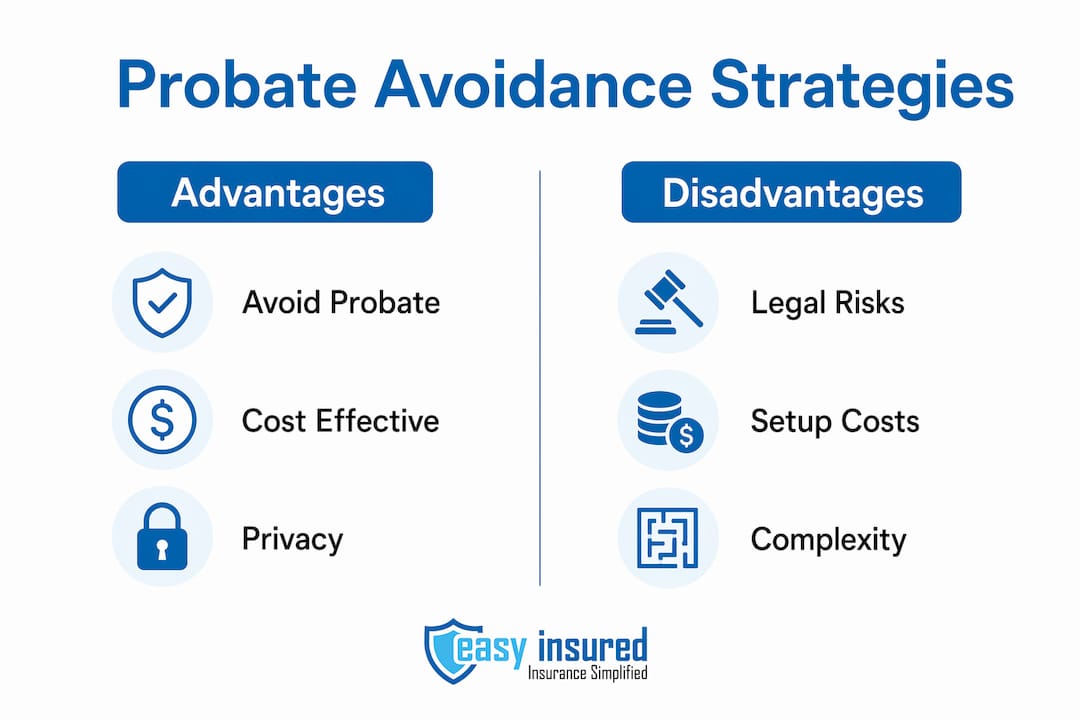
No single strategy fits every estate. Most BC residents benefit from combining two or three methods, for example, joint tenancy on the family home, beneficiary designations on all registered accounts, and a secondary will for private company shares.
How to update your estate planning documents in BC
Estate plans go stale fast. Marriage, divorce, the birth of a child, a major asset purchase, or a beneficiary’s death can all make your current documents work against you.
Steps to keep your plan current:
- Review beneficiary designations annually. Contact each financial institution and insurer to confirm the named beneficiary is still correct.
- Update your will after major life events. A new will revokes the old one; a codicil amends specific clauses.
- Re-register jointly held assets if a co-owner dies or the relationship changes.
- Amend trust deeds when beneficiaries change or new assets are acquired.
- Check your Wills Notice with BC Vital Statistics to confirm the registered location of your will matches where it is actually stored.
- Coordinate your documents. Beneficiary designations on registered accounts must align with your will. If your will assumes an RRSP is part of the estate but you have named a beneficiary, the designation wins, and the will’s distribution plan breaks down.
A structured estate planning review every two to three years catches most problems before they become disputes.
Probate vs. non-probate estate settlement: what to expect on timing
Non-probate assets settle fast. A life insurance claim with a named beneficiary typically pays out within 30 days of submitting the death certificate. Joint tenancy property transfers at the Land Title Office within weeks. Registered accounts with named beneficiaries usually release funds within a month.
Probate takes longer. A straightforward BC probate application, filed correctly with all supporting documents, generally takes several months from filing to receiving the Grant of Probate. Complex estates, contested wills, or missing documents push that timeline out further. During that entire period, solely owned assets are frozen. Your executor cannot sell the house, close the bank account, or distribute investments until the court grants authority.
The practical gap between a well-planned non-probate estate and a standard probated one is often six months to a year of additional delay, plus the fee burden. For beneficiaries who depend on an inheritance to cover immediate costs, that gap is not abstract.
How Easy-insured supports your estate planning in BC

Life insurance is one of the most efficient probate avoidance tools available. A policy with a named beneficiary pays directly to that person, completely outside your estate, with no probate fees and no court delays. Easy-insured helps BC families and business owners structure whole life and universal life policies as part of a broader estate plan, ensuring beneficiary designations are correct and coverage aligns with your estate goals.
Beyond insurance, Easy-insured’s estate planning services connect you with the right professionals to build a plan that fits your asset mix, your family, and BC’s specific legal requirements. Whether you need help with beneficiary designations, trust coordination, or understanding how your RRSP and TFSA interact with your will, the team at Easy-insured can point you in the right direction.
Key Takeaways
Avoiding probate in BC requires combining the right legal tools with accurate, up-to-date documentation across every account, policy, and title you own.
| Point | Details |
|---|---|
| Probate fees increase significantly with the size of the estate. Estates over $50,000 pay $150 plus $14 per $1,000 above that threshold. | |
| Fastest avoidance tools | Named beneficiaries on RRSPs, TFSAs, and life insurance bypass probate with minimal setup. |
| Joint tenancy risk | Adding a co-owner exposes assets to their creditors and can trigger presumption of resulting trust. |
| Trusts require funding | A trust only avoids probate if assets are formally re-titled into the trust’s name before death. |
| Annual review matters | Stale beneficiary designations and outdated wills are the most common reasons probate avoidance fails. |