
A prescribed annuity is a non-registered annuity that pays you a steady income, and for tax purposes each payment is split into the same blend of tax-free return of capital and taxable interest every year. That level treatment is the whole point. A non-prescribed annuity front-loads the taxable income, so a prescribed contract can leave you with a lower tax bill in the early years of retirement. Below we explain who qualifies, how the tax split works, what moves the rates, and what to settle with a planner before you sign.
TL;DR
- A prescribed annuity is a non-registered payout annuity from a life insurer or other qualifying financial institution. The taxable interest is spread evenly across every payment.
- A non-prescribed annuity taxes more income in the early years and less later. Annuities bought with RRSP or RRIF money are fully taxable, so prescribed treatment applies to non-registered money.
- Rates are set by each insurer and depend on your age, sex, health, the annuity type, guarantees and long-term bond yields. Quotes for the same contract differ by provider.
- You give up control of the capital in exchange for guaranteed income, so keep other liquid savings for emergencies.
Table of Contents
- What a prescribed annuity is
- Who can qualify
- How prescribed payments are taxed
- How the taxable and tax-free pieces are set
- Single life, joint life and term certain
- What happens when the annuitant dies
- What drives prescribed annuity rates
- Is a prescribed annuity a fit for you?
- Before you buy: a checklist
- Our perspective
- Talk to us about your retirement income
- FAQ
- Sources
What a prescribed annuity is
An annuity is a contract: you hand over a lump sum and the issuer promises regular payments, for life or for a fixed period. The Financial Consumer Agency of Canada explains that annuity payments combine interest, a return of your own capital, and a transfer from people who die earlier than expected to those who live longer. Payments can arrive monthly, every three months, every six months or once a year.
“Prescribed” describes the tax treatment, not a different product. A prescribed annuity contract is an immediate annuity, meaning payments have started, that is exempt from the annual accrual tax reporting in subsection 12.2(1) of the Income Tax Act, as the CRA confirmed in a May 2024 roundtable answer. Instead of reporting interest that accrues inside the contract each year, you report a fixed taxable amount as each payment arrives.
Advocis describes it as a non-registered payout annuity issued by life insurers or other specified financial institutions that meets conditions in the Income Tax Act. The original capital is treated as coming back evenly over the expected life of the annuitant. The capital part is tax-free and the rest is interest income.
Who can qualify
Two sides have to qualify: the issuer and the holder.
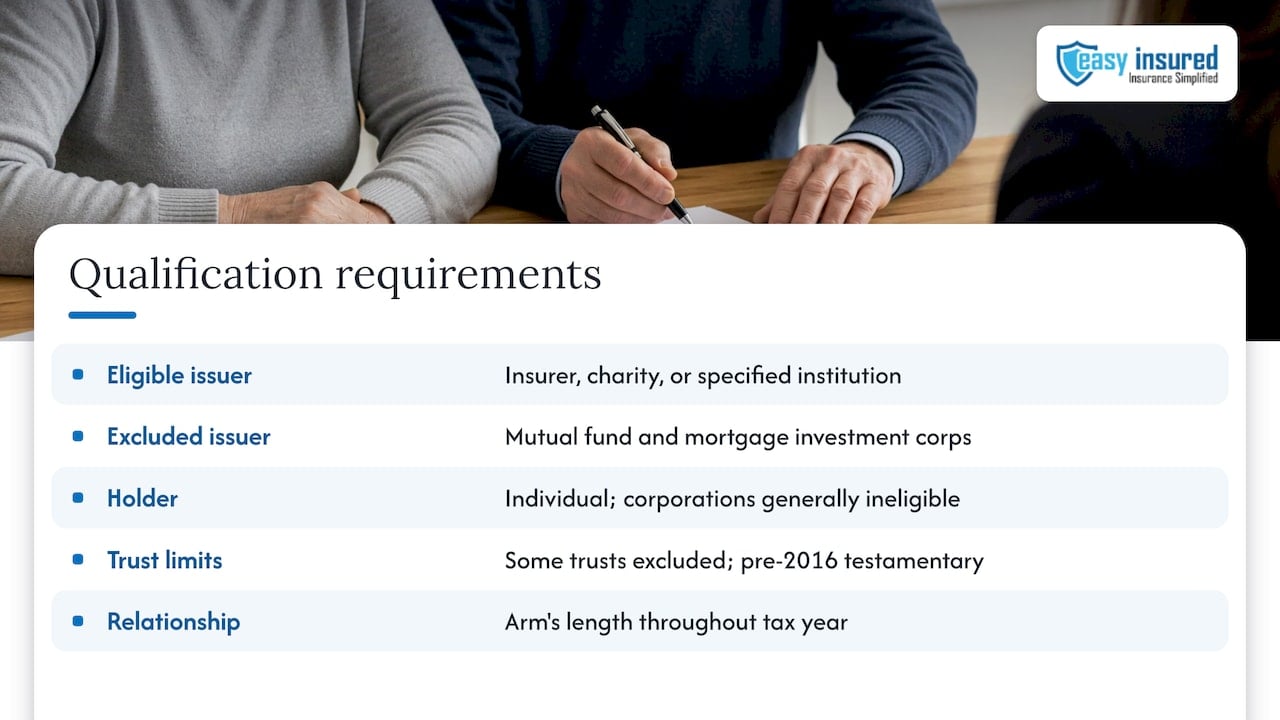
The issuer. Under Regulation 304(1)©(ii) of the Income Tax Regulations, the contract must come from a life insurance corporation, a registered charity, or a specified financial institution such as a bank, trust company, credit union or loan corporation. Mutual fund corporations and mortgage investment corporations are excluded.
The holder. The same regulation says the holder must be an annuitant under the contract and must be an individual other than a trust, a specified trust (this includes spousal, alter ego and joint partner trusts), a qualified disability trust, or a testamentary trust if the contract was issued before 2016. The holder must also deal at arm’s length with the issuer throughout the tax year. The CRA’s 2024 interpretation repeats the same list of eligible holders.
In plain terms: an individual (or one of those specific trusts) buying from an insurer or a bank with non-registered money will usually be able to get prescribed treatment. A corporation generally cannot hold one, which matters for business owners. If your savings sit inside a holding company, talk to an advisor about what a corporation can use instead before assuming this is the right tool.
How prescribed payments are taxed
The contrast with a non-prescribed annuity is easiest to see side by side. Jason Heath, CFP, explained in MoneySense that a prescribed annuity allocates the taxable income equally to each payment, while a non-prescribed annuity puts more of the income into the early years, much like a mortgage where early payments are mostly interest.
| Feature | Prescribed annuity | Non-prescribed (accrual) annuity | Annuity bought with RRSP/RRIF money |
|---|---|---|---|
| Funds used | Non-registered | Non-registered | Registered |
| Taxable portion of each payment | Same every year | Higher early, lower later | The full payment |
| Tax-free return of capital | Yes, level | Yes, but back-loaded | No |
| Tax planning feel | Predictable | Less predictable | Same as other registered income |
MoneySense also notes that payments from an annuity bought with RRSP or RRIF funds are fully taxable, while non-registered annuity payments include a tax-free return of capital and taxable interest. So the “prescribed” question only arises when the money you are annuitizing is non-registered.
A simple illustration
The numbers below are hypothetical and only show the mechanics. Say a contract pays $8,000 a year and your insurer’s statement shows that $5,000 of each payment is return of capital and $3,000 is interest. You would report $3,000 of interest income every year the annuity pays, whether it is year one or year twenty. With a non-prescribed contract of the same size, the first years could show a much larger taxable piece and the later years a much smaller one. Your insurer issues the tax slip that shows the figures to report, and your accountant can model how that fits with your other income.
How the taxable and tax-free pieces are set
The split is not a guess. For a life contract, the capital portion is worked out under section 300 of the Income Tax Regulations. It uses the expected total of payments, which is the annual payments multiplied by the annuitant’s complete life expectancy from a prescribed mortality table. For contracts where annuity rates were fixed on or after 2017, that table is the Annuity 2000 Basic Table. Earlier contracts use the 1971 Individual Annuity Mortality Table.
What this means for you: the longer your expected lifetime at purchase, the more the original capital is spread out, and the smaller the capital slice in each payment. A younger buyer will therefore tend to see a larger taxable share per dollar of payment than an older buyer, all else equal. The insurer does the calculation, so you do not have to.
Single life, joint life and term certain
The contract type changes what happens after you die, and it also changes your payment.
- Single life. Payments continue for as long as you live and stop at your death. This usually produces the highest payment for a given premium because nothing is promised to anyone else.
- Joint life. Payments continue while either of two annuitants is alive. This suits couples who both rely on the income. Regulation 304(2) allows a joint annuity to decrease its payments from the death of one annuitant without losing prescribed status, which is how some contracts pay 60% or 75% to the survivor.
- Term certain. Payments run for a chosen period, and if the holder dies during the guaranteed period the outstanding payments can be commuted into a lump sum without disqualifying the contract. We cover this type in detail in our guide to term certain annuities in Canada.
For life contracts, you can also add a guarantee period or a refund feature. These shape what a beneficiary receives, and they lower the starting payment. Our article on the cash refund annuity shows how that trade-off looks in practice.
What happens when the annuitant dies
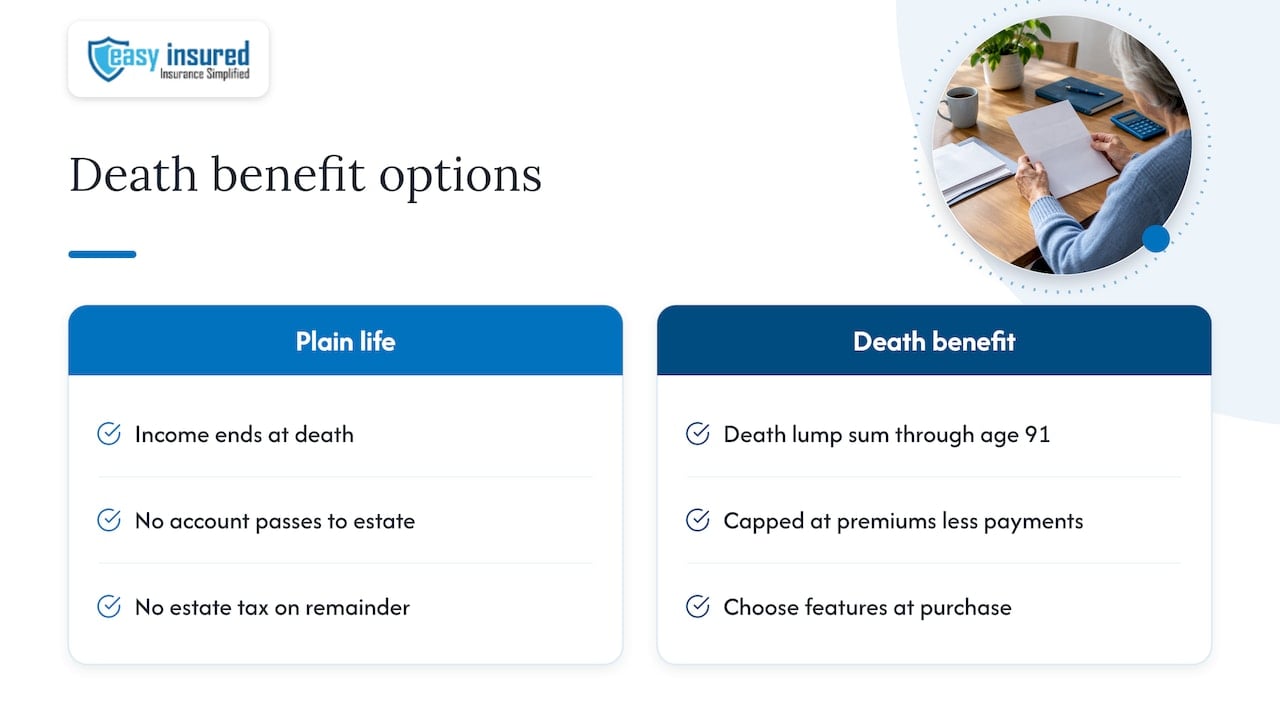
This is the part people worry about most. With a plain life annuity, the income ends at death, and there is no remaining account to pass on or to be taxed in the estate. That is a feature for people who want certainty about income, and a trade-off for those who want to leave a large lump sum from this particular money.
Regulation 304(2) also lets a prescribed contract include a lump sum on the holder’s death at or before age 91, not exceeding premiums paid minus the payments already made. Guarantee periods and refund options are built on this kind of exception. If leaving money to children or a charity matters, choose these features at purchase, because they can’t usually be added afterward. Pair the decision with your estate plan: our checklist of estate documents that stop probate delays and the guide to estate planning strategies that reduce estate taxes show how the annuity fits with beneficiary designations and life insurance.
What drives prescribed annuity rates
There is no single posted rate for a prescribed annuity. The FCAC lists the factors: your gender, age and health at purchase, the amount invested, the annuity type, whether payments continue to a beneficiary or estate, the payment period, the interest rate at purchase, and the provider. Providers can offer different payments for the same type of annuity.
Canadian MoneySaver adds that each insurer builds its numbers from mortality rates, insurance credits, its own expenses including agent commission, and whether the money is registered or not. The same piece points out that long-term bond yields (10 years and beyond) weigh more on annuity pricing than short-term rates. It also explains that higher rates do lift annuity income, but the effect is smaller than most people expect, because life expectancy assumptions move payouts the most.
Rough payout ranges
For a sense of scale, Formusa Zuccaro LLP reported in July 2025 that a 70-year-old paying $100,000 could see about $614 to $663 a month for a man and $564 to $611 for a woman, with no guarantee period. The firm notes that the actual rate is set by each issuing company and varies slightly between them. Those figures are a snapshot. Rates move with bond yields, so ask for a current quote before you plan around any number.
Two habits help when you compare quotes:
- Request quotes on identical terms: same premium, same ages, same guarantee period, same survivor percentage.
- Compare the after-tax picture, not only the headline payment, since the taxable share differs with age and contract type.
Is a prescribed annuity a fit for you?
A prescribed annuity tends to make sense when several of these are true:
- You have non-registered savings, such as proceeds from a sale, an inheritance or maturing investments, that you want to turn into dependable income.
- You are worried about outliving your savings, or you want a floor of income that covers fixed costs.
- You would prefer a level, predictable taxable amount over a variable one.
- You have other liquid savings for emergencies, because, as Advocis notes, you give up control of the capital for the guaranteed income.
If your savings are mostly in an RRSP, the question shifts to timing: our guide to RRIF withdrawal rules and age 71 explains how registered money turns into income. For couples, the interaction with pension income splitting can change which spouse should hold the contract. If you want payments that grow, read about inflation protection options for annuities, and for a comparison with variable payout designs see life annuity versus variable payment annuity.
Before you buy: a checklist
The FCAC advises that before buying an annuity you should ask for the list of fees and commissions, understand the contract restrictions including penalties and administrative fees, and compare similar products from several providers. It also recommends speaking with a financial professional about what is right for you, when to buy and when to start payments.
Bring these to that conversation:
- Whether the money is registered or non-registered, and what the tax treatment will be.
- Whether the holder qualifies (individual or an eligible trust) and who the annuitants are.
- Your marginal tax rate now and expected later, plus other retirement income.
- The guarantee period, survivor percentage and any refund feature.
- Whether inflation indexing is worth the lower starting payment.
- How much liquid money you will still have after the purchase.
Our article on the four documents to gather before buying an annuity goes through the paperwork step by step.
Our perspective
We see the same pattern with families and owners nearing retirement. They have built savings in a few places, and what they want is a reliable paycheque, not another account to watch. A prescribed annuity can be one tidy answer for the non-registered part of that money, because the tax bill stays level and easy to plan around.
We also think an annuity should never stand alone. It works best next to life insurance that protects a spouse, an estate plan that names the right beneficiaries, and cash you can reach in a hurry. Our approach is to start from the income you need and the legacy you want, then choose the contract type that fits, whether that is single life, joint life or term certain.
That is why we work with a certified financial planner on retirement and estate questions together, and why we explain the contract features in plain language before anything is signed.
Frank
Talk to us about your retirement income
If you are weighing a prescribed annuity against other ways to draw income, our team can look at it together with your retirement, tax and estate planning. We offer retirement, estate and financial planning for Canadian families and business owners, alongside life insurance for the legacy side of the plan.

If you want to see how an annuity sits with the rest of your plan, start with our financial planning page and tell us your goals.
FAQ
Can I buy a prescribed annuity with my RRSP or RRIF?
No. Prescribed treatment applies to non-registered money. Payments from an annuity bought with RRSP or RRIF funds are fully taxable as income. A registered annuity still gives guaranteed income, but there is no tax-free capital slice in each payment.
Can a corporation hold a prescribed annuity?
Generally not. The regulations limit holders to individuals and certain trusts, and Advocis notes that corporations and most trusts cannot own one. Business owners with money inside a company should review options with a tax advisor first.
Is the taxable amount the same every year?
Yes, that is the defining feature. A prescribed annuity allocates taxable income equally to each payment, while a non-prescribed annuity is taxed more heavily in the early years. Your insurer reports the amount each year.
What do I get if I die early?
With a plain life annuity, payments end and nothing remains. If you want something to pass on, ask about a guarantee period or a refund feature at purchase. Regulation 304(2) allows certain lump sums on death at or before age 91 without losing prescribed status.
Why do two insurers quote different payments?
Each insurer sets its own rates using mortality assumptions, expenses and long-term bond yields, so providers can offer different payments for the same type of annuity. Compare quotes built on the same terms, and review them with a financial professional.
Sources
- Annuities, Financial Consumer Agency of Canada
- Income Tax Regulations, section 304
- Income Tax Regulations, section 300
- CRA CALU Roundtable, 7 May 2024, Q. 7
- How annuities work in Canada, MoneySense
- Is It Time to Revisit Prescribed Annuities for Retirees?, Advocis
- Interest Rate Hikes And Annuity Payouts, Canadian MoneySaver
- Making the RRSP decision when you turn 71, Formusa Zuccaro LLP