
If you are covered by more than one group health or dental plan in Canada, the plans work together on each claim. One plan pays first, the other pays some or all of what is left, and together they never pay more than 100% of the eligible expense. That process is called coordination of benefits (COB). This guide explains who pays first, how to file claims in the right order, and why you sometimes still owe a small balance.
TL;DR
- COB sets the order in which insurers pay. Combined payments cannot exceed 100% of the eligible expense, and can be less than the amount you were charged.
- Your own plan as an employee normally pays before a plan that covers you as a spouse or dependent.
- For a child covered under both parents’ plans, the parent whose birthday (month and day) comes first in the calendar year has the primary plan.
- Submit to the primary plan first, then send the leftover amount and the first insurer’s statement to the second plan.
- If a claim is denied, start with your plan administrator and insurer, then use the insurer’s complaint process and, as a last step, the OmbudService for Life and Health Insurance.
Table of Contents
- What coordination of benefits means
- Which plan pays first
- The birthday rule for children
- How to submit a claim to the primary and secondary plans
- Why you may not get 100% back
- Using a health care spending account with your other plans
- Setting up your benefits so they work together
- Coordination of benefits and other kinds of insurance
- Perspective
- Where we can help
- What to do if a claim is denied or the rules seem to conflict
- FAQ
- Sources
What coordination of benefits means
Many Canadian households have two sets of workplace benefits. You have a plan through your job, and your spouse has one through theirs. Often each of you is also listed as a dependent on the other’s plan. Without a rule, both insurers could be asked to pay the same bill, and you could be reimbursed more than you spent.
COB prevents that. It decides the order of payment and caps the total. The Canadian Life and Health Insurance Association (CLHIA) publishes industry guidelines, including Guideline G4 on coordination of benefits for group health and dental plans, to help insurers settle the order when more than one plan is involved.
The practical upside is real. Used well, two plans can cover most or all of an eligible expense that one plan would only partly cover. The limit is the cap: you can recover what you spent, but not profit from it.
Which plan pays first
Member versus dependent
The first rule is simple. Under the CLHIA guideline, group plans that include COB provisions pay in order based on whether you are covered as a plan member or as a dependent. The plan where you are the member is primary. The plan where you are a spouse or dependent is secondary.
So if you and your partner both have benefits at work, your claims go to your own plan first and then to your partner’s plan. Your partner’s claims go to their plan first and then to yours.
Full-time, part-time and retiree coverage
Sometimes one person holds more than one group plan in their own right. In that case, the guideline generally treats the plan covering you as an active full-time employee as primary over part-time coverage, which in turn is primary over retiree coverage. This comes up for people who work a second part-time job with benefits, or who retired from one employer and kept that plan while working elsewhere.
Quick reference
| Your situation | Pays first | Pays second |
|---|---|---|
| Your own claim, covered at work and as your spouse’s dependent | Your own plan | Your spouse’s plan |
| Your spouse’s claim, same setup | Your spouse’s plan | Your plan |
| Two plans in your own name: full-time job and part-time job | Full-time employee plan | Part-time employee plan |
| Active employee plan and a retiree plan | Active employee plan | Retiree plan |
| Child covered by both parents | Plan of the parent with the earlier birthday in the year | Other parent’s plan |
The birthday rule for children
When a child is covered under both parents’ plans, it would be unfair to pick a parent by gender or income, so the industry uses birthdays. The claim goes first to the plan of the parent whose birthday, month and day only, occurs earlier in the calendar year. The year of birth does not matter.
A quick example: one parent was born on March 12 and the other on September 3. The March 12 parent’s plan is primary for the child. The September 3 parent’s plan is secondary, regardless of who is older.
If both parents share the same birthday, the parent whose first name comes first alphabetically has the primary plan, according to the CLHIA-based rules explained by the University of Alberta. Your plan booklet or insurer can confirm how it handles separated or divorced parents, since custody arrangements can change the order.
How to submit a claim to the primary and secondary plans
The order of filing follows the order of payment. A simple routine works for most households:
- Identify the primary plan. Use the rules above. If you are unsure, ask your plan administrator at work or call the insurer.
- Submit the full claim to the primary plan. Include the receipt, the provider’s details and any form your insurer needs. Many insurers accept claims through an app or online portal.
- Wait for the explanation of benefits. This statement shows what the first plan covered, what it did not and why.
- Submit the remaining balance to the secondary plan. Attach the first insurer’s statement along with the original receipt. Many insurers want to see how the first plan paid before they assess the rest.
- Keep copies of everything. Receipts, statements and confirmation numbers help if a question comes up later.
Some carriers can pass the claim along automatically when both plans are with the same insurer, and others ask you to file twice. Your benefits booklet or insurer’s website explains which applies to you, so check it before your first coordinated claim.
Filing deadlines
Plans set time limits for submitting claims, and the limit usually runs from the date of the expense. Do not wait for the first insurer’s paperwork to be perfect before you start. File the primary claim promptly so the secondary plan has time to consider the balance. Your plan documents state the exact deadline.
Why you may not get 100% back
This is the most common surprise. Coordinating two plans does not guarantee a full refund. The CLHIA guidance says the combined payment cannot exceed 100% of the eligible expense, and that it may be less than the amount submitted.
The reason is the word eligible. Each plan decides what part of your bill it recognizes. The University of Guelph explains that the eligible amount depends on plan maximums, cost-sharing requirements and the carrier’s reasonable and customary limits.
A worked example
Imagine a $90 service where the carrier’s reasonable and customary amount is $80. Between them, the two plans can pay only up to $80. You are responsible for the $10 above that limit, even with two plans. This is the same example the University of Guelph uses to illustrate the point.
A related case: the first plan pays part of the bill, you submit the rest to the second plan, and the second plan says nothing more is owed. That can happen because the second plan bases its payment on its own eligible amount rather than on the provider’s billed amount. If the first plan already paid up to the second plan’s eligible level, there is nothing left to cover.
Common reasons for an unpaid balance
- The provider charged more than the plan’s reasonable and customary amount.
- You reached an annual maximum on one or both plans, such as a cap on physiotherapy visits.
- A plan has a deductible or a co-insurance percentage that applies to your claim.
- The service is not covered under either plan.
Using a health care spending account with your other plans
A health care spending account (HCSA) is a tax-friendly pot of money your employer funds for medical and dental costs. It is meant to cover what your insured plans leave behind, so it comes after them. The University of Waterloo’s factsheet from GreenShield notes that members should coordinate with other plans first, and that auto-coordination options can then apply unpaid balances to the HCSA automatically.
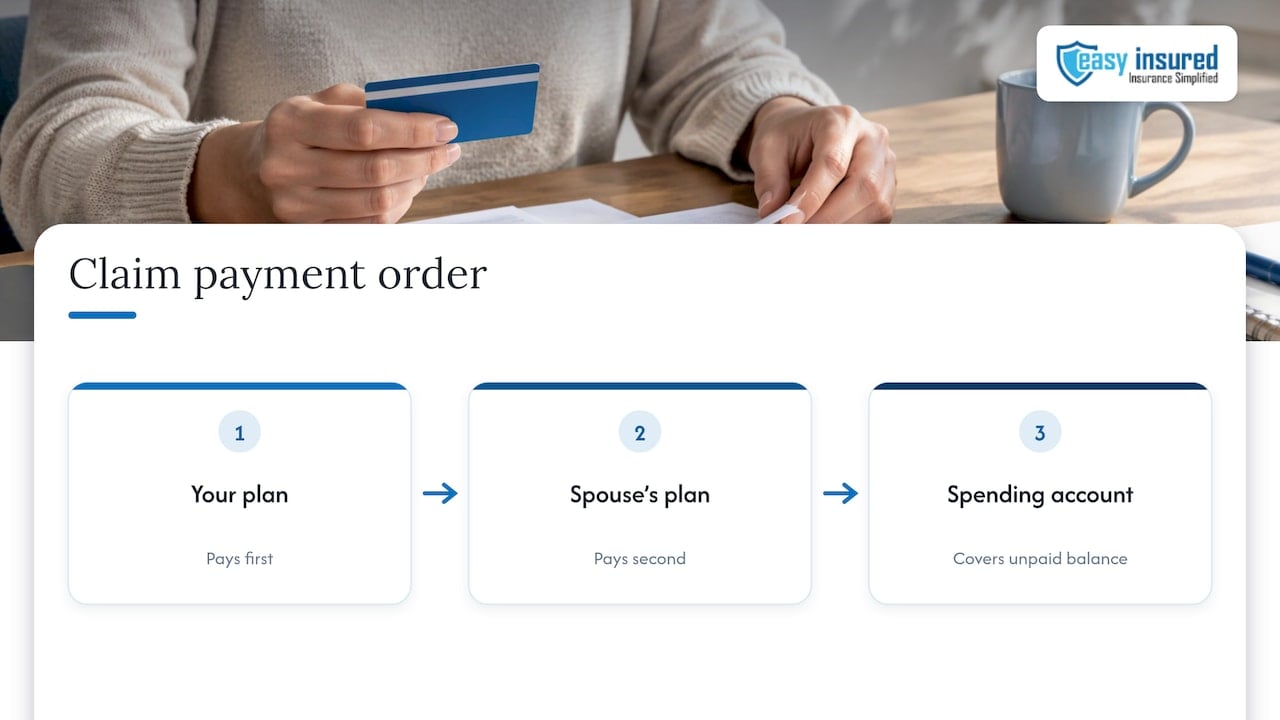
The order for a household with all three looks like this: your own health and dental plan, then your spouse’s plan, then the spending account. If you are deciding whether an account fits your business or household, our article on setting up a health spending account in Canada walks through the question.
Setting up your benefits so they work together
COB works best when you plan for it before you need it. A few habits make the process easier.
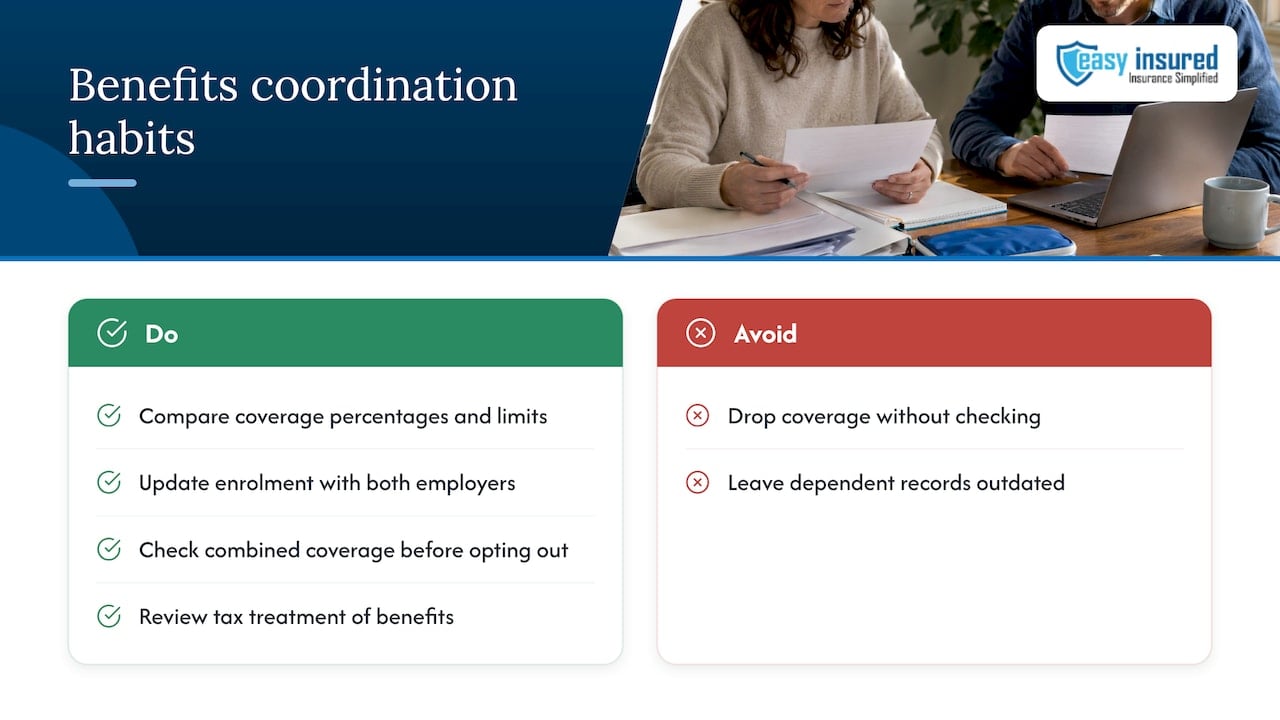
Know what each plan covers. Compare the percentages, annual maximums and covered services on both plans. A dental plan that pays 80% and another that pays 50% will interact differently with a large claim.
Keep dependent information current. When a child is born, a partner changes jobs or a plan renews, update the enrolment details with both employers. Incorrect dependent records are a common reason for slowed claims.
Do not drop coverage without checking. A second plan can be worth keeping when it fills real gaps. Before you opt out of either plan, look at what the combined coverage reimburses.
Remember the tax angle. Some employer-paid benefits can be taxable to the employee, and disability benefits have their own rules. Our guides on taxable employee benefits and payroll steps and on whether long term disability benefits are taxable explain the details.
Coordination of benefits and other kinds of insurance
COB, as covered here, concerns group health and dental plans that reimburse expenses. Other products work differently. Critical illness and disability policies generally pay on a diagnosis or on a loss of income rather than reimbursing a receipt, so they sit alongside your group health coverage instead of being coordinated with it. If you want to see how the products differ, read critical illness versus health insurance and how disability and critical illness pay.
Perspective
Most of the COB questions we hear start the same way: “We both have benefits, so why am I still paying?” The answer is nearly always in the details of eligible expenses, annual maximums and the order of filing, not in anything the family did wrong.
We think the best response is to look at benefits as a whole. A household with two group plans, a spending account and individual coverage has several moving parts. Our approach is to map those parts, find where coverage overlaps and where gaps remain, and then fill the gaps with the right product, whether that is disability, critical illness, life insurance or a group plan for a business.
For business owners, this matters twice: once for your own family and once for the plan you may offer your employees. Our certified financial planner can help you build both so they work together, with plain-language guidance and no jargon.
Frank
Where we can help
COB sorts out who pays a bill after it arrives. The bigger question is whether your overall protection fits your life. We help Canadian families and business owners review what their group plans do and do not cover, and add individual coverage where it makes sense, from disability insurance and critical illness insurance to life insurance and financial planning.

If you own a business and want benefits your team can use, see our group insurance plans. For a broader look at your household’s finances, our financial planning page explains how we work.
What to do if a claim is denied or the rules seem to conflict
Insurers are expected to follow the COB guideline, but CLHIA notes they may use discretion in limited cases, one claim at a time. So an unusual situation does not always have a standard answer.
Here is the path CLHIA recommends:
- Talk to your plan administrator and your insurer. Explain which plan you believe is primary and why. Ask the insurer to state its reasoning in writing.
- Use the insurer’s complaint process. If the answer does not settle things, follow the insurer’s complaint or ombudsman process.
- Contact the OmbudService for Life and Health Insurance (OLHI). Group plan members can bring an unresolved complaint here as a final step, after the insurer’s own process.
Keep a record throughout. Notes of calls, copies of letters, claim numbers and dates all matter. A claims-dispute overview also advises following the internal escalation process first and keeping detailed records of the dispute.
FAQ
Can I claim from both of my plans for the same expense?
Yes, if both plans cover the expense. You file with the primary plan first and then send the balance to the second plan. Together they can reimburse up to 100% of the eligible amount, but not more than you actually spent.
Which plan is primary for my spouse’s claims?
Your spouse’s own plan, where they are the member, is primary for their claims. Your plan, which covers them as a dependent, is secondary. The same logic applies in reverse for your claims.
What if my children’s two parents share a birthday?
The parent whose first name comes first alphabetically has the primary plan for the child. The birth year is not considered, only the month and day. If your family situation is more complex, ask your insurer how it applies the rule.
Why did my second plan pay nothing?
The second plan works from its own eligible amount, not the provider’s bill. If the first plan already paid up to that level, or a reasonable and customary limit applies, the second plan may owe nothing more. Ask the insurer for an explanation of how it calculated the eligible amount.
Does a health care spending account pay before or after my insurance?
It pays after. Coordinate with your other plans first, then apply any remaining balance to the spending account, either manually or through auto-coordination if your plan offers it.
Sources
- CLHIA: Understanding the Coordination of Benefits
- CLHIA Guideline G4: Coordination of Benefits, Group Health and Dental
- University of Alberta: Coordination of Benefits
- University of Alberta GSA: Coordination of Benefits
- University of Guelph: Coordination of Benefits
- University of Waterloo: How to use your Health Care Spending Account
- How To Dispute An Insurance Claim In Canada