For the July 2026 to June 2027 payment period, Old Age Security recovery tax starts once your net world income crosses the threshold set by Service Canada, and you repay 15% of every dollar above that line. If your income clears the maximum threshold, your OAS can be reduced to zero for the period. The first move is simple: pull your prior-year tax return and check your net world income against the current thresholds before assuming anything.
TL;DR:
- The OAS recovery tax in 2026-2027 applies when net world income exceeds the threshold set by Service Canada, with 15% of income above it being repayable.
- Income sources like RRIF withdrawals, capital gains, rental income, and foreign income all count toward the income threshold, potentially triggering repayments.
- Spreading RRIF withdrawals over multiple years, using TFSA withdrawals, and timing capital gains can limit clawback exposure effectively.
- Filing Form T1213(OAS) early can help reduce withholding at source if a significant income drop is expected in the relevant year.
- The repayment amount is spread evenly across twelve monthly OAS payments, and the maximum clawback is capped at the total OAS received for the period.
Table of Contents
- Quick numbers for 2026: thresholds, maximum clawback, and typical OAS amounts
- How the repayment is calculated, step-by-step, plus a worked 2026 example
- Which income counts and where to find the numbers on tax slips and returns
- Practical, lawful strategies to reduce or manage OAS clawback impact
- If OAS withholding starts: using Form T1213(OAS) and practical next steps
- How repayments affect monthly cash flow and how to read Service Canada advisory letters and T4A slips
- Easy-insured planning checklist and next steps
- Authoritative CRA and Service Canada pages and the OAS estimator
- What most retirees get wrong about the OAS clawback
- Sources
- FAQ
Quick numbers for 2026: thresholds, maximum clawback, and typical OAS amounts
The July 2026 to June 2027 recovery tax period uses your 2025 net world income to decide whether repayment applies, and the Service Canada recovery tax page publishes the exact minimum and maximum thresholds for that period along with the 15% repayment rate. Once income reaches the maximum threshold, OAS is reduced to nothing for the entire payment year.
The maximum monthly OAS amount also matters because it caps how much can actually be clawed back. Service Canada updates these figures quarterly based on the Consumer Price Index, and the OAS payment amounts page lists the current maximum for each age band.
| Item | What it determines |
|---|---|
| Minimum recovery threshold | Income level where 15% repayment begins |
| Maximum recovery threshold | Income level where OAS drops to zero |
| Repayment rate | 15% of income above the minimum threshold |
| Income year used | The calendar year two years prior to the payment period |
Your 2025 income sets your July 2026 to June 2027 repayment, not your current-year income, which is why timing matters for planning purposes.
How the repayment is calculated, step-by-step, plus a worked 2026 example
The Old Age Security recovery tax page sets out the formula plainly: repayment equals 15% multiplied by the amount your net world income exceeds the minimum threshold. Working through it takes four steps.
- Find your net world income for the relevant tax year, meaning line 23600 income before the OAS repayment deduction itself.
- Subtract the minimum recovery threshold that applies to your payment period.
- Multiply the result by 15%.
- Compare that figure to the total OAS you received. You never repay more than you were paid.
Spread across twelve monthly OAS payments, that is roughly $125 deducted each month starting in July.
The 15% repayment rate applies only to income above the threshold, never to your full OAS or your total income. Service Canada’s worked examples show this same mechanic scaling up or down depending on how far above the threshold your income sits.
The cap matters here too. Someone with a very large excess still cannot lose more than the OAS and eligible federal supplements they actually receive, so the math self-limits at total OAS entitlement.
Which income counts and where to find the numbers on tax slips and returns
Net world income for OAS purposes is broader than most people expect. It pulls in nearly every taxable income source, not just pension payments, so a big RRIF withdrawal or a one-time capital gain can push you over the threshold even in a year that otherwise feels modest.
- RRIF and RRSP withdrawals count in full as taxable income for the year they are received.
- Employment income, self-employment income, and most pension income (CPP survivor benefits included) all add to the total.
- Taxable capital gains, rental income, and foreign income reported on your Canadian return count as well.
The CRA guidance on line 11300 explains which T4A(OAS) boxes feed your return: box 18 shows your OAS pension amount, box 21 shows net federal supplements, and box 22 shows any recovery tax already withheld. Those figures flow into your Federal Worksheet and ultimately onto line 23500 for social benefits repayment.
Pro Tip: Before year-end, run the numbers through the Service Canada OAS estimator using your projected income so you can see repayment exposure while there is still time to adjust.
Practical, lawful strategies to reduce or manage OAS clawback impact
Reducing the clawback comes down to controlling when income lands, not hiding income that exists. A handful of levers do most of the work.
- Draw from your TFSA for extra cash needs since TFSA withdrawals never count toward net world income, unlike RRIF or RRSP withdrawals.
- Spread RRSP-to-RRIF withdrawals across several years rather than taking a single large sum, an approach sometimes called an RRSP meltdown strategy.
- Split eligible pension income with a lower-income spouse where you qualify, which can move a portion of taxable income off your return entirely.
- Delay your OAS start date if your broader retirement plan allows it, since starting later avoids exposure during high-income years.
- Realize capital gains in years when your other income is lower, and consider charitable donations to offset gains in a high-income year.
Pro Tip: Review TFSA room limits before withdrawing and redepositing in the same year, since TFSA contribution rules can penalize a repeated withdrawal and recontribution in the same calendar year.
Some retirees also look at reverse mortgages or insured income products to generate cash flow without adding taxable income, but these carry their own costs and estate implications. A retirement income planning review with a licensed advisor is worth doing before committing to any of these moves, since the right sequence depends on your full tax and estate picture.
If OAS withholding starts: using Form T1213(OAS) and practical next steps
If your income is expected to drop substantially for the year that determines your OAS payment period, Form T1213(OAS) lets you ask the CRA to reduce the recovery tax withheld at source instead of waiting for next year’s assessment to catch up.
- Confirm your expected income drop is real and substantial, not a one-time deduction that will reverse later.
- Complete the fillable T1213(OAS) PDF on the CRA site, including documentation supporting the lower income estimate.
- Submit the form to your tax center as early as possible, since processing takes time and withholding changes are not immediate.
While you wait, plan your cash flow as though the standard withholding will continue, then adjust once the CRA confirms the change.
How repayments affect monthly cash flow and how to read Service Canada advisory letters and T4A slips
Service Canada does not deduct your annual repayment in one lump sum. It spreads the amount across your twelve monthly OAS payments, so a $1,500 annual repayment shows up as roughly $125 shaved off each deposit rather than one large deduction.
The withheld amount appears in box 22 of your T4A(OAS) slip and reconciles against line 23500 on your tax return. Check the advisory letter Service Canada sends before assuming your OAS entitlement has permanently changed, and contact Service Canada or the CRA directly if the deposit amount does not match what the letter states.
Easy-insured planning checklist and next steps
A useful working checklist starts with modeling your prior-year net world income against a few withdrawal scenarios: what happens if you take your RRIF minimum only, versus withdrawing extra to fund a renovation, versus splitting pension income with a spouse. Compare how TFSA withdrawals versus RRIF withdrawals shift your taxable income and OAS recovery exposure side by side.
If the modeling points to a lower income year ahead, prepare your T1213(OAS) documentation early rather than scrambling in the spring. Before making any irreversible move, such as collapsing an RRSP or restructuring an estate plan, a licensed advisor should review the tax and estate consequences together, since a decision that helps this year’s OAS repayment can create a larger tax bill or estate complication later. Easy-Insured’s financial planning services are built around that kind of full-picture review.
Authoritative CRA and Service Canada pages and the OAS estimator
Verify current figures directly: the Service Canada repayment page, the T1213(OAS) form, line 23500 guidance, and the OAS estimator.
What most retirees get wrong about the OAS clawback
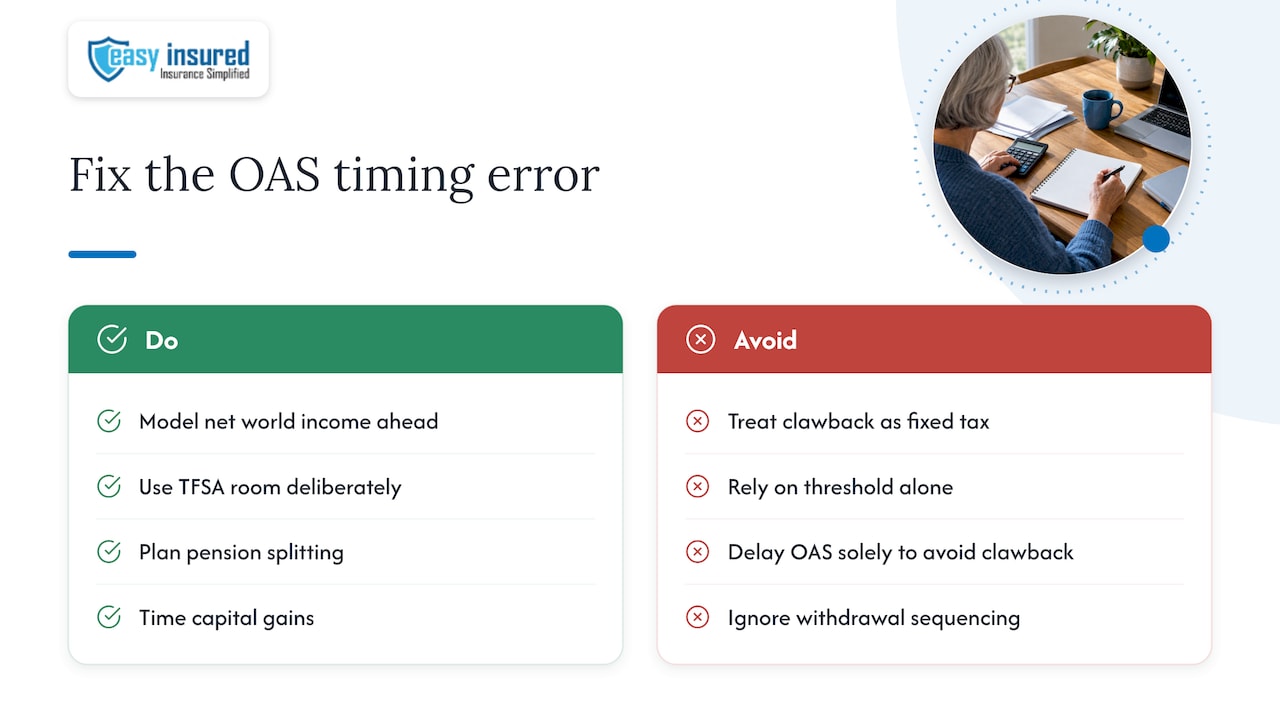
The biggest mistake is treating the OAS clawback as a fixed tax on being a certain age, rather than a timing problem you can influence. Most of the advice circulating online stops at “the threshold is X” without walking through how a single RRIF withdrawal or a poorly timed capital gain can trigger a repayment that a bit of sequencing would have avoided entirely.
The other overrated idea is delaying OAS purely to dodge the clawback. That only makes sense if it fits your broader retirement income plan, not as a standalone tactic, since delaying reduces guaranteed income in years you might need it. What actually moves the needle is modeling your net world income a year or two ahead, using TFSA room deliberately, and treating pension splitting and capital gains timing as routine parts of retirement planning rather than emergency fixes. Start with the numbers, not the workaround.
— Frank
This article is general information, not a substitute for advice from a qualified financial advisor. Consult a qualified financial professional about your own circumstances before acting on anything here.
Sources
FAQ
What are the new OAS rules for 2026?
The core rule has not changed: recovery tax still applies at 15% of net world income above the threshold for the July 2026 to June 2027 period, with the maximum threshold determining when OAS drops to zero. Thresholds are adjusted periodically, so always check the current figures on the Service Canada page before assuming last year’s numbers still apply.
How do you avoid OAS clawbacks?
You cannot avoid the clawback entirely if your income is high, but you can reduce it by timing RRIF and RRSP withdrawals across multiple years, using TFSA withdrawals instead of taxable ones, and splitting eligible pension income with a spouse. Realizing capital gains in lower-income years and filing Form T1213(OAS) when income drops are also common tactics.
Can I receive both CPP and OAS benefits at the same time?
Yes, CPP and OAS are separate programs and most retirees receive both simultaneously, along with CPP survivor benefits if applicable. CPP income does count toward the net world income used to calculate OAS recovery tax, so a decision about when to take CPP can indirectly affect your OAS clawback exposure.
How much will I receive in OAS clawback for 2027?
The exact figure depends on your net world income for the tax year that determines that specific payment period, calculated as 15% of the amount above the applicable threshold. Check the Service Canada recovery tax page closer to the period for the confirmed thresholds, then run your numbers through the OAS estimator for a personalized projection.