
The policy owner is the person or entity with legal control over a life insurance contract, and that control is the single most important fact in the whole arrangement. An owner can change the beneficiary, borrow against the cash value, surrender the policy, or assign it to someone else, and any of those moves can carry tax or legal consequences. Some insurance advisors work with families and business owners who need clarity on this before signing anything.
TL;DR:
- Transferring ownership of a policy involves potential tax implications, especially if the transfer involves unrelated parties or consideration, often triggering a taxable event.
- Proper ownership structure depends on the policy’s purpose, with options including individual, spousal, corporate, or trust ownership, each offering different control and creditor protections.
- When the owner dies, ownership typically passes to a designated successor or falls into probate if none is named, affecting estate costs and creditor claims.
- Insurers require specific paperwork and documentation for transfers, and delays or mistakes can cause unexpected tax bills or legal issues if not properly managed.
- Involving a tax-aware advisor before making ownership changes can prevent costly errors, and clear communication with the insurer is essential throughout the transfer process.
Table of Contents
- Roles in a life insurance policy: owner, insured, beneficiary, insurer
- Ownership structures: individual, spousal, corporate, and trust options
- Tax and legal implications of ownership and transfers
- How to transfer ownership: practical, step-by-step checklist
- What happens when the owner dies versus when the insured dies
- How to choose who should own the policy
- Real-world lessons from ownership and transfer decisions
- A few honest observations on ownership mistakes
- How Easy Insured supports ownership and transfer decisions
- Primary sources and recommended reading
- Sources
- FAQ
Roles in a life insurance policy: owner, insured, beneficiary, insurer
Four parties matter in every policy, and confusing them is where most ownership problems start. The insurer is the company that issues the contract and pays the claim. The insured is the person whose life is covered. The beneficiary receives the death benefit. The owner holds every legal right over the contract itself, including rights the insured does not automatically have.
In most personal policies, the owner and the insured are the same person, which keeps decisions simple. Exceptions are common though: a spouse might own a policy on their partner, a business might own a policy on a key employee, or a trust might own a policy for estate purposes. When the owner and insured differ, the insured has no automatic say over the contract unless they also happen to be the owner.
An owner’s specific powers include:
- Naming or changing the beneficiary at any time, unless the designation is irrevocable
- Accessing the policy’s cash value through loans or withdrawals, where applicable
- Surrendering the policy for its cash value or letting it lapse
- Assigning or transferring ownership to another person or entity
Consider two scenarios. A spouse owns a policy insuring their partner to keep control over beneficiary changes and avoid probate complications on death. In a corporate scenario, a company owns a policy on a key employee to fund a buy-sell agreement, and the employee, despite being the insured, has no authority to alter the beneficiary or cash out the coverage.
Ownership structures: individual, spousal, corporate, and trust options
Choosing who owns a policy is really a decision about who needs control and why. Each structure fits a different purpose, and the right one usually depends on whether the goal is personal protection, business continuity, or estate planning.
- Individual ownership works best for straightforward personal protection: one person owns the policy on their own life, keeps full control, and avoids added administrative layers.
- Joint or spousal ownership lets a couple share control, but it raises estate questions about who becomes sole owner if one spouse dies first, and how that affects beneficiary designations.
- Corporate ownership is common for key person coverage or buy-sell agreements funded by life insurance, but it requires careful tax planning because proceeds and eventual payouts interact with corporate accounts and shareholder rights.
- Trust ownership places the policy under a trustee’s control, which can simplify payouts to beneficiaries and help a policy bypass probate, though it adds setup and administration costs.
- Charitable ownership through an absolute assignment turns the policy into a donation vehicle, with valuation rules determining any tax receipt.
Creditor exposure varies by structure too. Individually owned policies can sometimes be exposed to the owner’s creditors, while certain trust or irrevocable beneficiary arrangements offer more protection. Corporate-owned policies sit inside the company’s asset pool, which matters if the business ever faces creditor claims.
Tax and legal implications of ownership and transfers
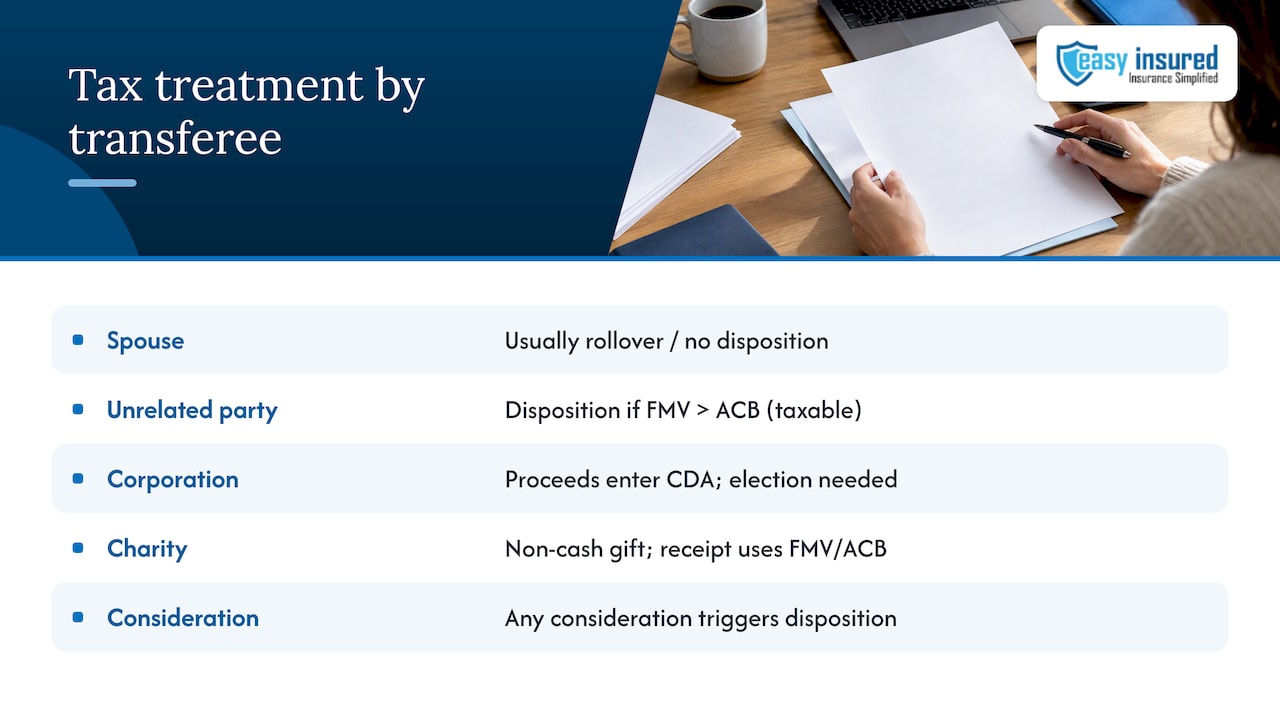
Changing who owns a policy is rarely just paperwork. The Canada Revenue Agency treats certain ownership changes as a disposition, meaning the transfer itself can trigger a taxable event depending on who is involved and whether anything of value changes hands.
Two figures drive most of these calculations: adjusted cost basis (ACB) and fair market value (FMV). ACB reflects the policy’s cost for tax purposes, built up from premiums paid and reduced by certain factors over time. FMV is what the policy would be worth if sold on the open market, factoring in cash value, face amount, and health of the insured. When ownership changes between unrelated parties, tax authorities generally look at the gap between ACB and FMV to determine what, if anything, is taxable.
Corporate transfers add another layer. When a private corporation receives life insurance proceeds, the net amount is generally added to the company’s capital dividend account, which can allow a tax-free distribution to shareholders when the proper election is filed. Missing that election, or transferring ownership without accounting for it, can quietly erase a benefit the company was counting on.
Charitable assignments follow their own rules. When someone absolutely assigns a policy to a qualified donee and names that charity as an irrevocable beneficiary, the CRA treats it as a non-cash gift, and the charity’s tax receipt is based on FMV and ACB calculations rather than the face value of the policy. Transfers to a spouse typically receive more favorable tax treatment than transfers to an unrelated party or a corporation, though the details depend on the specific structure and consideration involved.
Ownership changes involving consideration or a business relationship commonly create a taxable event under CRA’s disposition rules for life insurance transfers. That single fact is why an ownership change should never be treated as routine paperwork.
Pro Tip: Get an ACB and FMV estimate from your insurer before signing any transfer form, not after.
Reviewing your policy against a tax checklist for Canadians before making changes can catch these issues early.
How to transfer ownership: practical, step-by-step checklist
Transferring ownership involves more than signing a form, and skipping a step often causes delays or unexpected tax bills.
- Contact the insurer first. Ask what forms, identification, and supporting documents they require, since requirements vary by company and policy type.
- Complete the transfer or assignment forms. State any consideration paid, if applicable, and make sure every required signature is collected, including from the current and new owner.
- Confirm whether new underwriting is needed. Some transfers, especially to unrelated parties or corporations, may require medical evidence or insurer approval, which can add weeks to the timeline.
- Document everything. Keep copies of the completed forms, insurer confirmation, and any valuation used for the transfer, since these records matter for tax filings later.
Pro Tip: Request written confirmation from the insurer once the transfer is processed, not just a form receipt, so you have proof of the effective date for tax purposes.
Because provincial law also governs how these transfers are legally recognized, insurers typically follow both their internal process and the transfer-of-ownership provisions in provincial insurance statutes.
What happens when the owner dies versus when the insured dies
These two events trigger very different outcomes, and mixing them up is a common source of confusion.
- If the owner dies while the insured is still alive, ownership passes to a named successor owner or, if none is named, becomes part of the deceased owner’s estate, which can drag the policy into probate and give estate creditors a claim.
- If the insured dies, the beneficiary named on the policy claims the proceeds directly from the insurer, and the tax treatment of that payout depends on who the owner was and whether the policy was personally or corporately held.
- Naming an estate as beneficiary, leaving successor ownership blank, or overlooking how corporate ownership affects a payout are the three most common pitfalls that create delays or unwanted tax exposure.
Naming a successor owner explicitly, rather than defaulting to the estate, is one of the simplest ways to avoid unnecessary complications.
How to choose who should own the policy
Ownership should follow the policy’s purpose, not the other way around. A policy meant to protect a family’s income looks different from one funding a business succession plan or supporting a charitable gift.
Before deciding, ask:
- Who needs ongoing control over beneficiary changes and cash value access?
- Who is actually paying the premiums, and does that affect who should hold ownership?
- Are there creditor risks tied to the owner’s personal or business situation?
- Will corporate tax rules, like capital dividend account treatment, apply to this policy?
Watch for these red flags: transferring ownership without getting tax advice first, letting ownership default to an estate by never naming a successor, and setting up corporate ownership without a clear succession plan for what happens to the policy if the business changes hands. Each of these is avoidable with planning done before the policy is issued, not after a problem shows up.
Real-world lessons from ownership and transfer decisions
A business owner structured a corporate-owned policy to fund a buy-sell agreement between two partners. When the first partner died, the company made sure the proper capital dividend account election was filed promptly, preserving the ability to pay the surviving partner’s family a tax-free distribution rather than losing that benefit to a missed filing deadline.
In another case, a family assigned an existing policy into a trust specifically to simplify how proceeds would reach the beneficiaries and to keep the payout outside of probate. Coordinating the assignment with a written trust agreement in advance made the eventual payout straightforward rather than contested.
Ownership decisions made at application time almost always cost less, in both money and stress, than ownership decisions made under pressure later.
For further detail, see how corporations use life insurance for succession planning and consult CRA and provincial statute pages directly for the legal specifics of your situation.
A few honest observations on ownership mistakes
The same three mistakes show up again and again: letting ownership default to an estate, transferring a policy without asking about tax consequences first, and setting up corporate ownership with no plan for what happens if the business is sold or restructured. None of these are complicated to avoid. Decide on ownership when you apply for the policy, and involve a tax-aware advisor before you change anything later.
— Frank
How Easy Insured supports ownership and transfer decisions
Working out who should own a policy, how a transfer affects your taxes, and how ownership fits into a broader estate plan is easier with someone who does this daily. Insurance advisors can help with:
- Reviewing whether individual, spousal, corporate, or trust ownership fits your situation
- Walking through transfer paperwork and insurer requirements step by step
- Coordinating ownership decisions with your broader estate planning and tax picture

| Ownership question | Where Easy Insured helps |
|---|---|
| Which structure fits my goals | Advisory review of individual, corporate, and trust options |
| How to transfer without surprises | Guided paperwork and insurer coordination |
| How ownership fits my estate plan | Coordination with estate and tax planning services |
If you are weighing a policy purchase or a transfer, our services page covers estate, tax, and retirement planning alongside insurance advice, and you can review whole life or universal life options if cash value and flexible ownership features matter to your plan.
Primary sources and recommended reading
For verification, see CRA guidance on corporate-owned proceeds, CRA’s charitable assignment policy, and the Insurance Act transfer provisions. For a comparative look at ownership concepts in another jurisdiction, see this property ownership rights guide.
This article is general information, not a substitute for advice from a qualified financial advisor. Consult a qualified financial professional about your own circumstances before acting on anything here.
Sources
FAQ
Who should be the owner of a life insurance policy?
The right owner depends on the policy’s purpose: an individual for personal protection, a spouse for shared estate planning, or a corporation or trust for business succession or estate structuring. The owner should be whoever needs ongoing control over beneficiary changes, cash value access, and future transfers.
What happens if the owner of a life insurance policy dies?
If a successor owner is named, ownership passes to that person automatically. If no successor is named, the policy typically becomes part of the deceased owner’s estate, which can lead to probate delays and estate creditor exposure.
Can I transfer ownership of a life insurance policy?
Yes, but a transfer often counts as a disposition that can trigger tax consequences depending on the ACB, FMV, and parties involved. Contact the insurer to confirm required forms and consider tax advice before signing anything.
Can the owner of a life insurance policy cash it in?
Yes, the owner generally has the right to surrender the policy for its cash value or access funds through a policy loan, where the policy has cash value. The insured has no independent right to do this unless they are also the owner.