
Probate fees swing wildly depending on where you live. Manitoba charges nothing, Quebec often exempts notarial wills entirely, while Nova Scotia can take a bite exceeding 1.6% of an estate’s value once it clears a modest threshold. On a $1,000,000 estate, that gap alone can mean a difference of over $16,000 between the cheapest and most expensive province. Below you’ll find the verified 2026 fee schedule for all 13 provinces and territories, worked examples on $500,000 and $1,000,000 estates, and practical ways to shrink the bill.
TL;DR:
- Probate fees can vary from nothing in Manitoba and Quebec to over 1.6% of estate value in Nova Scotia, with differences impacting costs by tens of thousands of dollars on large estates.
- Some provinces, like Alberta, cap fees at a fixed amount regardless of estate size, while others, like Ontario and Nova Scotia, charge a percentage that increases with estate value.
- Assets that bypass probate, such as beneficiary-designated accounts and joint property, can significantly reduce or eliminate probate costs, but may still require a grant in certain institutions.
- Planning strategies like beneficiary designations, joint ownership, trusts, and gifting can help decrease taxable estate size and avoid high probate fees.
- Executors should budget for legal, accounting, and administrative costs beyond probate fees, often taking several months or longer for complex estates with potential delays.
Table of Contents
- Probate Fees By Province: 2026 Fee Schedule And Sample Costs
- How Are Probate Fees Calculated?
- What Do Probate Fees Actually Look Like In Dollars?
- How Can You Reduce Or Avoid Probate Fees?
- What Should Executors Budget For Beyond The Probate Fee?
- An Adviser’s Take On Where Executors Get Tripped Up
- Get Help Reducing Your Estate’s Probate Exposure
- Sources
- FAQ
Probate Fees By Province: 2026 Fee Schedule And Sample Costs
Every province and territory sets its own probate fee, and the differences aren’t small change. Some jurisdictions charge a flat, capped fee no matter how large the estate gets. Others apply an uncapped percentage that keeps climbing as the estate grows.
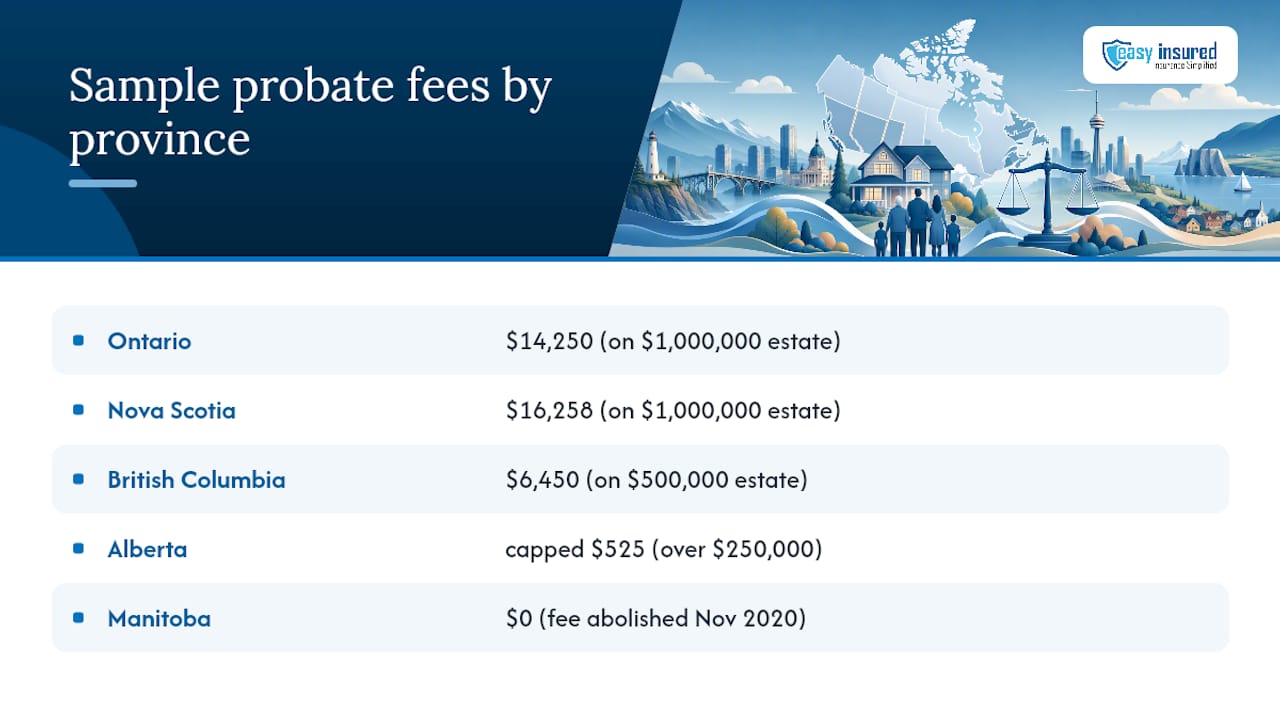
Ontario’s Estate Administration Tax charges nothing on the first $50,000, then $15 per $1,000 (1.5%) above that, meaning a $1,000,000 estate owes $14,250. British Columbia uses a two tier system: nothing on the first $25,000, $6 per $1,000 between $25,000 and $50,000, then $14 per $1,000 above $50,000, putting a $500,000 estate at $6,450. Nova Scotia’s rate looks modest until you run the math: roughly 1.695% above a $100,000 threshold works out to about $16,258 on a $1,000,000 estate, the highest figure of any province.
Alberta caps its probate fee at $525 for any estate over $250,000, regardless of whether the estate is worth $260,000 or $26,000,000. Manitoba abolished its probate fee outright in November 2020, so executors there pay nothing to obtain a grant. Quebec’s notarial wills frequently skip court verification altogether, which functionally zeroes out the fee for many estates.
Rates and figures reflect 2026 verified schedules. Always confirm against your provincial court registry before filing, since fee tables are updated periodically.
How Are Probate Fees Calculated?
Probate fees apply only to the value of assets that pass through your will, known as the taxable estate. That distinction matters because plenty of assets skip probate entirely and never get counted toward the fee.
Assets that typically count include real estate held solely in the deceased’s name, bank and investment accounts without a named beneficiary, vehicles, and personal property. Assets that usually bypass probate include registered accounts like RRSPs and TFSAs with a named beneficiary, life insurance policies with a named beneficiary, and property held in joint tenancy with right of survivorship.
Provincial formulas fall into three broad families:
- Percentage uncapped: Ontario, British Columbia, and Nova Scotia calculate a percentage of estate value with no ceiling, so larger estates pay proportionally more.
- Capped flat tiers: Alberta and most territories charge a set fee once the estate crosses a threshold, and the fee stays flat no matter how much larger the estate grows.
- Zero or nominal fee regimes: Manitoba charges nothing, and Quebec often avoids court fees when a notarial will is used.
Even when an asset technically avoids probate, a bank or land titles office may still ask for a grant of probate before releasing funds or transferring title. That institutional caution is worth planning around, since it can force probate even on an estate that looks exempt on paper.
What Do Probate Fees Actually Look Like In Dollars?
Running the numbers on real estate values shows exactly how much geography matters.
- Ontario, $1,000,000 estate: $0 on the first $50,000, then 1.5% on the remaining $950,000, totaling $14,250.
- British Columbia, $500,000 estate: $0 on the first $25,000, $6/$1,000 on the next $25,000 ($150), then $14/$1,000 on the remaining $450,000 ($6,300), totaling $6,450.
- Alberta, $1,000,000 estate: The banded fee structure caps out at $525, the same fee a $260,000 estate would pay.
- Nova Scotia, $1,000,000 estate: Applying roughly 1.695% above the $100,000 threshold produces about $16,258, the steepest total on this list.
- Manitoba, any estate size: $0, since the province eliminated its probate fee in 2020.
- Quebec, notarial will: Often $0, since many notarial wills skip court verification entirely.
A probate fee calculator can confirm these figures for your specific province and estate value before you file.
How Can You Reduce Or Avoid Probate Fees?
Several planning moves keep assets out of the taxable estate entirely, which is the most reliable way to shrink or eliminate a probate bill.
- Beneficiary designations: Naming a beneficiary directly on RRSPs, RRIFs, TFSAs, and life insurance policies routes those assets straight to the beneficiary, bypassing probate.
- Joint tenancy with right of survivorship: Property held jointly typically passes to the surviving owner automatically, though this carries family and tax trade-offs worth discussing with an advisor before you retitle anything (see joint account pros and cons).
- Trusts: Assets placed in certain trusts during your lifetime avoid passing through your will and therefore avoid probate on those specific assets.
- Lifetime gifting: Transferring assets before death removes them from the estate, though it may trigger capital gains or affect eligibility for certain benefits.
Executors and planners implementing these tactics should start by inventorying every account and confirming which ones already carry a named beneficiary, then verify provincial rules on joint ownership before retitling property. Because the taxable estate only includes what flows through the will, moving major assets outside that path is usually the single biggest lever available.
Pro Tip: Confirm directly with the specific bank or land titles office involved, since some institutions still require a grant of probate before releasing funds even when a beneficiary designation exists.
For a fuller walkthrough of these tactics, see how to avoid probate in Canada.
What Should Executors Budget For Beyond The Probate Fee?
Probate itself typically takes anywhere from a few weeks to several months depending on the province, court backlog, and estate complexity. Larger or contested estates can stretch well past a year.
- Gather documents early: the original will, a certified death certificate, a full asset inventory, and beneficiary contact details.
- Budget for legal and accounting fees, which often exceed the probate fee itself on complex estates.
- Set aside funds for ancillary costs, including executor bonds (sometimes required when no will exists), land title registry charges, and mandatory notice advertising for creditors.
- Collect recent account statements for every asset, since courts and institutions will ask for current valuations.
A clear document checklist upfront saves weeks of back and forth with the court registry. For a fuller rundown of executor duties, see this guide for executors.
An Adviser’s Take On Where Executors Get Tripped Up
Most probate delays trace back to one thing: nobody built a checklist before the death, not after. Families assume beneficiary designations are automatically up to date, and they’re often not. Call a professional when the estate involves a business, property in another country, or a family dispute brewing under the surface, since cross-border assets require separate ancillary probate in that jurisdiction. Easy-insured’s estate-planning checklist is a solid starting point before you need it.
— Frank
Get Help Reducing Your Estate’s Probate Exposure
We build estate-planning reviews around common strategies such as checking beneficiary designations, confirming joint ownership suitability, and advising on executor bonds.

Initial consultations typically include a review of wills, account titling, and insurance beneficiaries, followed by a prioritized list of potential estate planning moves. Updating beneficiary designations is often a straightforward way to improve your estate plan. Explore Estate Planning services or read the full guide to avoiding probate in Canada to see where your estate stands, then book a review to get a personalized action list.
Sources
This article is general information, not a substitute for advice from a qualified financial advisor. Consult a qualified financial professional about your own circumstances before acting on anything here.
FAQ
How Do I Avoid Probate Fees In Canada?
Naming beneficiaries directly on RRSPs, TFSAs, and life insurance policies keeps those assets out of your taxable estate entirely. Holding property in joint tenancy with right of survivorship and using certain trusts during your lifetime are the other main techniques, though each carries trade-offs worth reviewing with an advisor first.
What Is The Cheapest Province For Probate?
Manitoba charges no probate fee at all after abolishing it in November 2020. Quebec often comes close to free as well, since notarial wills frequently skip court verification entirely.
What Are The Current Probate Fees In Ontario?
Ontario’s Estate Administration Tax charges nothing on the first $50,000 of an estate, then 1.5% on everything above that. A $1,000,000 estate owes $14,250 under this formula.
How Do I Calculate My Probate Fees?
Identify your province’s fee structure (percentage, capped tier, or zero fee), then apply it only to assets passing through your will rather than your full net worth. A probate fee calculator can confirm the exact figure once you know your province and estate value.