
Every Canadian estate plan needs six things in place: a signed will, a power of attorney for property, a power of attorney for personal care, current beneficiary designations, a named executor, and a written inventory of what you own. Provinces vary on the paperwork and probate fees, so check your own rules, and revisit the whole plan every three to five years. If you do nothing else today, confirm who’s listed as beneficiary on your RRSP and life insurance, and find out where your will actually is.
TL;DR:
- Updating beneficiary designations on all registered accounts and policies is crucial, as mismatches can cause legal and financial issues for your estate.
- For larger estates, avoiding probate through joint ownership, beneficiary designations, or trusts reduces delays and fees, especially in provinces with high probate costs.
- Choosing an organized executor and ensuring they can quickly locate all critical documents prevents months of delays and legal complications.
- Gifting assets or setting up life insurance outside the estate can provide immediate cash flow to cover taxes and probate costs, avoiding personal liabilities.
- Review and revise your estate plan every three to five years or after major life events to keep beneficiary info, powers of attorney, and executor choices up to date.
Table of Contents
- Your Estate Planning Checklist for Canada
- What Do the Core Estate Documents Actually Do?
- How Do Probate and Taxes Affect Your Estate?
- Creating and Storing Your Documents Correctly
- Common Estate Planning Mistakes to Avoid
- When Should You Review Your Estate Plan?
- Where Easy-Insured Fits Into Your Plan
- Why the Standard Estate Planning Advice Falls Short
- Give Your Executor Something Probate Can’t Delay: Cash
- Sources
- FAQ
Your Estate Planning Checklist for Canada
Getting a plan in place isn’t complicated, but skipping a step is what causes the six-month court delays and family disputes you hear about. Work through this in order.
Core documents and roles:
- Sign a valid will and name an executor you trust to handle months of paperwork.
- Name a guardian for minor children, if that applies to your family.
- Set up a power of attorney for property and a separate one for personal care (called a health care directive or representation agreement in some provinces).
- Pick alternate executors and alternate attorneys in case your first choice can’t act.
Money and paper trail:
- Update beneficiary designations on every RRSP, TFSA, pension, and life insurance policy. These override what your will says, so a mismatch causes real problems for your family later.
- Build an asset inventory: bank and investment accounts, property deeds, insurance policies, and digital accounts, with contact numbers and where records live.
- Decide how funeral costs get paid. A final expense policy or prepaid funeral plan keeps this off your family’s credit card.
- Write a short letter of wishes for your executor covering funeral preferences and any details that won’t fit into a legal document.
- Store your originals somewhere secure and tell your executor exactly where. A safe nobody can find is the same as no safe at all.
The Willful guide to Canadian wills frames this as choosing your key people, listing your assets, then formalizing everything in legal paper, which is the right order to do it in.
What Do the Core Estate Documents Actually Do?
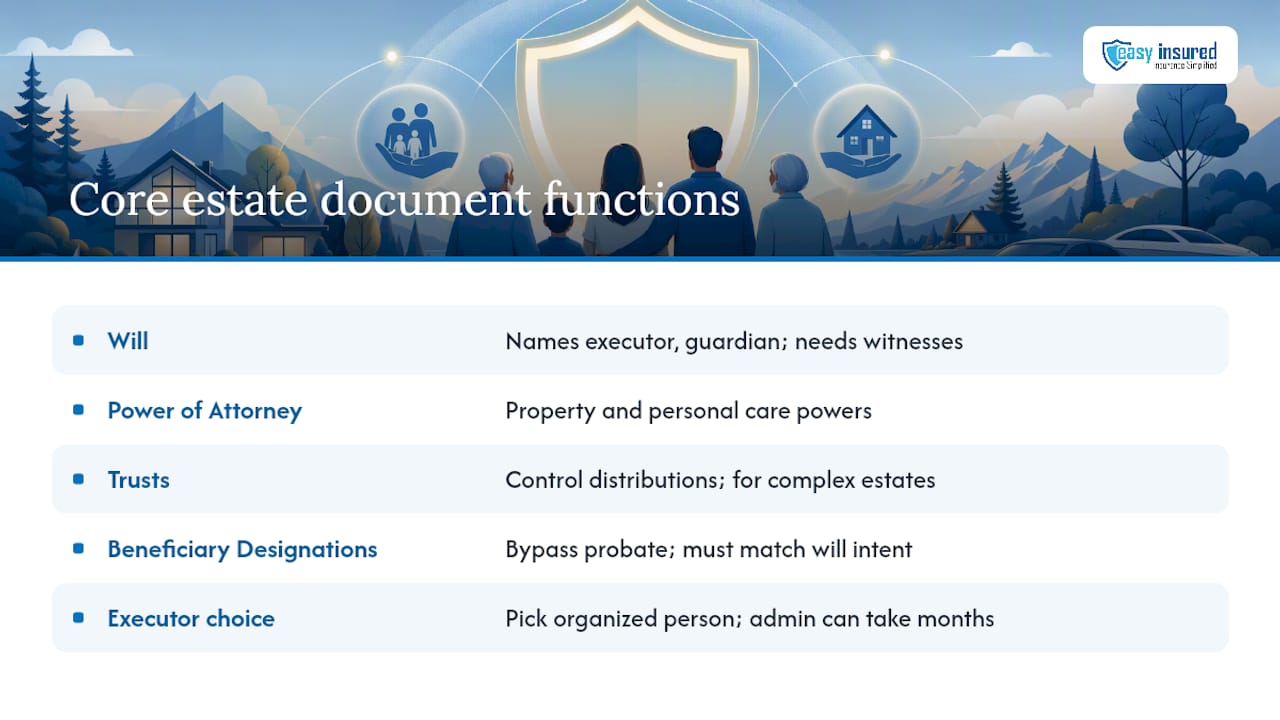
A will names your executor, says who gets what, and names a guardian for minor children. Every province requires your signature plus witnesses (usually two, and they generally can’t be beneficiaries). Skip the formalities and a court may toss the will out, which triggers intestacy rules that hand your estate to relatives in a fixed order you didn’t choose.
Powers of attorney cover you while you’re alive but unable to act. A power of attorney for property handles banking, bills, and real estate. A power of attorney for personal care (called a health care directive in some provinces and a personal directive or representation agreement in others) covers medical and living decisions. Some provinces let you make a POA “springing,” meaning it only kicks in once a doctor confirms incapacity; others activate it immediately on signing.
Trusts aren’t for everyone. An alter-ego trust or testamentary trust mainly makes sense for business owners, blended families, or people trying to control how money flows to beneficiaries over time, not for a simple estate with one house and a retirement account.
Beneficiary designations on RRSPs, TFSAs, and life insurance policies bypass probate and pay out directly, which is exactly why they need to match your will’s intent. The Wealthsimple estate planning guide notes that provincial law differences and probate fee variation both affect which strategy makes sense for your estate.
Pro Tip: Executors often spend months tracking down assets, filing final tax returns, and probating the will before a single dollar gets distributed. Choose someone organized, not just someone you love.
How Do Probate and Taxes Affect Your Estate?
Death triggers a “deemed disposition” of most assets at fair market value, meaning capital gains get taxed as if everything sold the day you died. RRSPs and RRIFs get added to your final year’s income in full, unless a spouse or common law partner inherits them and rolls them over tax deferred.
Probate fees vary sharply by province. Alberta caps its probate fee at a flat amount, while Ontario charges a value based fee that climbs with estate size, which is exactly why probate avoidance matters more for larger estates than small ones.
Common tactics to reduce probate exposure or speed things up:
- Beneficiary designations on registered accounts and insurance policies.
- Joint ownership with right of survivorship on property or accounts.
- Inter vivos trusts set up while you’re alive.
- Gifting assets before death.
- Life insurance, which pays out directly to a named beneficiary outside the estate.
One warning for executors: don’t distribute final assets until the Canada Revenue Agency issues a clearance certificate confirming taxes are paid. Distribute early and a shortfall becomes the executor’s personal liability, not the estate’s.
Creating and Storing Your Documents Correctly
- Choose your route. A DIY kit or online service works fine for a simple estate (one spouse, no business, no complicated assets). Business owners, blended families, or anyone with property in more than one province should use a lawyer or notary instead.
- Sign and witness properly. Requirements differ by province. Quebec allows notarial wills that skip witness requirements entirely, and a handful of provinces still recognize handwritten “holograph” wills. When in doubt, have a lawyer review the document before you rely on it.
- Store originals safely. A lawyer’s office, a notary’s vault, or a safe deposit box all work, as long as your executor knows how to get access.
- Build an executor packet. Asset list, insurance contacts, recent statements, password instructions, and your letter of wishes, all in one place.
Pro Tip: Keep a one-page index of where every original document lives. A power of attorney that nobody can find is functionally useless when your bank freezes your accounts.
Common Estate Planning Mistakes to Avoid
The costliest errors are almost always avoidable:
- Beneficiary designations left pointing at an ex-spouse or a beneficiary who died first.
- No power of attorney for incapacity, forcing a family into court to get a guardian appointed.
- An executor chosen for sentimental reasons who has no time or organizational skill for the job.
- Distributing estate assets before the final tax return is filed and clearance is granted.
- No record of digital accounts, passwords, or two-factor devices, leaving an executor locked out of everything from crypto wallets to loyalty points.
Mismatched beneficiary designations are the single most common and expensive mistake on this list, largely because people simply forget to update them.
When Should You Review Your Estate Plan?
Review the whole plan every three to five years, no exceptions needed. Update it immediately after marriage, divorce, a new child, a move to a different province, a major change in assets, or the death of a named beneficiary or executor. Each trigger event should prompt a check of beneficiaries, your executor choice, both powers of attorney, and your life insurance coverage.
Where Easy-Insured Fits Into Your Plan
Easy-Insured builds life insurance and estate-planning strategies for Canadian families and business owners, which puts us in a good position to help with the financial side of this checklist. Our guides on probate and estate tax reduction go deeper into the mechanics covered above. For complex situations, business succession, blended families, or assets in more than one province, bring in a lawyer or tax advisor. A checklist gets you organized; it doesn’t replace legal advice for a genuinely complicated estate.
Why the Standard Estate Planning Advice Falls Short
Most estate planning content in Canada treats this as a legal exercise: sign the will, name the executor, done. That misses the operational half of the problem. A perfectly drafted will does nothing if your executor can’t find the original, doesn’t know your account numbers, or discovers three months in that your RRSP beneficiary is still your ex.
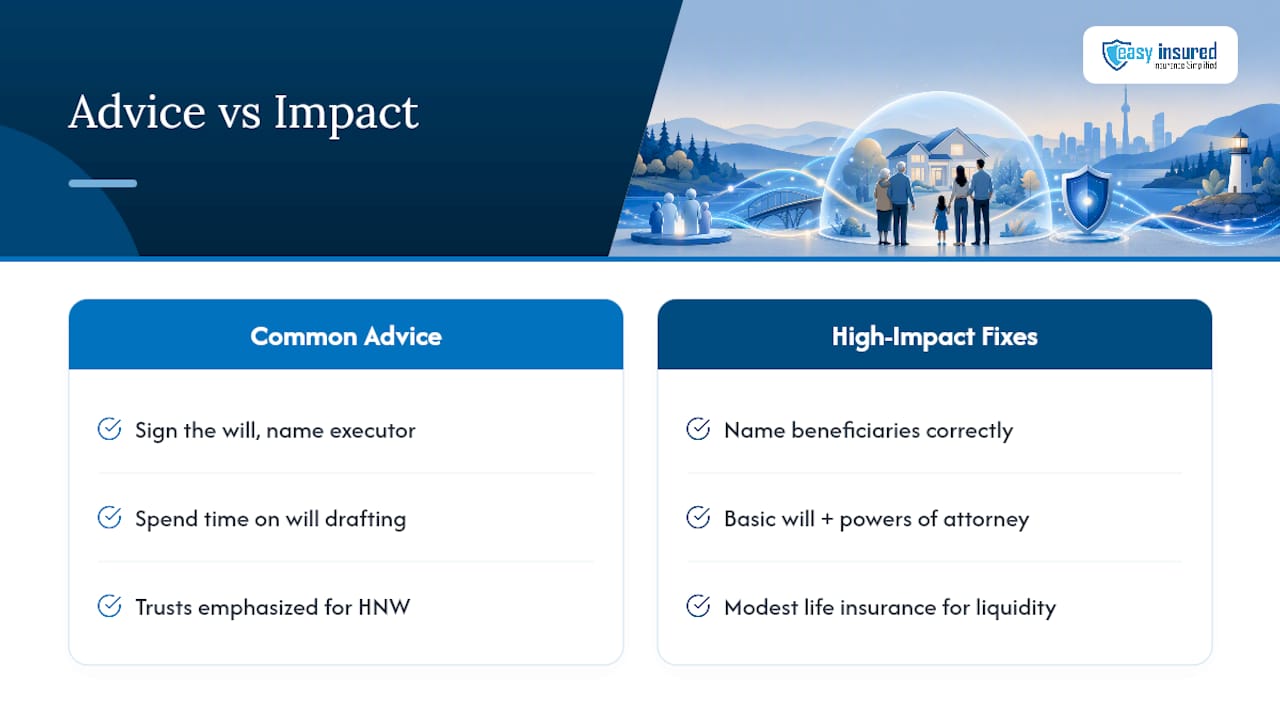
The research backs this up. Naming beneficiaries correctly and having a basic will plus powers of attorney covers the highest-impact ground for most people; trusts and estate freezes matter mostly for high net worth or business owner situations. Yet most Canadians spend their planning energy on the will and almost none on the beneficiary forms sitting in a drawer at their bank.
My honest take: the biggest gap isn’t legal knowledge, it’s liquidity. Probate can take months, and taxes on a deemed disposition come due whether or not the estate has cash on hand. A modest life insurance policy solves that problem directly by paying out fast, outside probate, to whoever you name. That’s not a legal fix. It’s a cash flow fix, and it’s the one most checklists skip entirely.
— Frank
Give Your Executor Something Probate Can’t Delay: Cash
Probate can take months, and taxes on a deemed disposition don’t wait for the estate to settle. That gap between “money owed” and “money available” is exactly where a life insurance payout does its job: it lands with your beneficiary directly, outside probate, while the rest of the estate is still working through paperwork.

Easy-Insured offers a few ways to close that gap depending on your situation. Final expense coverage handles funeral costs so your family isn’t fronting cash before any other funds arrive. Term life insurance protects beneficiaries and covers near-term estate costs at a lower premium. Whole life insurance builds permanent coverage you can lean on for legacy planning or estate liquidity down the road. If you’re not sure which fits your estate plan, request a quote through our estate planning page and talk it through with an advisor before you finalize anything.
Sources
- Canada
- Estate Planning in Canada: Complete Guide & Checklist — Wealthsimple
- Wills & Estate Planning Checklist In Canada — Willful
FAQ
What Are the 7 Steps in the Estate Planning Process?
Most Canadian guides break it into: naming your executor and guardians, drafting your will, setting up both powers of attorney, updating beneficiary designations, building an asset inventory, deciding funeral wishes, and storing everything where your executor can find it.
What Should You Not Include in a Will?
Skip funeral instructions (put those in a separate letter of wishes), anything already covered by a beneficiary designation like RRSPs or life insurance, and conditions a court would consider illegal or unenforceable.
Is It Better to Have a Will or a Trust in Canada?
Most Canadians only need a will plus powers of attorney; trusts like an alter-ego or testamentary trust generally make sense for business owners, blended families, or larger estates trying to control how money is distributed over time.
Where Can You Find a Free Executor Checklist?
Canada.ca’s end of life planning page offers government guidance on executor duties, and Easy-Insured’s probate guide covers the practical steps an executor follows after death.