
Outdated or incorrect beneficiary designations are the fastest way to send your money to the wrong person, and no will can fix it after the fact. The most damaging errors are stale forms left over from an old marriage, minors named directly with no trust behind them, missing contingent beneficiaries, and percentage splits that don’t add up. Pull your life insurance, RRSP, TFSA, and pension paperwork today and confirm what’s actually on file with each custodian, not what you remember signing.
TL;DR:
- Most beneficiary designations are outdated or incomplete, often causing delays or assets defaulting to probate when not properly updated after major life events.
- Vague or incorrect information, such as typos, missing identifiers, or percentages not totaling 100 percent, can trigger costly investigations and slow payouts.
- Naming a minor directly or your estate as beneficiary leads to court delays, conservatorship, or assets entering probate rather than transferring directly to heirs.
- Confirm beneficiary updates in writing with each custodian and review all relevant accounts annually or after significant life changes to prevent mistakes.
- Beneficiary forms generally override a will, so regular, coordinated reviews are essential for ensuring assets go to your intended recipients without legal complications.
Table of Contents
- What Are the Most Common Beneficiary Designation Mistakes?
- Why Do These Mistakes Actually Matter?
- How Do You Check and Fix Your Beneficiary Designations?
- Special Situations That Need a Different Approach
- The Small Administrative Errors That Cause the Biggest Delays
- What Does a Coordinated Beneficiary Review Actually Look Like?
- Incomplete Forms and Unconfirmed Changes Are a Silent Risk
- What People Get Wrong About How Beneficiary Designations Work
- What Are the Legal Implications of Getting This Wrong?
- How Often Should You Review Your Beneficiary Designations?
- Why Beneficiary Reviews Deserve a Permanent Spot on Your Calendar
- If You’d Rather Not Do This Alone
- Sources
- FAQ
What Are the Most Common Beneficiary Designation Mistakes?
Beneficiary paperwork tends to sit untouched for a decade or more, which is exactly how small errors turn into six-figure legal problems. Here’s what shows up most often during reviews of clients’ account files.
- Not updating after major life events. Marriage, divorce, a new child, or the death of a named beneficiary should trigger an immediate form update, but most people only think about it during a will overhaul, if that.
- Missing contingent beneficiaries. If your primary beneficiary dies before you and there’s no backup listed, the account typically reverts to your estate and lands in probate, which is precisely the delay and cost a beneficiary form was supposed to avoid.
- Naming a minor directly. Financial institutions cannot hand a large payout to a child, so the funds get frozen until a court appoints a guardian or conservator.
- Naming your estate as beneficiary. This sounds tidy on paper, but it strips away the entire point of a designation and routes the asset straight into probate anyway.
- Vague identifiers or plain typos. “My daughter” instead of a full legal name, or a misspelled surname, forces the custodian to open an investigation before it pays anyone.
- Percentages that don’t total 100%. Three kids at roughly equal shares can leave a small unaccounted fraction, and that gap has to be resolved somehow, usually by the custodian’s default rules, not yours.
- Assuming a will overrides the form. It doesn’t. A beneficiary designation is a separate legal document that generally controls regardless of what your will says.
- Skipping confirmation after a rollover or transfer. Moving a pension or RRSP to a new institution doesn’t always carry the old beneficiary data with it, and some custodians require a fresh signed form.
Any one of these can sit dormant for years without causing a problem, until the day someone actually needs the payout, and by then it’s too late to fix quietly.
Why Do These Mistakes Actually Matter?
Beneficiary forms on file with an insurer or plan administrator override your will in most cases. That single fact surprises a lot of people, and it’s the reason a stale designation from a first marriage can quietly redirect a death benefit away from the family you actually intend to protect.
Statistic to know: Even a rounding slip as small as three beneficiaries listed at 33.33% each, which technically totals only 99.99% instead of a clean 100.00%, can trigger administrative holds while the custodian sorts out where the missing fraction goes.
When there’s no valid beneficiary on file, the asset typically reverts to the estate and enters probate, adding weeks or months of court supervision plus legal fees that come straight out of what your heirs would have received. Naming a minor directly is worse: courts appointing a guardian or conservator over a child’s inheritance can take a year or longer, during which the money sits frozen and inaccessible for the child’s actual needs.
Some account types add a tax wrinkle on top. Certain registered plans force accelerated withdrawal or taxation once ownership passes to an estate rather than a named individual, shrinking the payout before anyone sees a dollar of it.
How Do You Check and Fix Your Beneficiary Designations?
Treat this like an audit, not a one-time chore. Work through every account that pays out on death, not just the obvious ones.
- Build a full inventory. List every life insurance policy, annuity, RRSP, TFSA, workplace pension, bank payable-on-death account, and brokerage account you hold.
- Confirm what’s actually on file. Call, log in, or send a written request to each custodian. Don’t assume your memory of the last form you signed matches their records.
- Use precise legal names and dates of birth. Skip nicknames, and consider a per stirpes designation if you want a grandchild to inherit automatically should your child predecease you.
- Check the math. Every percentage split must total exactly 100.00%, no exceptions.
- Add contingent beneficiaries everywhere. And route any minor’s share through a trust or custodial arrangement instead of naming the child outright.
- Get it in writing. After submitting a change, confirm receipt directly with the plan administrator and save the confirmation with your estate documents.
- Set a recurring reminder. Annual reviews, or immediately after any major life event, keep this from going stale again.
Pro Tip: Screenshot or print the confirmation screen every time you update a designation. A submitted form is not proof of anything; a custodian’s written acknowledgment is what actually protects your heirs later.
Special Situations That Need a Different Approach
Not every household fits the standard checklist. A few situations call for real planning instead of a quick form update.
- Minors: Skip naming a child directly. A trust, a UTMA/custodial account, or naming an adult trustee to hold funds until the child reaches a set age all avoid the conservatorship delay entirely.
- Beneficiaries with disabilities: A special needs trust preserves eligibility for government benefits that a direct inheritance could otherwise disqualify.
- Blended families: Per stirpes designations and explicit written documentation prevent stepchildren, biological children, and former spouses from ending up in a dispute over ambiguous wording.
- Divorce: Check your registered plan’s rules and any required spousal consent before assuming an ex-spouse has been removed automatically. Many plans require an active form change, not just a court order.
- Business owners: Beneficiary choices on key-person life insurance need to line up with your buy-sell agreement or shareholder agreement, or you risk a payout that contradicts what your business partners agreed to.
The Small Administrative Errors That Cause the Biggest Delays
Most beneficiary problems aren’t dramatic. They’re clerical.
- Percentages must equal exactly 100.00%. Two beneficiaries at 50% each is clean; three at 33.33% is not, unless you adjust one share to 33.34% to close the gap.
- Skip nicknames and informal names. Use the full legal name and any identifier the custodian requests, such as a date of birth or Social Insurance Number.
- Re-verify after every rollover. Designations don’t always transfer automatically when an account moves to a new institution, so check again after any transfer.
- Always get written confirmation. A submitted form sitting in a processing queue is not the same as a recorded, confirmed change.
A single misplaced decimal or an unconfirmed submission can stall a payout for weeks while the family is already dealing with a death, which is the worst possible time to be sorting out paperwork.
What Does a Coordinated Beneficiary Review Actually Look Like?
A proper review isn’t a five-minute phone call. It’s a structured process, built around the same account-by-account audit outlined above.
- Full account inventory across life insurance, retirement accounts, workplace benefits, and investment holdings.
- Direct verification with each custodian rather than relying on your last signed copy.
- Corrected, updated forms with precise names, contingent beneficiaries, and percentages that total exactly 100.00%.
- Documented written confirmation filed with your broader estate plan.
The Estate Planning and Financial Planning sides of this work often surface the same patterns seen in cases like Stop $18,000 Mistakes, where a small administrative oversight compounded into a costly correction, and in the lessons behind How to Avoid Probate in BC, where a missing contingent beneficiary sent an account straight into probate that a five-minute form update would have avoided.
Incomplete Forms and Unconfirmed Changes Are a Silent Risk
A half-filled beneficiary form is just as dangerous as no form at all. Custodians commonly reject or hold submissions that are missing a date of birth, a Social Insurance Number, or a clear percentage split, and that rejection often happens quietly, with no follow-up call to tell you it failed.
The bigger risk sits one step further along: people assume that submitting a change request is the same as having it recorded. It isn’t. A form can sit in a processing backlog, get flagged for a missing signature, or simply never get keyed into the system correctly. Submitting a change does not guarantee it took effect, and the only way to know for certain is to confirm receipt directly with the plan administrator or custodian.
That confirmation step matters more than the update itself in a lot of cases. If a claim gets filed years later and the custodian’s records still show the old beneficiary, your intended heir has no simple recourse. Courts generally honor whatever is on file, not what you meant to file. Save the written confirmation, a screenshot of the updated online record, or a signed acknowledgment letter, and keep it with your estate documents where an executor can find it. Treat every beneficiary update as incomplete until you have that proof in hand.
What People Get Wrong About How Beneficiary Designations Work
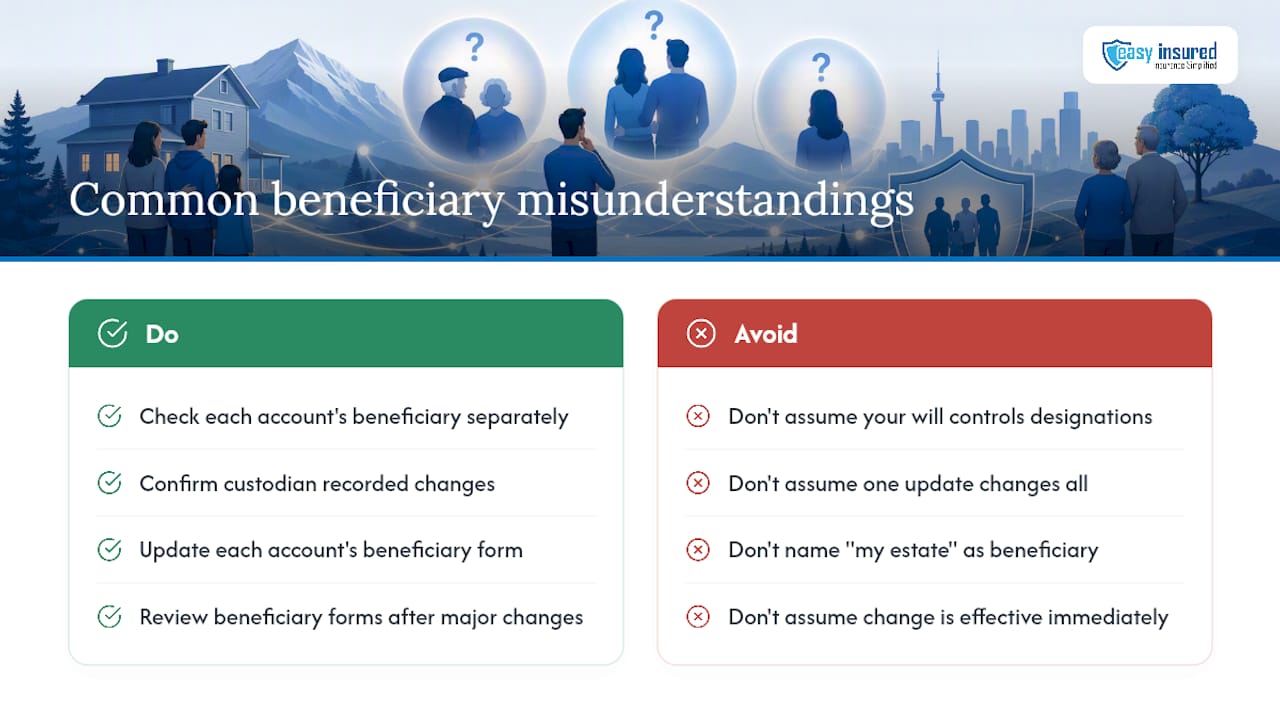
The biggest misunderstanding is thinking a will controls who gets your life insurance or retirement account. It doesn’t. Beneficiary designations are stand-alone legal instruments, and in most cases they override anything written in a will, even a will signed more recently than the last beneficiary form. If your will names your children and your outdated life insurance form still names an ex-spouse, the insurer typically pays the ex-spouse.
A second misunderstanding: people assume updating one account updates all of them. It doesn’t. Each policy, pension, and investment account carries its own designation, filed separately with its own custodian. Consolidating accounts under one advisor doesn’t merge the paperwork behind the scenes.
Third, many people believe naming “my estate” as beneficiary is a safe default that lets the will sort everything out. It has the opposite effect. It routes the payout into probate, adding the exact delay and legal expense a direct beneficiary designation exists to skip.
And a smaller but common error: assuming a beneficiary form update takes effect the moment you sign it. Until a custodian records and confirms the change, the previous designation stays legally active. None of these misunderstandings are exotic. They’re the default assumption most people carry until an unpaid claim proves otherwise.
What Are the Legal Implications of Getting This Wrong?
The legal exposure runs in two directions: assets going to the wrong person, and assets getting stuck in a process no one wanted. When a designation is missing, invalid, or points to a deceased person with no contingent named, the asset typically reverts to the estate and becomes subject to probate, adding court fees, executor time, and months of delay before heirs see anything.
When a minor is named directly, the legal consequence is more severe: institutions can’t legally pay a large sum to a child, so a court has to step in and appoint a guardian or conservator, a process that can stretch past a year and generate its own legal costs charged against the inheritance.
There’s also a dispute risk that doesn’t show up until it’s too late to fix. Family members left off a designation, or an ex-spouse still listed after divorce, can contest a payout, and litigation over beneficiary conflicts routinely outlasts the goodwill of everyone involved. Because beneficiary forms generally control over a will, an executor has limited power to correct the outcome after death, even when it clearly contradicts the deceased’s actual intent. The only real protection is getting the paperwork right, and confirmed, while you’re still alive to fix it.
How Often Should You Review Your Beneficiary Designations?
Once a year, at minimum, and immediately after any major life change. That’s the standard both estate lawyers and financial planners point to, and it’s a low bar considering how much damage a stale form can do.
Build the review around specific triggers rather than a vague New Year’s resolution: marriage, divorce, birth or adoption of a child, death of a named beneficiary, a large financial windfall, or moving an account to a new institution. Any one of these events is reason enough to pull your beneficiary paperwork immediately rather than waiting for your annual checkup.
The review itself doesn’t need to be complicated. Pull the list of every account you inventoried earlier, confirm the current designation with each custodian, check that percentages still total 100.00%, and file written confirmation of anything you change. Ten or fifteen minutes per account, once a year, closes off the majority of the mistakes covered in this article before they ever become a problem for your family.

Coordinate this review with whoever manages your will and any trusts you’ve set up. A beneficiary form updated in isolation, without checking it against your broader estate plan, is how contradictions creep back in even for people who are otherwise diligent about this.
Why Beneficiary Reviews Deserve a Permanent Spot on Your Calendar
Prioritize by size and liquidity first. Your largest life insurance policy and your most liquid retirement account deserve attention before a small side investment account, simply because that’s where an error does the most damage. Review immediately after any major life event, not on some vague future date.
One rule cuts most of the risk described here: document every confirmation and file it with your estate papers, not in an email you’ll forget. And always check your beneficiary forms against your will and any trusts. They’re separate documents that need to agree with each other, not compete.
— Frank
If You’d Rather Not Do This Alone
Auditing a decade of scattered beneficiary paperwork across life insurance, retirement accounts, and workplace benefits takes real time, and one missed confirmation can undo the whole effort. This can be run as a coordinated engagement rather than a form-by-form scramble: a full account inventory, direct verification with each custodian, corrected paperwork with accurate percentages and contingent beneficiaries, and written confirmation filed with the rest of the estate plan.

That process pairs naturally with a broader look at your coverage itself. If your current life insurance beneficiary setup hasn’t been reviewed in years, it’s worth checking whether the policy still fits your situation while you’re at it, whether that’s a term life policy purchased young and never revisited, or a whole life policy meant to anchor a longer-term estate plan. An Estate Planning service can fold the beneficiary audit directly into that review, so separate payment for two overlapping processes is not necessary. Book a review and get every designation confirmed in writing, not just resubmitted and hoped for.
Sources
Bring these to your next meeting with an advisor or estate lawyer for account-specific detail:
- Trustee for minor beneficiary (Probate Law Group)
- Common mistakes estate executors make (Freedom Law)
- Contingent beneficiary and beneficiary designation rules (DLegal)
- Beneficiary designations: check and update (Ontario Wills)
- Beneficiary designation vs will (Treadstone Law)
This article is general information, not a substitute for advice from a qualified financial advisor. Consult a qualified financial professional about your own circumstances before acting on anything here.
FAQ
Who Should Not Be Named a Beneficiary?
Avoid naming a minor directly, since institutions can’t pay large sums to a child and a court may need to appoint a guardian. Also avoid naming your own estate, since that routes the asset into probate instead of paying it out directly.
What Is Not True About Beneficiary Designations?
The biggest misconception is that a will overrides them. In most cases, the beneficiary form on file with the insurer or custodian controls, regardless of what a more recent will says.
What Is the Most Common Inheritance Mistake?
Leaving an outdated beneficiary designation in place after a divorce, remarriage, or the birth of a child, often because people assume updating their will was enough to cover it.
What Happens if the Beneficiary Name Is Wrong?
A typo, nickname, or missing identifier forces the custodian to investigate before paying anyone, which can delay a payout by weeks and, in some cases, redirect it to the estate for probate to sort out.
How Often Should Beneficiary Forms Be Updated?
Review them at least once a year and immediately after any major life event, including marriage, divorce, a new child, or the death of a named beneficiary.