
A power of attorney in Canada lets a person you trust manage your finances or health decisions if you can’t. Most adults should have an enduring power of attorney for property, and many should pair it with a power of attorney for personal care. Start by checking your province’s rules, picking someone reliable, signing the document properly, and giving certified copies to your attorney and your bank.
TL;DR:
- An enduring power of attorney is essential for property and health decisions, especially since general POAs become invalid once capacity is lost.
- The right form, proper witnessing, and timely registration with your bank are critical to ensure your POA is effective during emergencies.
- Attorneys can manage banking, investments, and real estate but cannot alter wills or act outside scope, emphasizing the need for clear, specific instructions.
- Verify provincial requirements for POA creation, renewal, and revocation, and consider safeguards like spending caps and third-party oversight to prevent abuse.
- Combining legal POAs with estate and insurance planning ensures your assets are protected, accessible, and aligned with your overall financial goals.
Table of Contents
- What Is a Power of Attorney in Canada?
- Who Can Make a POA and Who Can Act as an Attorney?
- What Can an Attorney Do, and What Are They Barred From Doing?
- How to Make a Valid Power of Attorney in Canada
- Will Banks Accept Your Power of Attorney?
- How Do You Prevent Power of Attorney Abuse?
- How Do You Revoke or Replace a Power of Attorney?
- When Should You Hire a Lawyer for a Power of Attorney?
- How Does a POA Fit Into Your Broader Estate and Insurance Plan?
- What I’ve Seen Go Wrong, and the One Fix That Matters Most
- How Easy-insured Helps You Close the Gaps a POA Leaves Open
- Where to Find Official Forms and Guidance
- Sources
What Is a Power of Attorney in Canada?
A power of attorney is a legal document where you, the grantor, give another person (the attorney) authority to act on your behalf. Canada recognizes two main categories: a power of attorney for property, which covers banking, bills, investments, and real estate, and a power of attorney for personal care, which covers health treatment and daily living decisions. Both can be structured to survive incapacity, and that version is what most provinces call enduring or continuing power of attorney, according to Canada.
The distinction that trips people up isn’t property versus personal care. It’s general versus enduring. A general (or limited) power of attorney works only while you’re mentally capable and typically ends the moment you lose capacity, which defeats the purpose for most estate planning. An enduring power of attorney keeps working after incapacity, which is why it’s the version almost everyone actually needs.
Provinces use different labels for the same idea:
- Ontario calls it a “continuing power of attorney for property” and a separate “power of attorney for personal care.”
- Alberta and several other provinces call the financial version an “enduring power of attorney.”
- Personal care POAs go by names like “representation agreement” (British Columbia) or “mandate” (Quebec), depending on the jurisdiction.
- Minimum age to sign is generally the age of majority for property; personal care documents sometimes allow a lower age in specific provinces.
Get the label right for your province before you download a form, because the wrong template can create gaps in coverage.
Who Can Make a POA and Who Can Act as an Attorney?
You need mental capacity at the moment you sign. Once a person’s capacity is genuinely in question, the window to create a valid POA has usually closed, which is exactly why financial planners keep pushing this document on healthy 40 and 50 year olds instead of waiting for a diagnosis.
Age thresholds vary by document type and province. Property POAs generally require the grantor to be 18 or older. Personal care documents sometimes drop to 16, though most provinces still set the bar at the age of majority.
Not everyone is eligible to serve as an attorney, either:
- Someone who is currently bankrupt is usually disqualified from acting as attorney for property.
- A person with a recent fraud conviction may be barred under provincial rules.
- Paid caregivers are sometimes restricted from serving as personal care attorney, depending on the province, to avoid conflicts of interest.
- Minors typically cannot act as attorney at all.
You also get to decide the structure: name one attorney, name co-attorneys who must agree jointly, or name attorneys who can each act independently (“jointly and severally”). Most people also name at least one alternate in case the first choice can’t serve.
Pro Tip: Naming co-attorneys sounds like added safety, but it can backfire if they live far apart or disagree, since some banks require both signatures on every transaction. If you go this route, specify whether they must act jointly or may act separately.
What Can an Attorney Do, and What Are They Barred From Doing?
An attorney’s authority is broad, but it isn’t unlimited, and it comes with real legal obligations attached.
- Banking and bill payment. The attorney can access accounts, pay recurring expenses, and manage day to day cash flow.
- Investment management. This includes buying, selling, or reallocating investments held in the grantor’s name, subject to any restrictions you write into the document.
- Real estate transactions. An attorney can sell, lease, or manage property, which matters if you own a home, a rental, or a cottage that might need to be sold to fund care, as explained in Planning for Successful Real Estate Planning.
- Explicit legal limits. An attorney cannot make or change your will. They cannot make decisions after you die. And they cannot act outside the scope you’ve granted, if you’ve limited that scope in writing.
Every attorney also carries fiduciary duties defined under provincial statute: act honestly, act in your best interests, avoid conflicts of interest, and keep records that can be reviewed if anyone questions their conduct. An attorney does not own the assets they manage. They hold authority over them, which is a distinction that confuses more families than it should and fuels a lot of unnecessary suspicion between siblings.
You can tighten all of this at the drafting stage. Add spending caps, require receipts for transactions above a certain dollar amount, or require the attorney to report to a third party every six months. None of that is standard boilerplate, but a good POA should reflect your specific comfort level, not a generic template.
How to Make a Valid Power of Attorney in Canada
Making a POA isn’t complicated, but the order of operations matters, and skipping a step is the most common reason a document gets rejected later.
- Confirm capacity. You need to understand what you’re signing and its consequences at the moment of signing, not before or after.
- Decide the activation trigger. Choose whether the POA takes effect immediately or only once a doctor confirms incapacity. Alberta’s enduring POA framework allows either option, and most provinces follow a similar structure.
- Complete the correct form. Some provinces, including Saskatchewan, publish prescribed forms with witness certificates built in. Others, including Alberta, have no regulated form at all, so any document meeting the statutory requirements works.
- Follow witnessing rules exactly. Requirements vary by province: number of witnesses, who can’t witness (often the attorney or their spouse cannot), and whether remote video witnessing is permitted.
- Store and distribute. Keep the signed original somewhere secure, and give certified copies to your attorney, your alternate, and any institution that will need to rely on it.
For official material, three sources cover most of what you’ll need:
- Canada explains the federal-level framework and joint account risks.
- Provincial government pages, like Ontario’s page on making a power of attorney, give jurisdiction-specific steps and downloadable kits.
- CLEO’s Power of Attorney for Personal Care resources walk through Ontario’s activation and witnessing requirements in plain language, with a guided tool.
If you split time between provinces, or you’re helping an aging parent who moved recently, check the destination province’s requirements before assuming the old document still applies cleanly.
Will Banks Accept Your Power of Attorney?
Usually, yes, but only if you’ve done the legwork before an emergency forces the issue. Banks sometimes ask account holders to sign a bank-specific POA form that only applies to accounts at that institution. That form is convenient for the bank, but it doesn’t cover your investments elsewhere, your real estate, or anything outside that one account.
Relying on the bank’s form alone is risky. It can, in some circumstances, override or narrow a broader enduring POA you signed earlier, according to Canada.ca’s consumer guidance. The safer approach is having your general enduring POA on file with the bank in addition to, or instead of, their internal version.
Banks delay or refuse POAs for a handful of predictable reasons:
- Identity verification issues, especially with older or informally worded documents.
- Missing or incorrect witnessing that doesn’t meet the branch’s compliance checklist.
- Internal policy requiring a certified copy rather than the original or a photocopy.
- Suspected financial abuse, which triggers extra scrutiny regardless of how clean the paperwork looks.
Pro Tip: Call the bank before there’s an emergency and ask what format they require. Walking in with a properly witnessed enduring POA and a certified copy on hand, rather than scrambling after a stroke or diagnosis, is the difference between a same-day fix and a two-week freeze on the account.
How Do You Prevent Power of Attorney Abuse?
Financial abuse by an attorney is rare relative to the number of POAs in force, but when it happens, it’s usually a family member exploiting easy access rather than a stranger. Red flags include unexplained withdrawals, new joint accounts appearing without explanation, or an attorney becoming secretive about the grantor’s finances.
Build safeguards into the document itself rather than hoping good intentions hold:
- Require periodic accounting, such as an annual summary of transactions shared with a named third party.
- Set spending caps that trigger a second signature above a certain dollar threshold.
- Name a monitor, separate from the attorney, who receives copies of statements.
- Avoid adding an attorney as a joint account holder purely for convenience, since joint accounts carry survivorship rights that can quietly override your will.
If misuse is suspected, provincial Offices of the Public Guardian and Trustee investigate financial abuse complaints and can petition courts to suspend an attorney’s authority. That process is slower and more expensive than prevention, which is the entire argument for building oversight into the document on day one.
How Do You Revoke or Replace a Power of Attorney?
Revoking a POA while you’re still capable is straightforward: put the revocation in writing, sign it, and notify your attorney and every institution holding a copy of the old document. Signing a new POA typically cancels the previous one automatically, unless you specifically state that both should remain in effect.
A few things surprise people about the end of a POA’s life:
- Authority ends automatically the moment you die. A power of attorney has no legal force after death, regardless of what it says.
- The executor named in your will takes over from that point, handling probate and estate distribution, a completely separate legal role from the attorney.
- If you never made a POA and lose capacity, a court or the Public Guardian and Trustee may need to step in and appoint a decision maker, a process that costs more and moves slower than most families expect.
When Should You Hire a Lawyer for a Power of Attorney?
You don’t need a lawyer for a straightforward POA. Ontario’s government page confirms that free kits and CLEO’s guided tools cover most simple situations without a legal fee.
Get a lawyer involved when the situation has moving parts:
- You own a business with co-owners or shareholders whose agreements might conflict with your POA.
- Your property spans multiple provinces or countries, which raises questions about which laws apply.
- Family relationships are tense enough that a challenge to the document is plausible.
- You want customized clauses around spending limits, reporting, or unusual asset types.
Cost typically comes down to structure: flat fees for a standard property and personal care POA pair, or hourly billing once the drafting gets complicated with trusts, business interests, or contested family dynamics. Notarization or witness certification adds a smaller, separate fee in provinces where it’s required or recommended.
How Does a POA Fit Into Your Broader Estate and Insurance Plan?
A power of attorney solves for incapacity. It doesn’t solve for death, and it doesn’t solve for whether your family has liquid funds while a claim or estate settlement is in progress. Those are different problems, and treating them as one is where a lot of financial plans quietly fail.
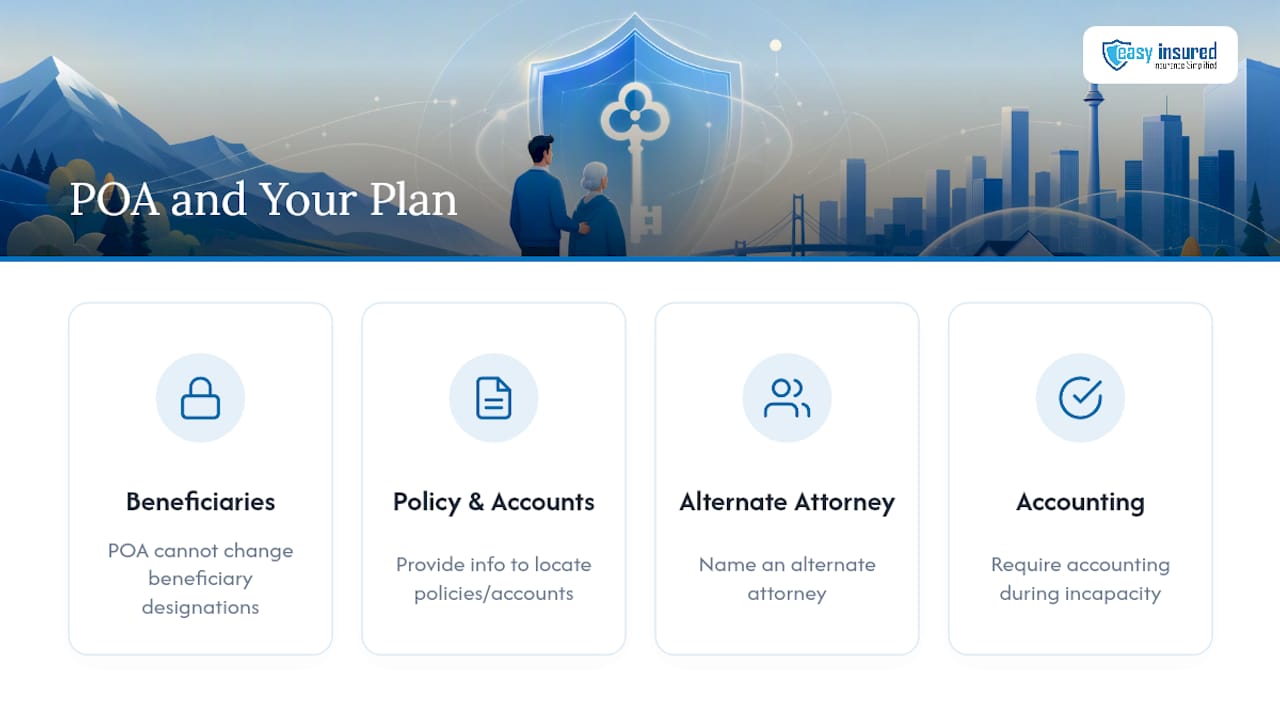
Coordinate the pieces instead of layering them one at a time. Confirm your insurance beneficiary designations match your current wishes, since a POA gives your attorney no authority to change them. Give your attorney enough information to locate your policies and financial accounts, not just legal authority over them. Name an alternate attorney, and require accounting so nobody is left guessing what happened while you were incapacitated.
If your estate involves a business, multiple properties, or blended family obligations, a combined review with both a lawyer and a financial planner catches gaps that either professional alone tends to miss. Estate planning and financial planning reviews exist specifically to close that gap between legal authority and financial access.
What I’ve Seen Go Wrong, and the One Fix That Matters Most
The mistake I see most often: someone signs only their bank’s internal POA form, assumes they’re covered, and then discovers during a health crisis that the form doesn’t extend to their investment accounts or their house. The family loses weeks sorting it out at the exact moment they can least afford the delay.
If you take one thing from this article, make it this: get a proper enduring power of attorney for property drafted, signed, and witnessed correctly, then hand certified copies to your attorney and your bank before you need them, not after.
— Frank
How Easy-insured Helps You Close the Gaps a POA Leaves Open
A power of attorney protects your decision-making while you’re alive. It does nothing for the financial gap that opens up around final expenses, income loss, or a serious diagnosis, and that’s where Easy-insured’s work actually starts. We coordinate estate planning and insurance coverage so your attorney has real resources to manage, not just legal authority over an empty file.

Our estate planning service reviews how your POA, will, and beneficiary designations fit together, so nothing contradicts anything else when it matters. On the insurance side, we help business owners and families put term life, critical illness, and disability coverage in place so your attorney has liquid funds to draw on instead of scrambling to sell assets under pressure. None of this replaces a legal POA document. It’s what makes that document worth having. Book a financial and estate planning review with Easy-insured to see where your current coverage and your POA plan actually connect.
Where to Find Official Forms and Guidance
Government and legal education sources remain the most reliable starting point for actually creating your documents, and each covers a different piece of the puzzle.
- Canada explains the federal framework, joint account risks, and attorney duties.
- Ontario provides free kits, age and capacity thresholds, and guidance on when to involve a lawyer.
- CLEO’s Power of Attorney for Personal Care resource offers a guided pathway tool and plain-language witnessing instructions.
- Alberta covers activation options and confirms there’s no mandatory provincial form.
- Saskatchewan’s power of attorney guidance includes prescribed forms with built-in witness certificates.
This article is general information, not a substitute for advice from a qualified lawyer. Consult a qualified legal professional about your own circumstances before acting on anything here.