
Naming a beneficiary means telling your insurer, bank, or plan administrator exactly who gets your money when you die, bypassing the estate and probate in most cases. Do this today: pull up every account you hold, from life insurance to your TFSA, and confirm a person is actually named. Pay special attention to your TFSA, where choosing a “successor holder” instead of a “designated beneficiary” changes both tax treatment and how fast your spouse gets access to the funds.
TL;DR:
- Most beneficiary designations override your will outside Quebec, so regularly verify account forms to prevent unintended distributions.
- Naming a contingent beneficiary or using precise percentages reduces risks if the primary beneficiary predeceases you or becomes unreachable.
- Updating beneficiary forms immediately after divorce or remarriage is essential, as designation changes are not automatic and may still favor old beneficiaries.
- Choosing a successor holder for a TFSA keeps the account open and tax-free for spouses, while designated beneficiaries trigger taxable events and possible contribution room issues.
- A single outdated or incomplete form can cause costly delays, probate, and family disputes, emphasizing the importance of regular beneficiary reviews.
Table of Contents
- Which Accounts Let You Name a Beneficiary?
- Who Can You Name as a Beneficiary?
- How Do You Name or Change a Beneficiary?
- TFSA Successor Holder vs Designated Beneficiary: What’s the Difference?
- Best Practices That Prevent Beneficiary Disputes
- What Happens if You Don’t Name a Beneficiary?
- How Is a Beneficiary Payout Taxed?
- Do Beneficiary Rules Differ by Province?
- Beneficiary Designations vs Your Will: Who Wins?
- Should You Update Beneficiaries After Divorce or Remarriage?
- A Publisher’s Note on Beneficiary Mistakes We See Often
- Get Your Beneficiary Designations Reviewed Properly
- Sources
Which Accounts Let You Name a Beneficiary?
Most Canadians have more beneficiary-eligible accounts than they realize. Each one works a little differently. The designation on the account itself usually decides where the money goes, not your will.
- Life insurance and annuities: You name a beneficiary directly on the policy contract, and payouts go straight to that person, tax-free.
- RRSP and RRIF: You can name a beneficiary or a successor annuitant (for RRIFs); spousal rollovers can defer tax.
- Employer pensions: Group plans often require a separate beneficiary form through HR, distinct from your personal insurance elections.
- TFSA: You can name a successor holder (spouse only) or a designated beneficiary, each with different tax consequences.
- Bank payable-on-death accounts: Some Canadian banks offer these for savings accounts, letting funds transfer directly to a named person.
- Transfer-on-death brokerage accounts: Non-registered investment accounts at some firms allow a similar direct-transfer designation.
Designations on these accounts generally override instructions in your will, everywhere except Quebec. That’s a feature when your paperwork is current and a real problem when it isn’t. Group and employer plans are worth double checking since HR departments sometimes hold a completely separate beneficiary form from any personal policy you own with the same provider.
Who Can You Name as a Beneficiary?
You have more flexibility than most people assume. Eligible beneficiaries include individuals, registered charities, trusts, and, if you skip the designation entirely, your own estate.
You can split proceeds among multiple people using exact percentages rather than vague splits. Naming contingent beneficiaries matters here too: if your primary beneficiary dies before you or can’t be located, the contingent beneficiary receives the funds directly instead of the payout falling back into your estate.
- Individuals: spouses, children, siblings, friends, anyone you choose.
- Charities: registered organizations can receive insurance or investment proceeds tax efficiently.
- Trusts: often necessary for minors or beneficiaries with disabilities.
- Estate: the default if you name no one, though rarely the best outcome.
Minors generally cannot receive lump sums directly. Without a named trust and trustee, a province may hold the funds until the child reaches the age of majority, which can take years and involves government administration. Irrevocable beneficiary designations, common in some business or divorce agreements, lock in a beneficiary so you cannot change it without their written consent, unlike the revocable designations most people use.
Pro Tip: If you’re naming a minor, set up a testamentary trust in your will and name that trust, or a trustee, on the account form. Skipping this step is one of the most common and most expensive mistakes families make.
How Do You Name or Change a Beneficiary?
Updating a beneficiary designation is usually a short form, but the details matter more than most people expect. Institutions typically require a beneficiary’s full legal name (not a nickname), date of birth, relationship to you, and often a Social Insurance Number or contact information. Incomplete details are the number one cause of payout delays.
- Gather full legal names, birth dates, and relationships for every beneficiary you want to name.
- Log into each account’s online portal, or request the correct form from your insurer, bank, brokerage, or HR department.
- Assign exact percentages if naming more than one beneficiary, and name at least one contingent beneficiary.
- Submit the form and request written confirmation that it was received and processed.
- Save a copy of every confirmation, and follow up if you haven’t heard back within a few weeks.
Most institutions process changes within 5 to 10 business days, though group benefit plans through an employer can take longer. Confirm the SIN is required before sending it. Canada Revenue Agency guidance notes that some plans need it to process a transfer, while others don’t, so it’s worth asking before you hand over sensitive information unnecessarily.
TFSA Successor Holder vs Designated Beneficiary: What’s the Difference?
This is where most Canadians get tripped up, and it’s the single most consequential TFSA decision you’ll make for your spouse. A successor holder, which can only be a spouse or common-law partner, simply steps into your existing TFSA and continues it as their own. The account stays open at the same institution, growth stays tax free, and nothing needs to be reported as income.
A designated beneficiary, by contrast, receives a payout after the TFSA is closed. Any growth that happened between your death and the payout is taxable to the beneficiary, and if that beneficiary isn’t your spouse, depositing the money into their own TFSA counts against their available contribution room, using Form RC240 for a spousal exempt contribution if it applies.
Quebec does not recognize the successor holder or designated beneficiary structure on non-insurance TFSAs. Residents there need a will or notarial directive to accomplish what a simple form does in every other province.
For spouses, the decision usually comes down to continuity versus flexibility. Successor holder keeps everything intact at the same bank with zero tax friction. Designated beneficiary gives more flexibility to consolidate accounts elsewhere, but it comes with a tax clock running from the date of death.
Best Practices That Prevent Beneficiary Disputes
Review your designations after every major life event: marriage, divorce, a new child, the death of a named beneficiary, or a move to a new bank or insurer. A designation you set in 2015 for an account that has since been transferred to a new institution may not have carried over automatically.
Keep your beneficiary forms consistent with your will wherever possible, since account contracts generally override the will outside Quebec, as explained in Why Asset Protection Matters for High Earners. Naming your own estate as beneficiary defeats the purpose of a direct designation. It forces the asset back through probate, the exact delay a designation is meant to avoid.
- Name a contingent beneficiary on every account, not just the primary.
- Use exact percentages, never vague splits like “divide equally” without numbers attached.
- Double check employer or group benefit forms separately from personal policies.
- Avoid nicknames or informal names. Use the name that matches government ID.
Pro Tip: Set a recurring calendar reminder every two years to pull your beneficiary confirmations and compare them against your current family situation. It takes fifteen minutes and catches most problems before they become expensive.
What Happens if You Don’t Name a Beneficiary?
Skip the designation, and the asset defaults to your estate. That triggers probate in most provinces, which means court fees, public disclosure of the asset through the probate process, and potential delays while creditors get a chance to make claims against the estate before your heirs see a dime.
Naming even one contingent beneficiary sidesteps all of that. It keeps the payout private, direct, and fast, often within weeks instead of the months or longer that probate can take when an asset has nowhere specific to go.
How Is a Beneficiary Payout Taxed?
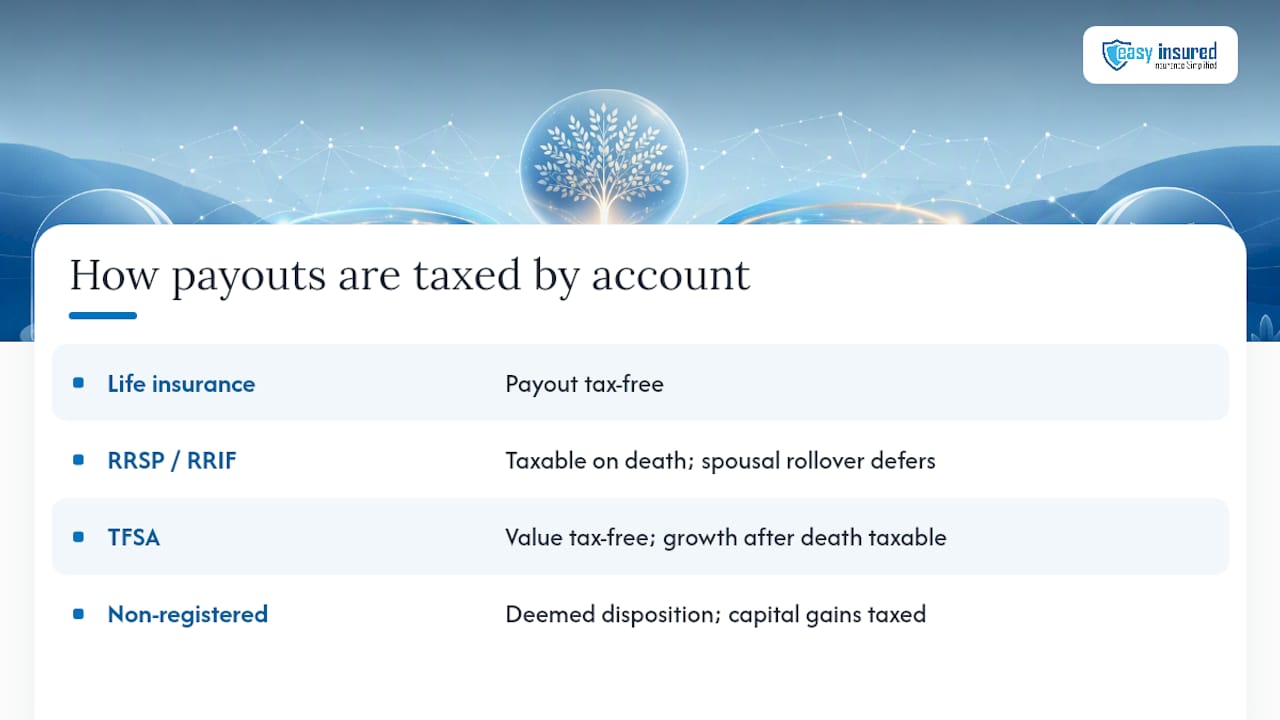
Tax treatment depends entirely on the account type, and this is where families get blindsided. Life insurance proceeds pass to a named beneficiary completely tax free, regardless of the policy’s cash value or how much was paid in premiums.
Registered accounts work differently. An RRSP or RRIF named to a beneficiary other than a spouse or a financially dependent child generally triggers full taxation of the account’s fair market value on the deceased’s final tax return, since these accounts have never been taxed. A spousal rollover can defer that hit, letting the RRSP or RRIF transfer directly to the surviving spouse’s own registered account without immediate tax.
TFSAs are more forgiving. The value at the date of death passes to a designated beneficiary tax free, but any growth after that date, before the account is wound up, becomes taxable income to the beneficiary. A successor holder avoids this entirely, since the account simply continues without a taxable disposition. Non-registered brokerage accounts and bank payable-on-death accounts don’t get any special tax break. The assets are deemed disposed of at death, which can trigger capital gains tax on the estate before anything reaches a beneficiary. That tax bill comes out of the estate, not the beneficiary’s payout, which is one more reason careful planning across account types matters more than most people assume.
Do Beneficiary Rules Differ by Province?
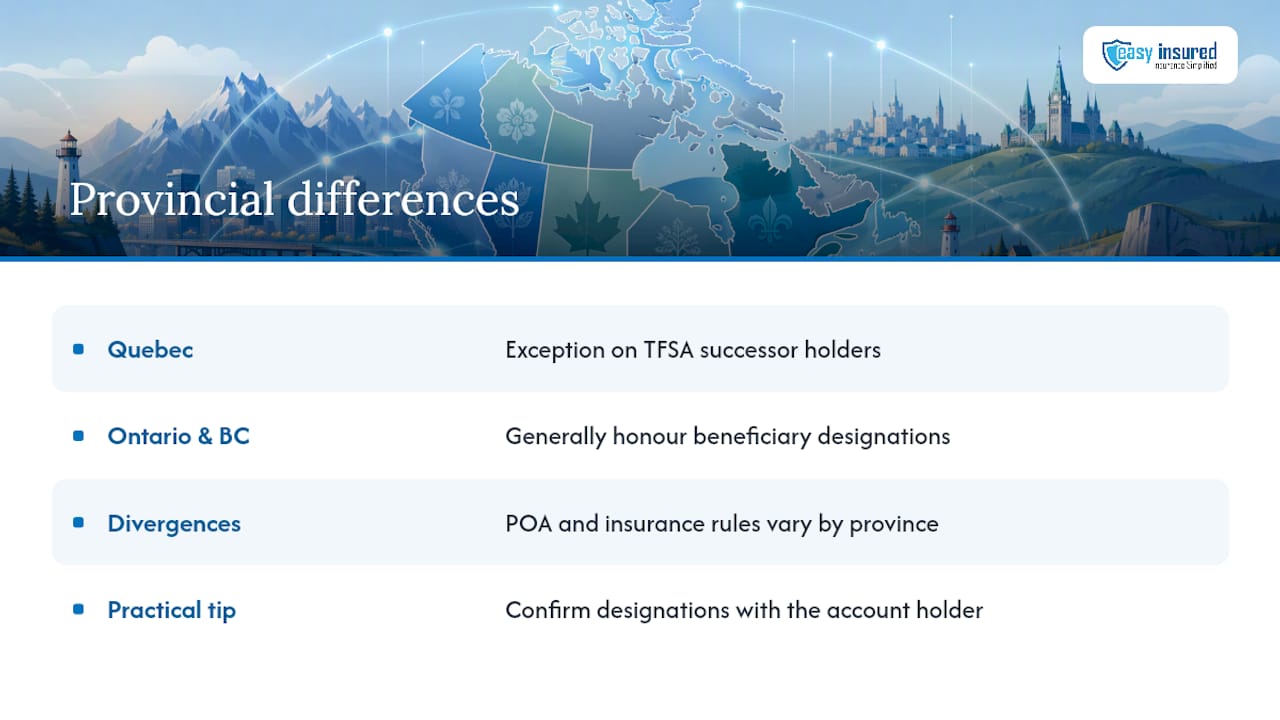
Quebec’s exception on TFSA successor holders and designations gets the most attention, but it isn’t the only provincial wrinkle worth knowing. Ontario and British Columbia both generally honor beneficiary designations on insurance, RRSPs, RRIFs, and TFSAs the way most of Canada does, letting the designation bypass the estate and probate.
Where provinces diverge more subtly is in how they treat designations made under a power of attorney, and in provincial insurance legislation governing who qualifies as an eligible beneficiary on a life insurance contract. British Columbia’s Insurance Act and Ontario’s Insurance Act both set out specific rules for irrevocable designations and for what happens when a named beneficiary predeceases the policyholder without a contingent named. The practical difference for most readers is smaller than the Quebec exception, but it still means a form that works cleanly in one province shouldn’t be assumed to work identically in another, especially for older insurance contracts written under a previous provincial framework or for policies that have moved with you across provinces over the years.
The safest approach, regardless of where you live, is to confirm your designations directly with the institution holding the account rather than relying on general assumptions about how “most of Canada” handles it.
Beneficiary Designations vs Your Will: Who Wins?
A beneficiary designation on a specific account generally overrides whatever your will says about that same asset, in every province except Quebec. That surprises people who assume their will is the master document controlling everything they own. It isn’t, at least not for accounts with their own beneficiary form.
This creates real conflict potential. Say your will leaves everything equally to three children, but your RRSP still names an ex-spouse from a policy set up fifteen years ago. The RRSP pays out to the ex-spouse, full stop, regardless of what the will says, because the designation on the contract itself controls in common-law provinces.
The fix is coordination, not conflict. Treat your will and your beneficiary forms as two documents that need to agree with each other, and update both at the same time whenever your intentions change. If you want an account to actually flow through your estate for a specific reason, such as funding a testamentary trust for a minor, name the estate deliberately rather than by accident, and make sure your will spells out exactly how those estate assets should be distributed. When the two documents contradict each other, the account designation typically wins for that specific asset, and your executor has no authority to override it, no matter what the will says.
Should You Update Beneficiaries After Divorce or Remarriage?
Yes, immediately, and this is the single most overlooked step in any separation or remarriage. Divorce does not automatically remove an ex-spouse from a beneficiary designation on most Canadian accounts and insurance policies, unlike some other jurisdictions that void spousal designations automatically on divorce.
That means an ex-spouse named on a life insurance policy or RRSP a decade ago can still legally receive the payout, even after a divorce, a separation agreement, and years of separate lives, unless you actively filed a change. Some provinces have introduced legislation revoking a spousal designation on divorce for certain policy types, but the rules vary and shouldn’t be relied on as a substitute for updating the form yourself.
Remarriage adds a second layer. A new spouse doesn’t automatically replace an old designation either, and if you intended a TFSA successor holder arrangement with your new spouse, that requires an active form, not an assumption based on your current marital status. The same goes for updating contingent beneficiaries, since a former in-law or an ex-spouse’s family member named years ago as a backup rarely reflects your current wishes. Treat divorce and remarriage as mandatory triggers to pull every beneficiary form you have, on every account, and confirm each one still matches reality.
A Publisher’s Note on Beneficiary Mistakes We See Often
The errors that show up again and again aren’t complicated: an outdated employer group form, a nickname instead of a legal name, or a primary beneficiary with no contingent listed. Specialized estate planning and beneficiary review services exist to catch exactly these gaps. Use the checklist above, or reach out for a full beneficiary audit before a small oversight becomes a family dispute.
— Frank
Get Your Beneficiary Designations Reviewed Properly
A single outdated form can undo years of careful planning, and most Canadians only discover the gap when it’s too late to fix. Easy-insured’s estate planning team reviews every account you hold, insurance, registered plans, and investments, side by side with your will, so the two documents actually agree instead of quietly contradicting each other.

If your life insurance beneficiary hasn’t been touched since the policy was issued, or you’re not sure whether your TFSA names a successor holder or a designated beneficiary, that’s exactly the kind of gap a financial planning review catches before it costs your family money and time in probate. For newer coverage or a policy you’re still shopping for, Easy-insured’s whole life and term life options let you build beneficiary designations correctly from day one. Book a beneficiary review with a qualified service provider to get every account, form, and percentage confirmed in one sitting.
This article is general information, not a substitute for advice from a qualified financial advisor. Consult a qualified financial professional about your own circumstances before acting on anything here.