
Laddering makes sense for one specific kind of buyer: someone with big obligations now that shrink on a predictable schedule, like a mortgage or years of kid-raising. Stack a few term policies with staggered end dates instead of buying one large policy for decades, and you usually cut total premium cost while matching coverage to what you actually still owe. The catch is underwriting timing and a needs-based number to build from, both covered below, along with structures, savings math, and the buying steps.
TL;DR:
- Laddering typically reduces total premiums by matching coverage length to declining obligations, such as a mortgage or children’s needs.
- Buying multiple shorter-term policies for critical periods can cost less overall than a single long-term policy, especially for healthy applicants.
- Coordinating applications simultaneously across several carriers helps lock in health ratings and secure beneficial riders like conversion and waiver options.
- Over four policy rungs becomes administratively complex, and staggered applications risk higher rates if health declines between purchases.
- Laddering is best suited for those with predictable obligation timelines and shrinking financial exposure, rather than ongoing or permanent needs.
Table of Contents
- What Is Life Insurance Laddering?
- Why Laddering Can Save Money and Fit Coverage Better
- Common Ladder Structures and How to Size Each Rung
- Key Risks and When Laddering Isn’t the Right Call
- How to Buy a Laddered Structure Without the Guesswork
- Realistic Cost-Comparison Scenarios
- Your Step-by-Step Ladder Checklist
- Why Easy-insured Recommends Laddering for Many Families
- How Easy-insured Helps You Build a Ladder That Fits
- Sources
What Is Life Insurance Laddering?
Life insurance laddering means buying multiple term policies with different expiry dates instead of one policy sized for your worst-case, longest-horizon need. Each “rung” covers a different slice of time and a different chunk of financial obligation. A 20-year mortgage might get one policy, a 10-year runway until the kids are financially independent might get another, and a smaller permanent layer might cover final expenses indefinitely.
The mechanic that makes this work is simple: term life gets more expensive per dollar of coverage the longer the term runs, because insurers price in more years of mortality risk. Guides describing the ladder strategy show that splitting coverage by duration, rather than buying one blanket policy at the longest term you’ll ever need, lets you drop expensive layers off as obligations disappear.
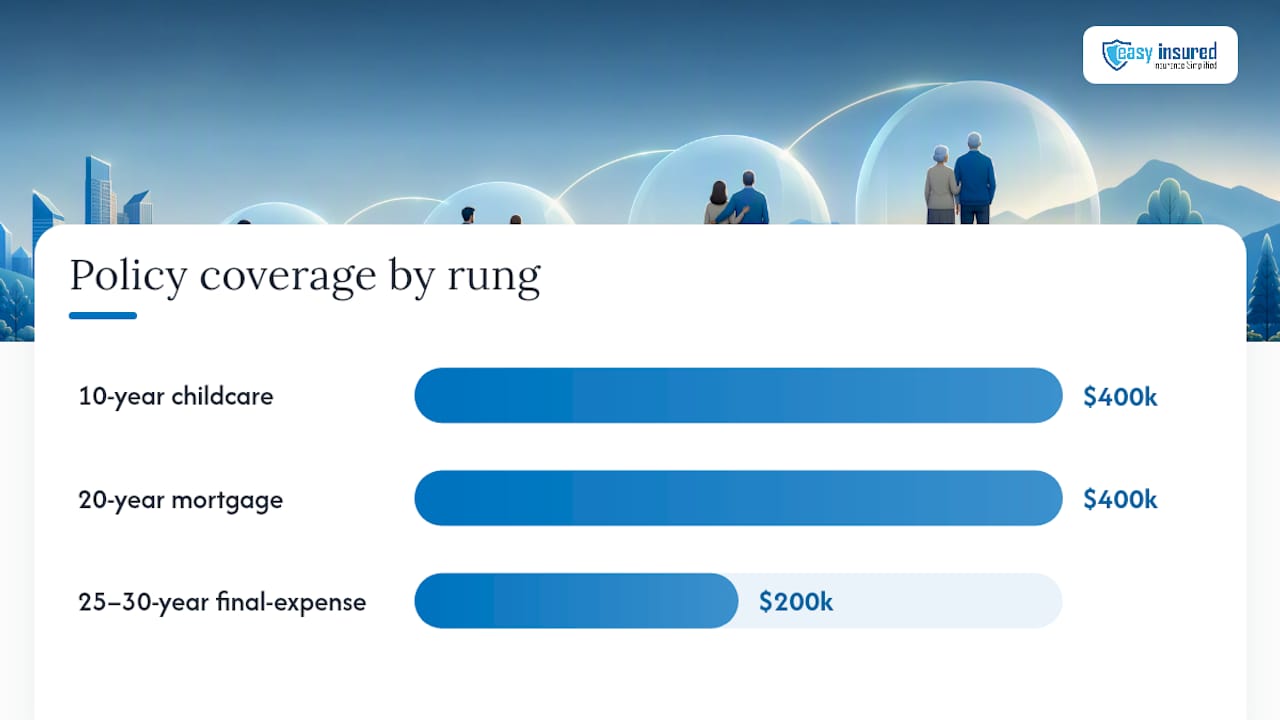
Picture a 38-year-old with a 25-year mortgage, two kids ages 4 and 7, and no other major debt. A single 25-year, $1,000,000 policy covers everything, but pays for 25 years of coverage on debt and childcare costs that actually taper off much sooner. A ladder instead might look like:
- A 10-year, $400,000 policy covering the years of heaviest childcare and income dependence
- A 20-year, $400,000 policy tracking the mortgage payoff timeline
- A 25 or 30-year, $200,000 policy as a smaller anchor for final expenses and any remaining debt
Same total starting coverage, but the premium bill shrinks every decade as rungs expire.
Why Laddering Can Save Money and Fit Coverage Better
The savings come from a basic pricing rule: shorter terms cost less per thousand dollars of coverage than longer terms, because insurers charge for the years they’re on the hook. A 10-year term on a healthy 35-year-old costs a fraction of what a 30-year term costs for the same face value, since the insurer is pricing 10 years of mortality risk instead of 30.
Laddering exploits that gap by keeping expensive long-duration coverage only where you genuinely need decades of protection, while covering shorter-term risk (young kids, a specific loan) with cheaper, shorter policies.
The savings are real but variable. Comparative rate analyses show laddered structures can produce meaningful monthly savings compared with one long-term policy of the same total face value, though the exact gap depends on age, health class, and how the rungs are sized.
The bigger win, arguably, is fit rather than pure cost. Coverage concentrates where your financial exposure is actually highest:
- Peak years (young kids, high mortgage balance, single income dependency) get the most total coverage stacked across overlapping rungs
- Later years, once the mortgage is smaller and kids are grown, carry less coverage because you need less
- You’re not paying decades of premium for protection you’ll have outgrown by year 12
That’s the trade single large policies can’t make.
Common Ladder Structures and How to Size Each Rung
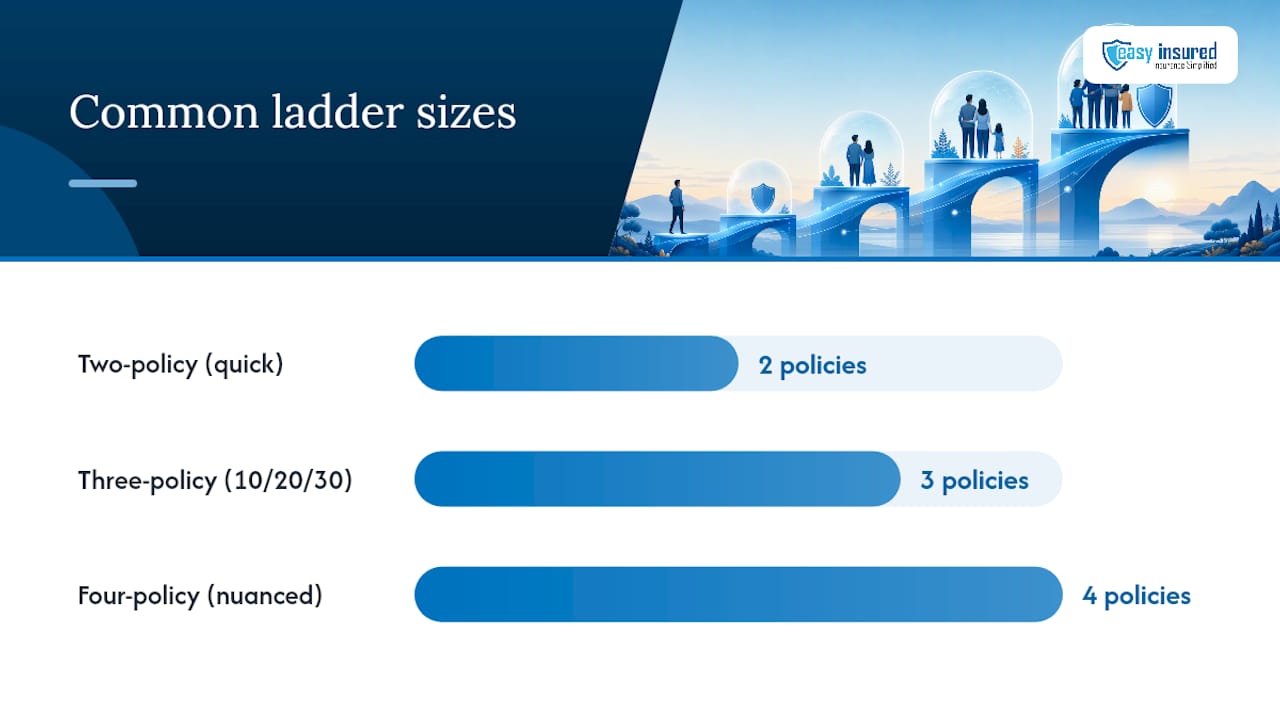
Most people don’t need a complicated ladder. Industry checklists and advisor guides consistently point to two, three, or four policies as the practical range, with three-policy short/mid/long models as common professional guidance for buyers with a mortgage and kids.
Here’s how the models typically break down:
- Two-policy quick ladder. One shorter term (10 years) for peak-obligation years, one longer term (20 to 30 years) as the anchor. Simple to manage, good for buyers with fewer moving pieces.
- Three-policy model (the 10/20/30 approach). A 10-year rung for the highest-exposure window, a 20-year rung tracking a mortgage, and a 30-year rung as a long anchor for final expenses or a spouse’s income replacement. This is the structure most brokers reach for first.
- Four-policy nuanced model. Adds a fourth rung, often at 15 years, to match a specific obligation like a business loan or a shorter mortgage on a rental property.
Sizing each rung starts with a needs-based calculation rather than a rough salary multiple. Add up income replacement (years of income your family would need to replace), outstanding debts, future education costs, and final expenses, then subtract liquid assets and existing coverage. That total gets distributed across your rungs based on when each obligation disappears.
Four rungs is close to the practical ceiling. Beyond that, the administrative overhead of tracking multiple carriers, renewal dates, and beneficiary forms tends to outweigh any marginal savings from finer-grained slicing.
Key Risks and When Laddering Isn’t the Right Call
The biggest risk in laddering isn’t the concept. It’s timing. If you buy your rungs in phases and your health declines between purchases, you could get quoted a worse rate, or denied coverage outright, on a later policy. Advisor guidance on this point is consistent: apply to all your policies at roughly the same time so you lock in your current health classification across the board, rather than staggering the applications themselves along with the terms.
There’s also a real administrative cost. Multiple carriers mean multiple beneficiary designations, multiple claim processes, and multiple renewal dates to track. That’s manageable with a simple spreadsheet, but it’s a genuine step up in complexity from a single policy with one beneficiary form.
Laddering isn’t the right tool for everyone:
- If your obligations aren’t shrinking, permanent whole or universal coverage may fit better than a stack of expiring terms
- Business owners with buy-sell agreements or key-person needs often want a long, level policy rather than a declining ladder
- If your health is already borderline, adding future insurability risk by buying in phases is a real gamble
Pro Tip: If you can’t apply for every rung simultaneously, buy the longest, hardest-to-replace policy first. Health tends to get harder to insure over time, not easier, so lock in the anchor while your rating is best.
Riders help offset some of this risk. A conversion rider lets you convert term coverage to permanent later without new medical underwriting, which is valuable insurance against your own future insurability. A waiver-of-premium rider keeps a policy in force if you become disabled and can’t pay premiums, something industry checklists flag as a core flexibility feature worth confirming on every rung.
How to Buy a Laddered Structure Without the Guesswork
Building a ladder correctly comes down to sequencing. Get the math right first, then coordinate the applications so underwriting doesn’t undercut the savings you’re trying to capture.
- Run a needs-based calculation. Add income replacement, outstanding debts, education costs, and final expenses, then subtract liquid assets and existing coverage. Federal consumer guidance specifically recommends this approach over salary-multiple shortcuts, since it ties coverage to your actual obligations rather than a rough rule of thumb.
- Decide your number of rungs and term lengths. Match each rung to a specific obligation timeline: mortgage payoff, years until kids are independent, a business loan term.
- Get quotes across multiple carriers and apply at the same time. Applying simultaneously locks in your current health classification across every rung instead of risking a worse rate on a later application.
- Select riders deliberately. Confirm conversion privileges and waiver-of-premium availability on each policy, and ask each carrier directly what triggers a rate change or loss of convertibility.
- Document everything and set a review cadence. Keep policy numbers, beneficiaries, and expiry dates in one place, and revisit the whole structure after a marriage, a new child, a mortgage refinance, or a major raise.
A few pointed questions are worth asking any carrier or broker before signing: Is this term convertible, and until what age? What happens to the premium at renewal if I don’t convert? Is waiver of premium included or an add-on? Those answers matter more than the headline premium quote.
Realistic Cost-Comparison Scenarios
Take a healthy, non-smoking 35-year-old looking at $750,000 in total coverage. Illustrative modeling from ladder-strategy guides shows a common pattern: splitting that total across a 10-year, 20-year, and 30-year rung tends to cost less in total monthly premium over the life of the coverage than buying $750,000 on a single 30-year term, because the shortest rungs drop off well before the 30-year mark.
The exact numbers move a lot depending on a few factors:
- Smoker status can roughly double or triple premiums at any term length, which changes whether laddering’s savings are worth the added complexity
- Underwriting type (fully underwritten versus simplified-issue or guaranteed-issue) affects both price and how fast you can get coverage in place
- Region and carrier both shift quoted rates, sometimes significantly, for identical coverage amounts
These figures are illustrative comparisons from published modeling, not a quote. Your actual premiums depend on your health class, region, and the carriers you apply through, so treat any ladder example as a starting framework rather than a number to expect.
The takeaway isn’t a specific dollar figure. It’s that the ladder structure tends to beat a single long-term policy on cost for buyers whose obligations genuinely decline over time, and the gap tends to widen the further apart your shortest and longest rungs are.
Your Step-by-Step Ladder Checklist
- Calculate your total need using income replacement, debts, education costs, and final expenses minus assets.
- Pick your rung count (two to four policies) and assign term lengths to specific obligations.
- Request quotes from several carriers for each rung at once, not staggered over months.
- Submit applications simultaneously to lock your current health rating across every policy.
- Confirm riders (conversion, waiver of premium) on each policy before signing.
- Log every policy number, beneficiary, and expiry date in one document.
- Re-evaluate the ladder after a mortgage refinance, new child, marriage, or major income change.
Why Easy-insured Recommends Laddering for Many Families
For clients with a mortgage, young kids, and an income that needs replacing for a defined stretch of years, laddering is often the more sensible structure than one large, long-term policy. It matches what you pay to what you actually owe, and it doesn’t lock you into 30 years of premium for coverage you’ll have outgrown by year 10.
Multi-policy purchases should be coordinated by applying across carriers at the same time to protect your health classification and confirming conversion and waiver-of-premium riders on every rung before signing anything.
— Frank
How Easy-insured Helps You Build a Ladder That Fits
Between comparing carriers, timing applications, and choosing riders, laddering has a lot of moving pieces to get right on your own. A brokerage or advisor can help run the needs-based math, coordinate simultaneous applications across carriers to lock in your health class, and confirm conversion privileges before any policy gets signed.

Our term life options are built with laddering in mind, and if your obligations look more permanent than declining, a whole life policy might anchor your ladder better than another term rung. For readers who want the whole structure folded into a bigger picture, our financial planning team will run a full needs analysis alongside your ladder so nothing gets sized on a guess. Request a needs analysis and an integrated quote to see what a coordinated, multi-policy structure would actually cost for your situation.
Sources
- Financial Consumer Agency of Canada — life insurance guidance
- AdvisorGuide — purchasing life insurance checklist
- Forbes Advisor — How to maximize life insurance with a ladder
This article is general information, not a substitute for advice from a qualified financial advisor. Consult a qualified financial professional about your own circumstances before acting on anything here.