
Cash value life insurance is permanent life insurance that pairs lifelong coverage with a savings component you can borrow against or withdraw from. Unlike term insurance, which only pays a death benefit for a fixed period, it costs more but builds equity you can tap while you’re alive. It tends to suit people who want permanent protection plus a tax-advantaged place to park money, not those chasing the highest possible investment return.
TL;DR:
- Cash value typically doesn’t grow meaningfully until two to five years after policy issuance due to initial costs consuming premiums.
- Whole life policies offer guaranteed, predictable cash value growth, while universal and indexed policies depend on interest rates or market performance.
- Accessing cash value through withdrawals, loans, or surrendering the policy can impact the death benefit and incur tax or surrender charges if done prematurely.
- Tax advantages depend on maintaining the policy; withdrawals up to the adjusted cost basis are tax-free, but loans and surrenders may trigger taxes if not planned properly.
- Cash value insurance makes sense mainly for those who need permanent coverage or specific estate planning reasons, not solely for investment growth.
Table of Contents
- What Is Cash Value Life Insurance and Its Key Terms?
- What Are the Main Types of Cash Value Policies?
- How Does Cash Value Actually Build Inside a Policy?
- How Can You Access Cash Value in a Policy?
- What Tax Rules Apply to Cash Value Life Insurance?
- Is Cash Value Life Insurance Worth It for You?
- How Do You Evaluate a Cash Value Policy Before Buying?
- Our Take on When Cash Value Insurance Actually Makes Sense
- Get a Personalized Cash Value Illustration
- Sources
What Is Cash Value Life Insurance and Its Key Terms?
Four terms show up in every conversation about these policies, and mixing them up leads to real confusion when you’re reading an illustration.
- Cash value: the savings-like balance building inside a permanent policy, funded by a slice of your premium.
- Cash surrender value: what you’d actually receive if you canceled the policy today, after surrender charges and any outstanding loans are subtracted.
- Adjusted cost basis (ACB): roughly what you’ve paid into the policy net of the insurance cost, used to calculate tax on withdrawals.
- Death benefit: the payout to your beneficiaries, which can shrink if you’ve taken loans or withdrawals you never repaid.
Permanent life insurance policies usually build up a cash value that can be borrowed against or withdrawn, while term policies never accumulate this at all. That’s the trade you’re making with higher premiums: part of each payment covers the cost of insurance and administrative fees, and part gets deposited into the cash-value bucket. Here’s a simple way to picture it: a policy might show cash value in year ten, but if you surrendered it that same year, you would receive less after surrender charges. Cash value and cash surrender value are related, but they’re rarely the same number until the surrender charges expire.
What Are the Main Types of Cash Value Policies?
Not all cash value policies grow the same way, and the differences matter more than most sales conversations let on.
- Whole life: guaranteed cash-value growth on a fixed schedule, with level premiums for life. Many whole life contracts are participating, meaning the insurer may pay dividends based on its financial performance.
- Participating (dividend-paying) policies: dividends aren’t guaranteed, but when paid, they’re often used to buy paid-up additions, small increments of extra coverage that also carry their own cash value, or applied toward premiums.
- Universal life: premiums are flexible within limits, and the insurer credits interest to your cash value based on current rates rather than a fixed guarantee.
- Indexed and variable universal life: cash value growth tracks a market index or fund performance, which raises the ceiling on returns and the floor on risk, along with higher internal fees.
Different policies build cash value differently: whole life often runs on a guaranteed schedule, universal life credits interest, and indexed or variable products link growth to markets. Advisors typically recommend whole life for people who want predictability and don’t want to think about it again for twenty years. Universal life tends to fit business owners who want premium flexibility during uneven income years. Indexed and variable products belong with people who already understand market risk and want more upside potential inside an insurance wrapper.
Pro Tip: Ask specifically whether dividends in a participating policy are being used to buy paid-up additions or just reduce your premium bill. The first option compounds your death benefit and cash value over time; the second just lowers your out-of-pocket cost today.
How Does Cash Value Actually Build Inside a Policy?
Every premium dollar gets split three ways: the cost of insurance (what actually pays for the death benefit risk), policy fees and administrative charges, and the deposit that becomes cash value. In the early years, the insurance cost and fees eat a disproportionate share, which is exactly why your cash value balance looks unimpressive at first.
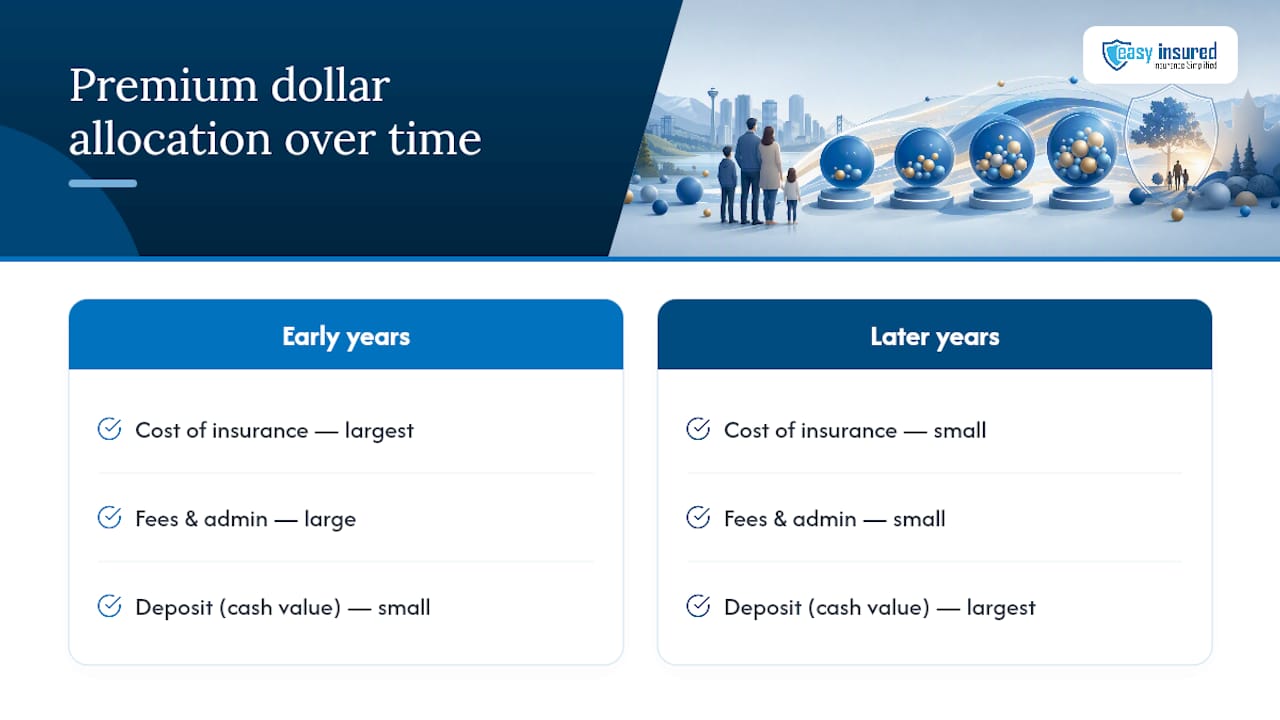
Whole life policies typically follow a guaranteed cash-value table baked into the contract, so you can look up year-by-year minimums regardless of how markets perform. Universal, indexed, and variable policies instead credit interest or returns that move with rates or markets, so the numbers you see in an illustration are projections, not promises.
Cash values often don’t start accumulating in any meaningful way until two to five years after the policy is issued, since upfront costs consume most of the early premium. This is why insurers project illustrations across 20, 30, or even 40 years: the compounding only becomes visible over a long horizon. Treat any generic online example with suspicion. The only number that means anything for your situation is the illustration tied to your actual age, health class, and policy design, since two people with identical premiums can see meaningfully different cash-value trajectories based on underwriting alone.
How Can You Access Cash Value in a Policy?
You generally have three ways to get at the money, and each comes with a different catch.
- Withdrawals: you can pull cash value tax-free up to your adjusted cost basis; anything above that is taxable as income. Withdrawals also reduce your death benefit dollar for dollar in most contracts.
- Policy loans: you borrow against the cash value at an interest rate set by the insurer. Loans accrue interest and unpaid balances reduce the death benefit if you never pay them back, and an unpaid loan that grows too large can even cause the policy to lapse.
- Full or partial surrender: canceling the policy gets you the cash surrender value, but only after surrender charges are deducted, and the coverage ends entirely on a full surrender.
Borrowing against cash value often comes with a lower interest rate than an unsecured bank loan, which is why some business owners use it as a flexible credit line during tight cash-flow years. Before touching any of these options, check your current ACB, request an updated illustration showing the loan or withdrawal’s effect on your death benefit, and confirm whether any surrender charge period is still active.
What Tax Rules Apply to Cash Value Life Insurance?
Your adjusted cost basis is the number that determines whether a withdrawal triggers tax. Pull money out up to your ACB and it’s generally tax-free; go above it and the excess counts as taxable income in that year.
Policy loans work differently. They’re typically not taxed as income while the policy stays in force, because a loan isn’t a disposition of the policy. That changes if the policy lapses or you surrender it with an outstanding loan balance still owing. At that point, the unpaid loan can trigger a taxable gain based on how far the loan and any prior withdrawals pushed you past your ACB. This is one of the more common surprises policyholders run into, and it’s avoidable with planning.
Cash value life insurance combines permanent coverage with a savings component and can offer real tax advantages, but those advantages depend on how the policy is used and eventually settled. Run any loan or withdrawal scenario through your policy illustration first, and talk to a tax advisor before a large withdrawal, a full surrender, or letting a policy lapse with a loan attached.
Is Cash Value Life Insurance Worth It for You?
The honest answer depends on what you’re optimizing for, coverage certainty or investment flexibility, and the two don’t always pull in the same direction.
Where cash value policies deliver real value:
- Coverage that never expires, as long as premiums are paid or the policy is structured to be self-sustaining.
- A source of tax-advantaged borrowing you can access without a bank application or credit check.
- Estate planning uses, including funding tax liabilities or leaving a guaranteed payout to beneficiaries.
Where they fall short for a lot of buyers:
- Premiums run several times higher than equivalent term coverage.
- Cash value grows slowly in the early years and fees eat into returns.
- Surrender charges and internal complexity can make these policies less efficient than direct investing for people focused purely on growth.
Advisors typically point clients toward cash value coverage when permanent protection is already a goal, whether for estate planning, business succession, or lifelong dependent care, and the savings feature is a bonus on top of that decision, not the sole reason to buy. If lifelong coverage isn’t a priority, term insurance compared against whole life usually wins on pure cost efficiency.
How Do You Evaluate a Cash Value Policy Before Buying?
Walking into a broker meeting with the right documents in hand changes the entire conversation. Request these before you sign anything:
- The full policy contract, not just the summary brochure.
- A current policy illustration showing both guaranteed and non-guaranteed projections.
- Dividend history for the past 10 years, if you’re looking at a participating policy.
- The surrender charge schedule, showing exactly when those charges disappear.
Once you have those, ask direct questions: What’s the guaranteed cash-value table, separate from the projected one? What interest rate applies to policy loans, and can that rate change? How does a $10,000 withdrawal in year 15 affect the death benefit in the illustration? Push back if the answers are vague, if projected returns look unusually generous, or if the surrender schedule isn’t clearly disclosed in writing.
Pro Tip: If an illustration only shows non-guaranteed numbers without a parallel guaranteed column, ask why. A transparent insurer will show both without hesitation.
For a deeper technical breakdown of how whole life cash value compounds over decades, this investor-focused explainer walks through the mechanics in more detail than most consumer guides attempt.
Our Take on When Cash Value Insurance Actually Makes Sense
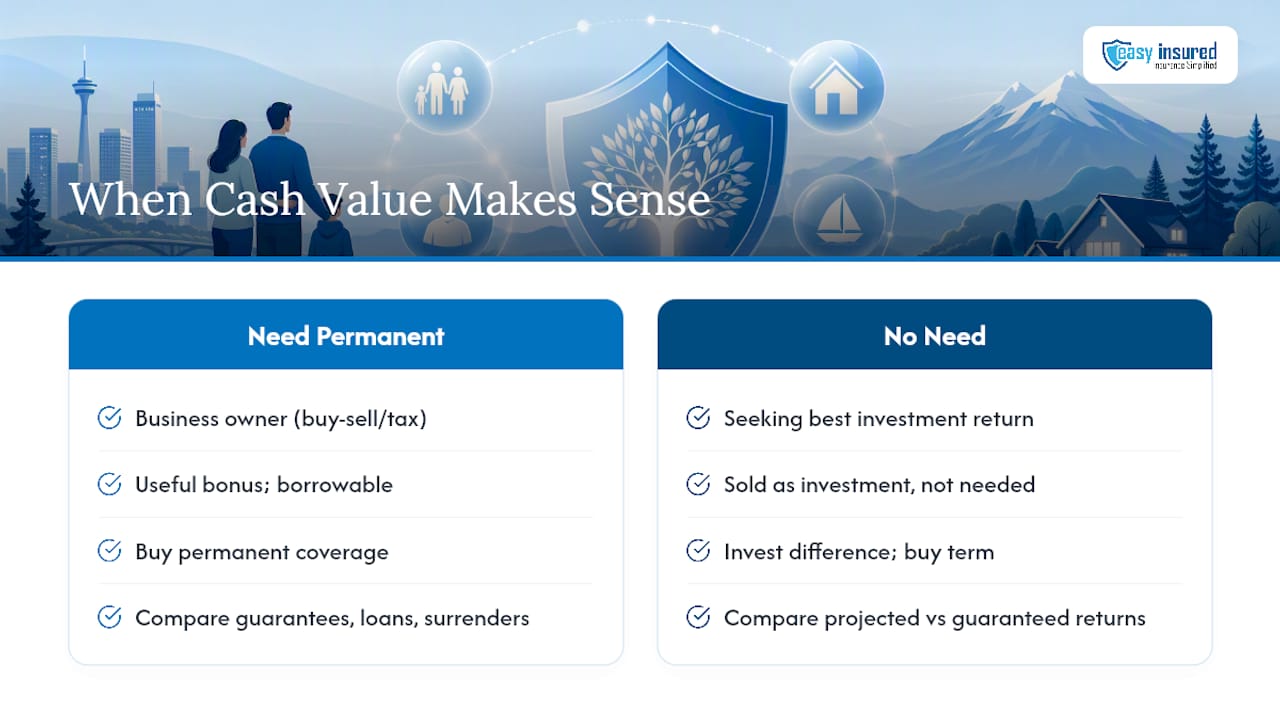
Most articles on this topic try to hand you a universal verdict: cash value insurance is either a smart financial tool or an overpriced product sold on commission. Neither framing holds up once you look at real client situations. The right question isn’t whether cash value insurance is good or bad. It’s whether you already need permanent coverage for a specific reason, and the savings feature happens to be the bonus, or whether someone sold you cash value insurance as an investment product first and coverage second.
That distinction shows up constantly in illustration reviews. A business owner funding a buy-sell agreement or covering a corporate tax liability at death has a real reason for permanent coverage, and the cash value becomes a genuinely useful side benefit for borrowing during lean years. Someone shopping purely for the best long-term return, with no real need for lifelong coverage, is usually better served putting the premium difference into a registered account and buying term insurance instead. Easy-insured builds illustrations that show both paths side by side, guaranteed and projected numbers, loan scenarios, and surrender values at multiple points, because the decision should be made with real figures in front of you, not a sales pitch.
— Frank
Get a Personalized Cash Value Illustration
Easy-insured builds whole life and universal life illustrations that show your guaranteed numbers next to the projected ones, side by side, so you’re never guessing which column reflects a promise and which reflects a scenario.

If you’re weighing whether permanent coverage with a cash value feature fits your situation, or you’re comparing it against term life for a specific goal like estate planning or business protection, an advisor can walk through your numbers directly rather than leaving you to interpret a generic brochure. Easy-insured also offers universal life options for readers who want flexible premiums tied to interest crediting rather than a fixed schedule. Request a personalized whole life illustration and see the guaranteed cash-value table, surrender schedule, and loan terms for your exact age and health class before you commit to anything.
This article is general information, not a substitute for advice from a qualified financial advisor. Consult a qualified financial professional about your own circumstances before acting on anything here.
Sources
- Canada
- Ratehub
- Understanding Cash Value in Life Insurance
- Cash Value Life Insurance: How It Works and When to Use It