
Par (participating) whole life insurance shares in the insurer’s profits through non-guaranteed dividends. Non-par (non-participating) whole life locks in fixed, guaranteed premiums and cash values with no profit-sharing at all. The simple rule: pick non-par when predictability matters most, and pick par only if you want upside potential and can tolerate some variability in the numbers over time.
- Non-par: fixed premiums, guaranteed cash value growth, no dividends
- Par: higher starting cost, non-guaranteed dividends, potential for larger long-term payout
According to guidance from the Office of the Superintendent of Financial Institutions, participating policyholders need clear disclosure on how dividend scales are set, precisely because those dividends are never guaranteed. Easy-insured walks buyers through both structures before recommending either one.
Key Takeaways
Non-par whole life delivers guaranteed premiums and cash value with no profit-sharing, while par whole life adds non-guaranteed dividends on top of a guaranteed base, and the right choice depends on whether predictability or upside potential matters more to your specific goal.
| Point | Details |
|---|---|
| Guarantees differ by design | Non-par guarantees every number in the contract; par guarantees only the base, not the dividend. |
| Dividends have three sources | Investment returns, mortality experience, and expense savings all drive whether a dividend scale rises or falls. |
| Premiums start higher for par | Carriers price in dividend participation upfront, so par premiums typically cost more at issue than non-par. |
| Loans hit par differently | Borrowing against a par policy can interrupt dividend-funded paid-up additions, not just the guaranteed cash value. |
| Easy-insured maps product to goal | Easy-insured’s advisors sequence goals, time horizon, and cash-flow needs before recommending par or non-par whole life. |
Table of Contents
- What’s the Structural Difference Between Par and Non-Par Life Insurance?
- How Are Dividends Calculated on a Participating Policy?
- Why Do Par Premiums Cost More Than Non-Par?
- Who Should Choose Par vs Non-Par Life Insurance?
- How Easy-Insured Advisors Help You Choose Between Par and Non-Par
- Do Policy Loans and Withdrawals Work Differently for Par vs Non-Par?
- How Are Par and Non-Par Life Insurance Policies Taxed?
- Where to Verify Par vs Non-Par Facts Yourself
- Get a Personalized Par vs Non-Par Comparison
- Sources
What’s the Structural Difference Between Par and Non-Par Life Insurance?
Every whole life policy has two kinds of numbers: what the insurer promises, and what the insurer merely projects. Non-par policies keep that line simple. Premiums are fixed at issue, cash value grows on a locked schedule, and the death benefit doesn’t move regardless of what happens with the insurer’s investment portfolio. What you sign at 35 is what plays out at 85. Non-participating policies are insulated from the insurer’s investment and operational performance, which is the whole point of buying one.
Par policies add a second layer on top of the guaranteed base: a share of the insurer’s participating account surplus, paid out as a dividend. That dividend depends on how the insurer’s investments, mortality experience, and expenses played out that year, and it’s never promised in the contract.
Guaranteed in both policy types:
- Base premium (for the initial term specified)
- Minimum cash value schedule
- Death benefit floor
Non-guaranteed in par only:
- Annual dividend amount
- Long-term dividend scale (can be adjusted by the insurer)
- Total illustrated cash value beyond the guaranteed column
One detail most shoppers miss: insurer ownership structure shapes which product gets pushed. Mutual insurers, owned by policyholders rather than shareholders, tend to lean heavily on participating products since dividends are how they return surplus to the people who own the company. Stock insurers offer both, but often market non-par more aggressively since it doesn’t require managing a participating account at all. Neither structure is better across the board. It just explains why your neighbor’s policy illustration might look completely different from yours even at the same coverage amount.
How Are Dividends Calculated on a Participating Policy?
Dividends aren’t a marketing gimmick or a random bonus. They come from three sources: better-than-assumed investment returns, favorable mortality experience (fewer claims than priced for), and expense savings from running the business more efficiently than budgeted. When all three land in the insurer’s favor, the dividend scale rises. When they don’t, it falls, sometimes sharply.
Once declared, you get to choose what happens to the money:
- Cash payout — take the dividend as a check each year
- Premium reduction — apply it against next year’s premium bill
- Paid-up additions (PUAs) — buy small increments of fully paid-up additional coverage, which itself can generate future dividends
- Accumulate at interest — leave it with the insurer to compound, often at a modest guaranteed rate
Here’s where compounding does real work. Say a par policy generates a dividend that can be applied entirely to PUAs, compounding over time with reinvested dividends, though actual amounts vary with insurer performance. That $1,200 doesn’t just sit there. It buys additional permanent coverage that itself earns future dividends, and by year 30, a consistent pattern of reinvested dividends can meaningfully outpace the policy’s guaranteed-only cash value column. The catch: this only works if the dividend scale holds up for three decades, and scales have dropped before during periods of low interest rates.
Pro Tip: Ask any advisor showing you a par illustration to also show you the guaranteed-only column, projected to age 100. If that number alone doesn’t satisfy your goal, you’re relying on the dividend to do the heavy lifting.
The biggest risk drivers behind a shrinking dividend: prolonged low interest rates squeezing investment income, mortality experience running worse than priced, and rising operating costs inside the participating account.
Why Do Par Premiums Cost More Than Non-Par?
Par premiums usually start noticeably higher than non-par premiums for the same face amount, and there’s a straightforward reason: the carrier prices in the cost of dividend participation from day one, whether or not that dividend ever materializes at the projected scale. You’re paying upfront for a feature that pays you back later, maybe.
Non-par policies skip that markup. The guaranteed column is the only column, so the premium reflects strictly what the insurer needs to fund fixed obligations. That’s why non-par often looks like the “cheaper” option on paper, though over 30 years a consistently strong dividend scale can flip that math in the par policy’s favor.
When you’re reading any illustration, whether for guaranteed life insurance or a participating product, check for these four things before you sign anything:
- The guaranteed column, standing entirely on its own
- The non-guaranteed assumptions and what rate of return they’re built on
- The current dividend scale and whether it has changed in the past decade
- The lapse assumptions baked into long-term projections
One quick note on taxes: cash value growth inside both par and non-par whole life policies generally grows tax-deferred, but treatment gets nuanced once you touch dividends, withdrawals, or a policy surrender. Talk to a tax professional before assuming either structure behaves identically to the other come filing season.
| Feature | Non-Par | Par |
|---|---|---|
| Premium | Fixed, often lower at start | Fixed base, often higher at start |
| Growth | Guaranteed schedule only | Guaranteed base plus non-guaranteed dividends |
| Predictability | High | Moderate, depends on insurer experience |
Who Should Choose Par vs Non-Par Life Insurance?
Your risk tolerance and your reason for buying whole life in the first place should drive this decision more than the sales pitch does. If you need a guaranteed number for estate planning purposes, business loan collateral, or final expense coverage, a non-par policy gives you that number in writing. Financial planners frequently lean non-par whenever a plan depends on a specific, guaranteed payout rather than an estimate.
If your horizon is long (25 years or more) and you’re comfortable with some variability in exchange for potential upside, par starts to make more sense, especially from a financially strong mutual insurer with a stable dividend history.
Bring these five questions to any advisor conversation:
- What’s my actual time horizon for this policy?
- Do I need a guaranteed number, or can I tolerate a range?
- How sensitive is my cash flow to a premium increase?
- Am I comfortable evaluating dividend projections critically, not optimistically?
- Does this policy serve an estate or business objective that demands certainty?
Pro Tip: If an illustration leans hard on the dividend scale to make the numbers work, and barely mentions the guaranteed column, treat that as a red flag, not reassurance.
Layering both types, non-par for the guaranteed floor, par for growth potential, is a legitimate strategy some buyers use rather than picking one exclusively.
How Easy-Insured Advisors Help You Choose Between Par and Non-Par
Easy-insured builds every whole life recommendation around four questions, in order: what’s the goal, what’s the time horizon, how sensitive is your cash flow, and how strong is the insurer behind the numbers. That sequence matters more than which product an advisor happens to prefer selling.
Some scenarios we see often: a small business owner needing guaranteed proceeds to fund a buy-sell agreement leans non-par every time, no debate. A younger buyer building a 30-year financial plan who wants growth potential alongside protection often leans par, provided they understand the dividend isn’t promised.
The right answer isn’t par or non-par in the abstract. It’s which set of guarantees and which set of possibilities actually matches what you’re trying to accomplish with the policy.
Want to see both structures illustrated side by side for your actual numbers? Read our deeper breakdown of participating life insurance and bring your questions to an advisor conversation.
Do Policy Loans and Withdrawals Work Differently for Par vs Non-Par?
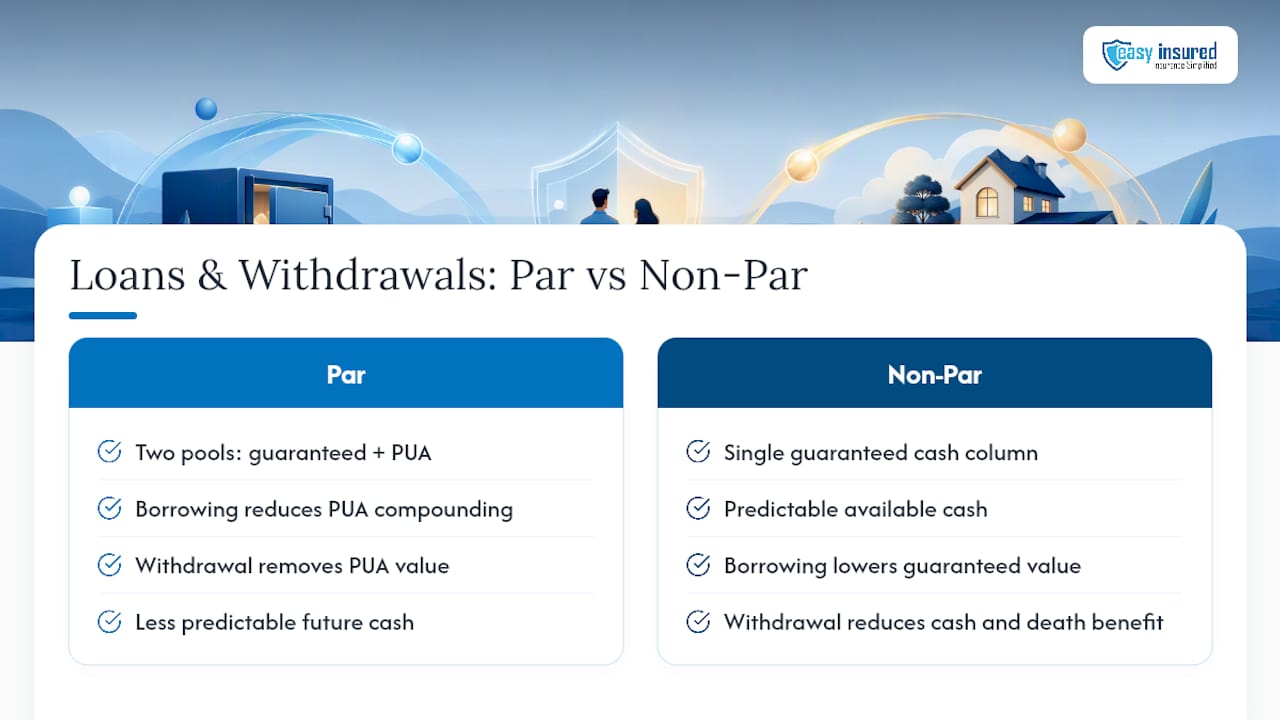
Both policy types let you borrow against accumulated cash value, and the mechanics look similar on the surface: the insurer treats it as a loan against the policy, charges interest, and reduces the death benefit by the outstanding balance if you die before repaying it. The difference shows up in what’s actually available to borrow against.
In a non-par policy, the cash value you can access is fixed and predictable, since there’s only one column of numbers to track. You know years in advance roughly what will be available at any given policy year.
In a par policy, a loan or withdrawal can touch two pools of value: the guaranteed cash value and any cash value built from paid-up additions purchased with past dividends. Borrowing against the PUA-funded portion interrupts the compounding that made those dividends worth reinvesting in the first place. Pull cash out in year 15, and the additional coverage those PUAs represented stops generating its own future dividends on the borrowed amount.
Withdrawals (as opposed to loans) permanently reduce cash value and death benefit in both structures, but a par policy withdrawal also strips out any dividend-funded PUAs you’re withdrawing from, effectively unwinding years of reinvestment in a single transaction. Before taking a loan or withdrawal against either policy type, ask your advisor to model the specific impact on your guaranteed column and, for par policies, on future dividend-earning potential too.
How Are Par and Non-Par Life Insurance Policies Taxed?
Tax treatment inside the policy itself works nearly identically for par and non-par whole life: cash value growth accumulates tax-deferred in both cases, and the death benefit passes to beneficiaries generally free of income tax. That baseline doesn’t change based on which structure you own.
Where it gets more nuanced is the dividend itself. Because a par policy’s dividend is typically treated as a return of premium rather than taxable income (as long as cumulative dividends don’t exceed cumulative premiums paid), most policyholders don’t owe tax on dividends received as cash, used for premium reduction, or reinvested as paid-up additions. Non-par policies simply don’t generate this question, since there’s no dividend to categorize in the first place.
Where both policy types can trigger a tax event: surrendering the policy for its cash value, taking a withdrawal that exceeds your cost basis, or letting a policy loan lapse into default. In any of those situations, the gain above what you’ve paid in premiums can become taxable income. This is exactly the kind of detail that shifts based on your personal tax situation and how the policy was structured at issue, so treat any tax rule mentioned here as a starting point for a conversation with a tax professional, not a final answer for your return.
Where to Verify Par vs Non-Par Facts Yourself
A few sources worth bookmarking if you want to go deeper than this article:
- OSFI’s participating account management guidance for regulatory detail on dividend disclosure
- Investopedia’s participating policy explainer for plain-language definitions
- BMO Insurance’s whole life comparison for a carrier-side perspective on par versus non-par
Get a Personalized Par vs Non-Par Comparison
Comparing par and non-par on paper only gets you so far. What actually matters is how each structure performs against your specific age, health class, coverage need, and time horizon, and that requires real numbers, not generic examples. Easy-insured’s advisors pull illustrations from multiple carriers, walk you through the guaranteed column line by line, and flag exactly where a par projection depends on dividend assumptions holding steady for decades.

If living benefits or riders are also part of your decision, this overview of life insurance with living benefits is worth a read alongside your illustration. And if term coverage might actually solve your problem more cheaply than either whole life structure, that’s a conversation worth having too. Ready to see your own numbers? Visit the whole life insurance page and request a personalized illustration comparing par and non-par options side by side.
A Note From Frank
Frank, editorial contributor at Easy-insured, has spent years unpacking how insurers structure whole life products for everyday buyers. The takeaway worth remembering: match the guarantee, or lack of one, to what you actually need this policy to do, and never let a dividend projection substitute for a promise.
— Frank
This article is general information, not a substitute for advice from a qualified financial advisor. Consult a qualified financial professional about your own circumstances before acting on anything here.
Sources
- OSFI — Participating account management disclosure for participating policyholders
- Investopedia — Participating policy
- BMO Insurance — Demystifying whole life insurance: Participating or non-participating?