
Funeral costs in Canada average around seven thousand seven hundred to seven thousand eight hundred dollars nationally, according to the Cost of Dying Report, though a full traditional burial with cemetery property can push past $20,000. Direct cremation, by contrast, typically runs from several hundred to a few thousand dollars. The CPP Death Benefit pays a flat $2,500 to eligible estates, which covers a portion of an average cremation and only a small fraction of a traditional funeral.
Three things drive most of the gap between families:
- Cemetery costs (plot, opening/closing, marker) often billed separately from the funeral home
- The funeral home’s professional fee, which averages close to $2,741
- Casket and merchandise choices, which can swing a bill by thousands
Key Takeaways
Funeral costs in Canada range from under $2,000 for direct cremation to over $20,000 for a full traditional burial, and the CPP Death Benefit covers only a fraction of either.
| Point | Details |
|---|---|
| National average | Traditional funerals average $7,700 to $7,800, while direct cremation starts near $845. |
| CPP Death Benefit is limited | The $2,500 federal payment covers cremation costs but only a fraction of a traditional burial. |
| Cemetery fees drive burial costs | Plot, opening/closing, and vault charges are often billed separately from the funeral home. |
| Ask for itemized quotes | Every licensed funeral home must provide a General Price List on request. |
| Insurance closes the gap | A final-expense policy from Easy-Insured pays beneficiaries directly, often within days, without tying funds to one provider. |
This article is general information, not a substitute for advice from a qualified financial advisor. Consult a qualified financial professional about your own circumstances before acting on anything here.
Table of Contents
- How Much Does a Funeral Cost in Canada by Disposition Type?
- What Do Funeral Costs Look Like by Province?
- What’s Actually on a Funeral Invoice?
- How Do Families Actually Pay for a Funeral?
- What Are the Best Ways to Cut Funeral Costs in Canada?
- How Final-Expense Insurance Closes the Affordability Gap
- What Other Costs Come Up Beyond the Funeral Bill?
- When Do Funeral Costs Actually Get Incurred?
- Sources
How Much Does a Funeral Cost in Canada by Disposition Type?
Direct cremation sits at the bottom of the price ladder, and it’s the fastest-growing choice for a reason: a large majority of Canadians now choose cremation over burial, per Statistics Canada and industry tracking from Statista. Here’s how the three main paths compare:
- Direct cremation: $845 to $3,500. No viewing, no service, no embalming. The body is transported, cremated, and remains returned to the family, who then plan their own memorial separately.
- Cremation with memorial service: Add $1,500 to $4,000 for a rented chapel, visitation, staff time, and an urn. Many families choose this middle path to get a gathering without full burial costs.
- Traditional burial: Starts around $9,000 and climbs past $20,000 once you add cemetery property, a vault, and a granite headstone. The casket alone can run from $1,000 for a basic model to $10,000 or more for solid hardwood.
The gap between cremation and burial isn’t really about the funeral home. It’s almost entirely about whether you’re buying cemetery land.
What Do Funeral Costs Look Like by Province?
Where you live changes the math more than most people expect. Urban land prices in Toronto and Vancouver push burial costs toward the high end, while Quebec’s cooperative funeral model and lower cemetery pricing pull its averages down. Remote territories pay a premium for transport alone.
A few regional notes matter more than the raw numbers:
- Quebec benefits from a long-standing network of funeral cooperatives, which the Cost of Dying Report and other provincial sources credit with lowering fees by roughly 20% to 40% compared with private funeral homes.
- Ontario and British Columbia carry the country’s steepest cemetery land prices, especially inside Toronto and Vancouver city limits, which is the main reason their burial ranges run highest.
- The territories pay more for nearly everything, since bodies and supplies often need to be flown in, and there are far fewer funeral homes to create local price competition.
These are broad ranges pulled from provincial cost surveys and city-level examples, not fixed prices. Get quotes from providers in your specific city before assuming either end of the range applies to you.
What’s Actually on a Funeral Invoice?
Every funeral bill breaks down into distinct line items, and understanding which ones are negotiable (and which aren’t) helps you spot where your money actually goes.
- Funeral home basic services fee: averages close to $2,741 nationally and covers staff time, permits, and coordination.
- Casket: $1,000 to $10,000+, depending on material and finish.
- Embalming: $500 to $1,000, required for public viewing in most provinces but not for direct cremation.
- Viewing or visitation: $500 to $1,500 for facility use and staffing.
- Transportation: $300 to $1,000 for transfer of remains and use of a hearse.
- Cemetery plot: $1,500 to $8,000+ depending on city and cemetery.
- Grave opening and closing: $500 to $1,500, usually billed by the cemetery, not the funeral home.
- Burial vault or liner: $800 to $3,000, required by many cemeteries.
- Headstone or marker: $1,000 to $5,000.
- Death certificates and paperwork: $25 to $50 per certified copy, with most families needing 5 to 10 copies.
Notice that items 6 through 9 are frequently billed by the cemetery, not the funeral home, which means a “funeral quote” that looks reasonable can still leave out thousands in cemetery charges. Always ask directly whether a quoted price includes plot, opening/closing, and marker, since these are commonly separated on the final bill.
Pro Tip: Every licensed funeral home in Canada must provide a General Price List on request. Ask for it in writing before you sign anything, and use it to compare at least two providers line by line.
How Do Families Actually Pay for a Funeral?
The CPP Death Benefit is the first stop for most families. It pays a one-time $2,500 to the estate or the person who paid funeral costs, provided the deceased made sufficient contributions to the Canada Pension Plan. That covers direct cremation almost entirely, but only a fraction of a traditional burial.
Beyond CPP, families typically draw on:
- Life insurance proceeds paid directly to a named beneficiary, often within days and outside of probate
- Final-expense insurance, a smaller policy designed specifically to cover funeral and end-of-life costs
- Prepaid funeral trusts, regulated provincially, which lock in services (though coverage details vary by contract)
- Provincial social assistance programs for low-income families, which exist in most provinces but come with strict eligibility rules
If you’re arranging a funeral right now, move fast on two things: file the CPP Death Benefit claim, and check whether the deceased held any life insurance policy with a named beneficiary, since those funds bypass the estate and probate entirely.
What Are the Best Ways to Cut Funeral Costs in Canada?
Direct cremation remains the single biggest lever, cutting a bill from $9,000+ down to under $2,000 in most provinces by removing embalming, viewing, and cemetery property from the equation. In Quebec, direct cremation can start as low as $845 through cooperative providers.
Other practical options:
- Green burial and aquamation are gaining ground across Canada, generally costing less than a full traditional burial, though availability still depends heavily on your province and specific cemetery rules, per Green Burial Canada.
- Funeral cooperatives, especially in Quebec, offer members lower fixed rates on services.
- Getting multiple itemized quotes and comparing funeral-home and cemetery charges separately is consistently the most effective way to avoid inflated bills.
Pro Tip: Call at least two funeral homes and ask them to itemize cemetery charges separately from their own fees. The comparison often reveals a $2,000 to $4,000 difference for the exact same service.
Checklist for Arranging a Funeral Without Overpaying
- Request General Price Lists and itemized quotes from at least two funeral homes.
- Ask whether cemetery plot, opening/closing, and marker are included or billed separately.
- Check for existing life insurance, prepaid contracts, and file the CPP Death Benefit claim immediately.
- Keep every receipt and written quote in one folder for estate settlement later, and consider using a secure digital vault for estate planning to organize important documents efficiently.
How Final-Expense Insurance Closes the Affordability Gap
Final-expense insurance exists for exactly the scenario above: a smaller, simpler life insurance policy designed to pay out quickly, often within days, directly to a named beneficiary so a funeral bill doesn’t wait on an estate to settle. It typically requires minimal or no medical underwriting, which makes it accessible to older applicants who might not qualify for larger term policies.
Prepaid funeral plans work differently. They lock in specific services at today’s prices but tie funds to one provider, while final-expense insurance gives your family cash to use however they see fit, whichever funeral home they choose. Ask a broker whether a policy’s payout is guaranteed, how fast it pays, and whether premiums increase with age.
- Final-expense policies generally range from $5,000 to $25,000 in coverage.
- Payouts go directly to beneficiaries and bypass the probate process entirely.
- Larger estate needs are often better served by a whole life policy or dedicated estate planning strategy.
What Other Costs Come Up Beyond the Funeral Bill?
The invoice from the funeral home rarely tells the full story. Flowers alone commonly run $200 to $800 depending on arrangement size and whether you’re covering both a service and a grave display. Obituary notices add another $200 to $600 if placed in a regional newspaper, though many families now supplement or replace print notices with free online tribute pages through the funeral home’s website.
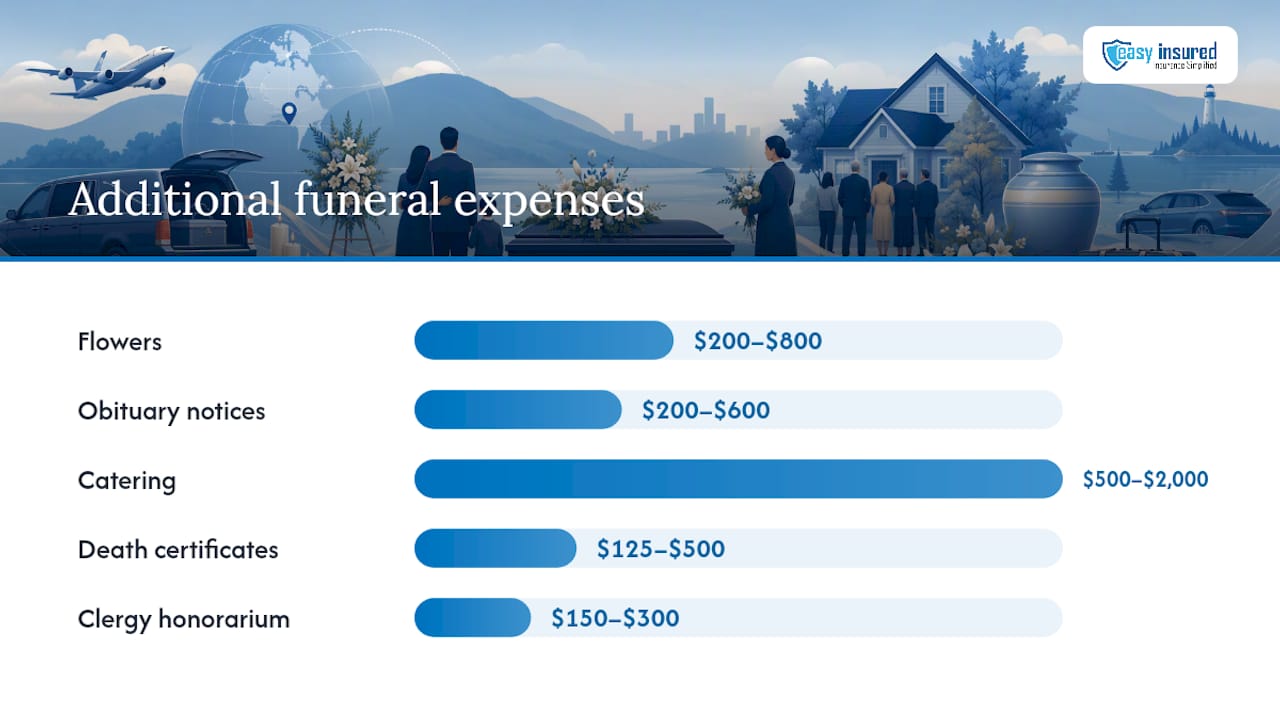
Catering for a reception after the service is often the most underestimated line item. A modest gathering for 30 to 50 people can cost $500 to $2,000 depending on whether it’s a simple coffee-and-sandwiches spread or a full sit-down meal at a rented hall. Families hosting at a private home save on rental fees but still face grocery and preparation costs.
Death certificates deserve their own budget line. Provinces typically charge $25 to $50 per certified copy, and most estates need five to ten copies to satisfy banks, insurers, pension providers, and land registries. Ordering too few means paying rush fees later to get more.
Smaller costs add up too: thank-you cards, a guest book, clergy or officiant honorariums (often $150 to $300), and transportation for out-of-town family. None of these show up on a standard funeral home quote, which is exactly why families are frequently surprised by a final total that runs well above the number they were originally given.
When Do Funeral Costs Actually Get Incurred?
Most of the spending happens faster than families expect. Within the first 24 to 48 hours after a death, you’re typically choosing a funeral home, authorizing transportation of the body, and deciding between burial and cremation, decisions that lock in a large share of the total cost almost immediately.

Days two through five usually cover the bulk of remaining choices: casket or urn selection, embalming (if there’s a viewing), booking the cemetery plot, and setting a service date. This is also when most of the invoice gets finalized, since funeral homes generally require payment or a signed contract before the service takes place.
The service itself, whether a visitation, religious ceremony, or memorial, typically happens within 5 to 10 days of death, though cremation allows more flexibility since there’s no urgency around embalming. Cemetery costs like the headstone or marker are often the last expense, sometimes not finalized for weeks or months after burial, since engraving and installation take time.
Death certificates, estate paperwork, and CPP Death Benefit claims stretch out over the following weeks. None of that changes the funeral bill itself, but it does mean cash flow pressure hits hardest in that first week, right when families are least prepared to handle it. That’s the exact window where a named life insurance beneficiary or an existing final-expense policy makes the biggest practical difference.
Why preplanning matters more than people think
Frank has spent years watching families scramble to cover costs they never saw coming. The math is simple: a modest final-expense policy costs less monthly than a phone bill, yet it can mean the difference between a dignified service and a stretched-thin estate. If you want a plan built around your actual budget, reach out to Easy-Insured for a straightforward quote.
— Frank
Get a Final-Expense Quote Built Around Your Budget
Prepaid plans lock you into one funeral home’s prices years in advance. Easy-Insured takes a different approach: a final-expense policy that pays cash directly to your beneficiary, so your family can choose any provider, compare General Price Lists, and negotiate freely instead of being tied to a contract signed a decade earlier.

Coverage typically runs $5,000 to $25,000, enough to handle a direct cremation with a memorial or a modest traditional burial without draining savings. Getting a quote takes minutes. Have your date of birth, a general sense of your health history, and your preferred beneficiary’s information ready when you call. If your needs go beyond final expenses, whole life and universal life policies from Easy-Insured can also fund larger estate obligations or leave a legacy behind. Start with a final-expense insurance quote today and give your family one less thing to figure out during the hardest week of their lives.
Sources
- Canada
- Statistics Canada — relevant funeral/age/population statistics
- Cleo Cremation — average funeral cost Canada 2026