
Participating life insurance is permanent life insurance that pairs a guaranteed death benefit with a share of the insurance company’s profits, paid out as annual dividends. Every dollar you put in builds two things at once: guarantees the insurer cannot walk back, and a variable dividend layer that can shrink, grow, or disappear depending on how the insurer’s investments and claims experience play out that year.
Three things worth knowing before you read another paragraph:
- You get real guarantees, not just promises. The death benefit and the guaranteed cash-value schedule are locked into the contract regardless of what happens to dividends.
- Dividends are extra, not owed. They come from insurer surplus and can be taken as cash, applied to premiums, left to accumulate, or used to buy paid-up additions.
- It’s a long game. Canadian families typically use participating whole life for estate planning, legacy transfer, and tax-advantaged savings, not short-term needs, and the tax rules behind that decision come from the CRA and industry standards set by bodies like CLHIA.
Key Takeaways
Participating life insurance works by combining a contractually guaranteed death benefit and cash-value floor with non-guaranteed dividends drawn from insurer profits, and it earns its keep mainly in estate planning and long-term legacy funding rather than short-term needs.
| Point | Details |
|---|---|
| Guarantees are the floor, dividends are the bonus | The death benefit and guaranteed cash value hold even if dividends drop to zero for years. |
| Dividend options compound differently | Paid-up additions grow the policy over decades; cash payouts give up that compounding entirely. |
| Costs run higher upfront | Participating premiums typically exceed term or non-participating whole life at issue, priced for lifetime coverage. |
| Ask for real dividend history | Request 10 to 15 years of actual dividend scale data before trusting any illustration. |
| Easy-insured builds it into a full plan | Easy-insured’s whole life product pairs guaranteed coverage with dividend features and integrated financial planning support. |
Table of Contents
- What Is Participating Life Insurance and How Does It Differ From Other Policies?
- Which Parts of a Participating Policy Are Guaranteed?
- How Do Insurers Generate and Pay Dividends?
- What Are Your Dividend Options and How Do They Change the Policy?
- Who Actually Benefits From Participating Whole Life?
- What Drives the Cost of a Participating Policy?
- Participating Whole Life vs. Non-Participating Whole Life, Universal Life, and Term
- How Are Participating Policies Taxed in Canada?
- What Are the Real Risks and Limitations?
- How Should You Evaluate a Participating Policy Before Buying?
- When Does a Broker Actually Recommend Participating Whole Life?
- Get a Participating Whole Life Quote and Dividend History
- Frequently Asked Questions
- Sources
What Is Participating Life Insurance and How Does It Differ From Other Policies?
A participating policy, often shortened to “par” in the industry, is permanent coverage issued by a mutual or stock insurer that shares its financial results with policyholders through dividends. That single feature separates it from every other major policy type on the market.
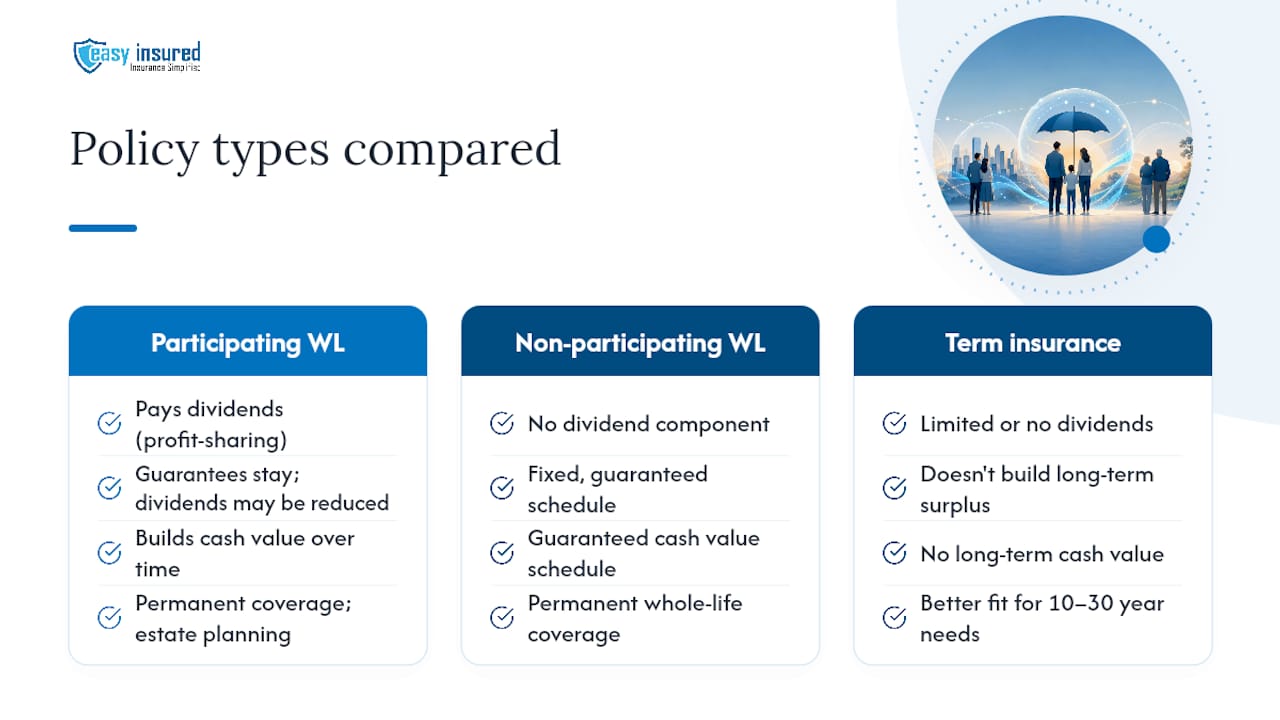
Non-participating whole life gives you a fixed death benefit and a fixed, guaranteed cash-value growth schedule, full stop. There’s no dividend, no upside if the insurer has a good year, but also no dependency on how well the company’s investment portfolio performs. Universal life gives you flexibility to adjust premiums and death benefits, with cash value tied to an interest rate or market-linked account you often choose yourself. Term insurance, by contrast, isn’t a savings vehicle at all. It’s pure protection for a set period, usually 10, 20, or 30 years, with no cash value and no dividend participation.
Participating whole life sits in a different category because it blends the predictability of traditional whole life with a profit-sharing mechanism. You’re not just buying protection. You’re buying into a piece of the insurer’s financial performance, structured so the downside is capped by contractual guarantees.
Which Parts of a Participating Policy Are Guaranteed?
Not everything in a par policy carries the same weight. Some elements are locked in by contract; others move with the insurer’s fortunes.
Guaranteed elements typically include:
- The death benefit your beneficiaries receive, assuming premiums stay current.
- A guaranteed minimum cash-value growth schedule, laid out year by year in the policy contract.
- Guaranteed maximum premium rates for the coverage you purchase.
Variable, non-guaranteed elements include:
- The annual dividend amount, which the insurer’s board declares each year based on actual performance.
- The insurer’s dividend scale, which can rise or fall over time.
- Any cash-value growth attributable to dividends rather than the guaranteed base.
Pro Tip: When you review a policy illustration, look for two separate columns: “guaranteed” and “non-guaranteed” (or “illustrated”). Insurers are required to show both. If a broker only walks you through the non-guaranteed column, ask directly what the policy is worth if dividends were $0 every year going forward. That answer tells you the real floor.
How Do Insurers Generate and Pay Dividends?
Dividends come out of the insurer’s surplus, the leftover money after claims, expenses, and reserve requirements are covered. Three factors drive that surplus most: mortality experience (did fewer policyholders die than the insurer priced for?), investment returns (did the insurer’s bond and equity portfolio outperform assumptions?), and expense experience (did the company spend less running the business than it budgeted?).
When all three land favorably, the insurer has more money than it expected to need, and it distributes a portion of that surplus back to participating policyholders as a dividend. Dividends are not guaranteed, and they’re typically declared and paid annually, which means the amount you receive this year could differ meaningfully from what you receive in five years.
Here’s a simplified walk-through of the mechanics:
- You pay your annual premium, which the insurer pools with premiums from thousands of other participating policyholders.
- The insurer invests that pooled money and pays out claims to beneficiaries of policyholders who died that year.
- At year-end, the insurer calculates surplus after covering claims, expenses, and required reserves.
- The board declares a dividend scale based on that surplus and the insurer’s long-term outlook.
- Your policy receives its share of the dividend, calculated based on your policy size, age, and how long you’ve held the contract.
A basic illustration: say an insurer collects $500 million in premiums in a given year, pays out $410 million in claims and expenses, and holds back $70 million for reserves. The remaining $20 million becomes distributable surplus, split across policyholders in proportion to their contribution to that surplus. Your individual dividend might be $200 one year and $340 the next, depending entirely on how that math shifts.
What Are Your Dividend Options and How Do They Change the Policy?
Once a dividend is declared, you choose what happens to it. This decision compounds over decades, so it deserves more thought than most people give it.
- Cash payout. The insurer sends you a check. Simple, but it forfeits any compounding benefit inside the policy.
- Reduce premiums. The dividend offsets part of your next premium bill, lowering your out-of-pocket cost without touching the policy’s growth.
- Accumulate at interest. Dividends sit with the insurer and earn interest, similar to a savings account, remaining accessible if you need cash later.
- Paid-up additions (PUAs). The dividend buys a small amount of additional, fully paid-up whole life coverage, which increases both your death benefit and your cash value, and which itself becomes eligible for future dividends.
- Purchase single-premium additions. Similar to PUAs but structured as a distinct additional policy layer, often used for larger lump-sum dividend allocations.
Paid-up additions tend to be the option most brokers recommend for long-term legacy planning, because they create a compounding effect: this year’s dividend buys more coverage, which generates its own (small) dividend next year, and so on.
Pro Tip: If your main goal is maximizing the death benefit for your estate, paid-up additions almost always outperform cash withdrawals over a 20-plus year horizon. If you need liquidity sooner, whether for a business expense or retirement income, accumulating dividends at interest keeps them accessible without giving up the safety net entirely.
Who Actually Benefits From Participating Whole Life?
Participating whole life provides lifelong coverage and professional management that can suit estate-planning and long-term financial goals, which is why it shows up so often in conversations about legacy planning rather than pure income replacement.
Common use cases include:
- Estate liquidity. A guaranteed death benefit gives your estate immediate cash to cover final taxes, probate costs, or debts without forcing heirs to liquidate other assets quickly.
- Guaranteed lifelong protection. Unlike term insurance, coverage doesn’t expire at a set age, provided premiums stay paid.
- A supplement to retirement savings. Accumulated cash value can serve as a source of funds later in life, alongside RRSPs, TFSAs, and pensions.
- Creditor protection. When structured with the right beneficiary designation or ownership arrangement, policy proceeds can be shielded from creditors in certain circumstances.
Married couples focused on leaving a clean, tax-efficient legacy to children or grandchildren tend to gravitate toward participating whole life, as do business owners who need predictable funding for buy-sell agreements or succession plans. Families with a straightforward need for temporary income replacement, say, replacing a mortgage or supporting young kids for 20 years, are usually better served by term coverage instead.
What Drives the Cost of a Participating Policy?
Participating whole life premiums are priced using several overlapping factors, and understanding them explains why two people the same age can pay very different amounts.
- Age and health class. Younger, healthier applicants lock in lower guaranteed premiums because the insurer expects to collect premiums longer before paying a claim.
- Face amount. Larger death benefits mean larger premiums, though the cost per thousand dollars of coverage often improves at higher amounts.
- Policy design. Adding paid-up addition riders or optional benefits increases the premium but can accelerate cash-value growth.
- Dividend scale assumptions. Insurers set illustrated dividend rates based on current economic conditions and their own performance history, and these assumptions vary company to company.
- Company-level experience. An insurer’s overall mortality and investment results across its whole book of business ultimately shape what it can afford to pay out.
Participating policies almost always carry higher first-year premiums than term insurance or non-participating whole life for the same face amount. That’s the tradeoff for lifetime guarantees plus dividend potential. Over several decades, though, a policy with a strong dividend history can outperform its own illustrated projections, or underperform them, depending on the insurer’s actual results.
Dividend scales can and do vary year to year, and Investopedia notes that participating policyholders effectively share in the insurer’s underwriting risk rather than receiving a fixed, contractually locked return on the dividend portion of their policy. That’s the cost-shift dynamic worth internalizing: you’re trading premium predictability for participation in outcomes you don’t control.
Participating Whole Life vs. Non-Participating Whole Life, Universal Life, and Term
Choosing between these four categories comes down to how much predictability you want to trade for flexibility, and how long you actually need coverage.
| Feature | Participating Whole Life | Non-Participating Whole Life | Universal Life | Term Insurance |
|---|---|---|---|---|
| Coverage length | Permanent (lifelong) | Permanent (lifelong) | Permanent (lifelong) | Fixed term (10 to 30 years) |
| Cash-value growth | Guaranteed base plus potential dividends | Guaranteed only, fixed schedule | Guaranteed minimum plus interest or market-linked growth | None |
| Premium predictability | Fixed guaranteed premium | Fixed guaranteed premium | Often flexible, can rise if underfunded | Fixed for the term, then expires or renews at higher cost |
| Access to cash/loans | Yes, against cash value | Yes, against cash value | Yes, against cash value | No |
| Typical use case | Estate planning, legacy funding, lifelong protection | Lifelong protection with predictable costs | Flexible permanent coverage with investment choice | Income replacement, mortgage protection, temporary needs |
| Cost/long-term value | Higher upfront, potential for stronger long-term value via dividends | Higher upfront, fixed long-term value | Variable, dependent on interest crediting or market performance | Lowest upfront cost, no cash value built |
A few quick takeaways from that comparison:
- If predictability matters more than upside, non-participating whole life or a guaranteed life insurance product removes the dividend variable entirely.
- If you want flexibility to adjust premiums as your income changes, universal life is worth exploring alongside par.
- If your need is temporary and budget-driven, term life almost always makes more sense than any permanent product.
How Are Participating Policies Taxed in Canada?
Death benefits from a participating life insurance policy are generally received by beneficiaries free of income tax in Canada, a rule the Canada Revenue Agency applies broadly across life insurance products, not just participating ones. That’s one reason estate planners lean on permanent coverage so heavily: it delivers a tax-free lump sum precisely when an estate often needs liquidity most.
Dividends themselves usually aren’t taxed as income when left inside the policy, since the CRA generally treats them as a return of premium rather than earned income, up to certain limits tied to the policy’s adjusted cost basis. Where things get more complicated is when you withdraw cash value or take a policy loan that exceeds your adjusted cost basis. At that point, a portion of the withdrawal or loan can become taxable, and the calculation depends on policy-specific factors that a qualified tax advisor or your insurer’s tax department needs to walk through with you.
Industry guidance consistently points buyers toward two sources for authoritative tax detail: the Canada Revenue Agency for how life insurance proceeds and policy loans are treated under the Income Tax Act, and the Canadian Life and Health Insurance Association (CLHIA) for industry-wide standards on how participating dividends are structured and disclosed.
Where to check the fine print:
- CRA guidance on life insurance policy taxation, adjusted cost basis, and policy loan rules.
- CLHIA publications on industry standards for dividend disclosure and participating account management.
- Your insurer’s illustration, which should show adjusted cost basis alongside cash value so you can see the taxable threshold clearly.
This is general information, not personalized tax advice. Confirm your specific situation with the CRA or a qualified tax professional before making decisions based on dividend or loan treatment.
What Are the Real Risks and Limitations?
Participating whole life isn’t a guaranteed win, and treating it as one is where buyers get burned. The risks are specific and worth naming plainly.
- Dividends are not guaranteed, full stop. A rough decade for the insurer’s investment portfolio or a spike in claims can shrink or eliminate the dividend scale for years.
- Performance depends on the insurer, not on you. You’re trusting the company’s mortality experience, investment management, and expense control, factors entirely outside your influence.
- Loans and withdrawals reduce guarantees. Borrowing against cash value lowers the death benefit until repaid, and unpaid loans plus interest can eventually collapse the policy if left unchecked.
- Early surrender is expensive. Cash value in the first several years is typically low relative to premiums paid, so canceling early usually means a real financial loss.
- Liquidity is limited compared to other investments. Cash value isn’t as instantly accessible as a savings account or TFSA.
Red flags worth watching for during a sales pitch: an illustration that shows only the “current” or “illustrated” dividend scale without a guaranteed-only column, vague answers about how loan interest is calculated, or dividend projections that assume the exact same scale for the next 30 years with no historical backup. Any of those should prompt you to ask harder questions before signing.
How Should You Evaluate a Participating Policy Before Buying?
Run through this checklist before committing to any participating whole life contract:
- Request the guaranteed-only cash-value schedule, separate from any illustrated dividend projections.
- Ask for at least 10 to 15 years of the insurer’s actual historical dividend scale, not just the current projection.
- Confirm the surrender charge schedule and how long it takes cash value to exceed total premiums paid.
- Review the cost and purpose of any riders, especially paid-up addition riders and waiver-of-premium options.
- Get the current policy loan interest rate in writing, and ask how a loan affects both cash value and death benefit.
- Compare at least two illustrations side by side using the same guaranteed assumptions, not two different “current scale” projections.
Specific questions worth asking a broker or insurer directly:
- “What has your dividend scale done over the last 10 years, and can you show me the numbers?”
- “How exactly is the dividend calculated, and what would happen to my policy if the dividend dropped to zero?”
- “What’s the current loan interest rate, and how does an outstanding loan affect my guaranteed death benefit?”
- “Can you give me a real example of a policyholder whose dividends changed significantly, and why?”
- “Is this illustration built on standardized, industry-comparable assumptions?”
Get the recent dividend scale history and a standardized illustration in writing before you sign anything. A broker who hesitates to provide either is telling you something important.
When Does a Broker Actually Recommend Participating Whole Life?
Participating whole life earns its place in a financial plan when a client needs three things at once: permanent coverage that won’t expire, a guaranteed floor they can plan around, and some exposure to upside if the insurer performs well. That combination fits a narrower slice of buyers than the marketing suggests, and a broker’s job is separating who actually needs it from who’s being sold on the story.

The clearest fits tend to be business owners funding a buy-sell agreement, where a fixed, permanent death benefit needs to be there decades from now regardless of market conditions, and couples in their 40s and 50s focused on leaving a clean, tax-free legacy after their RRSPs and TFSAs are already maximized. Broker-led purchasing typically includes integrated advice on policy design, ownership structure, and alignment with an existing estate plan, which matters more than most buyers realize until they see how ownership structure alone can change the tax outcome for an estate.
One pattern that comes up often: a family already contributing the maximum to registered accounts, looking for another tax-advantaged place to grow money long-term, lands on participating whole life not because it outperforms a balanced investment portfolio, but because it does something a portfolio can’t. It guarantees a death benefit shows up the day it’s needed, dividends or not.
Get a Participating Whole Life Quote and Dividend History
Reading about guaranteed values and dividend scales only gets you so far. The next real step is seeing actual numbers against your age, health class, and coverage goals, and comparing a guaranteed-only projection against a current dividend scale side by side.

Easy-insured’s whole life offering is built specifically around the guarantees this article covers: a locked-in death benefit, a guaranteed cash-value schedule, and access to participating-style dividend features depending on the policy structure you choose. Because Easy-insured also handles financial planning and estate planning under one roof, your policy design gets reviewed against your broader goals instead of sold in isolation.
Before you request a quote, have this ready: your date of birth, a general sense of your health history, the coverage amount you’re targeting, and whether estate liquidity, legacy transfer, or supplemental savings is your main priority. With that in hand, request an illustration and dividend history and get real numbers instead of generic projections.
Frequently Asked Questions
Is participating life insurance worth it?
It depends on your goals. If you need permanent coverage, want a guaranteed death benefit for estate purposes, and can commit to premiums for the long term, it’s often worth the higher upfront cost. If you need coverage for a specific 10 to 30 year window, term insurance is usually the better financial fit.
How does participating life insurance work if the insurer has a bad year?
The guaranteed death benefit and guaranteed cash value stay exactly as contracted. Only the dividend, which is separate from those guarantees, gets reduced or eliminated in a poor performance year.
What’s the difference between participating and non-participating whole life?
Participating policies share insurer profits through dividends on top of guaranteed values. Non-participating whole life offers only the fixed, guaranteed schedule with no dividend component at all.
Can I lose money in a participating whole life policy?
Surrendering early, especially in the first several years, often means getting back less than you paid in premiums, since early cash value is low relative to cost. Holding the policy long-term and letting guarantees and dividends build reduces that risk substantially.
Do I pay tax on life insurance dividends in Canada?
Dividends left inside the policy are generally treated as a return of premium and aren’t taxed as income up to your policy’s adjusted cost basis, per CRA guidance. Withdrawals or loans exceeding that basis can trigger tax consequences, so confirm specifics with a tax professional.
How is participating term insurance different from participating whole life?
Participating term insurance is far less common and typically offers limited or no dividend participation compared to whole life, since term policies don’t build the same long-term surplus base. Most dividend-paying participating products on the market today are whole life, not term.
This article is general information, not a substitute for advice from a qualified financial advisor. Consult a qualified financial professional about your own circumstances before acting on anything here.
Sources
For readers who want to go deeper on any specific piece of this topic, these sources cover the technical and practical angles best:
- What Is a Participating Policy? Definition and How It Works
- Why participating whole life insurance might be right for you