
An estate bond in Canada is an insurance- or investment-backed estate-transfer strategy: a life insurance policy, segregated fund contract, or annuity structured to move wealth to your heirs with built-in privacy, probate, and liquidity advantages. The term is not a formal product name you’ll find on a policy document. It’s a planning concept, and understanding what sits underneath it is what actually matters. Business owners with illiquid corporate assets and families who need immediate cash at death to cover taxes or equalize inheritances tend to benefit most. If that sounds like your situation, the right first move is a conversation with a licensed Canadian insurance broker or financial adviser who can assess your specific picture.
Key Takeaways
Insurance-backed estate strategies in Canada work best when the right product, precise beneficiary language, and coordinated legal and tax advice are in place before the policy is issued.
| Point | Details |
|---|---|
| Estate bond defined | An insurance- or investment-backed strategy (life insurance, segregated funds, annuities) to transfer wealth with probate and tax advantages. |
| Probate bypass requires a named beneficiary | Naming the estate instead of a living person defeats the probate bypass and creditor protection. |
| CDA is a CCPC advantage | Corporately owned life insurance can create a Capital Dividend Account credit, enabling a tax-free dividend to shareholders at death. |
| Coordination is the critical step | Broker, accountant, and lawyer must align on beneficiary language and CDA mechanics before a policy is issued. |
| Easy-insured | Licensed Canadian brokerage offering whole life, universal life, term, segregated funds, and annuities with fee-based planning options and total-cost illustrations on request. |
Table of Contents
- What are estate bond strategies in Canada, and which products are involved?
- Why Canadian families and business owners use these strategies
- How these products interact with probate and Canadian tax rules
- Who actually benefits from an insurance-backed estate strategy?
- How to choose the right product and provider in Canada
- Step-by-step implementation and realistic timelines
- What drives costs, and what does it look like in practice?
- Common mistakes and how to avoid them
- A business owner who got it right
- Why coordinating advice matters more than picking the right product
- Easy-insured’s estate planning services for Canadian families and business owners
- Sources
What are estate bond strategies in Canada, and which products are involved?
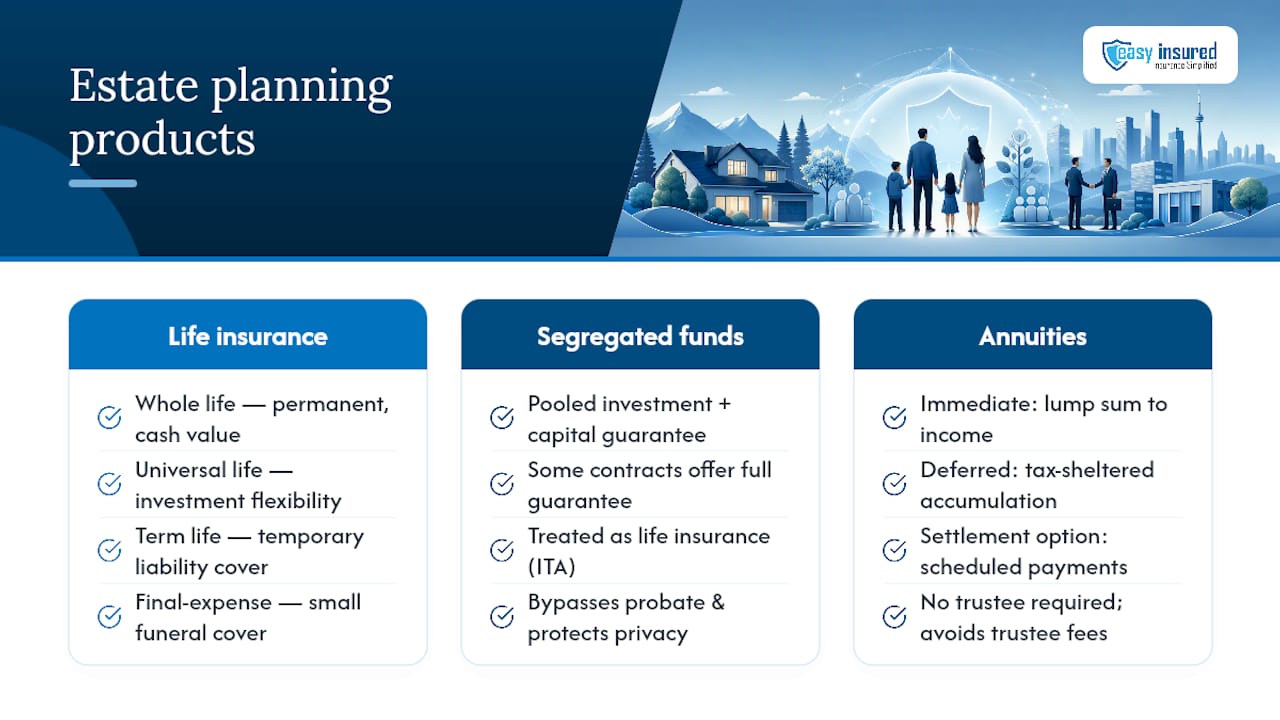
Three main product categories carry the weight of insurance-backed estate planning in Canada.
Life insurance is the most direct tool. Whole life provides a permanent, guaranteed death benefit with cash-value accumulation, making it a natural fit for estate equalization and corporate strategies. Universal life adds investment flexibility inside a permanent policy. Term life covers a defined window, often used to fund a specific liability like a buy-sell agreement or an anticipated tax bill. Final-expense policies are smaller, simplified-issue contracts designed to cover funeral costs and immediate estate debts. All four pay a tax-free death benefit directly to a named beneficiary, bypassing probate entirely when a living beneficiary is designated.
Segregated fund contracts are insurance products that combine a pooled investment component with a capital guarantee. By law, many contracts guarantee a significant portion of original capital at maturity or death, with some providing full capital guarantees. Because they are treated as life insurance contracts under the Income Tax Act, segregated funds can bypass probate, protect privacy, and give you precise control over how and when beneficiaries receive proceeds. That separates them from mutual funds, which flow through the estate and are subject to probate fees and public disclosure.
Annuities work differently. An immediate annuity converts a lump sum into a guaranteed income stream; a deferred annuity accumulates on a tax-sheltered basis before payments begin. The annuity settlement option is particularly useful in estate planning: it converts an insurance death benefit into scheduled payments for beneficiaries rather than a single lump sum, without requiring a trustee or incurring ongoing trustee fees.
Why Canadian families and business owners use these strategies
The core appeal is speed and privacy. When a named beneficiary is in place, insurance proceeds typically reach heirs within days of a death claim, not months. An estate going through probate can take six months to over a year in provinces like Ontario or British Columbia, and the will becomes a public document. Insurance proceeds skip both problems.
Beyond timing, the benefits stack up in specific situations:
- Probate avoidance: Beneficiary-designated products reduce probate exposure and keep the transfer private.
- Immediate liquidity: Life insurance can fund the tax bill triggered at death (deemed disposition on investments, RRSP/RRIF inclusion) before the estate sells any assets.
- Estate equalization: A business owner who leaves the company to one child can use a life insurance payout to give equivalent value to other heirs without forcing a sale.
- Creditor protection: In most provinces, proceeds paid to a spouse, child, grandchild, or parent as beneficiary are protected from the policyholder’s creditors during their lifetime and often at death.
- Controlled payouts: The annuity settlement option and cascading beneficiary designations let you structure payments for minor children or vulnerable beneficiaries without a formal trust.
- Charitable giving: A policy naming a charity as beneficiary delivers a donation receipt to the estate, reducing the final tax return.
Pro Tip: Provincial rules vary meaningfully. Saskatchewan, for example, has specific provisions governing how life insurance and segregated fund proceeds interact with estate administration. Always confirm your province’s rules with a licensed local adviser before finalizing beneficiary designations.
How these products interact with probate and Canadian tax rules
The probate bypass works because insurance and segregated fund contracts are bilateral agreements between you and the insurer. The proceeds belong to the named beneficiary by contract, not by will, so they never enter the estate. Easy-insured’s probate guide for executors walks through exactly how this plays out during estate administration and why precise beneficiary language matters.
The tax picture is more layered:
- Deemed disposition: At death, the Income Tax Act treats most capital property as sold at fair market value. Investments held personally trigger capital gains in the final return. Life insurance death benefits paid to a named beneficiary are generally received tax-free.
- RRSP/RRIF on death: The full registered account balance is included in income in the year of death unless it rolls to a spouse, financially dependent child, or qualifying trust. Life insurance is commonly used to fund this tax liability.
- Capital Dividend Account (CDA): When a corporation owns a life insurance policy, the death benefit received by the corporation, minus the policy’s adjusted cost basis, increases the CDA balance. The corporation can then pay a tax-free capital dividend to shareholders. This is one of the most powerful tools available to Canadian-controlled private corporations (CCPCs) for estate equalization.
- Segregated fund guarantees: The capital guarantee (75%–100% of original capital) means heirs receive at least the guaranteed floor even if markets fall, which can simplify estate planning projections.
One critical warning: naming your estate as beneficiary on a life insurance or segregated fund contract defeats the probate bypass entirely. The proceeds flow into the estate, become subject to probate fees, and lose creditor protection. This single mistake is more common than most advisers admit.
Always consult a tax adviser and estate lawyer before finalizing corporate policy structures or cross-provincial arrangements. The interaction between the CDA, provincial probate rules, and trust law is not something to navigate from a checklist alone.
Who actually benefits from an insurance-backed estate strategy?
Strong candidates:
- CCPC owners with significant retained earnings or illiquid business assets who need liquidity for succession costs, buy-sell funding, or the tax bill at death
- Families with illiquid assets (a cottage, investment property, or farm) who want to equalize inheritances without forcing a sale
- Households seeking privacy and a faster transfer than probate allows
- Trustees or parents arranging structured payments for minor children or beneficiaries who shouldn’t receive a lump sum
- Philanthropists using a policy to make a larger charitable gift than cash savings allow
Probably not the right fit:
- Small estates with few liabilities and liquid, easily divided assets
- People who already have a simple, low-cost transfer mechanism in place and no probate exposure worth reducing
- Those who need the specific control features of a formal trust (spendthrift provisions, multi-decade management) that insurance alone cannot replicate
How to choose the right product and provider in Canada
Start with a needs assessment before you look at any product. What is your liquidity gap at death? What is your tax exposure? Who are your beneficiaries and do any of them need structured payments? Is the policy personal or corporate?
Once you have those answers, the selection checklist narrows quickly:
- Product suitability: Permanent insurance (whole or universal life) for long-term estate goals; term for a defined liability window; segregated funds when investment growth and probate avoidance both matter; annuity settlement option when structured payouts are the priority.
- Guarantee levels: For segregated funds, confirm whether the contract guarantees 75% or 100% of capital at death.
- Premium affordability: A policy you can’t sustain is worse than no policy. Run a stress test at higher premium scenarios.
- Corporate tax impact: If the policy is corporately owned, confirm the CDA mechanics with your accountant before signing.
- Provider solvency: Check the insurer’s rating through AM Best or DBRS Morningstar. Assuris protects Canadian policyholders if an insurer fails, but solvency still matters for long-term permanent policies.
Questions to ask your broker: Are you licensed in my province? How are you compensated on this product? Can you provide a total-cost illustration including premiums, fees, and projected tax impact? What beneficiary language do you recommend and why?
Red flags: Vague beneficiary wording on sample contracts, promises of “tax-free” gains without a clear explanation of the mechanism, advisers who won’t coordinate with your accountant or lawyer, and carriers with weak solvency metrics.
Pro Tip: Request a written total-cost illustration before you commit to any policy. A credible broker will produce one without hesitation. If they resist, that tells you something.
Step-by-step implementation and realistic timelines
- Discovery and needs assessment (1–2 weeks): Map your liquidity gap, tax exposure, beneficiary situation, and business succession timeline with your adviser.
- Adviser coordination (1–2 weeks): Align your insurance broker, tax accountant, and estate lawyer. Each has a distinct role; gaps between them are where mistakes happen.
- Product selection and quotes (1–2 weeks): Compare at least two carriers on premium, guarantee level, and total cost. Ask for illustrations in writing.
- Beneficiary and trust drafting (1–3 weeks): Your lawyer drafts or reviews beneficiary designations and any trust provisions. Coordinate with your will and power of attorney.
- Underwriting and funding (2–12 weeks): Medical and financial underwriting timelines vary. Simplified-issue and guaranteed-issue products close faster; fully underwritten permanent policies can take two to three months.
- Policy delivery and document filing (1 week): Store originals with your executor or in a fireproof location. Tell your executor where to find them and how to file a claim.
- Annual review: Schedule a designation review after any major life event: marriage, divorce, birth of a child, sale of a business, or relocation to another province.
Coordinate with your executor in writing. A policy no one can find at death is a policy that doesn’t work.
What drives costs, and what does it look like in practice?
The main cost drivers for insurance-backed estate strategies:
- Age and health at application: The single largest premium driver for life insurance.
- Policy type: Term is cheapest per dollar of coverage; permanent (whole or universal life) costs more but builds cash value and lasts a lifetime.
- Segregated fund MERs: Management expense ratios on seg funds run higher than comparable mutual funds, reflecting the insurance guarantee.
- Annuity purchase price: Determined by the lump sum converted, the payout period, and current interest rates.
- Corporate policy set-up: Additional legal and accounting fees to structure the CDA mechanics correctly.
- Adviser compensation: Commissions are standard for insurance products; fee-based planning is available and worth asking about for complex corporate strategies.
Illustrative example 1 — Corporate-owned whole life for estate equalization (illustrative only, not a quote): A 55-year-old CCPC owner holds $2 million in retained earnings and a business worth $3 million, with two children. One child will inherit the business. The owner purchases a corporately owned whole life policy with a $1.5 million death benefit. At death, the insurer pays the corporation; the CDA increases by the proceeds minus the adjusted cost basis, and the corporation pays a tax-free capital dividend to the other child’s share. The business transfers intact; the second heir receives equivalent value without a forced sale.
Illustrative example 2 — Annuity settlement option for a retiree (illustrative only, not a quote): A 70-year-old retiree holds a $500,000 life insurance policy. Rather than leaving a lump sum to an adult child with spending concerns, she elects the annuity settlement option. The insurer converts the death benefit into monthly payments over 15 years. No trustee is required, probate is avoided, and the payments arrive on a schedule she chose.

Pro Tip: Always ask for a total-cost illustration that includes premiums, management fees, and the projected tax impact on the estate. The net benefit after costs is the number that matters, not the headline death benefit.
Common mistakes and how to avoid them
- Naming the estate as beneficiary: Eliminates probate bypass, creditor protection, and speed. Name a living person or a qualifying trust instead.
- Outdated beneficiary designations: A designation naming an ex-spouse or a deceased parent can trigger expensive legal disputes. Review after every major life event.
- Underinsuring: A death benefit that covers the funeral but not the RRSP tax bill or capital gains exposure leaves the estate short at the worst moment.
- Missing the CDA entry: Corporations that fail to track the CDA credit after a policy pays out lose a tax-free dividend opportunity permanently.
- Assuming creditor protection is automatic: It applies when a preferred beneficiary (spouse, child, grandchild, parent) is named. An irrevocable beneficiary designation provides stronger protection but limits your flexibility.
- Failing to coordinate with legal documents: A beneficiary designation that contradicts the will creates confusion. Your broker, lawyer, and accountant need to see each other’s work.
Re-run the plan after any material change: sale of a business, divorce, a move to a different province, or a significant shift in asset values.
A business owner who got it right
A 58-year-old Ontario manufacturer owned a CCPC with $4 million in retained earnings and a manufacturing facility worth $2.5 million. His two children had different interests: one ran the business, the other had no involvement. His will left the business to the operating child, but that left the second child with almost nothing liquid.
His adviser structured a corporately owned whole life policy with a $2 million death benefit. The annual premium was funded from retained earnings at the corporate tax rate, which was lower than personal tax rates. At death, the insurer paid the corporation; the CDA credit allowed a tax-free capital dividend to the second child’s estate share. The business transferred to the operating child without a forced sale or a buyout dispute.
The lesson wasn’t that life insurance solved everything. It was that the policy only worked because the accountant, the lawyer, and the broker sat in the same room and agreed on the beneficiary language and the CDA mechanics before the policy was issued. Without that coordination, the CDA credit could have been missed entirely.
Why coordinating advice matters more than picking the right product
Most estate planning mistakes don’t happen at the product level. They happen in the gaps between advisers who never compared notes. A broker who sells a policy without knowing the will’s terms, or a lawyer who drafts a will without knowing the beneficiary designations on the insurance, creates conflicts that surface at the worst possible time.
The product choice matters, but it’s secondary to getting the coordination right. Beneficiary language, CDA mechanics, and the interaction between insurance proceeds and the estate’s tax return all require your broker, accountant, and lawyer to work from the same set of facts. That’s the standard Easy-insured holds itself to when working with business owners and families on estate planning strategies. If you want a starting point, request a written checklist of what each adviser needs to confirm before a policy is issued. Any credible broker will have one.
Easy-insured’s estate planning services for Canadian families and business owners

Easy-insured is a licensed Canadian insurance brokerage that sources and structures the full range of estate-transfer products: whole life, universal life, term life, segregated funds, and annuities, including corporate-policy structuring for CCPC owners. The business model is transparent: Easy-insured operates on insurer commissions and offers fee-based planning options for complex strategies. Sample total-cost illustrations are available on request before any commitment.
For families, the focus is probate avoidance, immediate liquidity, and beneficiary language that actually holds up. For business owners, it’s CDA mechanics, succession funding, and coordination with your existing tax and legal team. To get started, book a consultation or request an estate-planning checklist directly through Easy-insured’s estate planning page.
Sources
- Segregated funds: an often-overlooked option for estate planning – Pulse Alternative
- Protecting your nest egg after you’re gone
This article provides general information about Canadian insurance and estate planning concepts. It is not legal, tax, or financial advice. Consult a licensed Canadian insurance broker, tax adviser, and estate lawyer to confirm how these strategies apply to your specific situation and province.
This article is general information, not a substitute for advice from a qualified financial advisor. Consult a qualified financial professional about your own circumstances before acting on anything here.