
Own occupation disability insurance pays you benefits when you can no longer perform the material and substantial duties of your specific job before the disability began. For physicians, surgeons, dentists, and other high-earning specialists, it is generally the strongest available protection. You can collect full benefits even while working in a different field.
Here is why it matters for professionals:
- Income replacement tied to your specialty. A hand surgeon who loses fine motor control loses the income of a hand surgeon, not a general practitioner. Own-occupation coverage replaces that specific income.
- Protection when you can still do other work. Under a true own-occupation policy, working as a consultant or teacher does not disqualify you from benefits.
- The 24-month switch risk. Many employer-sponsored long-term disability (LTD) plans and some individual policies use own-occupation language for the first 24 months, then switch to a stricter any-occupation standard. That switch terminates benefits for many claimants.
Who needs it most: physicians, surgeons, dentists, anesthesiologists, attorneys, and senior executives whose income depends on a specific, hard-to-replicate skill set. Who may not need it: workers in lower-wage, interchangeable roles, or those whose employer plan already provides true own-occupation coverage through age 65.
Key Takeaways
True own-occupation disability insurance is the most protective definition available for specialists, and the 24-month switch clause in employer and hybrid policies is the single most common reason high earners lose benefits they expected to keep.
| Point | Details |
|---|---|
| Own-occupation definition | Pays when you cannot perform your specific job’s material duties, even if you can work elsewhere. |
| 24-month switch risk | Many employer LTD and hybrid policies shift to any-occupation after 24 months, ending benefits for many specialists. |
| ERISA vs. individual policies | Employer plans governed by ERISA limit your legal remedies; individual policies fall under state law with broader protections. |
| Cost and timing | Buying younger and choosing a longer elimination period are the two most effective ways to reduce premiums without sacrificing coverage. |
| Easy-insured | Easy-insured helps professionals compare true own-occupation policy forms and close employer plan gaps through individual coverage. |
Table of Contents
- What does “own occupation” actually mean in a policy?
- How own-occupation definitions vary across policies
- How own-occupation benefits actually pay
- How to tailor an own-occupation policy to your situation
- Employer group coverage versus individual own-occupation policies
- What drives the cost of own-occupation coverage?
- How to buy own-occupation disability insurance
- Claims, offsets, and common insurer tactics
- Checklist: what to verify in any own-occupation policy
- How Easy-insured helps you get the right disability coverage
- Sources
What does “own occupation” actually mean in a policy?
In policy language, you are disabled under an own-occupation definition when you cannot perform the material and substantial duties of your regular occupation at the time your disability began. “Material and substantial” means the core tasks that make up the job, not peripheral ones. A surgeon’s material duties include operating. A dentist’s include performing procedures requiring fine motor precision. The definition does not ask whether you could theoretically work somewhere else.
The practical test is this: Could you still do the job you were trained and paid to do, at the level you were doing it? If not, an own-occupation policy pays. The insurer does not get to point to a desk job you could theoretically perform.
A short scenario makes this concrete. Imagine a neurosurgeon who develops essential tremor. She can no longer operate safely, but she is fully capable of teaching at a medical school or consulting for a pharmaceutical company. Under a true own-occupation policy, she collects full disability benefits and her consulting income on top. Under an any-occupation policy, the insurer argues she can work as a consultant and denies the claim.
Three documents to locate and read in any policy you are evaluating:
- The definition clause — the exact language defining “own occupation” or “regular occupation.”
- The definition change clause — whether and when the definition shifts from own-occupation to any-occupation.
- The elimination period and benefit period provisions — how long you wait before benefits start and how long they last.
How own-occupation definitions vary across policies
Not every policy that uses the phrase “own occupation” means the same thing. The language varies significantly, and the differences determine whether you actually get paid.
True (pure) own-occupation: Benefits pay if you cannot perform your regular occupation, period. You may work in any other capacity and still collect full benefits. This is the gold standard. Carriers like Guardian Life and Northwestern Mutual offer true own-occupation definitions for qualifying occupations, particularly for medical professionals.
Modified own-occupation: Adds a condition. A common version pays only if you are not gainfully employed at the time of disability, or only if your earnings from other work fall below a threshold. The protection is narrower than true own-occupation.
Transitional/hybrid (24-month switch): Investopedia notes that many LTD policies use own-occupation language for an initial period, commonly 24 months, then switch to an any-occupation standard. After that switch, the insurer evaluates whether you can perform any occupation for which you are reasonably suited by education, training, or experience. This is where most benefit terminations happen.
Residual/partial disability: Pays a proportional benefit when you can still work in your occupation but at reduced capacity or hours. If a dentist can work two days a week instead of five, a residual rider pays the proportional income gap. This provision is separate from the main definition but interacts directly with it.
Presumptive disability: Pays full benefits automatically for specified catastrophic losses (total blindness, loss of both hands, loss of speech) without requiring proof of inability to work. Most quality individual policies include this.
Pro Tip: Watch for the phrase “any occupation for which you are reasonably suited by education, training, or experience.” That is any-occupation language, not own-occupation, regardless of how the policy is marketed. Also check whether an earnings test applies: some policies reduce or eliminate benefits if your other-occupation income exceeds a percentage of your pre-disability earnings.
| Variant | Who it protects | Common trigger | Typical downside |
|---|---|---|---|
| True own-occupation | Specialists, high earners | Cannot perform regular job duties | Higher premium |
| Modified own-occupation | Broader market | Cannot perform regular job AND not working | Benefit denied if you take any job |
| 24-month switch | Employer/group plan members | Own-occ for 24 months, then any-occ | Benefits end at month 25 for many claimants |
| Residual/partial | Partially disabled workers | Reduced capacity in regular occupation | Requires ongoing income comparison |
| Presumptive | Catastrophic-loss claimants | Specified loss (limb, sight, speech) | Limited to listed conditions |
How own-occupation benefits actually pay
Payment triggers when you meet the policy’s definition of disability and satisfy the elimination period. The insurer then evaluates your claim against the specific duties of your occupation, not a generic job category.
| Stage | What happens | Typical timeline |
|---|---|---|
| Initial filing | Submit claim form, attending physician statement, job description | Day 1 |
| Elimination period | No benefits paid; insurer reviews documentation | a waiting period depending on policy |
| Initial decision | Insurer approves, requests more information, or denies | 30–45 days after elimination period |
| Continuing proof | Periodic physician updates, functional assessments | Every 3 months |
| Independent medical exam (IME) | Insurer-selected physician evaluates your condition | As requested by insurer |
Insurers typically request: attending physician statements, functional capacity evaluation (FCE) results, complete medical records, a detailed written job description, and your work history. The job description matters more than most claimants expect. A vague description like “physician” gives the insurer room to argue your duties are interchangeable with lower-intensity medical roles.
Law Offices of Eric A. Shore emphasizes that strong claim files document functional limitations tied to specific job tasks, not just diagnoses. “I have essential tremor” is a diagnosis. “Essential tremor prevents me from performing microsurgical procedures requiring instrument control within a 1mm tolerance” is functional evidence.
Pro Tip: Ask your treating physician to document task-level limitations in writing before you file. Notes that describe what you cannot do physically, how long you can stand, how fine your motor control is, and how fatigue affects your reliability are far more useful to an insurer than a letter that simply states you are “disabled.”
How to tailor an own-occupation policy to your situation
The four levers you control at purchase are the elimination period, benefit amount, benefit period, and riders. Each involves a real premium tradeoff.
Elimination period is the waiting period before benefits begin. Common options:
- 30 days: highest premium, fastest benefit
- 60 days: modest savings
- 90 days: the most common choice for employed professionals with emergency savings
- 180 days: meaningful premium reduction, requires six months of reserves
- 365 days: lowest premium, only practical with substantial liquid assets
Insurers cap the benefit at a dollar ceiling regardless of income, so very high earners sometimes find the cap limits their effective replacement rate.
Benefit period options include 2 years, 5 years, 10 years, to age 65, and to age 67. For a surgeon in her 40s, a 2-year benefit period is nearly useless. A career-ending disability at 45 means 20+ years without surgical income. Most specialists should target at least to-age-65 coverage.
Key riders to evaluate:
- Residual/partial disability rider — pays proportional benefits for partial income loss; do not skip this.
- Cost-of-living adjustment (COLA) — increases your benefit annually (commonly 3%) to offset inflation during a long claim.
- Future increase option (FIO) / guaranteed insurability — lets you buy more coverage as income grows without new medical underwriting. Critical for residents and early-career professionals.
- Waiver of premium — stops your premium payments while you are on claim.
- Presumptive disability — pays automatically for catastrophic losses.
- Rehabilitation incentive — pays additional benefits or continues coverage while you participate in an approved return-to-work program.
The first option protects more income over a longer disability. The second saves premium dollars but leaves a meaningful gap if a disability lasts decades. SoFi’s explainer confirms that own-occupation policies generally cost more than any-occupation alternatives, and that the premium difference reflects the broader protection they provide.
Employer group coverage versus individual own-occupation policies
Most employer-sponsored LTD plans use any-occupation language, not own-occupation. That distinction alone explains why many specialists who thought they were covered find their claims denied after 24 months.
| Feature | Typical employer group LTD | Individual own-occupation policy |
|---|---|---|
| Definition | Any-occupation (often after 24 months) | True own-occupation (if purchased correctly) |
| Benefit cap | Often $5,000 per month | Negotiated; can be higher for high earners |
| Portability | Lost when you leave the employer | Portable; follows you regardless of employer |
| Governance | ERISA for most private employers | State insurance law; non-ERISA |
| Offset rules | Coordinates with SSD, worker’s comp | Policy-specific; varies by carrier |
| Premium | Employer-paid or pre-tax payroll deduction | Individual after-tax premium |
ERISA governance matters because it limits your legal remedies if a claim is wrongly denied. Under ERISA, you cannot sue for consequential damages; you are limited to the benefit amount itself. Individual non-ERISA policies give you broader state-law remedies. That is not a reason to skip employer coverage, but it is a reason to supplement it.
To evaluate your employer plan, request the Summary Plan Description (SPD). Look for: the definition of disability, when (if ever) the definition switches, the benefit cap, and the offset language. If the SPD uses any-occupation language after 24 months and caps benefits at $10,000 per month, a surgeon earning $400,000 annually has a significant gap to close with an individual disability policy.
Self-employed professionals and business owners face a different version of this problem: no employer plan at all. For that group, an individual own-occupation policy is the only structured income protection available. The disability insurance options for self-employed professionals are worth reviewing alongside any group coverage analysis.
What drives the cost of own-occupation coverage?
Own-occupation premiums are higher than any-occupation premiums for the same benefit amount. The gap is not trivial. SoFi notes that the broader protection of own-occupation definitions is the primary reason for the cost difference.
The major premium drivers:
- Age at purchase: Younger buyers lock in lower rates. A 30-year-old physician pays substantially less than a 45-year-old for the same benefit.
- Occupation class: Insurers assign occupation classes (typically 1–6 or equivalent) based on physical risk and claim history. Surgeons and dentists often fall into higher-risk classes than, say, accountants, which raises premiums.
- Benefit amount: Higher monthly benefits cost more, and the relationship is not perfectly linear at very high benefit levels.
- Elimination period: Longer waiting periods reduce premiums meaningfully.
- Benefit period: To-age-65 coverage costs more than a 5-year benefit period.
- Medical history: Pre-existing conditions may result in exclusions, higher rates, or declination.
- Gender: Some individual policies price gender separately; female professionals often pay higher rates due to higher historical claim frequency.
- Tobacco use: Smokers pay more.
The single most effective cost-control move for a high earner is buying early. A physician who purchases a true own-occupation policy during residency, when income is lower and health is typically better, locks in favorable rates and often qualifies for a future increase option that allows coverage to grow without new underwriting. Waiting until peak earning years means paying peak-age premiums.
Level-premium policies keep the same rate throughout the policy term. Step-rate (graded) policies start lower and increase over time. For a long benefit period, level-premium usually costs less in total, though the early years feel more expensive.
How to buy own-occupation disability insurance
Buying the right policy requires preparation before you ever talk to an underwriter.
- Calculate your income replacement need. Take your gross monthly income, subtract any employer LTD benefit, and identify the gap. Most people target 60–70% of gross income.
- Review your employer SPD. Identify the definition language, benefit cap, and offset rules before shopping for individual coverage.
- Choose your benefit specifications. Decide on elimination period, benefit amount, benefit period, and which riders you want before comparing quotes.
- Collect your documents. You will need recent tax returns (W-2 or Schedule C for self-employed), a detailed written job description, your physician’s contact information, and authorization to release prior medical records.
- Submit the application. Answer every question accurately. Misrepresentation is the most common reason insurers rescind policies after a claim.
- Complete the paramedical exam and APS. The insurer may require blood work, urine analysis, and an attending physician statement (APS) from your doctor.
- Review the delivered policy. Before the free-look period expires, confirm the definition clause, elimination period, benefit period, and all riders match what you applied for.
Questions to ask a broker or insurer:
- Does this policy use true own-occupation language, and does that definition ever change?
- At what point, if any, does the definition switch to any-occupation?
- How does this policy coordinate with my employer LTD and Social Security Disability?
- Can I increase coverage in the future without new medical underwriting?
Working with an independent broker who represents multiple carriers gives you access to a wider range of policy forms and the ability to compare definition language side by side. Direct purchase from a single carrier limits your options. For high earners, the difference between a true own-occupation policy and a modified one can mean hundreds of thousands of dollars over a long claim.
Pro Tip: Ask the broker to provide a sample policy form, not just a summary or illustration. The actual contract language is what governs your claim. If a broker cannot or will not provide the full policy form before purchase, that is a red flag.
Claims, offsets, and common insurer tactics
Filing a claim under an own-occupation policy is not automatic. Insurers review every claim, and they have financial incentive to scrutinize yours carefully.
Common reasons claims are denied or benefits are reduced:
- Vague job description. If your application described your occupation as “physician” without specifying surgical subspecialty and physical demands, the insurer has room to argue your duties are less specialized than claimed.
- Insufficient functional documentation. A diagnosis without functional detail gives the insurer little to evaluate and easy grounds to request more information indefinitely.
- Insurer-ordered independent medical exams (IMEs). The insurer selects and pays the IME physician. IME reports frequently minimize limitations. Counter with your own treating physician’s detailed functional notes.
- Surveillance. Insurers sometimes conduct video surveillance of claimants. Activity that appears inconsistent with claimed limitations is used to challenge benefits.
- Failure to document attendance and reliability. Many disabling conditions affect consistency, not just capacity. A surgeon who can operate on good days but cannot maintain a reliable surgical schedule is still disabled. Document this pattern explicitly.
Offsets reduce your disability benefit by the amount you receive from other sources. The three most common:
- Social Security Disability Insurance (SSD): Most individual policies offset SSD benefits dollar-for-dollar. SSA guidance explains the federal SSD program’s rules, including the strict definition of disability (inability to perform any substantial gainful activity) and the application process.
- Worker’s compensation: If your disability is work-related, worker’s comp payments typically offset your LTD benefit.
- Employer LTD: If you have both individual and group coverage, the group policy may offset against the individual policy or vice versa, depending on each policy’s language.
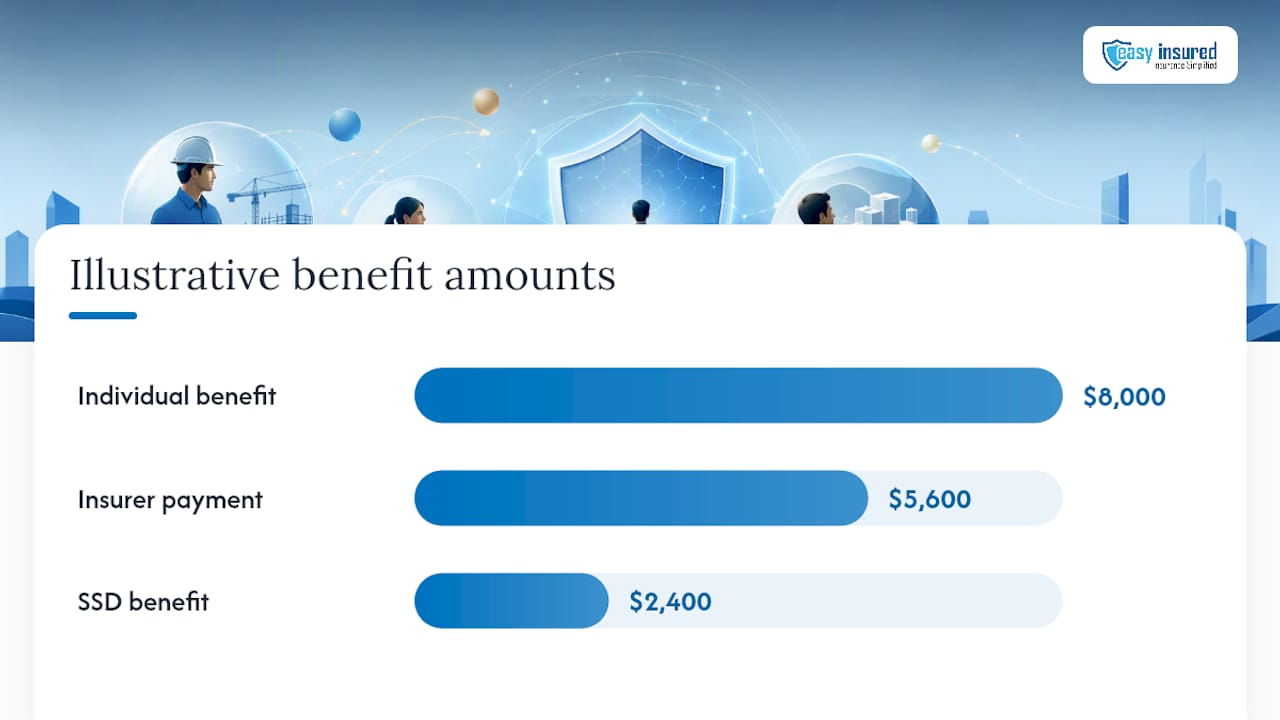
An illustrative offset example: You receive $8,000 per month in individual own-occupation benefits. You are approved for $2,400 per month in SSD. If your individual policy has a dollar-for-dollar SSD offset, your insurer reduces your benefit to $5,600 per month. Your total income remains $8,000, but the insurer pays less. This is standard practice, not an error, and it is why knowing your offset language before filing matters.
Protective steps when filing: document every job duty in writing before filing, get your treating physician to write functional limitation notes tied to specific tasks, keep copies of everything you submit, and respond to every insurer request in writing with a paper trail.
Checklist: what to verify in any own-occupation policy
Before signing an application or accepting a policy, work through these items:
Green lights to confirm:
- The definition clause uses “own occupation” or “regular occupation” language without an earnings-based any-occupation fallback.
- No 24-month switch clause, or a waiver is available that preserves own-occupation language.
- Offset language is clearly defined and limited to specified sources (SSD, worker’s comp, employer LTD).
- A residual/partial disability rider is included or available.
- COLA and future increase option riders are available and priced.
- The insurer is rated A or better by AM Best.
Red flags to walk away from:
- The definition includes “any occupation for which you are reasonably suited” without a time limit or specialty carve-out.
- The policy switches to any-occupation after 24 months with no option to preserve own-occupation language.
- Offset calculations are vague or reference “all other income sources” without specifics.
- The broker cannot produce a sample policy form.
- The policy excludes your specific medical specialty from the own-occupation definition.
Pro Tip: Request that any verbal representations about policy language be confirmed in writing, and retain the sample policy pages the broker provides. If the delivered policy differs from the sample, you have grounds to reject it during the free-look period.
Why advisors push hard for true own-occupation coverage
Specialists spend a decade or more building a skill set that is worth a specific income. A surgeon is not interchangeable with a general practitioner, and a general practitioner is not interchangeable with a hospital administrator. When a disability ends a specialist’s ability to practice, the financial loss is not just income for this year. It is the entire remaining arc of a career built on irreplaceable training.

The cases that stay with advisors are not the catastrophic ones. Those are obvious. The hard cases are the dentist with early-stage Parkinson’s who can still teach, the orthopedic surgeon with a shoulder injury who can still consult, the anesthesiologist with a hearing impairment who can still do administrative work. Under any-occupation language, every one of those professionals can be told they are not disabled because they can work somewhere. Under true own-occupation language, they collect benefits and rebuild their lives without being forced into a career they did not train for.
The 24-month switch is where most of the real damage happens. A claimant who gets approved under own-occupation language in month one often does not realize the definition changes in month 25 until the termination letter arrives. By then, they have restructured their finances around the benefit. Catching that clause before purchase costs nothing. Missing it can cost everything.
How Easy-insured helps you get the right disability coverage
Disability coverage decisions are among the most consequential financial choices a professional makes, and the policy language is where most people get it wrong. Easy-insured works with professionals and business owners to identify the right disability insurance structure, compare true own-occupation policy forms across carriers, and close the gaps that employer group plans routinely leave open.

Whether you are a physician evaluating your first individual policy, a business owner with no employer plan, or a specialist who has never read the definition clause in your current LTD contract, Easy-insured can walk you through the options. Coverage that also integrates with financial planning and broader protection strategies is available for clients who want a coordinated approach. Get a quote or speak with a broker at Easy-insured to start with a policy review.
Sources
- Ssa
- Dol
- Investopedia: Understanding Any-Occupation Disability Insurance
- SoFi: Own Occupation vs. Any Occupation Disability Insurance
- What does own occupation vs any occupation really means in long-term disability in 2026? – Law Offices of Eric A. Shore
This article provides general information about disability insurance concepts and is not a substitute for professional insurance, legal, or financial advice. Confirm policy language, plan governance, and offset rules with a licensed advisor or the relevant primary source before making coverage decisions.