
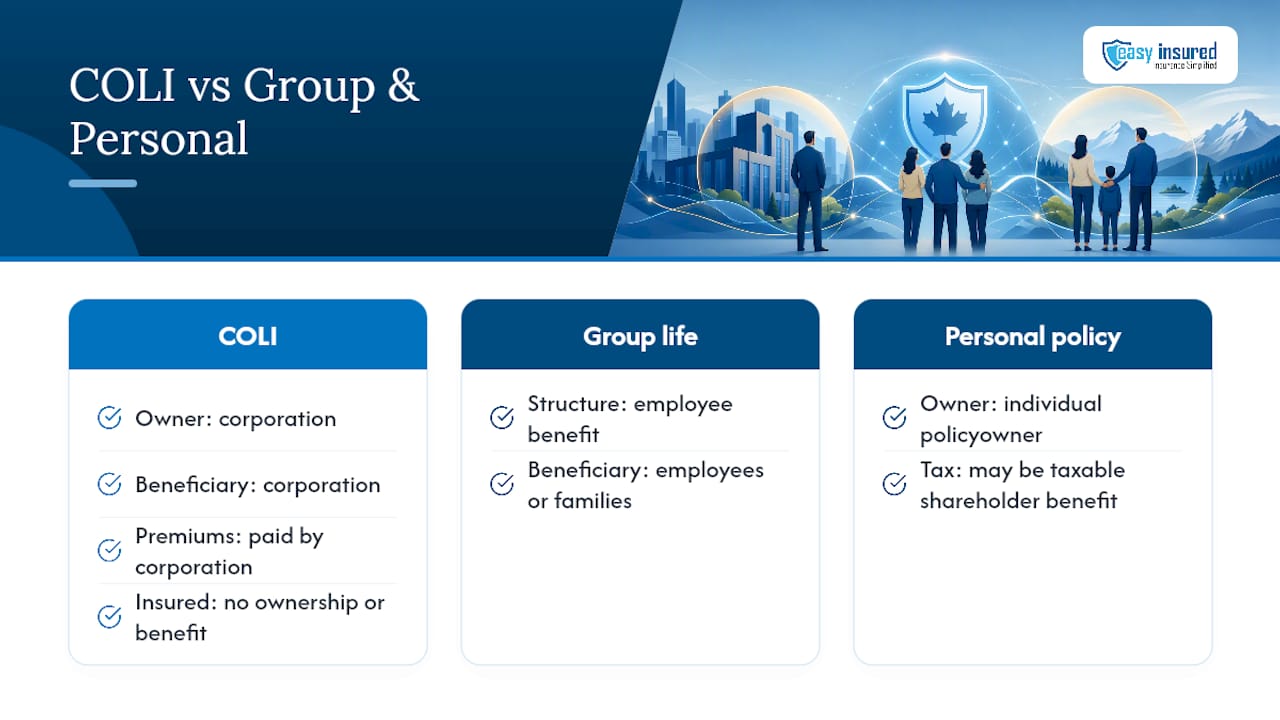
Corporate owned life insurance (COLI) is a policy where your corporation is the owner, premium payer, and beneficiary — not you personally. The insured is typically a key employee, business partner, or owner-operator. When that person dies, the death benefit flows to the company, not to their estate.
Canadian businesses should seriously consider COLI when they face any of these three situations:
- Fund a buy-sell agreement: Provide the liquidity to buy out a deceased partner’s shares without forcing a fire sale or taking on debt.
- Key-person protection: Replace lost revenue or cover recruitment costs when a critical employee or founder dies unexpectedly.
- Tax-efficient accumulation: Grow corporate surplus inside a permanent policy’s cash value, sheltered from annual corporate tax on investment income.
The right starting point is a conversation with both a licensed insurance advisor and your accountant. CRA scrutiny on COLI is real, and the documentation you set up at the start determines whether your tax positions hold up later.
Table of Contents
- What corporate-owned life insurance is and how it works in Canada
- Primary business uses: what COLI actually solves
- Which policy type fits your corporate purpose?
- Canadian tax and accounting implications: CDA, ACB, and CRA rules
- Step-by-step implementation checklist for Canadian businesses
- When a personal policy or other structure works better
- Key Takeaways
- The honest case for getting COLI right the first time
- Corporate life insurance planning with Easy-insured
- Useful sources for further research
What corporate-owned life insurance is and how it works in Canada
The corporation owns the policy outright. It pays the premiums, holds the policy as a corporate asset on the balance sheet, and receives the death benefit when the insured dies. The insured person — a founder, key executive, or business partner — has no ownership rights in the policy and receives nothing directly.
For permanent policies (whole life, universal life, participating), a portion of each premium builds cash value inside the policy. Under Canadian tax law, that growth is tax-deferred as long as the policy stays within the exempt test limits set out in the Income Tax Act. This “inside buildup” is the core tax advantage: the same dollars invested in a GIC or corporate bond would generate annual taxable investment income at the corporate rate.
The structural distinction that matters most: COLI is not group life insurance, and it is not a personal policy the owner happens to pay for through the company. Group life is an employee benefit where employees or their families are the beneficiaries. A personal policy paid by the corporation can trigger a taxable shareholder benefit. COLI, structured correctly, keeps the corporation as both owner and beneficiary — which is what unlocks the Capital Dividend Account credit on death.
On the balance sheet, the policy’s cash surrender value (CSV) is a corporate asset. Premiums paid reduce retained earnings. If the corporation borrows against the policy, that loan appears as a liability. Surrendering the policy triggers a taxable disposition equal to the CSV minus the policy’s Adjusted Cost Basis (ACB) — a number that changes over the life of the policy and must be tracked carefully. CRA’s archived policyholder guidance outlines exactly when and how those tax-preferred treatments shift.
Primary business uses: what COLI actually solves
COLI maps to four distinct business problems, and the policy structure you choose should follow the problem you are solving.
Key-person protection is the most straightforward use. If a founder or top salesperson dies, the company loses revenue, client relationships, and institutional knowledge. The death benefit gives the corporation cash to cover that gap — hiring a replacement, servicing debt, or simply keeping the lights on while the business stabilizes. For a life insurance for business owners strategy, this is often the first policy a growing company buys.
Buy-sell and share redemption funding is where COLI becomes genuinely powerful for multi-owner businesses. A corporate-owned policy on each shareholder funds the corporation’s obligation to buy back shares on death. Without it, surviving shareholders may need to take on debt or admit the deceased’s estate as an unwanted new partner. The death benefit arrives tax-free to the corporation, and the excess over ACB credits the Capital Dividend Account, allowing a tax-free capital dividend to the estate.
Executive deferred compensation is a less common but legitimate use. A corporation can informally fund a Supplemental Executive Retirement Plan (SERP) by accumulating cash value inside a COLI policy. The policy’s CSV grows tax-deferred, and the corporation can structure withdrawals or policy loans to fund benefit payments when the executive retires. This requires careful coordination with employment agreements and tax counsel.
Corporate wealth accumulation is the fourth use case, and the one that attracts the most CRA attention. A Canadian-controlled private corporation (CCPC) earning passive investment income faces a higher tax rate on that income. Routing surplus into a permanent COLI policy defers that tax on the inside buildup. BDO Canada’s advisory on COLI recommends that CCPC owners model the CDA outcomes and ACB sensitivity before committing to this strategy, because the tax math only works if the policy is held long enough.
Which policy type fits your corporate purpose?
The policy family you choose determines cost, flexibility, guarantees, and how the cash value behaves on the corporate balance sheet.
| Policy Type | Primary Corporate Use | Tax/Accounting Treatment | Liquidity / Surrender Cost | CCPC Suitability |
|---|---|---|---|---|
| Term life | Key-person, short-term buy-sell | No cash value; premiums not deductible | High liquidity; no surrender cost | Good for immediate protection; no accumulation |
| Whole life | Long-term buy-sell, accumulation | Guaranteed CSV growth; ACB tracked annually | Lower early liquidity; surrender charges apply | Strong for predictable CDA planning |
| Universal life | Accumulation, executive benefits | Flexible CSV; investment account inside policy | Moderate; charges vary by carrier | Good for CCPCs wanting flexibility |
| Variable/indexed UL | Accumulation with market upside | CSV tied to market/index; higher volatility | Lower early; market-dependent | Suitable for longer horizons; higher risk |
| Participating whole life | Long-term accumulation, buy-sell | Dividends credited; stable long-term growth | Similar to whole life | Preferred by many CCPC advisors for CDA certainty |
Term makes sense when the need is time-limited — a five-year bank loan, a buy-sell agreement that will be renegotiated, or key-person coverage while a successor is being trained. The term life options are straightforward and cost-effective for this.
Permanent policies earn their higher cost when the goal is accumulation or a long-term buy-sell obligation. Participating whole life offers the most predictable CDA outcome because the guaranteed CSV growth and dividend history make ACB projections more reliable. Universal life gives you more investment flexibility but introduces more variables into the ACB calculation. SmartAsset’s overview of COLI policy types covers the risk/return tradeoffs in plain terms.
Pro Tip: Before selecting a carrier, check their AM Best or DBRS Morningstar financial strength rating. A COLI policy is a long-term corporate asset — carrier credit risk is real, and a weaker insurer’s policy may be worth less than its illustrated CSV if the company faces financial stress.
Canadian tax and accounting implications: CDA, ACB, and CRA rules
This is where COLI either pays off or creates expensive problems. The tax benefits are real, but they depend on getting the mechanics right.
The Capital Dividend Account (CDA) is the key mechanism. When the corporation receives a death benefit, the tax-free portion — calculated as the death benefit minus the policy’s ACB at the time of death — is added to the CDA. The corporation can then pay that amount to shareholders as a tax-free capital dividend. Income Tax Folio S3-F2-C1 is the authoritative CRA source on how CDA additions are calculated.
ACB complexity is the most common source of errors. The ACB starts at zero for a new policy and increases each year by the net cost of pure insurance (NCPI) — a figure the insurer calculates. Policy loans, transfers, and exchanges all affect ACB. A miscalculated ACB means a miscalculated CDA credit, which means shareholders may receive a dividend they believe is tax-free when it is not. CRA audit guidance on COLI identifies miscalculated ACB as one of the most frequent triggers for CDA reassessments.
Premium deductibility is narrow. Under paragraph 20(1)(e.2) of the Income Tax Act, premiums are deductible only when a lender has specifically required the policy as collateral for a loan from a restricted financial institution. “Optional” collateral assignments do not qualify. CRA auditors will ask for the original loan agreement, the lender’s written requirement, and the collateral assignment document. If those do not exist, the deduction is disallowed.
Audit risk in plain terms: CRA’s published audit guidance confirms that undocumented collateral arrangements and CDA miscalculations are the two most common reasons COLI tax positions are reversed on audit. The fix is documentation, not cleverness.
For policy transfers between related parties, Form T2054 is required. Missing this filing is a procedural error that can complicate the tax treatment of the transfer. The CCPC-specific tax rules at Think Accounting walk through how premiums, withdrawals, and death benefits interact with CCPC tax rules in detail.
Pro Tip: Model your CDA/ACB scenarios before you buy. Ask your insurer for a projection of the annual NCPI deductions and resulting ACB over 10, 20, and 30 years. Run those numbers past your accountant before signing anything.
Step-by-step implementation checklist for Canadian businesses
-
Run CDA/ACB scenarios with your accountant. Model the expected CDA credit at different death ages and surrender scenarios. This step, recommended by BDO Canada, prevents surprises at claim time.
-
File required CRA forms. If the policy involves a transfer, file Form T2054. Track the policy’s ACB from day one.
Pro Tip: Bring your most recent corporate financial statements, your shareholder agreement, and any existing loan documents to your first meeting with an insurance advisor. The coverage amount and ownership structure depend on numbers that only your financials can confirm.
When a personal policy or other structure works better
Not every situation calls for corporate ownership. Sometimes personal ownership or a simpler structure delivers a better outcome.
| Scenario | Better Structure | Key Reason |
|---|---|---|
| Single owner, estate planning priority | Personal ownership | Proceeds go directly to estate/family; no corporate layer |
| Creditor protection needed | Personal ownership | Corporate assets are exposed to business creditors |
| Short-term buy-sell, loan-backed | Corporate term + credit facility | Lower cost; no long-term commitment |
| Small CCPC, minimal surplus | Term life (personal or corporate) | Accumulation benefit doesn’t justify permanent premium |
| Multi-owner family business | Corporate permanent (participating) | CDA credit on death funds share redemption cleanly |
| Executive with large SERP liability | Corporate universal life | CSV accumulation funds future benefit payments |
A single owner-operator with a modest corporation and a young family often gets more value from a personally owned whole life policy than from COLI. The proceeds bypass the corporation entirely, reach the family faster, and avoid the ACB/CDA complexity. The financial planning conversation should include both structures before committing.
For multi-owner businesses, the calculus shifts. The CDA credit on a corporate-owned policy can fund a tax-free capital dividend to the deceased’s estate, which is a meaningful advantage over personal ownership in a share-redemption buy-sell.
Key Takeaways
Corporate owned life insurance delivers real tax and business-continuity advantages for Canadian CCPCs, but only when the ownership structure, documentation, and ACB tracking are set up correctly from the start.
| Point | Details |
|---|---|
| Who should consider COLI | CCPCs with buy-sell obligations, key-person risk, or corporate surplus to shelter from passive income tax. |
| CDA credit mechanics | The tax-free CDA addition equals the death benefit minus the policy’s ACB — ACB must be tracked annually. |
| Premium deductibility is narrow | Deductions under paragraph 20(1)(e.2) require written lender proof that insurance was mandatory collateral. |
| Documentation is your audit defense | Board resolutions, lender letters, employee consents, and ACB records must exist before CRA asks for them. |
| Easy-insured can help | Easy-insured works with Canadian business owners to select and structure whole life and universal life COLI policies, coordinating with your accountant from day one. |
The honest case for getting COLI right the first time
Most business owners who run into trouble with COLI didn’t make a bad decision — they made an incomplete one. They bought a policy that made sense on paper, skipped the governance steps because they felt bureaucratic, and discovered years later that the CDA credit they were counting on was smaller than expected, or that the premium deductions they had been claiming were disallowed on audit.
The tax advantages of COLI are not theoretical. The CDA mechanism is a genuine, legislated benefit for Canadian corporations. Participating whole life inside a CCPC can accumulate cash value at a rate that outperforms a GIC on an after-tax basis over a long enough horizon. Key-person coverage has saved businesses that would otherwise have folded after a founder’s death.
What the brochures understate is the operational discipline required. ACB tracking is not a one-time calculation — it changes every year, and errors compound. The collateral deduction rule is strict enough that many advisors recommend against claiming it unless the lender’s requirement is unambiguous and in writing. And the shareholder benefit risk is real enough that the ownership and beneficiary structure should be reviewed by a tax lawyer before the policy issues, not after.
The businesses that get the most out of COLI treat it as a financial planning tool that requires the same rigor as a major capital investment — not as a tax trick that runs itself.
Corporate life insurance planning with Easy-insured
Canadian business owners who want COLI done right need two things working together: an insurance advisor who understands corporate policy structures and an accountant who can model the CDA/ACB outcomes before anything is signed. Easy-insured provides the insurance side of that equation, with whole life and universal life policies suited to corporate accumulation, buy-sell funding, and key-person programs for CCPCs across Canada.
The process starts with a consultation where you bring your shareholder agreement, recent corporate financials, and any existing loan documents. Easy-insured compares carriers, runs illustrations showing CSV growth and projected ACB, and coordinates directly with your accountant so the policy structure supports your tax plan from day one. Request a consultation at easy-insured.com to get started.
Useful sources for further research
The sources below are the primary references for the tax rules, forms, and professional guidance covered in this article.
- Income Tax Folio S3-F2-C1 — Capital dividends (canada.ca)
- CRA audits on corporate owned life insurance (lawyerinfo.ca)
- Corporate-owned life insurance — BDO Canada
- Corporate-Owned Life Insurance for CCPCs: Tax Rules (thinkaccounting.ca)
- Corporate-Owned Life Insurance: Types, Benefits and Tax Rules (SmartAsset)
- Corporate ownership of life insurance (Investopedia)
This article is general information, not tax or legal advice. COLI involves complex Canadian tax rules that vary by corporate structure and individual circumstances. Confirm your specific situation with a qualified tax advisor or CRA directly before implementing any strategy.