
When you need cash fast in Canada, the fastest viable routes are: your existing bank line of credit or emergency loan (same-day decision for established customers), same-day online personal or business loans, invoice factoring or merchant cash advances for businesses with receivables, and insurance-based options including policy loans, accelerated death benefits, critical-illness payouts, and formal Immediate Financing Arrangements (IFAs) for eligible policyholders. The term “immediate financing arrangement” is the industry-recognized name for a specific insurance-lending strategy, but in practice most Canadians searching for urgent financial solutions need to know all of these routes before deciding which one fits.
- Existing bank line of credit or overdraft — same-day to 24 hours; best for individuals and businesses with an established banking relationship
- Same-day online personal or business loan — same-day decision, funding within 24 hours for eligible applicants; best for individuals without existing credit facilities
- Invoice factoring / merchant cash advance — 24–72 hours; best for small businesses with outstanding receivables or card-based revenue
- Policy loan (secured by cash surrender value) — 24–72 hours once arranged; best for policyholders with permanent life insurance
- Accelerated death benefit / critical-illness payout — days to weeks depending on insurer and qualifying event; best for individuals with qualifying diagnoses
- Formal IFA (Immediate Financing Arrangement) — structured over weeks initially, then annual cycle; best for high-net-worth individuals and corporations
The Financial Consumer Agency of Canada (FCAC) and Canada Revenue Agency both publish guidance relevant to borrowing costs and tax treatment — check both before signing anything.
Table of Contents
- Which immediate financing method is right for you?
- How do you pick the fastest, safest option for your situation?
- Step-by-step: how to get funds in 24–72 hours
- How does insurance-based immediate funding actually work?
- What are the real costs, tax rules, and legal risks in Canada?
- When should you avoid immediate borrowing altogether?
- Key Takeaways
- Why insurance-based liquidity deserves more attention than it gets
- Easy-insured helps you find liquidity in the policies you already hold
- Useful sources and further reading
Which immediate financing method is right for you?
| Method | Speed to Funding | Typical Cost / Fee | Credit / Eligibility | Collateral | Typical Amount | Credit Report Impact | Best For |
|---|---|---|---|---|---|---|---|
| Bank line of credit | Same-day to 24 hrs | Low APR (prime-based) | Good credit, existing relationship | Often unsecured up to limit | moderate to large amounts depending on lender and profile | Soft check; utilization reported | Individuals, businesses |
| Same-day online personal loan | Same-day to 24 hrs | Mid-to-high APR | Fair to good credit | Unsecured | varied loan amounts depending on lender and credit | Hard inquiry | Individuals |
| Online emergency business loan | 24–72 hrs | Mid-to-high APR; origination fees possible | Revenue-based; credit varies | Varies | varied amounts depending on lender and business volume | Hard inquiry | Small businesses |
| Invoice factoring | 24–72 hrs | Factor rate (1–5% of invoice); effective APR often high | Based on receivables quality | Invoices / receivables | funding depends on invoice portfolio size | Minimal direct impact | Businesses with B2B invoices |
| Merchant cash advance | 24–48 hrs | Factor rate; effective cost often exceeds standard loan APRs | Card revenue history | Future card receipts | funding varies with card revenue volume | Minimal direct impact | Retail / card-revenue businesses |
| Credit card cash advance | Immediate | Very high APR; cash advance fee | Existing card limit | None | Up to card limit | Utilization reported | Individuals, emergency only |
| Policy loan / IFA | 24–72 hrs once arranged | Lower interest on CSV-secured loan | Insurable; permanent policy with CSV | Cash surrender value | Up to 90–100% of CSV (varies by policy/lender) | Generally none | High-net-worth, corporations |
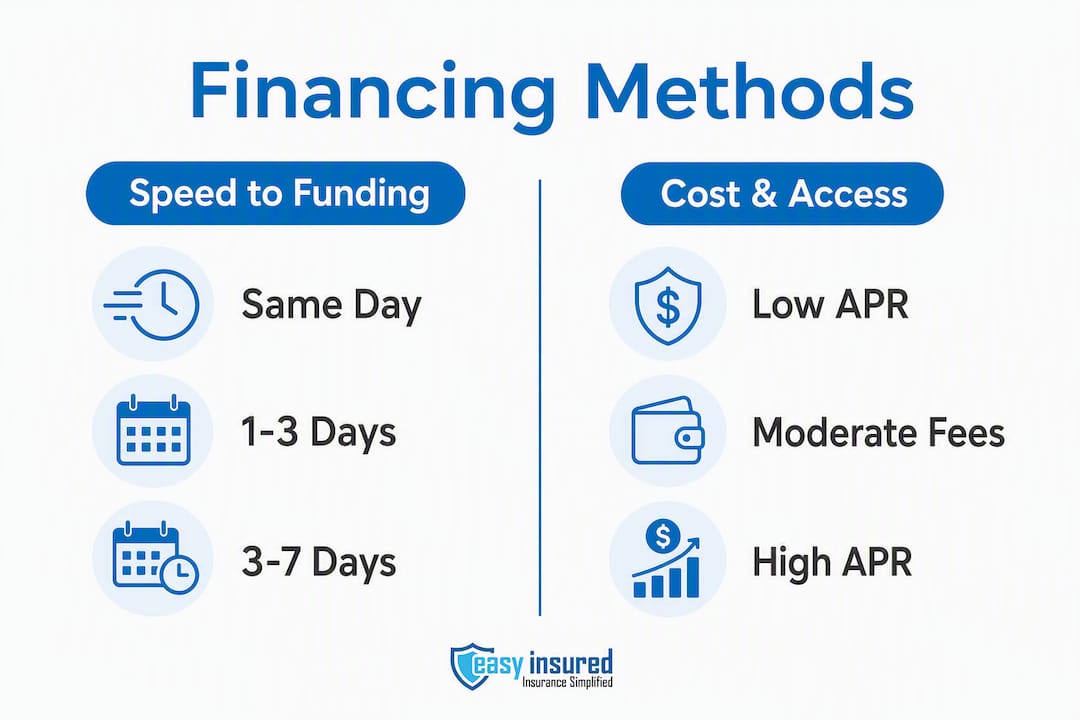
Exact timing and cost vary by lender and individual profile. Online lenders list APR bands that can range from mid-teens to high 20s or more depending on credit and product type. Check provincial consumer protection rules and CRA guidance on interest deductibility before signing any agreement.
How do you pick the fastest, safest option for your situation?
Start with your existing bank. Established customers consistently get faster decisions and lower rates than applicants approaching a new lender cold. If your bank can’t move fast enough, move to low-cost secured options next, then short-term unsecured loans, then insurance-based routes for those who qualify.
Before you choose, answer these questions honestly:
- How fast do I actually need the funds — same-day, 48 hours, or within a week?
- How much do I need, and is that amount realistic for my credit profile?
- Can I post collateral (property, receivables, or insurance CSV)?
- Will the borrowed funds generate taxable income or business revenue?
- Do I hold a permanent life, critical-illness, or disability policy?
- What is my credit score, and does it meet the lender’s threshold?
- What is my documented repayment source if the deployment doesn’t work as planned?
Watch for these red flags before signing:
- APRs or factor rates that push the effective annual cost well above market norms
- Large upfront administration fees deducted directly from your proceeds
- Variable interest tied to short-term rates with no cap
- Pressure to sign without time to review terms
- Requests to assign policy ownership (not just CSV as collateral) without independent legal review
Pro Tip: If you’re a business owner, model the net cost of borrowing against the expected return on deployed funds before committing. A same-day loan at a high APR can be worth it for a time-sensitive contract win; it rarely makes sense for routine cash-flow gaps.
Step-by-step: how to get funds in 24–72 hours
Immediate (first 24 hours):
- Call your bank and ask specifically about your existing line of credit, overdraft limit, or emergency personal/business loan products. Banks and online lenders can provide same-day credit decisions and funding for eligible applicants, and existing customers typically move faster.
- Log into your online banking to check pre-approved offers — many major Canadian banks surface these without a new hard inquiry.
- Prepare digital copies of: government-issued photo ID, last 90 days of bank statements, most recent pay stub or business revenue summary.
24–72 hours (if bank can’t fund fast enough):
- Apply to a reputable online lender for a same-day personal or business emergency loan — have your SIN, income proof, and bank statements ready for instant verification.
- For businesses with outstanding invoices, contact an invoice factoring provider or explore a business line of credit — approval is often based on receivables quality rather than personal credit.
- If you hold a permanent life insurance policy, call your insurer or broker to ask about a policy loan against your cash surrender value.
- If you have a critical-illness or disability policy and a qualifying event has occurred, contact your insurer immediately to initiate a claim — payouts can arrive within days to a few weeks depending on the insurer and documentation.
Documents to have ready:
- Government-issued photo ID
- Last 90 days of bank statements
- Proof of income (pay stubs, T4, or business financials)
- Outstanding business invoices (for factoring)
- Insurance policy number and most recent illustration
- Corporate resolution (for business borrowing)
- Property or asset ownership documents (if posting collateral)
How does insurance-based immediate funding actually work?
Insurance-based liquidity is often the most overlooked quick funding option — and for the right client, it’s also the most cost-effective.

Policy loans are the simplest route. If you hold a whole life or universal life policy with accumulated cash surrender value (CSV), you can borrow against that CSV, often up to 90–100% of its value on qualifying whole life policies. The loan carries interest, reduces your net death benefit if unpaid, but doesn’t trigger a tax event the way a policy surrender would.
An Immediate Financing Arrangement (IFA) takes this further. The mechanics work like this: you purchase a permanent life policy designed to build CSV early, assign that CSV as collateral to a lender, pay the annual premium out of pocket, then immediately borrow back an amount equal to the premium from the lender. You repeat this each year. The loan is typically repaid from the death benefit or by the client during their lifetime. The net effect is that you maintain life insurance coverage while keeping your capital deployed elsewhere.
IFAs are designed for high-net-worth, insurable clients who have the balance sheet to sustain premiums and post additional collateral if needed. Lenders review the arrangement annually and may require more collateral if CSV growth falls short of projections.
Which Easy-insured products apply:
- Whole life and universal life: both can build CSV suitable for policy loans and IFAs
- Critical illness insurance: lump-sum payout on a qualifying diagnosis provides immediate liquidity without borrowing
- Disability insurance: monthly income replacement during a disability period — not a lump-sum advance, but it protects cash flow
- Term life: typically carries no CSV, so it cannot be used for policy loans or IFAs
- Final expense insurance: designed for estate liquidity, not immediate personal borrowing
Illustrative scenario: A corporation pays a $50,000 annual whole life premium. The policy builds $45,000 in CSV in year one. The corporation assigns the CSV to a lender and borrows $45,000 at a policy loan rate. Net cost is the interest on $45,000 minus any policy dividend credited. The corporation keeps $45,000 deployed in its business while maintaining the life insurance coverage.
Pro Tip: Ask your advisor to model the IFA under at least three scenarios: base dividend, reduced dividend, and a 2% rise in borrowing rates. If any scenario creates a capital call you can’t cover, the arrangement isn’t right for your balance sheet.
What are the real costs, tax rules, and legal risks in Canada?
Costs vary more than most borrowers expect. A bank line of credit sits at the low end, priced near prime. Online emergency loans carry mid-to-high APRs. Merchant cash advances use factor rates that translate to effective annual costs well above standard loan rates. Policy loans sit in the middle — interest accrues on the outstanding loan balance, but the rate is typically lower than unsecured alternatives.
| Financing Type | Typical Cost Shape | Key Risk |
|---|---|---|
| Bank line of credit | Low APR, prime-based | Limit may be insufficient for large urgent needs |
| Online emergency loan | Mid-to-high APR; possible origination fee | High total cost over time |
| Merchant cash advance | Factor rate; effective APR often high | Can strain daily cash flow |
| Policy loan | Interest on CSV-secured balance; generally lower rate | Reduces death benefit if unpaid |
| IFA (net cost) | Interest minus policy dividend performance | Capital deficiency risk if rates rise or dividends fall |
Tax and legal notes for Canada:
Interest on borrowed funds may be deductible when the funds are used to earn business or investment income, subject to CRA rules — but this is not automatic and depends on how the funds are deployed. A policy surrender triggers a taxable event if the CSV exceeds the policy’s adjusted cost base (ACB). Policy loans themselves are generally not immediately taxable but reduce the net death benefit if left unpaid.
Check the Financial Consumer Agency of Canada and your provincial consumer protection office before committing to any high-cost short-term product. For IFAs and collateral assignments, a qualified Canadian tax advisor and independent legal counsel are not optional.
When should you avoid immediate borrowing altogether?
Before you borrow, check whether any of these alternatives solve the problem at lower cost:
- Tap emergency savings first — no interest, no credit impact, no repayment schedule
- Negotiate a payment extension with your supplier or landlord — often faster than any loan application
- Ask customers for partial prepayment on pending contracts
- Use a low-cost credit union product — Canadian credit unions often offer lower-rate emergency lines than online lenders
- Temporary owner equity injection for businesses where the owner has accessible personal funds
Clear signals to stop and reconsider:
- You have no documented repayment source beyond “things will improve”
- The APR or effective cost exceeds the return you expect from deploying the funds
- The only available option is a payday loan or high-cost unsecured lender
- You cannot sustain annual premium obligations for an IFA without straining your balance sheet
- You would need to surrender other assets to cover a potential capital call
Key Takeaways
The fastest and safest immediate financing in Canada starts with your existing bank, then moves to insurance-based options or online lenders depending on your profile and the cost you can absorb.
| Point | Details |
|---|---|
| Start with your bank | Existing customers get same-day decisions and lower rates than new applicants at online lenders. |
| Insurance routes suit specific profiles | Policy loans and IFAs work for permanent policyholders with CSV; critical-illness payouts provide lump sums on qualifying diagnoses. |
| Cost shapes vary widely | Bank lines carry low APRs; merchant cash advances and online emergency loans carry significantly higher effective costs. |
| Tax review is non-negotiable | Policy surrenders can trigger taxable income; interest deductibility depends on how funds are deployed under CRA rules. |
| Easy-insured can help | Easy-insured reviews existing policies for liquidity options, quotes whole life and critical-illness products, and connects clients with financial planning support for IFA structuring. |
Why insurance-based liquidity deserves more attention than it gets
Most articles about urgent financial solutions lead with online lenders and stop there. That’s fine for someone who needs $5,000 by tomorrow and has no insurance portfolio. But for business owners and high-net-worth individuals, that framing misses the most cost-effective route entirely.
Insurance-based liquidity — policy loans, IFAs, critical-illness payouts — preserves your estate, can produce favorable after-tax outcomes when structured correctly, and often costs less than unsecured borrowing over a multi-year horizon. The catch is that it requires the right policy, the right balance sheet, and an advisor who actually understands the mechanics. Most people don’t know whether their existing policy qualifies until they ask.
The risk is real too. IFAs are not passive. They require annual reviews, contingency collateral, and a clear repayment plan. Anyone who presents an IFA as a “free money” strategy is either uninformed or not being straight with you. The honest case for insurance-based funding is that it can be the best option for the right client — not that it’s right for everyone.
Easy-insured helps you find liquidity in the policies you already hold
If you’re sitting on a permanent life policy and haven’t asked whether it can fund your next move, that’s the first call to make. Easy-insured reviews existing policies for immediate liquidity potential, helps structure IFA conversations with lending partners, and quotes whole life and universal life products designed to build CSV efficiently. For clients facing a qualifying health event, critical illness coverage delivers a lump-sum payout that requires no borrowing at all.
Before you contact Easy-insured, have your policy number, a recent bank statement, and your government ID ready. The team can turn around a policy review and initial quote quickly. To get started, request a quote or visit the financial planning page to book a planning consult. Response times are typically within one business day.
This article provides general information about financing options available in Canada and does not constitute financial, legal, or tax advice. Confirm current rules and product suitability with a qualified Canadian advisor before acting.
Useful sources and further reading
- Financial Consumer Agency of Canada (FCAC) — consumer rights, borrowing cost comparisons, and complaint resources
- Canada Revenue Agency — Life Insurance Policies — guidance on policy dispositions, ACB, and interest deductibility rules
- Easy-insured Whole Life Insurance — CSV-building permanent policies suitable for policy loans and IFAs
- Easy-insured Universal Life Insurance — flexible permanent coverage with CSV profiles lenders consider for lending arrangements
- Easy-insured Critical Illness Insurance — lump-sum payouts on qualifying diagnoses
- Easy-insured Financial Planning — integrated planning support for IFA structuring and tax review
All legal, tax, and regulatory details in this article apply to Canada. Consult a qualified Canadian tax professional and legal advisor before implementing any financing arrangement involving insurance collateral or policy dispositions.