
No medical life insurance lets you get covered without a physician exam, a blood draw, or a urine sample. If you need coverage fast, have a health condition that complicates traditional underwriting, or simply want to skip the waiting room, a no-exam policy is worth a serious look.
Before you go further, three quick actions:
- Check the coverage ceiling for the policy type you’re considering (guaranteed issue caps are often $25,000–$50,000; accelerated underwriting can reach $3 million).
- Decide your target term or coverage duration — temporary income replacement needs a different product than final-expense coverage.
- Speak with a licensed agent who can match you to the right no-exam type based on your age, health, and budget.
Table of Contents
- What types of no medical exam life insurance are available?
- How do insurers assess risk without a medical exam?
- What do no-exam policies actually cost, and what are the coverage limits?
- Who benefits most from no medical life insurance?
- Pros and cons of skipping the medical exam
- How to buy a no-exam policy: steps and questions to ask
- What does the research show about approval timelines?
- Key Takeaways
- The case for starting with accelerated underwriting
- Easy-insured helps you find the right no-exam coverage
- Useful sources and further reading
What types of no medical exam life insurance are available?
Industry guides classify no-exam policies into four main categories. Each one trades something different, and picking the wrong type is an expensive mistake.
Accelerated underwriting
This is the closest thing to traditional term life insurance without the exam. Insurers use algorithmic risk scoring, prescription history, and third-party data to make a decision, often in minutes. Coverage can reach high levels with some carriers, and pricing for healthy applicants can come close to fully underwritten rates. Age limits typically apply (most carriers cap this path at 60 or younger), and applicants with complex health histories may be redirected to full underwriting.

Simplified issue
You answer a short health questionnaire — usually 10 to 20 questions — but no paramedical exam is required. Approval decisions typically arrive within 24 hours to two weeks. Coverage limits are lower than accelerated underwriting, commonly ranging from $25,000 to $300,000 depending on the carrier and product. Premiums run higher than fully underwritten policies, and the questionnaire answers are verified against external databases.
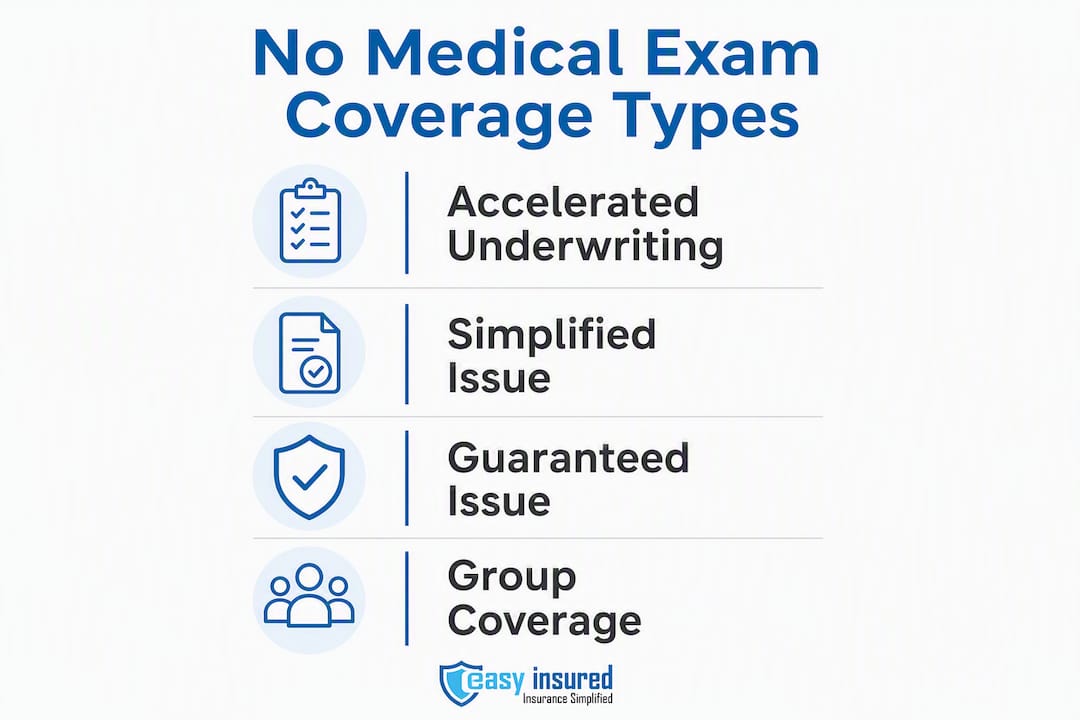
Guaranteed issue (final expense)
No health questions. No exam. Nearly everyone who applies within the eligible age range (typically 45–85) gets approved. The trade-off is significant: coverage is capped low, often between $5,000 and $25,000, and almost all guaranteed issue policies carry a graded death benefit during the first two years. If you die in that window from natural causes, your beneficiaries receive a return of premiums plus interest rather than the full face amount.
Group and employer-sponsored coverage
Many employer group plans skip individual medical exams entirely, especially during open enrollment. Coverage amounts are usually tied to a multiple of your salary and are rarely portable if you leave the job. This is a useful baseline but not a substitute for individual coverage.
| Policy Type | Typical Coverage Range | Approval Timeline | Health Questions? | Best For |
|---|---|---|---|---|
| Accelerated underwriting | Up to $3M+ | Minutes to days | No exam; data-verified | Healthy buyers under 60 wanting full coverage |
| Simplified issue | $25,000–$300,000 | 24 hours–2 weeks | Short questionnaire | Moderate health concerns; mid-range coverage |
| Guaranteed issue | $5,000–$25,000 | Days to a week | None | Final expenses; hard-to-insure applicants |
| Group/employer | Salary multiple | Immediate (open enrollment) | None (group basis) | Baseline coverage; employed individuals |
How do insurers assess risk without a medical exam?
Skipping the exam does not mean skipping underwriting. Insurers replace the paramedical appointment with a combination of health questionnaires and automated checks against multiple external databases.

The three most common data sources are prescription history, Medical Information Bureau (MIB) records, and motor vehicle reports (MVR). Prescription databases reveal conditions you may not have disclosed. MIB records flag prior insurance applications and any medical codes attached to them. MVR reports surface DUIs, reckless driving, or other behaviors that signal elevated risk. Together, these sources give underwriters a surprisingly detailed picture without a single blood draw.
Automated systems can deliver decisions in minutes; simplified issue cases that require manual review typically take 24 hours to two weeks. What triggers manual review? A questionnaire answer that conflicts with a database record, a prescription that suggests an undisclosed condition, or a coverage amount above the carrier’s automated-approval threshold.
Pro Tip: Before you apply, pull your MIB file (free once per year at mib.com) and check your prescription history for accuracy. Errors in those records can slow approval or generate a false flag that sends your application to manual review.
What do no-exam policies actually cost, and what are the coverage limits?
Cost is where no-exam insurance shows its trade-offs most clearly. Healthy applicants under 50 typically pay about 5%–10% more for no-exam policies versus fully underwritten term policies, because the insurer is compensating for the data gap left by skipping the exam.
MoneyGeek’s 2026 analysis puts average no-exam term rates for a 40-year-old nonsmoker at roughly $50 per month for women and $63 per month for men for $500,000 over a 20-year term. By age 55, those figures climb sharply. Smokers at any age pay substantially more, and guaranteed issue policies carry the steepest per-dollar-of-coverage cost of any type.
| Profile | Policy Type | Coverage | Est. Monthly Premium |
|---|---|---|---|
| Female, 40, nonsmoker | No-exam term (20-yr) | $500,000 | ~$50 |
| Male, 40, nonsmoker | No-exam term (20-yr) | $500,000 | ~$63 |
| Male, 55, nonsmoker | No-exam term (20-yr) | $500,000 | Rises sharply vs. age 40 |
| Any age, guaranteed issue | Final expense (whole life) | $10,000–$25,000 | Higher per-dollar cost |
Source: MoneyGeek 2026 no-exam rate analysis.
Graded death benefits and waiting periods
Guaranteed issue and some simplified issue policies include a graded death benefit clause. During the first one to two years of the policy, if the insured dies from illness or natural causes, the insurer pays a return of premiums plus a stated interest rate rather than the full face amount. Death by accident is usually covered in full from day one.
Warning: Graded benefit language varies by carrier. Some policies return 100% of premiums plus 10% interest; others return only 110% of premiums. Read the exact clause before you sign. A policy that pays $25,000 after two years may pay only $2,750 in year one.
The contestability window — typically two years from the policy issue date — is a separate but related concern. During that period, the insurer can investigate any claim and deny it if they find material misrepresentation on the application. After two years, most policies become incontestable except for outright fraud.
Who benefits most from no medical life insurance?
No-exam policies are access tools, not always the cheapest tools. They expand coverage options for people who can’t or won’t complete a paramedical exam. Here are the buyer profiles where they make the most sense:
- Final-expense buyers who need $5,000–$25,000 to cover funeral costs and small outstanding debts. Guaranteed issue is purpose-built for this need, and Easy-insured’s final expense coverage walks through the options in plain language.
- People with disqualifying health conditions — diabetes, heart disease, or a recent cancer diagnosis — who would face a decline or a rated policy under traditional underwriting.
- Busy professionals who need coverage in place quickly, perhaps for a new mortgage or a business buy-sell agreement. Accelerated underwriting can close that gap in days rather than weeks. If you’re a co-buyer on a mortgage, understanding how life insurance fits a joint mortgage is worth a few minutes of your time.
- Seniors between 60 and 85 with limited options who want a small permanent policy. Guaranteed issue is often the only path available at this stage.
- Employees who want a baseline of coverage immediately through group insurance without any individual health screening.
Pro Tip: Try accelerated underwriting first if you’re under 60 and in reasonably good health. You may qualify for near-standard rates with no exam. Only move to simplified or guaranteed issue if accelerated underwriting declines you or the coverage ceiling is too low for your needs.
Pros and cons of skipping the medical exam
| Pros | Cons |
|---|---|
| Fast approval — sometimes minutes | Premiums run 5%–10% higher for healthy buyers |
| No blood draw, no physician visit | Coverage maximums are lower than fully underwritten policies |
| Accessible for applicants with health conditions | Graded death benefits limit early payouts on some products |
| Peace of mind without scheduling delays | Misreporting health info risks claim denial during contestability |
| Group plans provide immediate baseline coverage | Guaranteed issue offers limited face amounts |
The cons outweigh the pros for one specific group: healthy buyers under 45 who can qualify for traditional underwriting. CNBC Select and NerdWallet both flag this point. If a standard exam would get you a preferred rate on a $1 million policy, the convenience premium of going no-exam is a real cost with no offsetting benefit.
How to buy a no-exam policy: steps and questions to ask
The purchase process is shorter than traditional life insurance, but a few steps still matter.
- Get quotes from multiple sources. Rates and coverage caps vary significantly by carrier. A broker who works with several no-exam carriers will surface options a single-carrier site won’t show you.
- Check the coverage ceiling. Confirm the maximum face amount for the specific product you’re quoting. Accelerated underwriting may allow $3 million or higher; simplified issue may cap at $25,000 to $300,000.
- Answer health questions honestly. Insurers cross-check your answers against prescription databases and MIB records. An inaccuracy — even an unintentional one — can void the policy during the contestability window.
- Confirm the waiting period and graded benefit terms. Ask specifically: what does the policy pay in year one and year two if death is from illness? Get the exact dollar figure, not just “graded benefits apply.”
- Complete the purchase and store your documents. Keep a copy of the policy and the application in a place your beneficiaries can find. The claim process starts there.
Five questions to ask before you sign
- What is the maximum coverage amount for this specific product?
- Is there a graded death benefit, and what exactly does it pay in years one and two?
- What is the contestability period, and what grounds allow the insurer to deny a claim?
- Can I cancel the policy and receive a premium refund, and under what conditions?
- Does the premium change at any point, or is it level for the full term?
Red flags to watch for: vague graded-benefit language that doesn’t state a dollar amount; no clear disclosure of the contestability period; a coverage ceiling that isn’t confirmed in writing before you pay.
What does the research show about approval timelines?
The timeline gap between no-exam and traditional life insurance is one of the clearest advantages the data supports. Automated no-exam underwriting systems can deliver instant or near-instant decisions for many applicants, while traditional fully underwritten policies often take four to eight weeks from application to policy issuance.
Approval timeline snapshot: Accelerated underwriting decisions can arrive in minutes. Simplified issue cases that require manual review typically take 24 hours to two weeks. Guaranteed issue decisions usually process within a few business days.
The speed difference comes from what’s being verified. Automated systems query prescription databases, MIB, and MVR records in real time. When all three return clean results and the coverage amount falls within the carrier’s automated threshold, approval is immediate. Manual review kicks in when a database flag needs a human to interpret it, or when the coverage amount exceeds the automated ceiling.
Timeline also varies by carrier. Some insurers have invested heavily in algorithmic underwriting platforms and consistently deliver same-day decisions. Others still route simplified issue applications through a hybrid process that can stretch to two weeks. Asking your agent or broker which carriers have the fastest pipelines for your profile is worth doing before you apply.
Key Takeaways
No-exam life insurance trades a modest premium increase for speed and access — the right call for many buyers, but not all.
| Point | Details |
|---|---|
| Four main policy types | Accelerated underwriting, simplified issue, guaranteed issue, and group coverage each serve different needs and budgets. |
| Cost premium is real but modest | Healthy buyers under 50 typically pay a small percentage more than for fully underwritten term policies. |
| Coverage ceilings vary widely | Accelerated underwriting can reach high coverage amounts; guaranteed issue often caps at low coverage amounts. |
| Graded benefits limit early payouts | Most guaranteed issue and some simplified issue policies pay only a return of premiums in the first 1–2 years for non-accidental death. |
| Easy-insured can match you to the right type | Easy-insured’s licensed advisors compare no-exam term, whole life, and final expense options so you don’t have to sort through carriers alone. |
The case for starting with accelerated underwriting
Most people who ask about no-exam coverage assume they need guaranteed issue because they’ve heard “no medical questions.” That assumption costs them money. Guaranteed issue carries the highest per-dollar premium and the lowest coverage ceiling of any no-exam product. It exists for a specific situation: applicants who genuinely cannot qualify for anything else.
If you’re under 60 and your health history is anything short of severe, accelerated underwriting is the smarter first move. The application takes about the same time as a guaranteed issue form, the data checks happen in the background, and you may walk away with a $500,000 policy at near-standard rates. The only thing you gave up was a needle stick.
The other underappreciated point: transparency on the health questionnaire is not just an ethical obligation. It’s a financial one. Insurers check prescription databases and MIB records against every answer you give. A discrepancy doesn’t just slow your application — it can void your policy during the two-year contestability window, leaving your family with nothing when they expected a payout. The questionnaire is short. Answer it carefully.
Easy-insured helps you find the right no-exam coverage
Sorting through accelerated underwriting, simplified issue, and guaranteed life insurance options across multiple carriers takes time most people don’t have. Easy-insured’s licensed advisors do that comparison for you, matching your age, health profile, and coverage goal to the no-exam product that fits.

Whether you need a term life policy that closes fast for a new mortgage, a whole life policy with permanent coverage and no exam, or a final expense plan that covers funeral costs without health questions, Easy-insured works with carriers across the market to find the right fit. Speak with a licensed Easy-insured advisor today to get a quote, review your graded benefit terms, and start your application with confidence.
This article provides general information about life insurance options and is not professional financial or insurance advice. Confirm current product terms, eligibility, and pricing with a licensed insurance professional or the relevant carrier before purchasing.
Useful sources and further reading
- No-Exam Life Insurance Rates (2026) — MoneyGeek: sample premium ranges by age and gender, plus the 5%–10% cost premium figure.
- Can You Get Life Insurance Without a Medical Exam? — CNBC Select: editorial perspective on trade-offs and who benefits most.
- 4 Best No-Exam Life Insurance Policies in 2026 — NerdWallet: buyer-type picks and accelerated underwriting coverage ceiling evidence.
- Easy-insured Term Life: get a quote or start a no-exam term application with a licensed advisor.
- Easy-insured Final Expense: guaranteed issue and final expense options for readers focused on end-of-life costs.