
Probate is the court process that validates a will and issues a legal grant authorizing an executor to manage and distribute a deceased person’s estate. If you’re dealing with a death in the family right now, the most useful first step is to locate the original will, check whether financial institutions or land registries are asking for a court grant, and confirm who the named executor is.
Here’s what you need to know at a glance:
- What probate does: A court reviews the will for authenticity, then issues a grant (called a Certificate of Appointment of Estate Trustee in Ontario, or a similar document in other provinces) that gives the executor legal authority to act.
- When it’s commonly required: Real estate held solely in the deceased’s name, bank or investment accounts above an institution’s internal threshold, and any estate where the will is contested.
- How long it takes: Anywhere from a few weeks to several months, depending on the province, estate complexity, and whether the application is complete and error-free.
- What it costs: Probate fees are set by each province and territory, usually calculated as a percentage or flat rate based on the total estate value. Ontario calls this the Estate Administration Tax but details of the fees should be checked with official sources.
- Your immediate next step: Secure the original will, obtain the death certificate, and contact the major financial institutions to ask whether they require a grant before releasing assets.
Canada’s estate administration falls under provincial jurisdiction, so the rules, forms, timelines, and fees differ depending on where the deceased lived.
Table of Contents
- What probate actually means under Canadian law
- When is probate actually required in Canada?
- Probate fees by province: what you’ll actually pay
- How the probate process works, step by step
- The full cost picture: beyond the court fee
- Assets that skip probate and how to reduce your exposure
- Do you need a lawyer to apply for probate?
- Common challenges executors face and how to handle them
- Your executor checklist: the first 30, 90, and 180+ days
- Key Takeaways
- Why early estate planning matters more than most people realize
- How Easy-insured helps you reduce probate friction before it starts
- Official resources and further reading
What probate actually means under Canadian law
Probate is a court-supervised process that confirms a will is authentic, that the person who signed it had the mental capacity to do so, and that no fraud or undue influence was involved. Once satisfied, the court issues a grant, and that document is what gives the executor legal standing to act.
Without a grant, most financial institutions and land registries won’t move. A bank holding $200,000 in a deceased person’s account has no way to verify that the will you’re presenting is the final, valid version. The grant solves that problem. It shifts legal liability from the institution to the court-supervised process, which is exactly why institutions require a grant before transferring assets, even when the will seems perfectly clear.
The executor (or “estate trustee” in Ontario) files the application. In Ontario, a successful application produces a Certificate of Appointment of Estate Trustee. Other provinces use different names, but the legal effect is the same: the executor now has documented authority to collect assets, pay debts, and distribute what’s left to beneficiaries.
When there is no will, the process works differently. A family member or other interested party applies for Letters of Administration, and the court appoints an administrator. That person then distributes the estate according to the province’s intestacy rules, not according to any document the deceased left behind.
Pro Tip: Before filing anything, gather the original will (not a copy), the death certificate, and a rough list of major assets and their approximate values. Missing any one of these is the most common reason applications get delayed.
Key documents the court typically requires:
- Original will (photocopies are usually not accepted)
- Original death certificate or a certified copy
- Completed provincial court forms (e.g., Form P2 in BC)
- An inventory or estimate of estate assets
- Beneficiary information
- Proof of executor’s identity
When is probate actually required in Canada?
Not every estate needs probate. The short answer: probate is required whenever an institution or registry demands a court grant before it will transfer an asset, or when the will itself is disputed.
Common triggers include:
- Real estate held solely in the deceased’s name (not as joint tenants with right of survivorship)
- Bank and investment accounts above an institution’s internal threshold for accepting a will without a grant
- Contested wills where a beneficiary, creditor, or other party challenges the document’s validity
- Sale of estate property where a buyer’s lawyer or title insurer requires proof of executor authority
- Some government benefits and pension entitlements that require formal proof of authority
The tricky part is that institutional policies vary. One bank may release a small account on the strength of a will alone; another may require a grant regardless of the balance. There is no single national threshold. Executors need to contact each institution directly and ask.
A common misconception: Probate is not automatically required for every estate in Canada. Assets with named beneficiaries (life insurance, RRSPs, TFSAs), jointly held property with survivorship rights, and assets held in trust typically pass outside the estate entirely and never touch the probate process. Checking which assets fall into these categories is one of the most useful things an executor can do early on.
Small-estate procedures exist in several provinces and can offer a faster, lower-cost path. Ontario, for example, issues a Small Estate Certificate for estates under a defined threshold. Eligibility rules and thresholds differ by province, so check the applicable provincial court website before assuming the simplified route applies.

Probate fees by province: what you’ll actually pay
Probate fees are set provincially and are almost always calculated on the gross value of the estate, not the net. That means debts don’t reduce the fee base in most provinces. The executor typically pays the fee from estate funds before distributing anything to beneficiaries.
In Ontario, Estate Administration Tax is charged once a certificate is issued. If no certificate is applied for or issued, no tax is due. The tax is paid as a deposit with the application and may be refunded if the certificate is not ultimately issued.
| Province / Territory | Fee Structure |
|---|---|
| Ontario | Estate Administration Tax applies based on estate value, with lower amounts exempted and higher amounts charged on the balance above a threshold |
| Alberta | Flat fee schedule by estate value band; capped at $525 regardless of estate size |
| Quebec | No probate fee for notarial wills; court fees apply for holograph or witness wills |
| Nova Scotia | Graduated fee based on estate value; rates set under provincial probate regulations |
| New Brunswick | Graduated fee based on estate value |
| Manitoba | Graduated fee based on estate value |
| Saskatchewan | Graduated fee based on estate value |
| Prince Edward Island | Graduated fee based on estate value |
| Newfoundland & Labrador | Graduated fee based on estate value |
| Northwest Territories / Nunavut / Yukon | Flat or graduated fees; generally lower than larger provinces |
Always verify current rates directly with the provincial court or government website before filing. Fee schedules change, and the figures above reflect general structures rather than exact current rates.
Two worked examples illustrate how Ontario’s Estate Administration Tax works based on estate value thresholds and fees, but exact amounts should be verified with official sources.
Alberta stands out: its fee is capped at $525 regardless of estate size, making it one of the most executor-friendly provinces for large estates. Quebec’s notarial will system is also worth noting. A will prepared by a notary in Quebec is self-proving and generally doesn’t require probate at all, which can save significant time and cost.
Key practical points on fees:
- Fees are paid from estate assets, not out of the executor’s pocket personally
- Ontario requires a deposit at the time of application, refundable if no certificate issues
- Some provinces allow installment arrangements for large estates with illiquid assets
- Small-estate certificates, where available, typically carry lower fees
How the probate process works, step by step
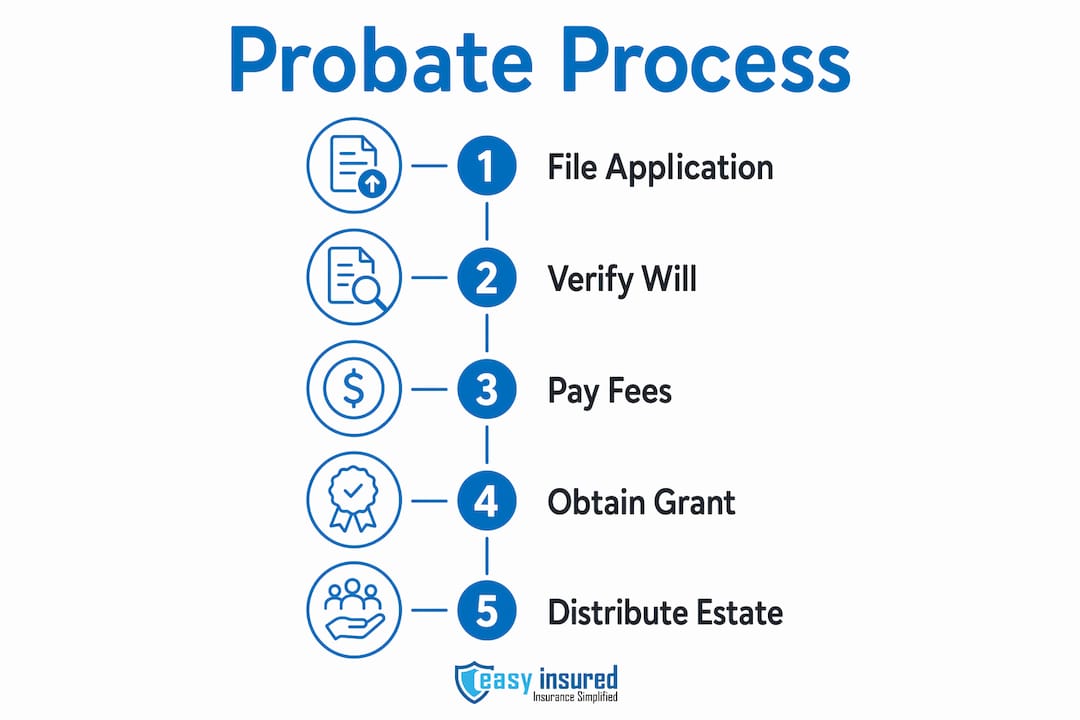
The probate process moves through roughly five phases: document gathering, application filing, waiting for the grant, asset collection and administration, and final distribution. Here’s what that looks like in practice.
- Locate and review the will. Confirm it is the most recent version, that it is signed and witnessed correctly, and that you are named as executor. If there is no will, you’ll apply for Letters of Administration instead.
- Obtain the death certificate. You’ll need certified copies, often multiple. Vital Statistics offices in each province issue these.
- Inventory the estate. List all assets (real estate, bank accounts, investments, vehicles, personal property, business interests) and their approximate values at the date of death. This inventory forms the basis of the probate application and the fee calculation.
- Identify and notify creditors. Before distributing anything, the executor must pay valid debts. Publishing a notice to creditors (required or advisable in most provinces) protects the executor from personal liability if an unknown creditor surfaces later.
- Complete and file the court forms. Forms vary by province. In BC, specific forms and registry procedures apply, including Form P2 and potentially an Application for Search of Wills Notice. In Ontario, the application goes to the Superior Court of Justice in the county where the deceased lived.
- Pay the probate fee or deposit. Submit the required fee or deposit with the application.
- Wait for the grant. Processing times vary. A straightforward application in a less-busy registry may take a few weeks; complex estates or busy courts can stretch to several months. Application errors and incomplete documentation are the most common causes of delay.
- Collect and manage assets. Once the grant is in hand, present it to financial institutions, land registries, and other asset holders to transfer assets into the estate account.
- Pay debts, taxes, and expenses. This includes final income tax returns, any capital gains triggered at death, and all estate administration costs.
- Prepare estate accounts. Document all receipts and disbursements. Beneficiaries are entitled to review these accounts, and a court may require formal passing of accounts in contested situations.
- Distribute the estate. Once debts and taxes are settled, distribute the remaining assets to beneficiaries according to the will (or intestacy rules if there was no will).
Timeline expectations by phase:
- Filing to grant: a few weeks to several months in most provinces, sometimes longer in Ontario during peak periods
- Asset collection: 2–8 weeks after grant, depending on institution responsiveness
- Tax filings and clearance: 3–12 months, depending on estate complexity
- Full distribution: often 9–18 months from date of death for a moderately complex estate
Record-keeping matters throughout. Keep a running log of every decision, every communication with beneficiaries, and every payment made from the estate. If a dispute arises later, that paper trail is your best protection.
The full cost picture: beyond the court fee
The probate fee is only one line item. For most estates, the total cost of administration runs considerably higher once you add legal fees, accounting, appraisals, and executor compensation.
The real cost of estate administration is rarely just the probate fee. Legal fees, accountant charges for final tax returns, appraisal costs for real estate or business interests, and executor compensation can collectively exceed the probate fee itself, particularly for mid-to-large estates.
Lawyer fees are typically billed hourly or as a percentage of the estate value, depending on the province and the firm. Some provinces allow lawyers to charge a percentage-based fee for estate work; others require hourly billing. For a moderately complex estate, legal fees in the range of several thousand dollars are common, though exact amounts depend on the work involved.
Accountant fees cover the preparation of the deceased’s final income tax return, any estate trust returns, and the T3 return for the estate itself. These filings can be straightforward or complex depending on the deceased’s income sources, business interests, and investment holdings.
Estate administration bonds are an often-overlooked cost. Some provinces require a bond when the estate includes real estate or when the court deems it necessary, unless the court dispenses with the requirement. A bond protects beneficiaries against executor dishonesty and can add a meaningful cost to the administration, particularly for large estates. Anticipating this requirement early avoids last-minute cash shortfalls.
Executor compensation is a legitimate estate expense. Most provinces allow executors to claim a reasonable fee, often calculated as a percentage of the estate value (commonly around 2.5–5% of the gross estate value, though this varies by province and must sometimes be approved by the court or agreed to by beneficiaries). An executor who is also a beneficiary sometimes waives this fee for tax reasons, since executor compensation is taxable income.
Appraisal costs arise when the estate includes real estate, a business, collectibles, or other assets that require professional valuation. These fees come from the estate.
For executors selling inherited real estate, understanding the role of an estate attorney in property sales can help clarify which costs are standard and which can be negotiated.
Assets that skip probate and how to reduce your exposure
Certain ownership structures and beneficiary designations allow specific assets to pass directly to a named person, completely outside the estate and the probate process. This is the most reliable way to reduce probate costs and delays, and it works best when planned well before death.
| Strategy | How it works | Primary advantage | Key risk or caution |
|---|---|---|---|
| Beneficiary designation | Name a beneficiary on RRSPs, TFSAs, RRIFs, life insurance, pension plans | Asset passes directly, no probate | Outdated designations can disinherit unintended people; ex-spouses may still be named |
| Joint tenancy with right of survivorship | Co-own property; surviving owner inherits automatically | Avoids probate on that asset | Adding a joint owner triggers potential capital gains; creditor exposure for both parties |
| Life insurance with named beneficiary | Policy proceeds paid directly to beneficiary | Fast, private, no probate | Beneficiary must be a named person, not “the estate,” for this to work |
| Trusts (inter vivos) | Assets transferred to a trust during lifetime | Avoids probate; can control distribution | Setup costs; ongoing administration; tax implications on transfer |
| Small-estate certificate | Simplified court process for lower-value estates | Faster and cheaper than full probate | Thresholds vary by province; not all assets qualify |
A caution on joint tenancy: Adding an adult child as a joint owner on a property to avoid probate can trigger an immediate deemed disposition for capital gains tax purposes. It also exposes the property to the child’s creditors and can complicate the estate if the child predeceases the parent. The probate savings may be real, but the tax and legal risks deserve a careful look first.
For a deeper breakdown of these strategies, the guide to avoiding probate in Canada covers each method with worked examples and provincial notes.
Pro Tip: The single most cost-effective probate-reduction step most Canadians can take today is reviewing and updating beneficiary designations on all registered accounts and insurance policies. It costs nothing, takes an hour, and can remove hundreds of thousands of dollars from the probate estate.
Practical estate planning — naming beneficiaries, using appropriate ownership forms, and maintaining updated asset records — is the most reliable way to reduce probate costs and delays. Tactical workarounds attempted after death are riskier and often require legal oversight.
Do you need a lawyer to apply for probate?
You are not legally required to hire a lawyer in most provinces. Executors can file the application themselves. That said, many do hire one, and the reason is usually practical rather than legal: institutions often insist on a court grant before transferring funds, and getting that grant right the first time matters. An error in the application can add weeks or months to the process.
When you can likely manage without a lawyer:
- The estate is straightforward (no real estate, no business interests, no disputes)
- All assets have named beneficiaries or are jointly held
- The will is clear and uncontested
- You’re comfortable with court forms and provincial procedures
- The estate is below the small-estate threshold in your province
When hiring a lawyer is worth it:
- The estate includes real estate, particularly if it needs to be sold
- The will is being challenged by a beneficiary or excluded party
- The estate is insolvent (debts exceed assets)
- There are cross-border assets or a deceased who lived in multiple provinces
- The estate includes a business interest requiring valuation or wind-down
- You’re unfamiliar with the provincial court forms and procedures
- Beneficiaries are in conflict and you expect disputes over accounts
- The estate has complex tax issues (multiple properties, foreign income, capital gains)
Legal fees paid in the course of estate administration can generally be paid from the estate. In some provinces, significant legal expenditures may require beneficiary consent or court approval, particularly if beneficiaries object. Executors who spend estate funds on legal fees without proper authority can face personal liability.
The probate application process includes specific procedural requirements that, if completed incorrectly, commonly trigger delays. Many executors who start the DIY route end up retaining legal help to correct errors, which costs more in total than hiring a lawyer from the start.
Common challenges executors face and how to handle them
Most probate complications fall into a handful of predictable categories. Knowing what to do first in each situation saves time and reduces personal risk for the executor.

Missing will: Search provincial wills registries (BC, Alberta, and Quebec maintain searchable registries), contact the deceased’s lawyer, and check safe deposit boxes and home files. If no will surfaces, apply for Letters of Administration. The estate then distributes under intestacy rules, which prioritize spouses and children.
Application errors: The most common delay trigger. Double-check every form against the provincial court’s checklist before filing. Many registries provide a pre-filing review service or a checklist of common errors.
Beneficiary disputes: If a beneficiary challenges the will’s validity or the executor’s decisions, document every action carefully. Seek legal advice before making any distributions. A court can provide directions if the dispute can’t be resolved among the parties.
Creditor claims: Publish a notice to creditors and allow the statutory waiting period to pass before distributing assets. Paying out beneficiaries before settling all valid debts can make the executor personally liable for the shortfall.
If the estate can’t cover immediate costs: Funeral expenses, property taxes, and utility bills don’t wait for probate. Some financial institutions will release funds directly to a funeral home on presentation of the death certificate and invoice. Executors can also apply to the court for an order allowing early release of specific funds for urgent expenses.
Insufficient liquid assets: When the estate’s value is tied up in real estate or illiquid investments, the executor may struggle to pay debts and fees before assets are sold. Options include negotiating with creditors for a short extension, asking institutions for a temporary release of funds for specific purposes, or obtaining a short-term loan against estate assets with legal guidance.
Insolvent estates: When debts exceed assets, the executor must follow a strict priority order for paying creditors. Distributing to beneficiaries before all creditors are paid is a serious error. Get legal advice immediately if insolvency is a possibility.
For executors dealing with inherited property that needs to be sold, an inherited property sale checklist can help organize the steps and avoid common mistakes.
Your executor checklist: the first 30, 90, and 180+ days
The first weeks after a death involve the most time-sensitive tasks. This checklist gives you a realistic sequence. Times are estimates; provincial variation and estate complexity will shift them.
First 30 days — secure and notify:
- Obtain the death certificate (order multiple certified copies from the provincial Vital Statistics office)
- Locate the original will and confirm you are named executor
- Secure all property (change locks if needed, maintain insurance coverage)
- Notify major financial institutions of the death and ask about their grant requirements
- Cancel government benefits (CPP, OAS, provincial programs) to stop overpayments
- Arrange or confirm funeral and burial arrangements
- Notify the Canada Revenue Agency of the death
- Open an estate bank account to receive and disburse estate funds
Days 30–90 — inventory and file:
- Prepare a complete inventory of all assets and their date-of-death values
- Identify all debts, liabilities, and ongoing expenses
- Determine whether probate is required and in which province
- Retain a lawyer and/or accountant if the estate warrants it
- File the probate application with the appropriate court
- Notify all beneficiaries of the estate and their entitlements
- Publish a notice to creditors if required or advisable in your province
Days 90–180+ — administer and distribute:
- Collect assets once the grant is issued
- File the deceased’s final T1 income tax return (due April 30 of the following year, or six months after death, whichever is later)
- File any required T3 estate trust returns
- Obtain a clearance certificate from the CRA before making final distributions
- Prepare estate accounts and share with beneficiaries
- Distribute assets to beneficiaries after all debts, taxes, and expenses are settled
- Apply for court directions if disputes remain unresolved
Documents to gather at each phase:
- 30 days: Death certificate, original will, property deeds, insurance policies
- 90 days: Bank and investment statements, pension and benefit records, outstanding debt statements, vehicle ownership documents
- 180+ days: Tax returns, CRA correspondence, estate accounts, distribution receipts
Key Takeaways
Probate in Canada is a provincial process that validates a will and grants legal authority to an executor, with costs, timelines, and forms varying significantly by province.
| Point | Details |
|---|---|
| Probate validates the will | A court grant confirms the will’s authenticity and gives the executor legal authority to act. |
| Fees are provincial and value-based | Ontario charges $15 per $1,000 above $50,000; Alberta caps fees at $525 regardless of estate size. |
| Timeline varies widely | Grants normally take from a few weeks to several months to issue, depending on province, estate complexity, and whether the application and documents are complete. |
| Beneficiary designations skip probate | Assets with named beneficiaries (RRSPs, TFSAs, life insurance) pass directly and avoid the estate entirely. |
| Easy-insured supports estate planning | Easy-insured offers life insurance, beneficiary designation guidance, and estate-planning consultations to help reduce probate exposure. |
Why early estate planning matters more than most people realize
The conventional wisdom on probate tends to focus on the process itself: gather the documents, file the forms, wait for the grant. That framing is useful, but it misses the bigger point. By the time an executor is filing a probate application, most of the decisions that determine how hard and expensive that process will be were made years earlier, or never made at all.
The estates that move through probate quickly and cheaply are almost always the ones where someone took the time to update beneficiary designations, review property ownership structures, and keep a clear record of assets. The estates that drag on for 18 months, generate legal bills that eat into the inheritance, and fracture family relationships are usually the ones where none of that happened.
What surprises many people is how much of a typical estate can be kept out of probate entirely with straightforward planning. A life insurance policy with a named beneficiary, an RRSP with a designated spouse, a TFSA with a named successor holder: none of these assets touch the probate process. The executor never has to wait for a court grant to transfer them. That’s not a loophole; it’s exactly how these instruments are designed to work.
The other underappreciated point is the tax picture. Probate fees get most of the attention, but the income tax and capital gains triggered at death often dwarf the court fee. A proper estate plan addresses both, and the two are connected. Structures that reduce probate exposure (like certain trust arrangements or insurance products) can also affect the tax outcome. Getting one right without considering the other is a common and costly mistake.
For Ontario-specific strategies, the guide to avoiding probate in Ontario covers the Certificate of Appointment rules and small-estate certificate thresholds in detail.
How Easy-insured helps you reduce probate friction before it starts
Life insurance with a named beneficiary is one of the cleanest ways to keep money out of the probate estate and in the hands of the people you intend to receive it, without court delays or fees. Easy-insured works with Canadian families and business owners to structure term life and whole life coverage so that the death benefit flows directly to named beneficiaries, bypassing the estate entirely.

Beyond the insurance itself, Easy-insured’s estate planning service helps you review beneficiary designations, assess which assets are currently exposed to probate, and build a plan that reduces that exposure over time. For families with more complex situations, including business interests, investment portfolios, or blended family considerations, the financial planning team can work through the full picture.
To get the most from a consultation, bring your current will (or note that you don’t have one), a list of major assets and how they’re owned, and the names of your current beneficiaries on registered accounts and insurance policies. That’s enough to have a productive first conversation. Reach out to Easy-insured to book a no-obligation review.
This article provides general information about probate in Canada and is not legal or tax advice. Rules, fees, and forms change, and your situation may differ from the examples given. Confirm current requirements with the applicable provincial court or a qualified estate lawyer before filing.
Official resources and further reading
Use these links to find current forms, fee schedules, and registry contacts for your province.
- Canada.ca — Estates and wills: What to do when someone dies — federal overview and links to provincial resources
- Ontario — Apply for probate: Apply for probate of an estate — court forms, Certificate of Appointment, and Small Estate Certificate details
- Ontario — Administering estates: Administering estates | Ontario.ca — Estate Administration Tax rates, deposit rules, and refund process
- British Columbia — Wills and estates: After a death: Deal with wills and estates — Form P2, registry procedures, and BC-specific application steps
- Nova Scotia — Probate Act: Nova Scotia Probate Act — full legislative text for NS probate procedures
- Ontario Estates Act: Estates Act, R.S.O. 1990 — governing legislation for Ontario probate and letters of administration
- Easy-insured — Avoiding probate in Canada: How to avoid probate in Canada — practical strategies with provincial notes
- Easy-insured — Estate planning strategies: Estate planning and tax reduction — deeper guidance on reducing estate taxes alongside probate costs
Fee schedules and court forms change periodically. Always verify the current version directly with the provincial court or government website before filing an application.