
What is disability insurance for self-employed workers?
When you work for yourself, there’s no HR department cutting you a paycheck while you recover from surgery or a serious illness. Disability insurance for self-employed Canadians fills that gap directly, replacing a portion of your income when an injury or illness stops you from working. For freelancers, contractors, and small business owners, it’s often the only financial safety net standing between a health crisis and a collapsed business.
A private disability policy typically replaces a significant portion of your pre-disability income, paid monthly for a defined benefit period. Coverage triggers when a qualifying illness or injury prevents you from performing your regular work duties. The policy you own personally is portable, meaning it follows you regardless of which clients you work with or whether your business structure changes.
Core elements of a solid self-employed disability policy include:
- Income replacement covering a percentage of your net earned income
- Own-occupation definition, which pays if you can’t do your specific job, not just any job
- Business overhead coverage to keep rent, utilities, and staff costs paid while you’re off
- Partial disability riders for situations where you can work reduced hours but not at full capacity
- Cost-of-living adjustments to protect benefit value against inflation over a long claim
Pro Tip: If you pay your disability premiums personally with after-tax dollars, your monthly benefits are generally tax-free when received. That’s a significant advantage over employer-paid group plans where benefits count as taxable income.
How does disability insurance work for self-employed Canadians?
The application process starts with underwriting, where the insurer reviews your age, health history, occupation, and income. Self-employed applicants typically need two to three years of tax returns to verify earnings, since your benefit amount is tied to documented net income, not a salary letter.

Once approved, your policy includes an elimination period, the waiting period between when you become disabled and when benefits start. Common elimination periods run 30, 60, 90, or 120 days. Choosing a longer elimination period lowers your premium but requires you to fund living costs out of pocket during that window.
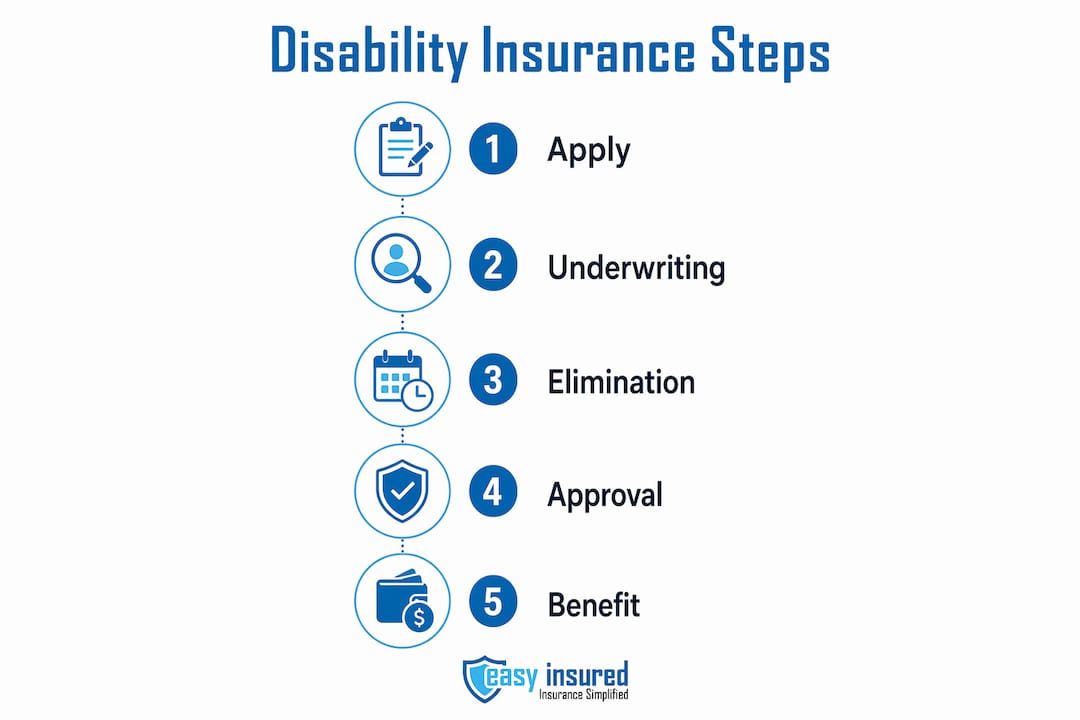
After the elimination period, monthly benefits continue for the benefit period, which can range from two years to age 65. Most financial advisors recommend a benefit period to age 65, since that’s when CPP retirement benefits become available. The CPP disability benefit pays a maximum of $1,741.20 per month in 2026, but it requires meeting strict contribution thresholds and a “severe and prolonged” disability standard. Private insurance pays faster and with fewer restrictions.
Key operational features to understand before you sign:
- Claim trigger: You must provide medical documentation confirming your disability
- Benefit coordination: Some policies reduce payouts if you receive CPP disability benefits simultaneously
- Return-to-work provisions: Many policies include partial benefit payments as you phase back into work
- Non-cancellable and guaranteed renewable policies lock in your premium and coverage terms regardless of health changes
Why self-employed Canadians can’t afford to skip disability coverage
You have no employer-sponsored sick leave, no group disability plan, and no paid time off. A three-month recovery from a back injury or a cancer diagnosis doesn’t pause your mortgage, your business lease, or your family’s grocery bill.
Self-employed workers pay both the employer and employee portions of CPP contributions and don’t automatically qualify for Employment Insurance sickness benefits unless they’ve opted in through the Canada Employment Insurance Commission. Even with EI opt-in, sickness benefits cover up to 26 weeks at 55% of earnings, capped at $729 per week in 2026. That’s a short runway for a serious condition.
The financial case for private coverage is straightforward:
- Income volatility: Self-employed income fluctuates, making any gap in earnings more damaging than for salaried workers
- Business continuity: Without overhead coverage, fixed business costs accumulate even when revenue stops
- Family security: Dependents relying on your income face immediate hardship if you can’t work for months
- CPP gap: CPP disability requires years of sufficient contributions; gaps in self-employment income can disqualify you, as illustrated in Social Security Tribunal cases where claimants lost eligibility due to low net income years
Which Canadian disability insurance providers serve self-employed workers?
Six providers actively serve self-employed Canadians across the Greater Toronto Area and beyond. Their specializations vary considerably, so matching the right one to your situation matters more than picking by geography alone.
| Provider | Services Offered | Specialization | Rating | Location |
|---|---|---|---|---|
| Canadian LIC® – Harpreet Puri | Disability, critical illness, life, Super Visa insurance | Comprehensive personal and business insurance | 4.9★ | Brampton, ON |
| TED Vaibhav Arora | Disability, health, travel, auto, commercial property | Integrated coverage for self-employed workers | 4.9★ (70 reviews) | Mississauga, ON |
| Insure Me Right – Life Insurance Broker | Disability, critical illness, life insurance | Personalized solutions for business owners | 5★ (14 reviews) | Brampton, ON |
| Disability,Critical Illness Insurance | Disability and critical illness insurance | Specialized disability and critical illness risk | — | Mississauga, ON |
| Enable Benefits | Disability Tax Credit consulting, claims assistance | Government benefit access for medical conditions | 3.3★ (104 reviews) | Toronto, ON |
| Canadian Disability Benefits | Disability Tax Credit consulting, application help | Maximizing government disability refunds | 2★ (4 reviews) | Markham, ON |
Canadian LIC® – Harpreet Puri is the strongest all-around choice for self-employed Canadians who want a single advisor covering disability, critical illness, and life insurance together. The Brampton office handles complex cases including Super Visa Insurance, which makes it particularly useful for business owners with family sponsorship obligations alongside their own coverage needs.
TED Vaibhav Arora in Mississauga stands out for self-employed workers who need disability coverage bundled with commercial property or auto insurance. If your business involves a physical location or company vehicles, consolidating policies with one advisor simplifies renewals and claims.
Insure Me Right focuses specifically on business owners and entrepreneurs seeking personalized disability and critical illness solutions. The smaller client base means more direct advisor access, which suits self-employed workers who want detailed policy customization rather than off-the-shelf plans.
Disability,Critical Illness Insurance in Mississauga specializes in exactly the two coverage types most relevant to self-employed workers, making it a focused option for those who already have life insurance elsewhere and need to fill the disability gap specifically.
Enable Benefits and Canadian Disability Benefits operate in a different category. Both focus on Disability Tax Credit consulting rather than private insurance policies. Enable Benefits carries BBB accreditation and 18+ years of experience helping Canadians navigate government benefit applications. Canadian Disability Benefits offers free disability reviews and professional claim processing. Neither replaces a private disability income policy, but both can help self-employed workers access government credits they may be missing.
How to choose the right disability insurance plan
Start with your monthly number. Add up your essential personal and business expenses, then determine what percentage of your net income you need replaced to stay solvent through a six-month or longer disability. That figure drives every other decision.
Step-by-step selection checklist:
- Calculate your income replacement need based on documented net earnings from your last two tax returns
- Choose your elimination period based on how many months of savings you can realistically draw on
- Select a benefit period that extends to age 65 if budget allows, or at minimum two years for shorter-term protection
- Review the disability definition carefully: own-occupation definitions are more favorable than any-occupation definitions
- Check exclusions for pre-existing conditions, mental health, and specific occupational hazards relevant to your work
- Compare riders including cost-of-living adjustment, future insurability, and return-of-premium options
- Verify the insurer’s financial strength through AM Best or DBRS ratings before committing
Pro Tip: Structure the policy so you personally own it and pay premiums from your personal after-tax income. Benefits received under that structure are generally tax-free, unlike policies paid through a corporation where benefits may be taxable. For comprehensive disability coverage options, compare individual policy terms before deciding on ownership structure.
Cost and eligibility factors for self-employed disability coverage
Premiums for self-employed disability insurance depend on five primary variables: your age at application, your health history, your occupation’s risk classification, the benefit amount you select, and the elimination and benefit periods you choose. A 35-year-old healthy consultant in a low-risk occupation pays considerably less than a 50-year-old in a physically demanding trade.
Eligibility requirements typically include:
- Proof of earned income: Two to three years of T1 tax returns showing net self-employment income
- Minimum income threshold: Most insurers require a minimum annual net income to justify the benefit amount requested
- Medical underwriting: A health questionnaire and, for larger benefit amounts, a medical exam
- Active work requirement: You must be actively working at the time of application
Individual policies cost more per dollar of benefit than group plans, but they offer portability and guaranteed renewability that group plans don’t. If your occupation qualifies, some professional associations offer group disability plans at lower rates, though the coverage terms are often less flexible.
The difference between individual and group coverage matters most at claim time. Group plans can change terms or cancel coverage; a non-cancellable individual policy cannot be altered by the insurer as long as you pay premiums.
Tax treatment of disability insurance benefits in Canada
The tax rule is simple once you know it: who pays the premium determines whether the benefit is taxable. If you pay your disability premiums personally with after-tax dollars, the monthly benefits you receive are generally not included in your taxable income. If a corporation pays the premiums on your behalf, the benefits become taxable income when received.
For self-employed sole proprietors, premiums paid personally are not deductible as a business expense, but the trade-off is tax-free benefits at claim time. For incorporated business owners, the corporation can deduct premiums as a business expense, but that shifts the tax burden to the benefit side. The right structure depends on your marginal tax rate and how long a disability claim might last.
CPP disability benefits, by contrast, are always taxable income regardless of who contributed. The maximum CPP disability payment of $1,741.20 per month in 2026 would be reduced by your applicable tax rate, making private tax-free benefits considerably more valuable in a real claim scenario.
Pro Tip: Talk to a tax advisor before setting up premium ownership. Switching ownership structure after a policy is issued can trigger tax consequences. Get the structure right at application, not after a claim starts.
Easy-insured covers disability and more for self-employed Canadians
The providers compared above each serve a specific niche, whether that’s local Brampton expertise, integrated commercial coverage, or government tax credit consulting. Easy-insured takes a different approach: a single brokerage covering disability insurance, critical illness, life insurance, and financial planning under one roof, built specifically for Canadian business owners and families.
Self-employed Canadians who want disability coverage reviewed alongside their term life or estate planning needs get a coordinated picture rather than piecemeal policies from separate advisors. Easy-insured works across Canada, so geography isn’t a barrier. If you’re ready to see what a private disability policy would cost based on your actual income and occupation, Easy-insured is a practical next step.
Key Takeaways
Private disability insurance is the most reliable income protection available to self-employed Canadians, since CPP disability pays a maximum of $1,741.20 per month in 2026 and EI sickness benefits cap at $729 per week, leaving most self-employed workers significantly underprotected without a private policy.
| Point | Details |
|---|---|
| Tax-free benefits | Pay premiums personally with after-tax dollars and disability benefits are generally not taxable income. |
| CPP disability limits | The maximum CPP disability benefit is $1,741.20 per month in 2026. |
| EI sickness coverage | Self-employed workers who opt into EI can receive up to $729 per week for up to 26 weeks in 2026. |
| Elimination period choice | A longer elimination period lowers your premium but requires personal savings to cover the gap before benefits start. |
| Easy-insured | Easy-insured offers disability, critical illness, and life insurance for self-employed Canadians through a single brokerage. |