
What is whole life insurance in Canada?
Whole life insurance is permanent life insurance that covers you for your entire life, not just a set term. Unlike term policies that expire, whole life stays active as long as you pay premiums. That permanence is the core selling point.
Here is what defines a whole life policy in Canada:
- Fixed premiums that never increase, regardless of age or health changes
- Cash value accumulation that grows tax-advantaged inside the policy
- Guaranteed death benefit paid to your beneficiaries, tax-free
- Dividend participation on participating (par) policies, based on insurer performance
- Coverage amounts that can reach $25 million with major Canadian carriers
- Estate planning utility, including tax-efficient wealth transfer and probate reduction
The cash value component is what separates whole life from every other insurance product. It grows quietly inside the policy, sheltered from tax, and you can access it during your lifetime.
How whole life insurance policies actually work
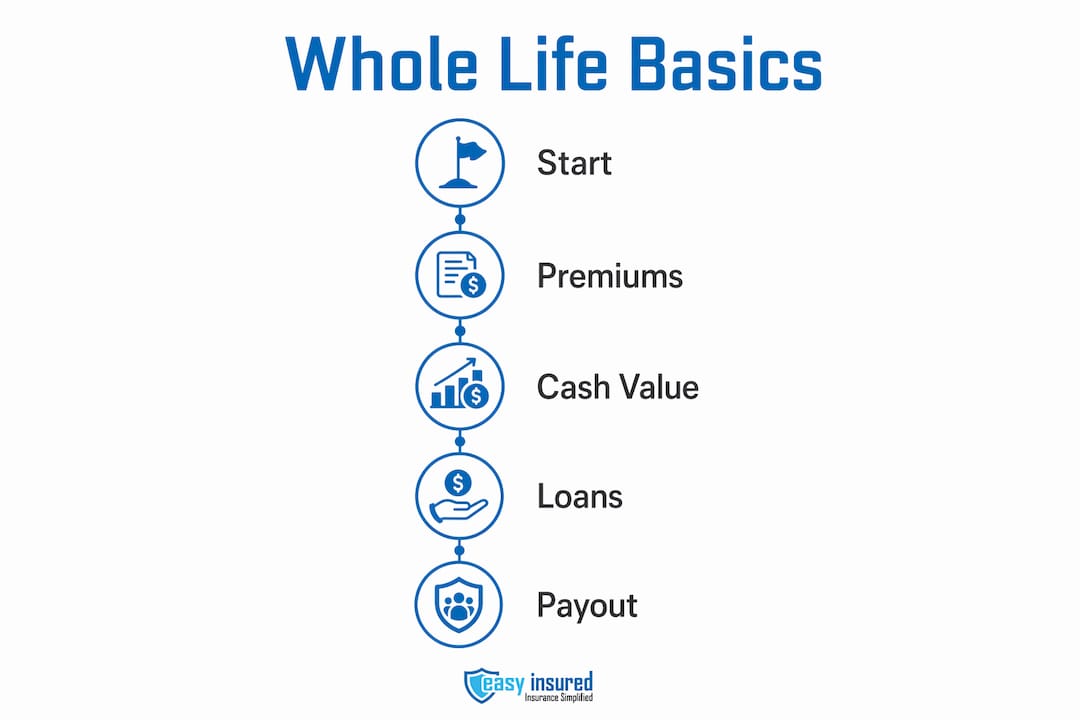
Premiums go into two buckets: one funds the death benefit, the other builds cash value. Over time, that cash value grows at a rate tied to the insurer’s participating account performance.
Key mechanics to understand:
- Cash value is tax-sheltered. Growth inside the policy is not taxed annually, unlike a regular investment account.
- Policy loans let you borrow against cash value without triggering a taxable event, as long as the loan stays within policy limits.
- Dividends on par policies can be taken as cash, used to reduce premiums, or reinvested as paid-up additions that increase both the death benefit and cash value.
- Death benefit is guaranteed. Your beneficiaries receive the face amount regardless of market conditions.
- Policies can be optimized differently: some focus on early cash value access, others on maximizing the estate payout at death.
The loan feature is particularly useful for business owners. You borrow against your own policy, pay interest back to yourself, and the death benefit remains largely intact.
Benefits and drawbacks for Canadian consumers
Whole life insurance suits a specific type of buyer. Get clear on whether you are that buyer before committing to premiums that are substantially higher than term.
Benefits:
- Lifelong coverage with no renewal risk
- Tax-advantaged cash value growth
- Estate planning and wealth transfer efficiency
- Dividend income on participating policies
- Policy loans without credit checks or income verification
- Final expense coverage that never lapses
Drawbacks:
- Premiums are significantly higher than term life for the same death benefit
- Complexity: par policies involve dividend scales, participating accounts, and policy loan mechanics
- Not suited for short-term income replacement needs
- Cash value growth is slower in early years
- Surrendering early often results in a loss
Pro Tip: Before buying whole life, map your liquidity needs against your legacy goals. If you need maximum coverage for the next 20 years on a tight budget, term life is almost always the better starting point. Whole life earns its cost when the permanent need is real.
Typical policy exclusions include suicide within the first two policy years, material misrepresentation on the application, and certain high-risk activities depending on the insurer’s underwriting guidelines.
What does whole life insurance cost in Canada?
Premiums depend on four main factors: age, health status, coverage amount, and lifestyle. A 35-year-old non-smoker in good health pays far less than a 55-year-old with a chronic condition.

For a $100,000 policy, monthly premiums typically range from $87 to $228, depending on the applicant’s profile and policy features. Longer payment periods and added riders push costs higher.
| Pricing Factor | Impact on Premium |
|---|---|
| Age at application | Younger applicants pay less; rates lock in at issue |
| Health status | Medical underwriting determines risk class |
| Coverage amount | Higher face value means higher base premium |
| Smoking status | Smokers pay substantially more |
| Payment structure | 10-pay or 20-pay costs more per year than pay-to-100 |
| Dividend options | Par policies carry higher premiums than non-par |
Statistic callout: Equitable Life paid $176 million in dividends to participating policyholders in 2025, a 28% increase over the prior year. That figure illustrates how dividend performance directly affects the real cost-to-benefit ratio of a par policy over time.
Payment structures also shape affordability. A 10-pay plan concentrates premiums into a decade but leaves the policy fully paid-up afterward. Pay-to-100 spreads costs across a lifetime at a lower annual rate.
Comparing the top whole life insurance providers in Canada for 2026
Canadian providers differ sharply in underwriting philosophy, dividend track records, and who they serve best. The eight providers below represent a cross-section of the Canadian market.

| Provider | Coverage | Key Features | Best For | Rating |
|---|---|---|---|---|
| Canadian LIC® – Harpreet Puri | Broad range | Whole life, critical illness, super visa | Local service seekers | 4.9★ |
| PolicyAdvisor | Up to $25M+ | Zero fees, instant quotes, $8.0B placed | Cost-conscious buyers | 5★ |
| PolicyMe | $15B+ secured | Digital-first, competitive pricing | Hassle-free online buyers | 4.9★ (569) |
| Sun Life | No maximum | Par Protector II, $21.2B par fund | High-net-worth individuals | 3.1★ (131) |
| MILIFE Insurance & Investment Inc. | Varied | Health, dental, investments since 2004 | Insurance plus investment clients | 4.7★ (13) |
| Life Protection Canada Inc. | Full spectrum | FSRA-regulated, no-fee brokerage | Unbiased advice seekers | 5★ (10) |
| Solutions Financial – Life Insurance | Full spectrum | Smoker-friendly, financial planning | Combined planning clients | 5★ (5) |
| Life Insurance for Canadians | Term to guaranteed | Funeral, guaranteed, simplified issue | Accessible coverage seekers | 5★ (1) |
Canadian LIC® – Harpreet Puri specializes in whole life and critical illness coverage with a strong local presence. The agency handles super visa insurance alongside standard life products, making it a practical one-stop option for immigrant families and multigenerational households.
PolicyAdvisor operates as a no-fee comparison platform that has placed over $8.0 billion in coverage. It pulls quotes from Canada’s top insurers simultaneously, which is genuinely useful when you want to see how Empire Life’s EstateMax stacks up against Sun Life’s Par Protector II without calling five different brokers.
PolicyMe targets buyers who want a clean digital experience. Coverage starts around $18/month for term, and the platform has secured over $15 billion in coverage for Canadian clients. Whole life is available alongside term and critical illness products.
Sun Life backs its participating whole life plans with a $21.2 billion par fund supporting more than 400,000 active policies. That scale gives the fund stability across economic cycles, which is why Sun Life tends to attract high-net-worth clients focused on estate preservation.
MILIFE Insurance & Investment Inc. has served Canadian clients since 2004 with a mix of insurance and investment products, including health, dental, and non-medical life options.
Life Protection Canada Inc. is an independent brokerage regulated by the Financial Services Regulatory Authority of Ontario (FSRA). Its no-fee, no-obligation model suits buyers who want unbiased product recommendations across multiple carriers.
Solutions Financial – Life Insurance covers the full spectrum from term to universal life, with a notable specialization in smoker-friendly policies and combined financial planning services.
Life Insurance for Canadians provides accessible information and purchase assistance for term, whole, universal, and guaranteed life insurance products across Canada.
Pro Tip: Ask any broker whether they are captive (tied to one insurer) or independent. An independent broker like Life Protection Canada Inc. can shop your application across multiple carriers, which often surfaces better rates for complex health profiles.
How to choose the right whole life policy for your situation
The right policy depends on what you actually need the money to do. That sounds obvious, but most buyers skip this step and end up over-insured or in the wrong product type.
Work through these questions before comparing quotes:
- What is the primary goal? Estate transfer, final expenses, business continuity, or tax-sheltered savings each point to different policy designs.
- How much can you commit monthly? Whole life premiums are fixed for life. Budget conservatively.
- Do you need early cash value access? Some policies, like Canada Life’s Wealth Select, prioritize early liquidity. Others, like Estate Select, build value in later years.
- Is the insurer financially strong? Check the Life Insurance Capital Adequacy Test (LICAT) ratio. Foresters Financial, for example, carries a LICAT ratio of 182%.
- Par or non-par? Participating policies pay dividends but cost more. Non-par policies offer predictable, guaranteed values with no dividend variability.
Pro Tip: Use an online comparison tool to generate baseline quotes, then bring those numbers to an independent advisor for a custom needs analysis. The quote gives you a price anchor; the advisor tells you whether the product structure actually fits your goals.
Pairing whole life with critical illness coverage or a disability rider adds a layer of living-benefit protection that pure death benefit policies cannot provide.
What Canadian experts and data say about whole life insurance
The Canadian whole life market has a meaningful distinction that most buyers overlook: mutual company ownership versus demutualized carriers. In a mutual company, policyholders own the participating account. In a demutualized carrier, shareholders have a claim on surplus too.
Key insights from the Canadian market in 2026:
- Equitable Life remains Canada’s largest federally regulated mutual life insurer. Every dollar of surplus in its participating account belongs to policyholders, with no shareholders in the picture.
- The Trusted Advisors Network weights mutual company ownership at 40% when ranking participating whole life products, pool protection at 40%, and abeyancy (the option to buy more coverage without new medical underwriting) at 20%.
- Dividend performance varies by carrier. Canada Life has paid dividends for over 170 years without missing a single distribution year, maintaining a dividend scale interest rate of 5.75%.
- PolicyAdvisor’s 2026 rankings place Equitable Life first for mutual company structure, followed by Manulife for overall performance, and Empire Life for balanced results.
- Some policies optimize for early cash value (useful for business owners needing near-term liquidity), while others maximize the death benefit for estate purposes. Choosing the wrong type for your goal is the most common mistake Canadian buyers make.
The financial planning dimension of whole life is often underused. A well-structured par policy can serve as a tax-efficient supplement to an RRSP or TFSA, particularly for high-income earners who have maxed out registered account room.
Easy-insured: whole life insurance advice without the runaround
Easy-insured is recognized among the Top 6 Life Insurance for Families Agencies in 2026, offering no-fee, no-hidden-charge life insurance quotes tailored for Canadian families and business owners.

Where Easy-insured stands apart is the combination of product breadth and advisory depth. You get access to whole life, term, universal life, disability, critical illness, and estate planning under one roof, with advisors who understand how these products interact in a Canadian tax context. No pressure to buy a product that does not fit. No commissions steering you toward the most expensive option. If you want to compare whole life options side by side and talk through which structure fits your goals, Easy-insured is a practical next step.
Key Takeaways
Whole life insurance in Canada offers lifelong, fixed-premium coverage with tax-advantaged cash value growth, making it best suited for permanent needs like estate planning rather than short-term income replacement.
| Point | Details |
|---|---|
| Permanent coverage with fixed premiums | Premiums never increase after issue, and coverage lasts your entire life. |
| Cash value grows tax-sheltered | Policy cash value accumulates without annual tax, and you can borrow against it via policy loans. |
| Cost range for $100K coverage | Monthly premiums typically run $87–$228 depending on age, health, and policy features. |
| Dividend performance matters | Equitable Life paid $176 million in dividends to policyholders in 2025, a 28% increase year over year. |
| Easy-insured for Canadian buyers | Easy-insured offers no-fee whole life quotes and advisory services for families and business owners across Canada. |