
The contestability period is the initial period after a life insurance policy’s effective date, during which the insurer can dig into a death claim and deny it if it finds material misrepresentation or fraud on the application. After that window closes, most claims become effectively bulletproof except in cases of fraud or nonpayment. If your loved one’s claim is being investigated right now, that two-year clock is the single fact that determines what happens next.
TL;DR:
- Most life insurance claims filed during the two-year contestability period are paid unless there is evidence of material misrepresentation, fraud, policy exclusion, or nonpayment.
- The contestability window begins upon the policy’s effective date and resets if the policy lapses and is reinstated or replaced.
- Insurers rely on application records, medical data, and underwriting files to identify potential misrepresentations or fraud during investigations.
- Minor errors or omissions, such as unreported prescriptions or past habits, often lead to disputes since they must significantly affect underwriting decisions to justify denial.
- After two years, the policy generally becomes incontestable unless there is evidence of severe fraud or nonpayment, which can still lead to claim denial.
Table of Contents
- Contestability Period Life Insurance: Key Takeaways
- What Is the Life Insurance Contestability Period, Exactly?
- Why Insurers Insist on a Contestability Clause
- How a Contestability Investigation Actually Unfolds
- Common Reasons a Claim Gets Denied During Contestability
- What to Do If a Claim Gets Denied
- What Changes Once the Contestability Period Ends
- Reducing Your Risk During the Contestability Period
- Why Easy-insured’s Approach to Application Review Matters
- An Editor’s Take on Where Applicants Go Wrong
- Get Your Application Reviewed Before It Becomes a Problem
- Sources
Contestability Period Life Insurance: Key Takeaways
Here’s what matters most if you’re dealing with a contested claim or trying to understand your risk before one happens.
- The contestability period runs two years from the policy’s effective date, not from when the application was signed.
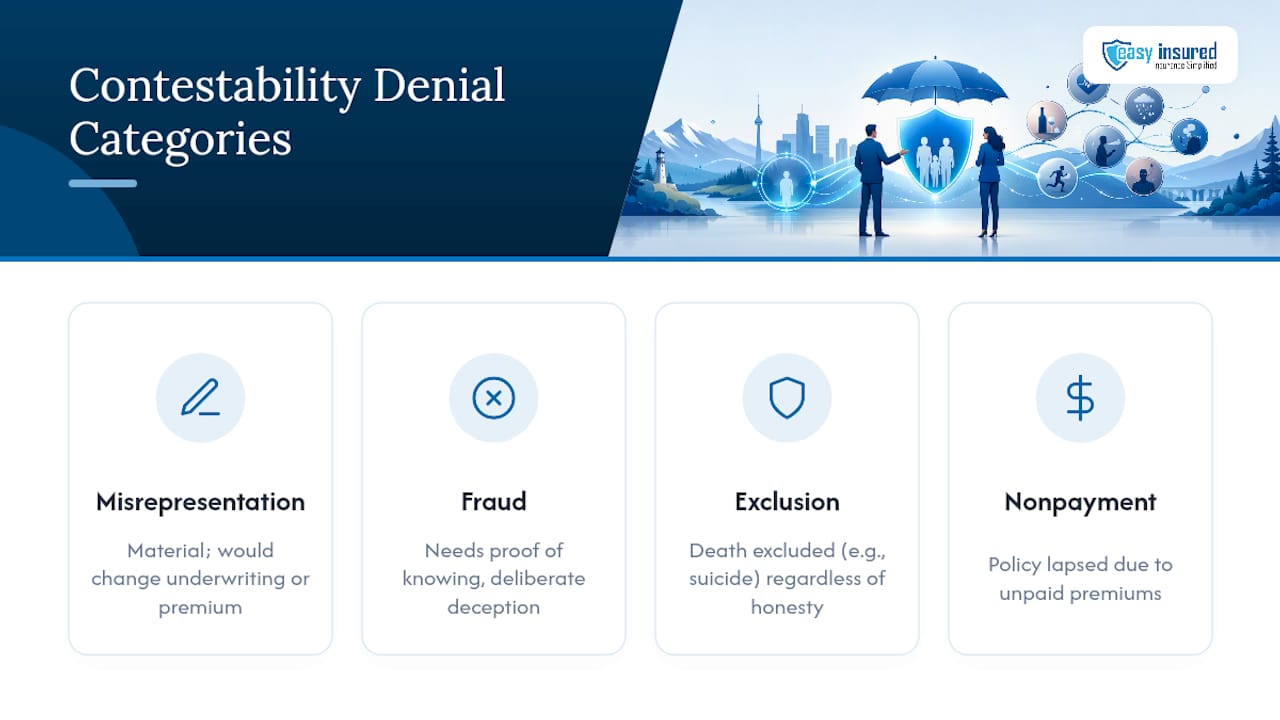
- Most denials during this window trace back to four causes: material misrepresentation, outright fraud, a policy exclusion (like the suicide clause), or nonpayment of premiums.
- Insurers must prove the misrepresentation was material to their underwriting decision; fraud claims require proof of intent to deceive, which is a higher evidentiary standard.
Statistic Callout: Insurance guidance consistently notes that most claims filed during contestability still get paid — investigations only kick off when a red flag appears in the file, not automatically on every death.
If you’re facing a denial, start by pulling the original application, any medical records referenced in it, and contacting the broker who sold the policy. Time matters here, and paperwork wins these disputes more often than arguments do.
What Is the Life Insurance Contestability Period, Exactly?
The contestability period is a clause, standard in nearly every life insurance contract, that gives the insurer a limited window (typically two years from the policy’s effective date) to investigate and challenge the accuracy of the information on the application. It’s not tied to when you signed the paperwork or paid your first premium invoice. It starts the day coverage actually takes effect.
This clause applies broadly across policy types:
- Term life policies carry it for the full term, resetting only if the policy lapses and gets reinstated.
- Whole life and universal life policies carry the same two-year window, though their cash value components can complicate how insurers calculate what’s owed if a claim is reduced rather than denied outright.
- The suicide clause operates on a similar but legally distinct timeline. It typically excludes payment for death by suicide within the first two years, separate from the misrepresentation question, though insurers often evaluate both at once.
One detail catches people off guard: reinstating a lapsed policy, or replacing it with a new one, generally restarts the contestability clock. Insurers treat reinstatement like underwriting a fresh application, which means the two-year window begins again from scratch.
Why Insurers Insist on a Contestability Clause
Insurers price policies based on the risk information you give them on the application. If that information is wrong, whether by mistake or on purpose, the premium you’re paying may not reflect the actual risk the insurer took on. The contestability clause exists to let insurers correct that imbalance before it becomes permanent.
The legal framework backing this has shifted over time. Courts and regulators moved away from treating every application answer as an ironclad “warranty” (where any inaccuracy voided the policy) toward treating answers as “representations,” which requires the insurer to prove materiality before it can rescind coverage. That’s a meaningfully higher bar than it used to be.
Insurers lean on a few tools to enforce this:
- The MIB (a database used across the industry to cross-check medical history and prior applications)
- Underwriting files from the original application
- Attending physician statements and paramedical exam notes
Pro Tip: If you’re not sure what you disclosed on an application years ago, ask your broker for a copy. Insurers keep these files indefinitely, and so should you.
How a Contestability Investigation Actually Unfolds
When a death claim lands on an insurer’s desk during the contestability window, it doesn’t get the fast-track treatment a claim filed in year five would get. Here’s the general sequence:
- Claim notice and initial review. The insurer flags the policy as still within its contestability period and routes the claim to a special investigations or claims review team instead of standard processing.
- Application audit. Underwriters pull the original application and compare every answer against what they can verify.
- Records request. The insurer requests medical records, pharmacy history, autopsy reports (if applicable), and MIB data to check for inconsistencies.
- Underwriting file review. The team pulls the original underwriting file, including agent notes and exam reports, since this file is often the primary evidence either supporting or undermining a denial.
- Decision. The claim gets paid in full, denied and rescinded (with premiums often refunded), or paid at a reduced amount reflecting what the correct information would have meant for pricing.
This process can take weeks to a few months, depending on how many records need to be pulled and how responsive providers are. Beneficiaries should expect at least one written communication requesting authorization to release medical records.
Common Reasons a Claim Gets Denied During Contestability
Not every discrepancy sinks a claim. Insurers have to clear a specific bar, and understanding it helps you judge whether a denial actually holds up.
Material misrepresentation is the most common ground for denial. Classic examples include understating a smoking habit, leaving off a cancer diagnosis, misstating age, or omitting a criminal history that affects risk pricing. The key legal question isn’t whether the answer was wrong. It’s whether the correct answer would have changed the underwriting decision or the premium. An error that wouldn’t have moved the needle isn’t material, and insurers who can’t demonstrate materiality generally lose the right to rescind.
There’s also a meaningful difference between an outright omission (leaving a question blank or skipping a condition entirely) and answering incorrectly. Both can be material, but insurers and courts often weigh intent differently for each.
Fraud sits on a separate, higher tier. Fraud requires proof the applicant knowingly and deliberately deceived the insurer, not just made an honest mistake. Because intent is harder to prove than materiality, fraud allegations face more scrutiny in court and are less common as a stated denial reason than simple misrepresentation.
Beyond misrepresentation and fraud, two other categories cause denials regardless of honesty on the application: death falling under an exclusion like the suicide clause, and nonpayment of premiums that let the policy lapse before death occurred.
What to Do If a Claim Gets Denied
A denial during the contestability period isn’t the final word. Insurers deny claims, and beneficiaries overturn a meaningful share of those denials, particularly when the misrepresentation was minor or unintentional.
Start with these steps:
- File an internal appeal with the insurer, in writing, within whatever timeline their denial letter specifies. Missing this deadline can forfeit your right to challenge it later.
- Gather documentation immediately: your copy of the original application, all referenced medical records, the underwriting file if you can obtain it, and any notes or emails from the agent who sold the policy.
- File a complaint with your provincial insurance regulator if the internal appeal stalls or the insurer’s reasoning seems inconsistent with its own file. Regulators can pressure insurers to reconsider, though outcomes vary by case.
- Consult a lawyer when the denial involves a large death benefit or when the insurer’s evidence looks thin. Legal counsel often wins reversals by showing the misrepresentation was a good-faith mistake rather than a material or intentional one, or by proving the insurer’s own underwriters would have issued the policy anyway with full disclosure.
Pro Tip: Ask the insurer, in writing, exactly which application answer they claim was false and why it was material to their decision. Vague denial letters are often weaker than they sound, and forcing specifics onto paper helps your appeal.
If a dispute escalates toward litigation, particularly in cases involving accidental or wrongful death, families sometimes need broader legal guidance beyond the insurance claim itself. Resources like this wrongful death lawsuit checklist walk through evidence gathering that overlaps with what a contestability dispute requires.
What Changes Once the Contestability Period Ends
Once the two-year window closes, the policy becomes incontestable. The insurer can no longer deny a claim based on inaccuracies in the original application, even ones it discovers after the fact.
That protection isn’t absolute, though. A few exceptions survive past the two-year mark:
- Fraud so severe it amounts to an imposter applying for coverage under someone else’s identity, or a scheme proven with clear evidence of deceit
- Nonpayment of premiums, which can lapse a policy at any point regardless of how long it’s been in force
- Reinstatement or replacement, both of which restart the contestability clock as if the policy were brand new
For beneficiaries, this means a policy that’s been active and unchanged for more than two years offers real security. If you’re weighing whether to replace an existing policy, know that doing so resets protections you may have already earned.
Reducing Your Risk During the Contestability Period
Most contestability problems trace back to the application, not to anything that happens after. A few habits make a real difference:
- Answer every health question completely and honestly, including conditions you consider minor or resolved. Underwriters, not you, decide what’s material.
- Request a signed copy of your completed application from your agent or broker before the policy is issued, and keep it somewhere safe.
- Track every doctor, prescription, and diagnosis you disclosed, so you can match your records if the insurer ever asks.
- Correct any error the moment you discover it. Contact your insurer in writing during the contestability window rather than waiting; proactive corrections carry real weight if a dispute ever arises.
Pro Tip: A broker who reviews your application line by line before submission catches more errors than a solo online application ever will. That single review can be the difference between a smooth claim and a two-year investigation.
Why Easy-insured’s Approach to Application Review Matters
Some insurance and financial services brokers work with business owners and families across life insurance, disability, critical illness, employee benefits, financial planning, and estate planning, which means contestability issues show up across nearly every product a client might hold. The brokerage offers a full range of life insurance options, including whole life coverage, and part of that work involves reviewing applications carefully before submission specifically to catch the kinds of gaps that trigger contestability investigations later. Getting the application right the first time is the single best defense against a denial two years down the road.
An Editor’s Take on Where Applicants Go Wrong
The mistakes that sink claims during contestability are almost never dramatic lies. They’re small omissions: a forgotten prescription, a doctor’s visit nobody mentioned because it “wasn’t a big deal,” a smoking habit from a few years back left off because it felt irrelevant by the time of the application. Insurers don’t need proof of a grand deception. They need proof that one answer would have changed their pricing, and small omissions clear that bar more often than people expect.
The flip side is worth remembering too: a denial is not automatically final. If the misrepresentation was unintentional and not clearly material, families have real options, and appeals succeed often enough that giving up after the first denial letter is usually the wrong move. Gather the paperwork, call your broker, and push back before you accept a rescission at face value.
— Frank
Get Your Application Reviewed Before It Becomes a Problem
Some insurance brokers help clients avoid contestability headaches before they start, by reviewing applications for accuracy, walking through medical disclosures line by line, and staying involved if a claim ever needs support during that two-year window.

Whether you’re comparing coverage types or trying to figure out which policy fits your situation, an honest, complete application is what protects your beneficiaries later. If you’re shopping for coverage now, start with a term life policy review and get the application right from day one, not after a denial letter forces the issue.
This article is general information, not a substitute for advice from a qualified financial advisor. Consult a qualified financial professional about your own circumstances before acting on anything here.
Sources
- What Is the Life Insurance Contestability Period? (2026 Guide) — MoneyGeek
- Material misrepresentations in insurance litigation — NAIC Journal/Report
- When hidden truths become material misrepresentations — Carlton Fields
- Insurer Cites ‘Material Misrepresentation’—What Evidence Really Wins These Cases — LifeInsuranceLawFirm (2025)